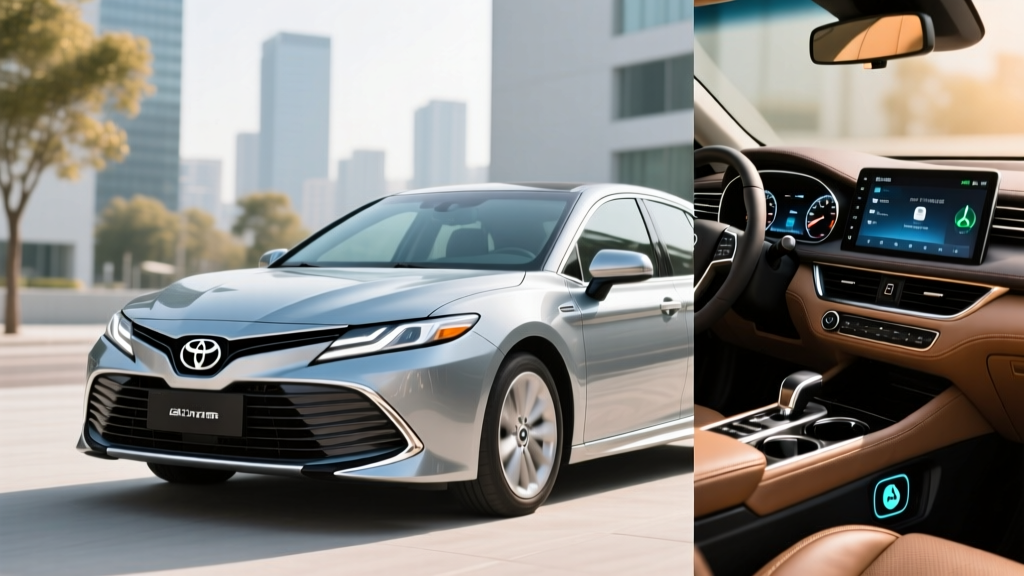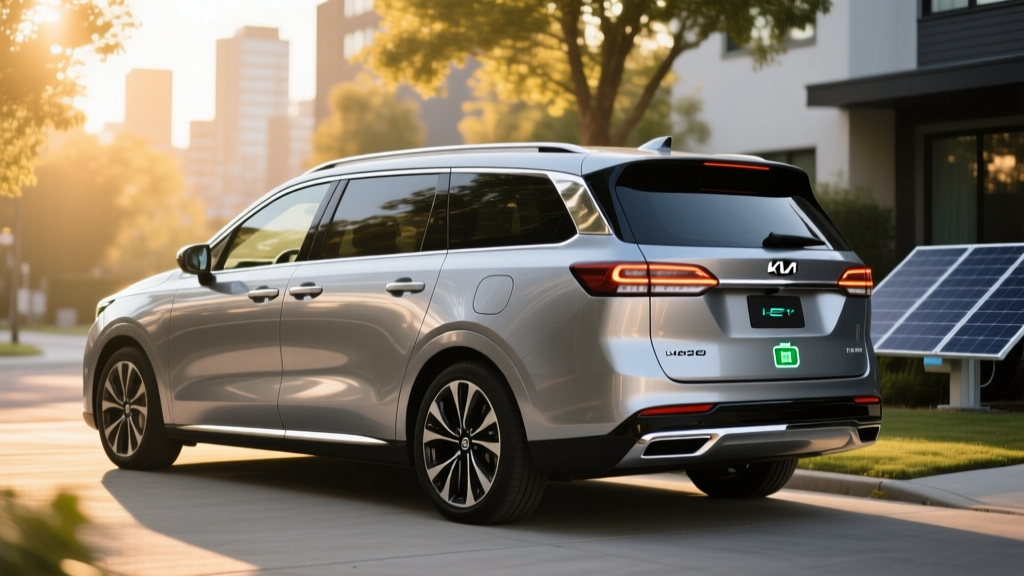
The Kia Carnival has been a segment favorite since it rebranded from the Sedona, and the addition of a hybrid powertrain makes the three-row minivan significantly more compelling for fuel-conscious families. The 2026 hybrid Kia Carnival pairs a turbocharged 1.6-liter four-cylinder with an electric motor to deliver 245 combined horsepower and an EPA-estimated 33 MPG combined — a meaningful jump over the gas-only model's 22 MPG combined. For buyers navigating the sprawling minivan market, the hybrid variant offers a no-compromise proposition: you don't plug in, you don't change your habits, and you save roughly $600-$900 per year at the pump depending on mileage.
This guide covers everything you need to know about the 2026 hybrid Kia Carnival: exact EPA fuel economy across trims, real-world MPG expectations, the HEV vs. PHEV distinction, powertrain specs, battery warranty details, pricing, and whether a hybrid minivan is the right call versus a full EV or conventional gas model.
HEV vs. PHEV: What the Hybrid Kia Carnival Actually Is
Before diving into specs, it's essential to understand what you're buying. The 2026 Kia Carnival Hybrid is a conventional hybrid electric vehicle (HEV), not a plug-in hybrid (PHEV). That distinction matters for your daily routine, your charging expectations, and your tax-credit eligibility.
| Feature | HEV (Carnival Hybrid) | PHEV (e.g., Chrysler Pacifica Hybrid) | Full EV (e.g., VW ID. Buzz) |
|---|---|---|---|
| Plug-in required? | No — refuels at gas station only | Yes — plugs in for electric-only range | Yes — electric only, no gas |
| Electric-only range | None (motor assists engine) | ~32 miles (Pacifica Hybrid) | 230+ miles (ID. Buzz) |
| Home charging needed? | No | Recommended (Level 2) | Required |
| Federal tax credit (§30D) | Not eligible | Up to $7,500 (if requirements met) | Up to $7,500 (if requirements met) |
| Typical combined efficiency | 33 MPG | 30 MPG + 82 MPGe | ~80 MPGe (2.5 kWh/mi) |
The Carnival Hybrid uses regenerative braking and the electric motor to supplement the gasoline engine. You never plug it in. The 1.49 kWh battery pack charges itself through braking energy and engine operation. If you want electric-only driving in a minivan, the Chrysler Pacifica Hybrid (PHEV) or the fully electric Volkswagen ID. Buzz are your alternatives — but both require home charging infrastructure and come with trade-offs the Carnival HEV avoids.
Fuel Economy: EPA Numbers and Real-World MPG
The headline number for the 2026 hybrid Kia Carnival is 33 MPG combined, according to EPA estimates on fueleconomy.gov. Here's the full breakdown by driving condition:
| Driving Condition | EPA Estimate | Real-World Expectation |
|---|---|---|
| City | 34 MPG | 34-37 MPG (hybrids often exceed EPA in stop-and-go) |
| Highway | 31 MPG | 28-31 MPG (hybrid advantage narrows at sustained speed) |
| Combined | 33 MPG | 31-34 MPG depending on driving mix |
Conventional hybrids like the Carnival HEV typically outperform their EPA city estimates in real-world stop-and-go driving. That's because the electric motor does its heaviest lifting at low speeds and during acceleration — exactly where gasoline engines are least efficient. On the highway, the engine runs more continuously and the hybrid system's advantage shrinks. Expect closer to 29-30 MPG on a flat 70-mph interstate run, and 35+ MPG in dense urban traffic with frequent stops.
For comparison, the gas-only 2026 Kia Carnival with the 3.5L V6 returns 19 city / 26 highway / 22 combined MPG. The hybrid's 11-MPG combined advantage translates to roughly 130 fewer gallons consumed per 15,000 miles driven annually — savings of approximately $430-$650 per year at $3.30-$4.00/gallon regular unleaded.
Powertrain Specs: Engine, Motor, and Combined Output
| Specification | 2026 Kia Carnival Hybrid |
|---|---|
| Engine | 1.6L turbocharged 4-cylinder |
| Engine output | 180 hp / 195 lb-ft torque |
| Electric motor | 47.7 kW (64 hp) / 195 lb-ft torque |
| Combined system output | 245 hp / 271 lb-ft torque |
| Transmission | 6-speed automatic |
| Drivetrain | Front-wheel drive (FWD) |
| Battery capacity | 1.49 kWh (lithium-ion) |
| 0-60 mph | ~7.8 seconds (est.) |
| Towing capacity | 3,500 lbs |
| Cargo volume (behind 3rd row) | 41.1 cu ft |
| Cargo volume (max, seats folded) | 145.1 cu ft |
The Carnival Hybrid's powertrain is shared with the Hyundai Santa Fe Hybrid and Kia Sorento Hybrid, though tuned for the minivan's larger mass (~4,700 lbs curb weight). The 1.6L turbo four is paired with a 47.7 kW electric motor integrated into the transmission housing. Combined output of 245 hp is adequate for merging and passing, though not as muscular as the gas V6's 290 hp. The trade-off is fuel economy — and for most family-hauling duty cycles, 245 hp is more than sufficient.
One notable limitation: the Carnival Hybrid is front-wheel drive only. If you need AWD for snow-belt winters, you'll need to look at the Toyota Sienna (hybrid standard, AWD available) or stick with the gas-only Carnival and accept the lower MPG.
Pricing, Trims, and Tax Credit Eligibility
The 2026 hybrid Kia Carnival is available across multiple trims. Pricing starts higher than the gas-only model due to the hybrid powertrain premium, but fuel savings close the gap within 3-5 years for most drivers.
| Trim | MSRP (est.) | Key Features |
|---|---|---|
| LXS Hybrid | $41,500 | 8-passenger, 12.3" touchscreen, Smart Power Tailgate |
| EX Hybrid | $44,500 | Leatherette seats, power sliding doors, Highway Driving Assist |
| SX Hybrid | $48,000 | Leather, dual sunroof, premium audio, ventilated front seats |
| SX Prestige Hybrid | $52,500 | Nappa leather, 2nd-class VIP lounge seats, surround-view monitor |
Federal Tax Credit: Not Eligible
Because the 2026 Kia Carnival Hybrid is a conventional HEV (not a PHEV or BEV), it does not qualify for the IRS §30D Clean Vehicle Credit. The federal tax credit of up to $7,500 applies only to plug-in electric vehicles that meet battery-sourcing, MSRP cap, and buyer income requirements. Some states and utilities offer rebates for conventional hybrids — check your local energy provider and state environmental agency for current programs. For the latest federal rules, see IRS guidance on clean vehicle credits.
Battery Warranty, Reliability, and Replacement Cost
Battery longevity is the number-one concern for hybrid buyers, and Kia addresses it with one of the strongest warranty packages in the industry.
| Warranty Coverage | Term |
|---|---|
| Hybrid battery | 10 years / 100,000 miles |
| Hybrid system components | 10 years / 100,000 miles |
| Powertrain (engine, transmission) | 10 years / 100,000 miles |
| Bumper-to-bumper | 5 years / 60,000 miles |
The 1.49 kWh lithium-ion battery pack in the Carnival Hybrid is small compared to a full EV's 60-100 kWh pack, and it operates within a narrow state-of-charge window (typically 40-80% SoC). This shallow cycling dramatically reduces degradation stress. Based on data from Toyota and Hyundai/Kia hybrid platforms with similar battery architectures, hybrid battery packs routinely exceed 150,000-200,000 miles before capacity drops below the warranty threshold (typically 70% of original capacity).
If replacement is needed outside warranty, a new hybrid battery pack for the Carnival Hybrid is estimated at $2,500-$4,000 (parts and labor) based on comparable Kia/Hyundai hybrid platforms. That's a fraction of the $10,000-$20,000 EV battery replacement costs that sometimes worry prospective electric-car buyers.
Kia's reliability record has improved substantially over the past decade. The Carnival platform earned a Top Safety Pick designation from the IIHS in prior model years, and the hybrid powertrain's shared architecture with the Sorento Hybrid (in production since 2021) provides a growing reliability track record.
Hybrid vs. PHEV vs. EV: Which Minivan Is Right for You?
The minivan segment now offers all three electrification levels. Here's a practical decision framework:
Choose the Carnival Hybrid (HEV) if:
- You can't charge at home (apartment, street parking, no garage outlet)
- You want maximum range flexibility — 550+ miles per tank, fill up in 5 minutes
- You don't want to change any habits from your current gas vehicle
- Your daily driving is under 40 miles but you take regular road trips
- You want the lowest purchase price among electrified minivans
Choose a PHEV (e.g., Chrysler Pacifica Hybrid) if:
- You can install a Level 2 home charger and want 32 miles of electric-only commuting
- Your daily round-trip commute is under 30 miles (you'll rarely use gas)
- You qualify for the $7,500 federal tax credit (income + sourcing requirements)
- You want to drive on electricity without range anxiety on longer trips
Choose a full EV (e.g., VW ID. Buzz) if:
- You have reliable home Level 2 charging and access to DC fast charging
- Your daily driving is under 200 miles and you're comfortable planning road-trip charging stops
- You want zero tailpipe emissions and the lowest per-mile fuel cost (~$0.04-$0.06/mi on home charging)
- You qualify for the federal tax credit and your state offers additional EV incentives
For the majority of minivan buyers — especially those without dedicated home parking or charging access — the Carnival Hybrid occupies the sweet spot. You get meaningful fuel savings, zero lifestyle changes, and a familiar ownership experience.
How the Hybrid Kia Carnival Stacks Up Against Competitors
| Model | Powertrain | Combined MPG/MPGe | Starting MSRP | AWD Available? | Federal Credit |
|---|---|---|---|---|---|
| 2026 Kia Carnival Hybrid | HEV | 33 MPG | $41,500 | No | No |
| 2026 Toyota Sienna Hybrid | HEV | 36 MPG (FWD) / 35 MPG (AWD) | $39,500 | Yes | No |
| 2026 Chrysler Pacifica Hybrid | PHEV | 30 MPG + 82 MPGe | $51,000 | No | Up to $7,500* |
| 2026 Honda Odyssey | Gas V6 | 22 MPG | $38,500 | No | No |
| 2026 VW ID. Buzz | BEV | ~80 MPGe | $59,995 | Yes (AWD trim) | Up to $7,500* |
*Federal tax credit eligibility depends on battery sourcing, MSRP caps, and buyer income limits per IRS §30D. Verify eligibility at fueleconomy.gov.
The Toyota Sienna remains the fuel-economy leader at 36 MPG combined and is the only hybrid minivan offering AWD. The Carnival Hybrid trades 3 MPG for a more premium interior, greater cargo volume (145.1 cu ft vs. Sienna's 108.9 cu ft max), and Kia's 10-year warranty. If maximum cargo space and interior refinement are priorities, the Carnival Hybrid has a clear edge. If MPG and AWD are non-negotiable, the Sienna wins.
Pros, Cons, and the Bottom Line
Pros
- 33 MPG combined — 50% better than the gas V6 Carnival
- Best-in-class cargo volume at 145.1 cu ft
- 10-year/100,000-mile hybrid battery and powertrain warranty
- No plug-in charging required — zero lifestyle change
- Premium interior, especially in SX Prestige trim
- 550+ mile total range per tank
Cons
- FWD only — no AWD option (Sienna Hybrid offers AWD)
- Not eligible for federal §30D tax credit (HEV, not PHEV/BEV)
- 3 MPG behind Toyota Sienna Hybrid in combined fuel economy
- Hybrid premium adds ~$2,500-$3,000 over gas-only trims
- 245 hp adequate but not as punchy as the gas V6's 290 hp
The 2026 hybrid Kia Carnival is the right minivan for families who prioritize interior space, premium features, and meaningful fuel savings without the complexity of plug-in charging. It doesn't chase the highest MPG (that's the Sienna's role) and it doesn't offer electric-only driving (that's the Pacifica Hybrid's domain). What it does offer is a well-rounded, practical hybrid that slots seamlessly into a gasoline-only lifestyle while cutting fuel costs by roughly a third.
Frequently Asked Questions
How many MPG does the hybrid Kia Carnival get?
The 2026 Kia Carnival Hybrid gets an EPA-estimated 34 MPG city, 31 MPG highway, and 33 MPG combined. In real-world city driving with frequent stops, many owners report 35-37 MPG thanks to regenerative braking. Highway fuel economy typically runs 28-31 MPG at sustained speeds above 65 mph.
Does the Kia Carnival Hybrid need to be plugged in?
No. The Carnival Hybrid is a conventional HEV — it charges its 1.49 kWh battery through regenerative braking and the gasoline engine. You never plug it in. You refuel at any gas station with regular unleaded.
Is the hybrid Kia Carnival reliable, and what does battery replacement cost?
Kia covers the hybrid battery for 10 years or 100,000 miles. Based on data from similar Hyundai/Kia hybrid platforms, these batteries routinely last 150,000-200,000+ miles. Out-of-warranty replacement is estimated at $2,500-$4,000 — significantly less than EV battery replacements.
Does the hybrid Kia Carnival qualify for any tax credit?
No. The federal §30D Clean Vehicle Credit applies only to plug-in vehicles (PHEVs and BEVs). The Carnival Hybrid, as a conventional HEV, is not eligible. Some state and utility programs offer hybrid rebates — check your local programs.
How does the Carnival Hybrid compare to the Toyota Sienna Hybrid?
The Sienna Hybrid achieves 36 MPG combined (3 MPG better), starts ~$2,000 lower, and offers AWD. The Carnival Hybrid counters with significantly more cargo space (145.1 vs. 108.9 cu ft max), a more upscale interior, and Kia's 10-year/100,000-mile warranty vs. Toyota's 8-year/100,000-mile hybrid coverage.
Is the hybrid Carnival good for road trips?
Excellent. With an 18.0-gallon fuel tank and 33 MPG combined, expect 550-600 miles of total range — meaning fewer fuel stops on long trips. Unlike EVs, there's no charging planning required, and refueling takes five minutes at any gas station.
What's the towing capacity of the Carnival Hybrid?
The 2026 Carnival Hybrid is rated to tow up to 3,500 pounds when properly equipped — sufficient for a small boat, utility trailer, or pair of personal watercraft. This matches the gas-only Carnival's towing rating.