2026 Toyota Highlander Hybrid: Towing Meets Efficiency
Three-row SUV buyers who need towing capability but cringe at the fuel pump have a narrow set of choices. The 2026 Toyota Highlander Hybrid occupies a specific niche: a self-charging hybrid (HEV) that delivers 35 MPG combined while still pulling a 3,500-pound trailer. It does not plug in, it does not offer electric-only driving, and it does not qualify for the federal EV tax credit. But for families hauling a small boat, utility trailer, or camper on weekends while commuting efficiently during the week, the math works in ways that neither a gas-only SUV nor a full EV can match.
This guide covers the exact numbers — EPA MPG, towing ratings, powertrain output, battery warranty, real-world fuel economy, and total ownership cost — so you can decide whether the Highlander Hybrid's towing capacity aligns with your needs.
HEV vs. PHEV: What the Highlander Hybrid Actually Is
Toyota offers the Highlander exclusively as a conventional hybrid (HEV). There is no plug-in hybrid (PHEV) variant in the US lineup. This distinction matters for buyers cross-shopping against models like the Chrysler Pacifica PHEV or the Toyota RAV4 Prime.
| Feature | Conventional Hybrid (HEV) | Plug-in Hybrid (PHEV) |
|---|---|---|
| Plug-in charging required? | No — self-charging via regen & engine | Yes — requires Level 1 or Level 2 outlet |
| Electric-only driving | Limited (low-speed, short distances) | 20-45 miles typical on full charge |
| Battery size | Small (1-2 kWh usable) | Larger (14-20+ kWh) |
| Federal tax credit (§30D) | Not eligible | Up to $7,500 if sourcing/income rules met |
| Highlander availability | Yes (all trims) | Not offered |
The Highlander Hybrid's traction battery is a sealed nickel-metal hydride (NiMH) pack on most trims, with select trims using a lithium-ion pack depending on model year and production batch. You never plug it in. The gasoline engine and regenerative braking system keep the battery charged automatically. This makes it a strong choice for buyers without access to home charging — apartment dwellers, street parkers, or anyone who simply wants hybrid efficiency without behavioral change.
Towing Capacity: The 3,500-Pound Ceiling
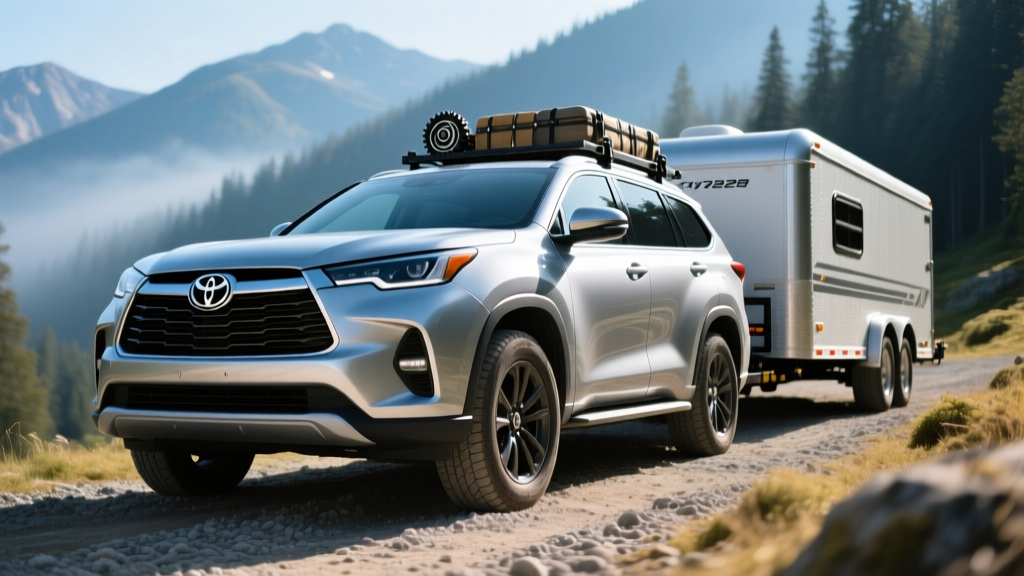
Every 2026 Highlander Hybrid trim — LE, XLE, Limited, and Platinum — carries the same maximum towing rating: 3,500 pounds when properly equipped with the factory tow package. This matches the gas-only Highlander's rating and covers a wide range of light-duty hauling:
- Small teardrop campers (1,500–2,500 lbs loaded)
- Single-axle utility trailers with ATVs or motorcycles
- Small aluminum fishing boats on a single-axle trailer (2,000–3,000 lbs)
- Horse trailers for a single lightweight horse (borderline — verify loaded weight)
- Cargo trailers up to approximately 5×10 feet (loaded)
What it cannot tow: large travel trailers, dual-axle boat trailers, or any load exceeding 3,500 lbs including cargo, passengers, and tongue weight. If you regularly tow above 4,000 pounds, you need a body-on-frame SUV like the Toyota Sequoia (hybrid, rated to 9,520 lbs) or a full-size truck.
The hybrid powertrain's electric motor torque actually helps with trailer launch from a stop — the initial electric assist reduces the lurch common in gas-only SUVs when starting on an incline with a trailer attached. However, sustained highway towing will drop fuel economy significantly, typically to 20–24 MPG depending on trailer aerodynamics and weight.
Fuel Economy: EPA Ratings and Real-World MPG
| Drivetrain | City | Highway | Combined |
|---|---|---|---|
| FWD (LE trim) | 36 MPG | 35 MPG | 36 MPG |
| AWD (all other trims) | 35 MPG | 34 MPG | 35 MPG |
Source: EPA fueleconomy.gov
Hybrids typically exceed their EPA city rating in stop-and-go traffic because regenerative braking recaptures energy that gas cars waste as heat. Expect 37–40 MPG in urban driving. Highway driving at 75+ MPH drops to 28–31 MPG due to reduced regen opportunity and increased aerodynamic drag. In cold weather (below 30°F), expect a 10–15% reduction across the board as the engine runs more frequently to provide cabin heat. When towing a 3,000-lb trailer, plan for 20–24 MPG combined.
At 35 MPG combined, the Highlander Hybrid uses roughly 428 gallons per year (assuming 15,000 miles). At $3.40/gallon, that's approximately $1,455 annually. A gas-only three-row SUV averaging 22 MPG combined would consume 682 gallons — roughly $2,319 per year. The hybrid saves about $860 per year in fuel, or $4,300 over five years, according to EPA annual fuel cost estimates.
Powertrain Specs: Horsepower, Engine, and Motors
| Engine | 2.5L inline-4 (Atkinson cycle) |
| Engine output | 186 HP / 186 lb-ft torque |
| Electric motors | 2 (front); 3 on AWD (adds rear motor) |
| Combined net horsepower | 243 HP |
| Transmission | eCVT (planetary gearset, no traditional belts) |
| Drivetrain | FWD (LE) or electronic AWD (XLE+) |
| 0-60 MPH | ~7.8 seconds (AWD) |
| Towing capacity | 3,500 lbs (all trims, with tow package) |
| Hybrid battery | NiMH or Li-ion (trim-dependent), ~1.6 kWh usable |
| Fuel tank | 17.1 gallons |
| Total range | ~598 miles (35 MPG × 17.1 gal) |
The 243 combined horsepower figure comes from Toyota's Hybrid Synergy Drive system, which blends engine and electric motor output through a planetary gearset. The rear electric motor on AWD trims provides on-demand all-wheel drive without a mechanical driveshaft — it engages only when slip is detected, reducing parasitic loss during normal driving.
The eCVT is not a traditional belt-driven CVT. It uses a planetary gearset with no clutches, belts, or pulleys to wear out, which contributes significantly to the Highlander Hybrid's reputation for long-term powertrain durability.
Pricing, Trims, and Tax Credit Eligibility
| Trim | Drivetrain | MSRP (incl. destination) |
|---|---|---|
| LE | FWD | $41,165 |
| XLE | AWD | $45,665 |
| Limited | AWD | $50,165 |
| Platinum | AWD | $54,065 |
Federal tax credit: The Highlander Hybrid does not qualify for the IRS §30D Clean Vehicle Credit. That credit applies only to plug-in electric vehicles (BEVs and PHEVs) meeting battery sourcing, MSRP cap, and buyer income requirements. Since the Highlander Hybrid is a conventional HEV with no plug, it is ineligible regardless of trim price or buyer income.
Some states offer separate incentives for conventional hybrids — for example, certain utility rebates or state-level clean vehicle programs — but these vary widely by jurisdiction. Check your state's energy office or your local utility for current programs. The IRS §30D guidelines confirm that HEVs are excluded from the federal credit.
Battery Warranty, Lifespan, and Replacement Cost
Toyota covers the hybrid battery with a 10-year / 150,000-mile warranty (whichever comes first) in all 50 states, effective from the 2020 model year onward. This warranty covers capacity loss below a defined threshold and any manufacturing defects. Prior to 2020, the warranty was 8 years / 100,000 miles in most states (10/150,000 in CARB states).
Real-world longevity data is encouraging. Toyota's hybrid system has been in production since the 1997 Prius, and the Highlander Hybrid has used a mature version of this architecture since 2006. Fleet data and owner reports commonly show hybrid batteries lasting 180,000–250,000 miles before significant degradation. The NiMH chemistry used in many Highlander Hybrid packs is less energy-dense than lithium-ion but is exceptionally tolerant of the shallow charge-discharge cycles that characterize hybrid operation — the battery rarely drops below 40% or above 80% state of charge, which dramatically extends cycle life.
If replacement is needed out of warranty, a new OEM hybrid battery pack costs approximately $3,000–$4,500 including labor at a Toyota dealer. Third-party reconditioned packs are available for $1,500–$2,500. Individual module replacement (only the degraded cells) can bring costs below $1,000 at a hybrid specialist shop.
Who Should Buy the Highlander Hybrid?
- You tow a trailer under 3,500 lbs and want 35 MPG when not towing
- You lack access to home or workplace charging (apartment, street parking)
- You want three rows, AWD, and hybrid efficiency without plug-in complexity
- You plan to keep the vehicle 8+ years and want proven hybrid reliability
- Your daily commute is city-heavy, where hybrids outperform their EPA rating
- You need towing above 3,500 lbs (look at the Sequoia Hybrid or an electric truck)
- You want electric-only commuting — the RAV4 Prime (42 mi EV range) or a BEV like the Kia EV9 may fit
- You want the federal $7,500 tax credit (requires a PHEV or BEV)
- You tow frequently on long highway trips where the hybrid MPG advantage narrows
- You prioritize maximum acceleration (the 7.8s 0-60 is adequate, not quick)
The Highlander Hybrid's closest competitor is the Hyundai Santa Fe Hybrid, which offers similar MPG but only two rows. For three-row hybrid SUVs, the Kia Sorento Hybrid (35 MPG combined, 2,000-lb towing) and the Mazda CX-90 PHEV (25 mi EV range, 3,500-lb towing, $7,500 credit eligible) are alternatives worth cross-shopping. The Mazda CX-90 PHEV is particularly relevant if you have home charging and want both electric-only commuting and towing capability.
Frequently Asked Questions
How many MPG does the Highlander Hybrid get?
The EPA rates the AWD Highlander Hybrid at 35 city / 34 highway / 35 combined MPG. FWD LE trims rate slightly higher at 36 combined. In real-world city driving, owners commonly report 37–40 MPG thanks to aggressive regenerative braking. Highway driving at sustained speeds above 70 MPH typically yields 28–31 MPG.
Can the Highlander Hybrid tow a camper trailer?
Yes, as long as the loaded trailer weight stays under 3,500 pounds. This covers most teardrop campers, pop-up trailers, and small single-axle travel trailers. Always weigh your loaded trailer at a certified scale before your first trip — camper dry weight alone does not include water, propane, cargo, or the weight of passengers in the tow vehicle.
Does the Highlander Hybrid need to be plugged in?
No. The Highlander Hybrid is a conventional (self-charging) hybrid. The battery charges through regenerative braking and the gasoline engine. There is no charging port. You fuel it like any other gas vehicle at a gas station.
Is the hybrid battery reliable and what does replacement cost?
Toyota's hybrid battery is covered for 10 years or 150,000 miles. Real-world data shows these batteries commonly lasting 180,000–250,000 miles. If replacement is needed out of warranty, expect $3,000–$4,500 for a new OEM pack at a dealer, or $1,500–$2,500 for a reconditioned unit from a third-party supplier.
Does the Highlander Hybrid qualify for any tax credit?
No. The federal §30D Clean Vehicle Credit applies only to plug-in vehicles (BEVs and PHEVs). Since the Highlander Hybrid is a conventional HEV with no plug, it does not qualify. Some state or utility-level programs may offer small incentives for hybrids — check your local jurisdiction.
How does towing affect Highlander Hybrid fuel economy?
When towing near the 3,500-lb maximum, expect fuel economy to drop to approximately 20–24 MPG combined, depending on trailer aerodynamics, terrain, and speed. The hybrid system's electric motor assist helps with low-speed trailer launch, but sustained highway towing relies primarily on the gasoline engine.
Hybrid vs. PHEV vs. EV — which three-row SUV fits me?
If you lack home charging and need simple, proven efficiency with towing: the Highlander Hybrid (HEV). If you have home charging, want 25–40 miles of electric-only commuting, and still need towing: look at the Mazda CX-90 PHEV. If you rarely tow, drive under 300 miles daily, and have reliable charging access: a three-row BEV like the Kia EV9 (304 mi range, 5,000-lb towing) eliminates fuel costs entirely.