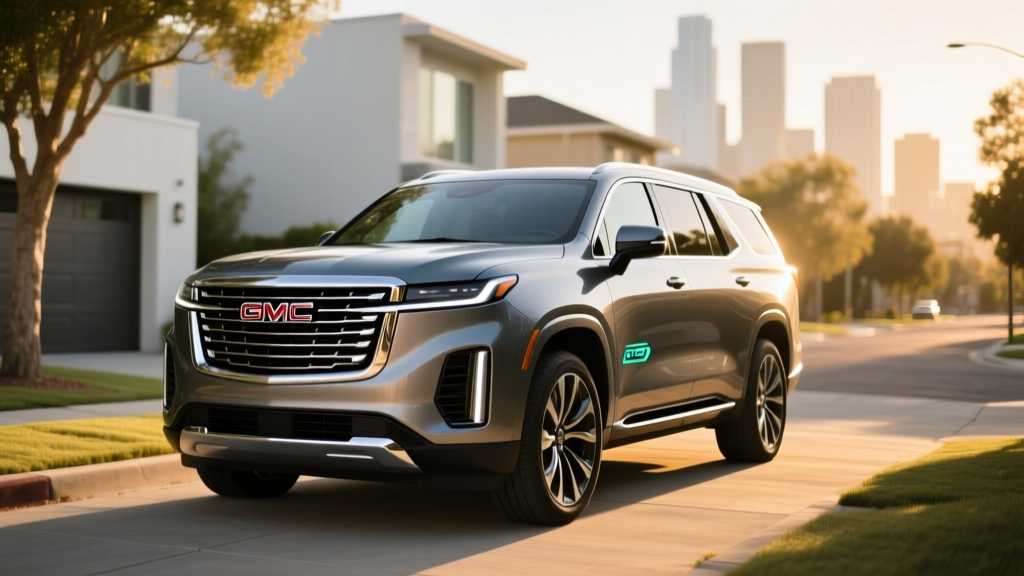
Full-size SUV buyers eyeing the GMC Yukon often ask the same question: does GMC offer a hybrid Yukon? As of the 2026 model year, the answer requires nuance. GMC has not released a conventional hybrid (HEV) or plug-in hybrid (PHEV) variant of the current-generation Yukon, even as competitors like Toyota (Sequoia) and Ford (Explorer Hybrid) have electrified their three-row lineups. However, industry signals and GM's broader electrification strategy suggest a hybrid Yukon is under serious consideration. Here is what we know, what we can project from GM's existing hybrid architectures, and how the Yukon compares to electrified alternatives you can actually buy today.
Does a Hybrid GMC Yukon Exist for 2026?
As of early 2026, GMC does not sell a hybrid or plug-in hybrid Yukon in the United States. The current fourth-generation Yukon (introduced for 2021, refreshed for 2025) is offered exclusively with gasoline V8 engines and GM's 10-speed automatic transmission. The lineup includes the 5.3L V8 (355 hp), the 6.2L V8 (420 hp), and the 3.0L Duramax turbo-diesel inline-six (277 hp / 305 hp for the updated version).
This stands in contrast to GM's own Chevrolet Tahoe and Suburban siblings, which share the Yukon's T1 platform. While those also lack a hybrid variant as of 2026, GM has deployed its two-motor hybrid system in the Chevrolet Colorado and Silverado (the 2.7L TurboMax with eTorque-style mild hybrid assist, and the Silverado PHEV concept). The absence of a full hybrid Yukon is notable given that Toyota's Sequoia is now exclusively a hybrid (i-FORCE MAX), achieving an EPA-estimated 22 MPG combined in a vehicle of comparable size and capability.
HEV vs PHEV: What a Hybrid Yukon Could Look Like
If and when GMC introduces a hybrid Yukon, it would likely follow one of two paths. Understanding the distinction between a conventional hybrid (HEV) and a plug-in hybrid (PHEV) is essential for evaluating any future announcement.
| Feature | Conventional Hybrid (HEV) | Plug-In Hybrid (PHEV) |
|---|---|---|
| Needs to plug in? | No — charges via regenerative braking and the engine | Yes — plug in to access electric-only range |
| Battery size | 1–2 kWh (small, assists engine) | 15–25 kWh (larger, enables EV driving) |
| Electric-only range | None (EV assist only at low speeds) | 20–45 miles typical |
| MPG improvement | 20–40% over gas-only | Gas-free daily commutes; similar MPG when battery depleted |
| Federal tax credit | Not eligible (§30D requires plug-in) | Up to $7,500 if battery sourcing and MSRP/income rules are met |
| Price premium | $1,500–$3,000 over gas | $5,000–$10,000 over gas (before credits) |
For a body-on-frame SUV like the Yukon, GM would most likely adapt the hybrid powertrain architecture used in the Silverado, pairing a turbocharged engine with one or two electric motors integrated into the transmission. A PHEV variant would require a significantly larger battery pack, adding weight and cost but unlocking electric-only commuting and potential §30D tax credit eligibility.
Projected MPG: What Could a Hybrid Yukon Achieve?
Since no hybrid Yukon exists yet, we can estimate fuel economy by looking at the current gas-only Yukon and comparable hybrid competitors.
| Vehicle | City MPG | Highway MPG | Combined MPG | Powertrain |
|---|---|---|---|---|
| GMC Yukon 5.3L V8 (2WD) | 15 | 20 | 17 | Gas V8 |
| GMC Yukon 3.0L Diesel (2WD) | 21 | 27 | 23 | Turbo-Diesel I6 |
| Toyota Sequoia (2WD) | 21 | 24 | 22 | HEV (i-FORCE MAX) |
| Projected Hybrid Yukon (HEV) | 19–22 | 23–26 | 21–24 | HEV (est.) |
Sources: fueleconomy.gov (EPA estimates for 2025–2026 model year vehicles). Projected figures are estimates based on comparable hybrid powertrains.
A conventional hybrid Yukon would likely achieve a 20–30% improvement over the 5.3L V8, landing in the low-to-mid 20s combined. This mirrors what Toyota achieved with the Sequoia's i-FORCE MAX hybrid, which pairs a 3.5L twin-turbo V6 with a 49-hp electric motor for 437 combined horsepower and 22 MPG combined. Real-world MPG for hybrids in this class tends to exceed EPA city estimates (regenerative braking shines in stop-and-go traffic) but fall slightly short on sustained highway driving.
Powertrain Speculation: GM's Hybrid Options for the T1 Platform
GM has several hybrid technologies it could deploy in a future Yukon:
- Silverado-derived parallel hybrid: A turbocharged engine (possibly the 2.7L TurboMax or a V6) paired with an electric motor integrated into the 10-speed transmission. This would be the most likely HEV approach, adding roughly 40–60 hp of electric assist and enabling engine-off coasting and low-speed EV creep.
- Voltec-derived PHEV (less likely): GM's older two-motor Voltec system (used in the discontinued Chevrolet Volt) could theoretically be adapted, but it was designed for front-wheel-drive cars. A body-on-frame application would require significant reengineering.
- Ultium-based PHEV (speculative): GM could pair a smaller Ultium battery pack (15–20 kWh) with a turbocharged engine, creating a PHEV with 25–35 miles of electric range. This would be the most expensive option but would qualify for federal tax credits and appeal to buyers who want daily electric commuting with gas-engine road-trip range.
Combined horsepower for a hybrid Yukon would likely fall between 400–470 hp, depending on the engine-motor pairing. For reference, the Sequoia's i-FORCE MAX produces 437 hp and 583 lb-ft of torque — figures that would be competitive with a hybridized 6.2L V8 or turbo-six Yukon.
Pricing and Tax Credit Outlook
The 2026 GMC Yukon starts at approximately $59,295 for the SLE trim with the 5.3L V8 (2WD), climbing to over $82,000 for the Denali Ultimate with the 6.2L V8 and 4WD. A hybrid variant would add a premium:
- HEV premium (estimated): $2,000–$4,000 over the equivalent gas trim
- PHEV premium (estimated): $6,000–$10,000 over the equivalent gas trim, before any tax credits
Given that a Denali trim already pushes past the $80,000 MSRP cap, only lower-trim PHEV Yukon models (SLE, SLT, possibly AT4) would likely qualify for the full credit. This is a critical consideration for buyers counting on the incentive to offset the PHEV price premium.
Battery Warranty and Reliability: What Hybrid Buyers Should Expect
Hybrid battery reliability has improved dramatically over the past two decades. Toyota's hybrid systems in the Sequoia and Highlander Hybrid have demonstrated battery packs lasting 200,000+ miles with minimal degradation, largely because HEV batteries are small and rarely cycle through full charge/discharge. A hybrid Yukon using a similar parallel-hybrid architecture would likely exhibit comparable longevity.
For a PHEV variant, the larger battery would experience deeper cycling, but modern NMC (nickel-manganese-cobalt) chemistry with active thermal management can sustain 80%+ capacity retention over 100,000 miles. Replacement cost for a full-size SUV hybrid battery typically ranges from $3,000–$6,000 (HEV) to $8,000–$14,000 (PHEV), though most owners will never need a replacement within the warranty period or typical ownership timeframe.
Hybrid vs PHEV vs EV: Which Full-Size SUV Fits Your Needs?
If you are cross-shopping a potential hybrid Yukon against available alternatives, here is a practical decision framework:
Choose a Conventional Hybrid (HEV) If:
- You want better MPG without changing your habits
- You don't have access to home or workplace charging
- You tow frequently (hybrids maintain towing capacity)
- You want a lower purchase premium ($2K–$4K)
- You drive mostly in the city (regen braking maximizes savings)
Choose a Plug-In Hybrid (PHEV) If:
- You have Level 2 charging at home or work
- Your daily commute is under 30 miles round-trip
- You want gas-free weekday driving with road-trip flexibility
- You qualify for the §30D tax credit (income + MSRP caps)
- You're willing to pay a higher upfront premium for long-term fuel savings
Choose a Full EV If:
- You have reliable home Level 2 charging
- You rarely tow heavy loads (towing cuts EV range 40–50%)
- You want the lowest per-mile fuel cost and minimal maintenance
- You qualify for the full $7,500 federal credit
- You're considering the Cadillac Escalade IQ or Rivian R1S
Alternatives You Can Buy Today
Since the hybrid GMC Yukon is not yet a reality, here are the closest electrified full-size SUVs available in 2026:
| Vehicle | Type | MPG / MPGe | EV Range (PHEV) | Starting MSRP |
|---|---|---|---|---|
| Toyota Sequoia | HEV | 22 combined | N/A | ~$62,000 |
| Jeep Grand Wagoneer 4xe | PHEV | ~25 combined (gas) | ~30 mi | ~$90,000 |
| Cadillac Escalade IQ | BEV | ~65 MPGe | ~450 mi (EPA est.) | ~$130,000 |
| Rivian R1S (Dual-Motor) | BEV | ~70 MPGe | ~352 mi (EPA) | ~$80,000 |
The Toyota Sequoia is the most direct competitor to a hypothetical hybrid Yukon: body-on-frame, three rows, hybrid-only powertrain, and a starting price in the low $60K range. If GMC introduces a hybrid Yukon, it will need to match or beat the Sequoia's 22 MPG combined while offering the premium interior and Super Cruise driver-assistance technology that Yukon buyers expect.
Frequently Asked Questions
How many MPG does the GMC Yukon get?
The 2026 GMC Yukon with the 5.3L V8 (2WD) gets an EPA-estimated 15 city / 20 highway / 17 combined MPG. The 3.0L Duramax diesel improves that to 21 city / 27 highway / 23 combined. A future hybrid variant could reach 21–24 MPG combined based on comparable hybrid full-size SUVs.
Does the GMC Yukon have a hybrid option?
As of the 2026 model year, no. GMC does not offer a hybrid or plug-in hybrid Yukon. The closest GM electrified full-size SUV is the Cadillac Escalade IQ (all-electric). The Toyota Sequoia is the most comparable hybrid full-size SUV currently on sale.
Will a hybrid Yukon qualify for a tax credit?
A conventional hybrid (HEV) would not qualify for the federal §30D Clean Vehicle Credit, which requires plug-in capability and minimum battery capacity. A PHEV variant could qualify for up to $7,500, subject to MSRP caps ($80,000 for SUVs/trucks), buyer income limits, and battery sourcing requirements. Verify current rules at irs.gov.
Is a hybrid full-size SUV reliable long-term?
Modern hybrid systems are among the most reliable powertrains on the road. Toyota's hybrid SUVs routinely exceed 200,000 miles with original battery packs. Federal law requires hybrid battery warranties of at least 8 years / 100,000 miles. Replacement costs, if ever needed, range from $3,000–$6,000 for an HEV battery to $8,000–$14,000 for a PHEV pack.
Should I wait for a hybrid Yukon or buy something now?
If you need a three-row SUV with hybrid efficiency today, the Toyota Sequoia (22 MPG combined, starting ~$62K) is the strongest option. If you can charge at home and want electric commuting, the Jeep Grand Wagoneer 4xe (PHEV) or Rivian R1S (BEV) are viable alternatives. If the Yukon's specific combination of styling, Super Cruise, and GMC brand appeal is non-negotiable, you may choose to wait — but GMC has not confirmed a hybrid Yukon timeline as of early 2026.