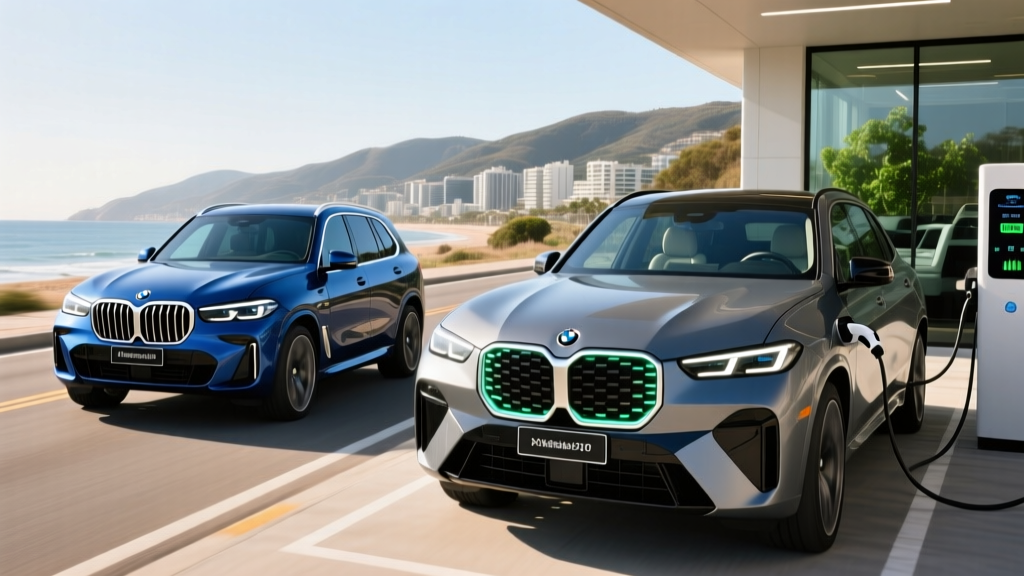
BMW's current hybrid strategy is unambiguous: every plug-in hybrid it sells in the U.S. is a PHEV, not a conventional hybrid. If you're searching for a hybrid BMW in 2026, you're looking at plug-in hybrid electric vehicles (PHEVs) that pair turbocharged gasoline engines with substantial battery packs and powerful electric motors. The two pillars of this lineup are the BMW X5 xDrive50e — the volume-selling luxury SUV — and the high-performance BMW XM. The 3 Series and 5 Series sedans have been sold in the U.S. exclusively as mild-hybrid (MHEV) or full EV (i4, i5) models in recent years, so the SUV PHEVs carry the hybrid BMW banner.
This guide breaks down exactly what each model delivers in range, efficiency, powertrain output, charging behavior, pricing, and tax-credit eligibility — with real-world caveats that the EPA sticker alone won't tell you.
HEV vs PHEV: What BMW Actually Sells in the U.S.
Conventional Hybrid (HEV): No plug. The battery is small (typically under 2 kWh), charged only by regenerative braking and the engine. It assists acceleration and enables brief engine-off coasting. MPG gains are moderate. You never plug it in.
Plug-in Hybrid (PHEV): Has a plug and a much larger battery (BMW's current PHEVs use 25.7–29.5 kWh gross). You charge it from a wall outlet or Level 2 charger, drive 30–40 miles on electricity alone, and when the battery depletes, the gasoline engine takes over seamlessly. BMW's U.S. PHEVs fall into this category.
Mild Hybrid (MHEV): A 48-volt system that smooths stop-start and adds a small torque assist. It cannot drive on electric power alone. BMW's current non-PHEV models (like the X5 xDrive40i) use MHEV. This is not what most buyers mean by "hybrid."
When shoppers search for a hybrid BMW, the X5 xDrive50e is almost always what they want: a practical midsize luxury SUV with genuine electric-only commuting range and no range anxiety on road trips. The XM is a niche performance flagship. Let's examine both.
2026 BMW X5 xDrive50e: Specs, MPG & Electric-Only Range
The X5 xDrive50e replaced the older xDrive45e for the 2024 model year and carries into 2026 with the same core powertrain. It pairs a 3.0-liter turbocharged inline-six with a single electric motor integrated into the 8-speed automatic transmission.
| Attribute | Value |
|---|---|
| Powertrain | 3.0L turbo I-6 + electric motor (8-speed auto, AWD) |
| Combined Horsepower | 483 hp |
| Combined Torque | 516 lb-ft |
| Battery (gross / usable) | 29.5 kWh gross / ~25.7 kWh usable |
| Battery Chemistry | NMC (nickel manganese cobalt) |
| EPA Electric-Only Range | 38 miles |
| EPA Combined MPGe (electric+gas) | 56 MPGe |
| EPA MPG (gas-only, charge-depleted) | 27 combined (25 city / 29 highway) |
| Total Combined Range | ~440 miles (est.) |
| AC Charging (Level 2 max) | 7.4 kW (0–100% in ~4.25 hours) |
| DC Fast Charging | Not available |
| 0–60 mph | 4.6 seconds |
| Battery Warranty | 8 years / 80,000 miles |
| Base MSRP | ~$72,575 (incl. destination) |
Real-World MPG and Range vs. EPA Sticker
The EPA rates the X5 xDrive50e at 38 miles of electric-only range. In real-world driving, owners report achieving 33–40 miles depending on conditions. City driving at moderate speeds with regenerative braking maximizes electric range; sustained highway speeds above 70 mph and cold weather (below 40°F) can reduce it to 28–32 miles.
Once the battery depletes, the inline-six takes over and the X5 operates as a heavy conventional hybrid. The EPA's 27 MPG combined rating is realistic for mixed driving. On the highway at 75 mph, expect 28–30 MPG. In stop-and-go city traffic, the hybrid system recovers energy effectively, and some drivers report 26–27 MPG city — close to the EPA's 25 MPG city estimate.
Real-World Range Expectation: EPA 38 miles electric-only. Expect 33–36 miles in mixed suburban driving, 28–32 miles in cold weather or sustained highway use. Gas-only range adds ~400 miles for a total trip range of ~440 miles.
Charging: Level 2 Only, No DC Fast Charge
The X5 xDrive50e accepts up to 7.4 kW on Level 2 AC charging. A full 0–100% charge takes approximately 4 hours and 15 minutes on a 32-amp Level 2 home charger. On a standard 120V household outlet (Level 1, ~1.4 kW), a full charge takes roughly 18 hours — impractical for daily replenishment of the full battery but sufficient to add ~5 miles per hour of charging.
BMW does not offer DC fast charging on the X5 PHEV. This is standard for most luxury PHEVs in this class; the battery is small enough that Level 2 replenishes it overnight. If you need road-trip fast charging, that's a use case for a full BEV like the BMW iX.
2026 BMW XM: The Performance PHEV Flagship
The BMW XM is the brand's standalone M Performance PHEV — a large, aggressively styled SUV built around a twin-turbo V8 paired with an electric motor. It is not a mainstream model; it's a statement vehicle competing with the Porsche Cayenne Turbo E-Hybrid and Mercedes-AMG GT 63 S E Performance.
| Attribute | XM (Base) | XM Label Red |
|---|---|---|
| Powertrain | 4.4L twin-turbo V8 + electric motor | 4.4L twin-turbo V8 + electric motor |
| Combined Horsepower | 644 hp | 738 hp |
| Combined Torque | 590 lb-ft | 738 lb-ft |
| Battery (gross / usable) | 29.5 kWh / ~25.7 kWh | 29.5 kWh / ~25.7 kWh |
| EPA Electric-Only Range | 31 miles | 30 miles |
| EPA Combined MPGe | 46 MPGe | 43 MPGe |
| EPA MPG (gas-only) | 17 combined (14 city / 20 hwy) | 15 combined (12 city / 19 hwy) |
| 0–60 mph | 4.1 seconds | 3.7 seconds |
| AC Charging (Level 2 max) | 7.4 kW | 7.4 kW |
| DC Fast Charging | Not available | Not available |
| Base MSRP | ~$159,995 | ~$185,995 |
The XM's electric-only range is shorter than the X5's due to its heavier curb weight (~6,100 lbs) and less aerodynamic profile. The 31-mile EPA figure drops to roughly 24–27 miles in cold weather or at highway speeds. Once the battery depletes, the V8 delivers thrilling performance but drinks fuel at 14–17 MPG in mixed driving — a stark contrast to the X5's efficiency.
Hybrid BMW Tax Credit Eligibility (2026 IRS §30D Rules)
Federal tax credit eligibility for PHEVs is governed by IRS §30D Clean Vehicle Credit. To qualify for up to $7,500, a vehicle must satisfy multiple requirements simultaneously:
- MSRP cap: SUVs must be priced at or below $80,000. The X5 xDrive50e base MSRP (~$72,575) qualifies; the XM ($159,995+) does not.
- Buyer income cap: Modified AGI must not exceed $150,000 (single), $225,000 (head of household), or $300,000 (joint).
- Battery sourcing: Critical minerals and battery components must meet escalating domestic/free-trade-partner thresholds. BMW sources battery cells from suppliers with varying supply chains; the exact credit amount (full $7,500, partial $3,750, or $0) depends on the model year's compliance status.
- North American assembly: The X5 PHEV sold in the U.S. is assembled at BMW's Spartanburg, South Carolina plant, satisfying this requirement.
- Point-of-sale transfer: As of 2024, buyers can transfer the credit to the dealer at purchase, reducing the purchase price upfront rather than waiting for a tax refund.
Bottom line for the X5 xDrive50e: The base trim's MSRP falls under the $80,000 SUV cap, and it's assembled in South Carolina. However, the critical-minerals and battery-component sourcing requirements are strict and subject to change. Check the fueleconomy.gov tax credit lookup for the specific model year's confirmed credit amount before purchasing. The XM is categorically ineligible due to its MSRP exceeding the cap.
Battery Longevity, Warranty & Replacement Cost
BMW PHEV Battery Warranty: 8 years or 80,000 miles (whichever comes first), covering defects and capacity loss below a specified threshold (typically 70% of original capacity). This is mandated by federal emissions warranty standards and applies in all 50 states. In CARB states (California, New York, etc.), hybrid component coverage may extend to 10 years / 150,000 miles under PZEV rules.
BMW's PHEV batteries use NMC chemistry, which has matured significantly. Real-world data from earlier-generation BMW PHEVs (like the 2018–2023 X5 xDrive45e) suggests typical degradation of 8–12% over 5 years / 60,000 miles when charged primarily on Level 2 and not repeatedly held at 100% SoC in extreme heat.
Out-of-warranty replacement cost: A full PHEV battery pack replacement for the X5 is estimated at $12,000–$18,000 including labor, based on current parts pricing and dealer labor rates. Individual module replacement (if only some cells degrade) can reduce this to $4,000–$8,000. BMW's modular battery design allows partial replacement, which is a cost advantage over some competitors.
To maximize battery lifespan, BMW's iDrive system includes a programmable charge limit (set to 80% for daily use), scheduled preconditioning, and thermal management. Following these built-in protections — rather than routinely charging to 100% and letting the car sit in hot garages at full SoC — keeps degradation minimal over a 10-year ownership horizon.
Who Should Buy a Hybrid BMW vs. a Full EV or Gas SUV?
Choose the BMW X5 xDrive50e PHEV if:
- Your daily commute is under 35 miles round-trip and you can charge at home (Level 2)
- You take road trips of 300+ miles regularly and don't want to plan around DC fast chargers
- You want luxury SUV refinement with the option to drive on electricity most weekdays
- Your household has one vehicle that must serve both commuting and long-distance roles
Choose a full EV (like the BMW iX) if:
- You have reliable home charging and your trips rarely exceed 250 miles between charge stops
- You want to eliminate gasoline entirely and reduce maintenance (no oil changes, fewer brake jobs)
- You're eligible for the full $7,500 federal credit and your state offers additional EV incentives
Choose a gas-only SUV (like the X5 xDrive40i MHEV) if:
- You cannot install a home charger (apartment, street parking, no garage)
- Your budget is tighter — the xDrive40i starts ~$8,000 lower than the xDrive50e
- You drive mostly highway miles where PHEV electric range provides minimal benefit
BMW X5 xDrive50e — Pros
- 38-mile EPA electric range covers most commutes gas-free
- 483 hp with seamless electric-to-gas transitions
- Assembled in South Carolina (supports §30D eligibility)
- No range anxiety — 440+ mile total range
- Level 2 charging fully replenishes overnight (~4 hrs)
- 8-year/80,000-mile battery warranty
BMW X5 xDrive50e — Cons
- No DC fast charging (limits road-trip electric use)
- Base MSRP near $73K; well-equipped examples push past $80K credit cap
- Electric range drops to 28–32 miles in cold weather
- Heavy (~5,500 lbs) — handling is competent but not sporty
- Third-row seat is tight; cargo space reduced vs. non-PHEV X5
Frequently Asked Questions
How many MPG does the hybrid BMW X5 get?
The 2026 BMW X5 xDrive50e is EPA-rated at 27 MPG combined (25 city / 29 highway) when operating on gasoline alone after the battery is depleted. In electric mode, it achieves 56 MPGe combined. Real-world gas-only MPG typically matches or slightly exceeds the EPA estimate in suburban driving, landing around 27–29 MPG mixed.
How far can the BMW X5 PHEV go on electric only?
The EPA rates it at 38 miles of electric-only range. In real-world conditions, expect 33–36 miles in moderate-temperature suburban driving and 28–32 miles in cold weather or at sustained highway speeds above 70 mph. The BMW XM's electric range is shorter at 30–31 miles EPA.
Does the hybrid BMW qualify for a federal tax credit?
The X5 xDrive50e may qualify for up to $7,500 under IRS §30D, depending on your income, the vehicle's MSRP (must be ≤$80,000 for SUVs), and the battery's critical-mineral/component sourcing compliance for the model year. The XM does not qualify due to its MSRP exceeding the cap. Always verify current eligibility on fueleconomy.gov and consult a tax professional.
Is the BMW hybrid battery reliable and expensive to replace?
BMW's PHEV batteries are covered by an 8-year / 80,000-mile warranty (10 years / 150,000 miles in CARB states). Real-world degradation has been moderate (~8–12% over 5 years). Out-of-warranty replacement is estimated at $12,000–$18,000 for a full pack, but BMW's modular design allows partial module replacement at lower cost ($4,000–$8,000) if only specific cells fail.
Do I need to plug in a BMW hybrid?
Yes — BMW's current U.S. hybrids are all plug-in hybrids (PHEVs). To get the advertised electric-only range and MPGe figures, you must charge the battery from an external source (Level 1 or Level 2). If you never plug it in, it will still operate as a conventional hybrid using the gasoline engine and regenerative braking, but you'll forfeit the 30+ miles of electric commuting and the efficiency advantages. A PHEV that's never plugged in is an expensive, heavy gas car.
Can the BMW X5 PHEV DC fast charge?
No. The X5 xDrive50e supports only AC charging up to 7.4 kW (Level 2). A full charge takes approximately 4.25 hours. DC fast charging is not offered on any current BMW PHEV. This is typical for the PHEV segment; the battery is small enough that overnight Level 2 charging is sufficient for daily use.
Hybrid BMW vs. full EV: which should I choose?
Choose the PHEV (X5 xDrive50e) if you need one vehicle for both electric commuting and long road trips without charging-stop planning. Choose a full EV (BMW iX, i5) if you have home charging, rarely drive more than 250 miles between stops, and want lower running costs with zero gasoline. Choose a conventional gas/MHEV model only if you cannot charge at home.