The BMW X5 Plug-In Hybrid: Luxury Meets Electrified Efficiency
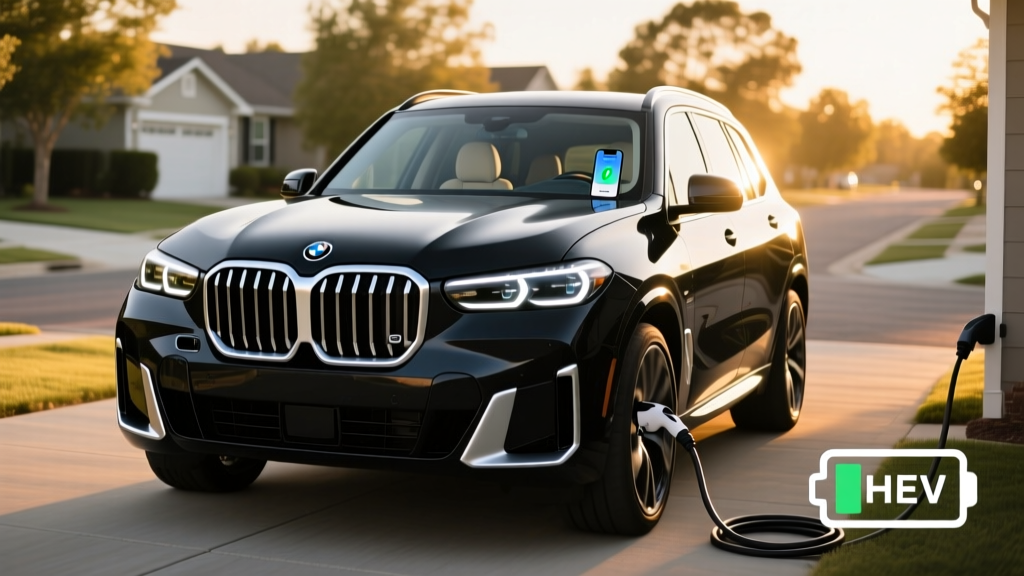
The 2026 BMW X5 xDrive50e occupies a specific niche in the luxury SUV market: it's a plug-in hybrid (PHEV) that delivers meaningful electric-only commuting range without sacrificing the performance and cargo utility buyers expect from a Bavarian midsize SUV. With 483 combined horsepower, an EPA-estimated 38 miles of electric-only driving, and the ability to function as a conventional hybrid once the battery depletes, the xDrive50e answers a real question for luxury shoppers who aren't ready to commit to a full battery-electric vehicle but want to reduce fuel consumption and emissions on daily drives.
This guide breaks down every number that matters — from real-world MPGe and highway fuel economy to Level 2 charging times, §30D tax credit eligibility, and long-term battery reliability — so you can decide whether the hybrid BMW X5 fits your garage and your budget.
| Specification | Value |
|---|---|
| Powertrain Type | Plug-in Hybrid (PHEV) |
| Engine | 3.0L turbocharged inline-6 + electric motor |
| Combined Horsepower | 483 hp |
| Combined Torque | 516 lb-ft |
| Battery (Usable) | 25.7 kWh (NMC lithium-ion) |
| EPA Electric-Only Range | 38 miles |
| EPA MPGe (Combined) | 56 MPGe |
| EPA MPG (Gas-Only, Combined) | 23 MPG |
| Total Combined Range | ~440 miles |
| 0–60 mph | 4.6 seconds |
| Max AC Charge Rate (Level 2) | 7.4 kW |
| DC Fast Charging | Not available |
| Level 2 Charge Time (0–100%) | ~3.75 hours |
| Drivetrain | xDrive AWD |
| Cargo Volume (rear seats up) | 33.9 cu ft |
| Base MSRP | $72,100 |
| Federal Tax Credit (§30D) | Up to $7,500 (eligibility varies) |
HEV vs. PHEV: What the Hybrid BMW X5 Actually Is
Before evaluating the X5 xDrive50e, it's essential to distinguish between the two hybrid architectures on the market, because BMW has offered both in the X5 lineup over the years.
| Feature | HEV (e.g., Toyota RAV4 Hybrid) | PHEV (BMW X5 xDrive50e) |
|---|---|---|
| Battery Size | 1–2 kWh | 25.7 kWh usable |
| Plug-In Charging | No — self-charges via regen & engine | Yes — plug in for full electric range |
| Electric-Only Range | ~1 mile at low speed | 38 miles (EPA) |
| Gas Engine | Always available, seamlessly blends | Activates when battery depletes or under hard acceleration |
| Federal Tax Credit | Generally not eligible under §30D | Eligible — up to $7,500 (rules apply) |
| Best For | Drivers without home charging access | Drivers with home/workplace charging and short commutes |
The 2026 X5 xDrive50e is a PHEV. It has a J1772/Type 2 charge port and requires plugging in to access its full 38-mile electric range. If you never plug it in, it operates as a conventional hybrid using its gas engine and regenerative braking — but you'll miss the efficiency gains and electric-only commuting that justify the price premium. If you cannot install a home charger or lack workplace charging access, a conventional HEV may be a more practical choice.
Fuel Economy: EPA Numbers and Real-World MPG
The EPA rates the 2026 BMW X5 xDrive50e at 56 MPGe combined when operating in electric+gas blended mode, and 23 MPG combined (22 city / 24 highway) when running on gasoline alone after the battery is depleted. These figures come from fueleconomy.gov.
| Mode | City | Highway | Combined |
|---|---|---|---|
| Blended (Electric + Gas) | — | — | 56 MPGe |
| Gas-Only (Battery Depleted) | 22 MPG | 24 MPG | 23 MPG |
Real-World MPG vs. EPA Sticker
PHEV fuel economy is highly dependent on your driving pattern. Here's what real-world ownership typically looks like:
- Short commutes under 38 miles with daily charging: You'll use little to no gasoline. Many owners report going weeks between fill-ups, effectively achieving 80–100+ MPGe in blended use.
- Mixed driving (commute + road trips): Expect 35–45 MPGe on days you start with a full battery and drive 50–80 miles total. Once the battery depletes, efficiency drops to the gas-only 23 MPG.
- Long highway trips with no charging: Sustained 70–80 mph highway driving yields roughly 22–25 MPG — similar to the gas-only X5 xDrive40i. PHEVs lose their advantage on extended highway runs because the battery contribution is minimal at steady high speeds.
- Cold weather (below 32°F): Expect 20–30% reduction in electric-only range (roughly 27–30 miles instead of 38) due to cabin heating demands and reduced battery efficiency. Gas-only MPG may drop 1–2 MPG.
The key insight: the X5 xDrive50e rewards daily charging. If your round-trip commute is under 35 miles and you charge every night, you'll burn almost no fuel on weekdays. The 18.5-gallon fuel tank provides a total combined range of approximately 440 miles, eliminating range anxiety on road trips.
Electric-Only Range and Charging: The Daily-Commute Equation
The xDrive50e's 25.7 kWh usable battery (part of a larger gross pack with buffer capacity to protect longevity) delivers an EPA-rated 38 miles of electric-only range. In real-world conditions:
- Mild weather, city/suburban driving (under 45 mph): 36–40 miles is achievable, as regenerative braking recaptures energy in stop-and-go traffic.
- Highway driving at 70 mph: Expect 28–32 miles of electric range before the engine engages.
- Cold weather with cabin heat: 25–30 miles. The X5 uses a heat pump for cabin heating, which is more efficient than resistive heaters, but cold still reduces battery output.
Charging Speeds and Times
| Charging Level | Power (kW) | Time (0–100%) | Typical Use Case |
|---|---|---|---|
| Level 1 (120V household outlet) | ~1.4 kW | ~18–20 hours | Emergency / overnight trickle |
| Level 2 (240V home or public) | 7.4 kW (max) | ~3.75 hours | Daily home charging |
| DC Fast Charging | Not supported | N/A | Not available on this model |
A critical limitation: the X5 xDrive50e does not support DC fast charging. This is common among PHEVs — the battery is small enough that Level 2 charging is sufficient for overnight replenishment, but it means you cannot top up quickly at a highway rest stop. For a PHEV buyer who charges at home nightly, this is rarely an issue. For those relying on public infrastructure, it's a constraint worth noting.
For home Level 2 charging, a 240V/32A circuit (like a BMW Wallbox or universal J1772 Level 2 unit) will replenish the battery in under 4 hours. Installation costs for a dedicated 240V circuit typically range from $500 to $2,000 depending on panel proximity and local permitting. Always consult a licensed electrician for final specifications.
Powertrain Performance: 483 HP and 4.6-Second 0–60
The xDrive50e pairs BMW's B58 3.0-liter turbocharged inline-six engine with an electric motor integrated into the 8-speed ZF automatic transmission. Combined output is 483 horsepower and 516 lb-ft of torque, routed through xDrive all-wheel drive.
The inline-six produces roughly 312 hp on its own, with the electric motor contributing up to 184 hp. Because the motor delivers instant torque from zero RPM, the PHEV X5 feels more responsive off the line than the gas-only xDrive40i despite similar peak horsepower figures. The 4.6-second 0–60 mph time places it firmly in performance-SUV territory — only a half-second behind the previous-generation X5 M50i.
Driving dynamics benefit from the low-mounted battery, which lowers the center of gravity slightly compared to the gas X5. The trade-off is approximately 400 pounds of additional curb weight (roughly 5,500 lbs total), which you'll notice during aggressive cornering but is well-masked by BMW's adaptive suspension tuning on most trims.
The regenerative braking system offers adjustable levels through the iDrive interface, including a one-pedal-driving mode in EV-only operation. However, the regen is less aggressive than a full BEV, so expect a more traditional braking feel than what Tesla or Hyundai Ioniq owners experience.
Pricing, Trims, and Federal Tax Credit Eligibility
The 2026 BMW X5 xDrive50e starts at a base MSRP of $72,100, including destination charge. Well-equipped examples with the Premium Package, Driving Assistance Professional, and panoramic roof typically land in the $78,000–$85,000 range before incentives.
Does the Hybrid BMW X5 Qualify for the Federal Tax Credit?
The X5 xDrive50e may qualify for up to $7,500 under IRS §30D (New Clean Vehicle Credit), but eligibility depends on several requirements that change periodically. As of the current tax year, the key criteria include:
- MSRP cap: SUVs must have an MSRP at or below $80,000. The base xDrive50e qualifies; heavily optioned units may exceed the cap.
- Buyer income limits: Modified adjusted gross income (MAGI) must not exceed $150,000 (single), $225,000 (head of household), or $300,000 (joint filers).
- Battery component sourcing: A percentage of battery components must be manufactured or assembled in North America, and critical minerals must meet sourcing thresholds. The credit splits into two halves ($3,750 each) based on these requirements.
- Point-of-sale transfer: Buyers can elect to transfer the credit to the dealer at purchase, reducing the out-of-pocket price immediately rather than waiting for tax filing.
- Final assembly: The vehicle must undergo final assembly in North America. The BMW X5 is assembled in Spartanburg, South Carolina, meeting this requirement.
Because critical-mineral and battery-component sourcing rules tighten annually, the exact credit amount ($3,750 or $7,500) can vary by model year and production batch. Always verify current eligibility on IRS.gov or through the dealer's point-of-sale credit tool before purchasing. State incentives may also apply — check your local energy agency or DMV for additional rebates.
Battery Reliability, Warranty, and Long-Term Costs
Hybrid and PHEV battery longevity remains a top concern for buyers spending $70,000+. Here's what the data shows:
BMW X5 xDrive50e Battery & Powertrain Warranty
- High-Voltage Battery Warranty: 8 years / 80,000 miles (whichever comes first), guaranteed to retain at least 70% of original capacity. This meets the federal minimum mandated by the EPA/CARB for emissions-related components.
- Powertrain Warranty: 4 years / 50,000 miles (BMW's standard new-vehicle coverage includes the engine, transmission, and hybrid components).
- New-Vehicle Limited Warranty: 4 years / 50,000 miles bumper-to-bumper.
Is the Hybrid BMW X5 Reliable?
BMW's B58 inline-six engine has proven to be one of the most reliable powerplants the company has produced in the modern era, with widespread use across the 3, 4, 5, 7, X3, X4, X5, and Supra lineups since 2015. The electric motor and power electronics add components that can fail, but PHEV systems have fewer moving parts than a conventional transmission (no torque converter, simplified gear engagement).
Long-term PHEV battery degradation data from similar BMW architectures (the 330e, 530e, and previous X5 45e) suggests 10–15% capacity loss over 8–10 years of typical use. The 25.7 kWh battery in the xDrive50e has a generous buffer, meaning usable capacity degradation is gradual. Owners of the predecessor X5 xDrive45e (24 kWh pack) report 30+ mile electric range retention after 5 years and 60,000+ miles.
Battery Replacement Cost
Out-of-warranty high-voltage battery replacement for the X5 PHEV currently ranges from $12,000 to $18,000 including parts and labor at a BMW dealership. This is a significant expense, but it's important to contextualize:
- Most PHEV batteries outlast the vehicle's practical ownership period. Catastrophic failure within the warranty period is covered.
- Individual module replacement (rather than the full pack) may be possible at lower cost, depending on the failure mode.
- The 8-year/80,000-mile warranty provides coverage through the period of highest depreciation and typical first- and second-owner use.
For comparison, a full engine or transmission replacement on a gas-only luxury SUV can cost $8,000–$15,000. The PHEV battery is an additional risk factor, but not an unprecedented one in the luxury segment.
Who Should Buy the Hybrid BMW X5 (and Who Shouldn't)
Pros
- 38-mile electric range covers most daily commutes without gasoline
- 483 hp provides genuine performance-SUV acceleration
- No range anxiety — 440-mile total range with gas engine backup
- Eligible for up to $7,500 federal tax credit (with caveats)
- Quiet, refined electric-only driving in city traffic
- BMW build quality, iDrive 8.5 infotainment, premium interior
- Strong resale value relative to luxury PHEV competitors
Cons
- No DC fast charging — limited to 7.4 kW Level 2
- $72,100 base price; options push past $80K MSRP cap
- Gas-only MPG (23 combined) is unremarkable for the segment
- Cargo space slightly reduced vs. gas X5 due to battery placement
- Heavy curb weight (~5,500 lbs) affects handling and tire wear
- Requires home or workplace charging to realize efficiency benefits
- BMW's 4-year/50K-mile bumper-to-bumper warranty is shorter than Genesis or Volvo
Choose the BMW X5 xDrive50e PHEV if:
- Your round-trip commute is 35 miles or less and you can charge at home nightly
- You want a luxury performance SUV but want to reduce weekday fuel consumption
- You take regular road trips where a full EV's charging stops would be inconvenient
- You qualify for the §30D tax credit and can keep MSRP under $80,000
- You value BMW driving dynamics and iDrive technology
Consider a full EV (BMW iX, Tesla Model X) if:
- You have reliable home and workplace charging and rarely drive more than 250 miles in a day
- You want zero gasoline expenses and minimal maintenance (no oil changes, fewer fluids)
- You live in a region with robust DC fast-charging infrastructure for road trips
Consider a conventional HEV or gas X5 if:
- You cannot install a home charger and lack workplace charging
- Your budget is under $60,000 — the PHEV premium is significant
- You primarily drive long highway distances where PHEV electric range offers little benefit
Hybrid BMW X5 FAQ
How many MPG does the hybrid BMW X5 get?
The 2026 BMW X5 xDrive50e is rated at 56 MPGe combined in blended electric+gas operation and 23 MPG combined (22 city / 24 highway) when running on gasoline alone. Real-world fuel economy depends heavily on how often you charge — daily charging with a short commute can yield months between fill-ups, while extended highway driving returns 22–25 MPG.
How far can the BMW X5 PHEV go on electric only?
The EPA rates the X5 xDrive50e at 38 miles of electric-only range. In real-world conditions, expect 36–40 miles in mild-weather city driving, 28–32 miles at highway speeds, and 25–30 miles in cold weather. Once the battery depletes, the gas engine engages seamlessly and the vehicle continues as a conventional hybrid.
Does the BMW X5 hybrid qualify for a tax credit?
The X5 xDrive50e may qualify for up to $7,500 under the IRS §30D New Clean Vehicle Credit, subject to buyer income limits ($300K joint / $150K single), an $80,000 MSRP cap for SUVs, and battery component/critical mineral sourcing requirements. The vehicle is assembled in Spartanburg, SC, meeting the final-assembly requirement. Verify current eligibility at IRS.gov before purchasing, as sourcing rules tighten annually.
Is the BMW X5 PHEV reliable, and what does a battery replacement cost?
The B58 inline-six engine has a strong reliability track record, and BMW's PHEV systems in the 330e/530e/X5 45e have shown modest 10–15% battery degradation over 8–10 years. The high-voltage battery is warranted for 8 years/80,000 miles at 70%+ capacity retention. Out-of-warranty battery replacement costs $12,000–$18,000, though catastrophic failures within the warranty period are covered.
Can the BMW X5 xDrive50e DC fast charge?
No. The X5 xDrive50e supports only AC Level 1 (120V) and Level 2 (240V) charging, with a maximum charge rate of 7.4 kW. A full Level 2 charge takes approximately 3.75 hours. DC fast charging is not available on this PHEV — this is standard for most plug-in hybrids, as the battery is small enough to replenish overnight on Level 2.
How does the BMW X5 PHEV compare to the BMW iX (full EV)?
The BMW iX xDrive50 offers 324 miles of EPA range, DC fast charging up to 200 kW, and 516 hp starting around $87,000. It eliminates gasoline entirely but requires commitment to charging infrastructure for road trips. The X5 xDrive50e is $15,000+ less expensive, offers gas-engine flexibility for long trips, and is better suited for buyers who can't reliably access DC fast charging. If your lifestyle supports full EV ownership, the iX delivers lower running costs and a more futuristic interior.
What's the difference between the X5 xDrive50e and the older X5 xDrive45e?
The xDrive50e replaced the xDrive45e for the 2024 model year with a larger battery (25.7 kWh usable vs. 22.3 kWh), more electric range (38 miles vs. 31 miles), and significantly more power (483 hp vs. 389 hp). The 50e also features updated iDrive 8.5 software and revised styling. If shopping used, the 45e remains a capable PHEV but with noticeably less electric range and acceleration.