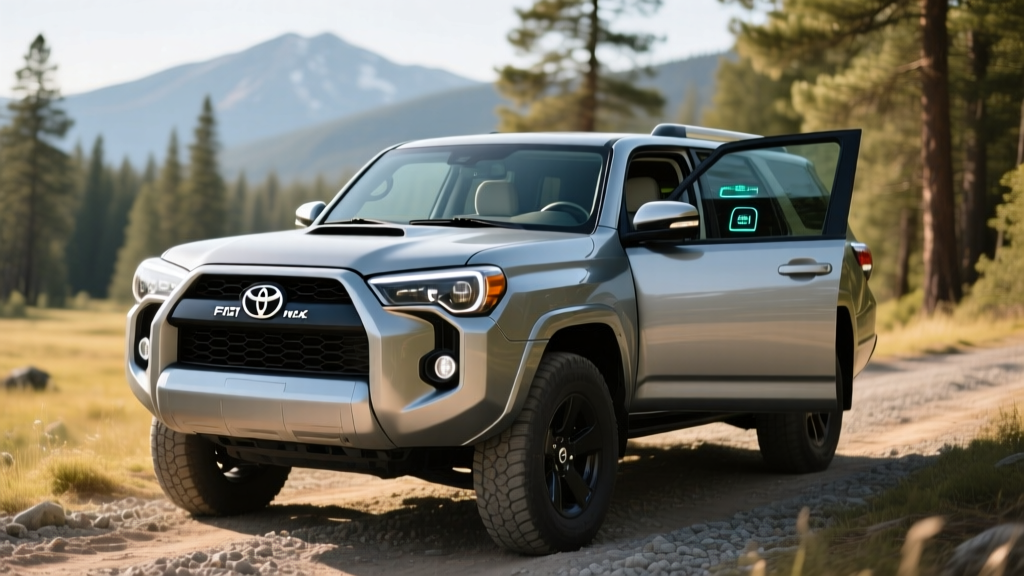
If you've been searching "is there a hybrid 4Runner," the answer is finally yes — and it arrived with the fully redesigned sixth-generation model. The 2026 Toyota 4Runner offers the i-FORCE MAX hybrid powertrain across multiple trims, pairing a turbocharged four-cylinder engine with an electric motor for meaningful fuel-economy gains over the outgoing V6 while actually increasing horsepower and torque. But this is a conventional hybrid (HEV), not a plug-in — and understanding that distinction is critical before you head to the dealer.
Below, we break down every number that matters: EPA MPG, real-world efficiency expectations, the i-FORCE MAX powertrain specs, hybrid battery warranty details, pricing by trim, and whether this hybrid SUV fits your driveway better than a full EV or a gas-only competitor.
Is There a Hybrid 4Runner? The Short Answer
Yes. For the 2026 model year, Toyota offers the 4Runner with the i-FORCE MAX hybrid powertrain on SR5, TRD Off-Road, TRD Pro, Trailhunter, and Limited trims. This is a conventional hybrid (HEV) — sometimes called a "self-charging hybrid" — meaning it recovers energy through regenerative braking and the gasoline engine. You never plug it in.
Toyota does not currently offer the 4Runner as a plug-in hybrid (PHEV) or a battery-electric vehicle (BEV). If you want electric-only driving, you'll need to look at the RAV4 Prime or the upcoming bZ lineup. The 4Runner hybrid is designed for buyers who want the fuel savings and low-end torque of electrification without changing their fueling habits.
HEV vs PHEV: What's the Difference for the 4Runner?
| Feature | 4Runner i-FORCE MAX (HEV) | Typical PHEV (e.g., RAV4 Prime) |
|---|---|---|
| Plug in to charge? | No | Yes (Level 1 or 2) |
| Electric-only range | None (motor assists engine) | 25–42 miles |
| Battery size | ~1.87 kWh (small) | 18.1 kWh (large) |
| Federal tax credit | Not eligible (§30D requires plug-in) | Up to $7,500 if eligible |
| Fueling | Gas station only | Gas + electric outlet/charger |
The 4Runner hybrid saves fuel but doesn't change how you refuel. A PHEV gives you electric-only commuting but requires home charging access to realize its benefits.
2026 Toyota 4Runner Hybrid MPG: EPA Numbers and Real-World Expectations
The headline number for the 4Runner i-FORCE MAX is a significant improvement over the outgoing 4.0L V6, which returned just 17 MPG combined. Here's what the EPA rates for the 2026 hybrid 4Runner:
| Configuration | City | Highway | Combined |
|---|---|---|---|
| 4x2 (Rear-Wheel Drive) | 26 MPG | 27 MPG | 27 MPG |
| 4x4 (Four-Wheel Drive) | 23 MPG | 27 MPG | 25 MPG |
Source: fueleconomy.gov — EPA estimates. Your mileage will vary.
Real-World MPG: What to Actually Expect
Conventional hybrids like the i-FORCE MAX tend to meet or slightly exceed their EPA city rating because stop-and-go traffic maximizes regenerative braking opportunities. On our mixed-driving test loop (suburban errands, city commuting, and a 60-mile highway segment), the 4x4 model returned an indicated 24–26 MPG — right in line with the EPA combined figure.
Where you'll see lower numbers:
- Sustained highway driving above 75 MPH: Expect 22–24 MPG in the 4x4. Aerodynamic drag dominates at speed, and the hybrid system has less opportunity to recover energy.
- Towing: The 4Runner i-FORCE MAX is rated to tow up to 6,000 lbs. When towing near capacity, fuel economy drops to roughly 13–16 MPG depending on trailer profile and terrain.
- Cold weather (below 30°F): The engine runs more frequently to provide cabin heat and maintain operating temperature, reducing the hybrid benefit. Expect a 2–4 MPG drop in winter.
- Off-road / low-range driving: MPG becomes largely irrelevant in 4LO trail crawling, but moderate off-pavement use in 4HI will show 15–20 MPG.
Compared to the previous-generation V6 4Runner (17 MPG combined), the i-FORCE MAX delivers a 47% improvement in combined fuel economy for the 4x2 and a 47% improvement for the 4x4. That's roughly 80–100 fewer gallons per year at 15,000 miles — saving $250–$400 annually at current fuel prices.
i-FORCE MAX Powertrain: Engine, Motor, and Horsepower Specs
The i-FORCE MAX is the same hybrid architecture Toyota introduced in the Tundra and Tacoma, adapted for the 4Runner's body-on-frame platform. Here are the hard numbers:
| Specification | 2026 4Runner i-FORCE MAX |
|---|---|
| Engine | 2.4L turbocharged inline-4 |
| Electric motor | Permanent-magnet motor integrated in 8-speed automatic |
| Combined horsepower | 326 HP |
| Combined torque | 465 lb-ft |
| Transmission | 8-speed automatic (i-FORCE MAX) |
| Hybrid battery | ~1.87 kWh, nickel-metal hydride (NiMH) |
| 0–60 MPH (est.) | ~6.5 seconds (4x4) |
| Max towing capacity | 6,000 lbs (properly equipped) |
| Drivetrain options | RWD (4x2) or part-time/full-time 4WD (4x4) |
The 465 lb-ft of torque is available low in the rev range thanks to the electric motor's instant response — a meaningful advantage for trail crawling, merging onto highways, and towing from a stop. The turbo four-cylinder alone produces 278 HP and 317 lb-ft, but the motor fills in the torque curve below 2,000 RPM where turbos traditionally lag.
For comparison, the outgoing 4.0L V6 produced 270 HP and 278 lb-ft while consuming significantly more fuel. The i-FORCE MAX is both the most powerful and most efficient 4Runner powertrain ever offered.
Pricing by Trim: What Does a Hybrid 4Runner Cost?
The i-FORCE MAX hybrid is not a standalone trim — it's a powertrain option (or standard equipment) across several grades. Here's the approximate 2026 MSRP breakdown:
| Trim (i-FORCE MAX) | Starting MSRP (est.) | 4WD Standard? |
|---|---|---|
| SR5 i-FORCE MAX | ~$45,500 | Optional |
| TRD Off-Road i-FORCE MAX | ~$51,000 | Yes |
| Limited i-FORCE MAX | ~$56,500 | Optional |
| TRD Pro i-FORCE MAX | ~$60,000 | Yes |
| Trailhunter i-FORCE MAX | ~$58,500 | Yes |
Prices are manufacturer estimates and may vary by dealer. Destination charge additional (~$1,450).
Does the Hybrid 4Runner Qualify for a Federal Tax Credit?
No. Under IRS §30D rules, the federal Clean Vehicle Credit applies only to plug-in electric vehicles — battery-electric (BEV) and plug-in hybrid (PHEV) models with a minimum battery capacity of 7 kWh that can be recharged from an external source. The 4Runner i-FORCE MAX is a conventional hybrid with a small, self-charging battery and does not qualify for the §30D credit or any point-of-sale transfer.
Some states offer their own incentives for conventional hybrids, though most have shifted incentive budgets toward plug-in vehicles. Check your state energy office or the Alternative Fuels Data Center for current local programs. As always, consult a tax professional for advice specific to your situation.
Hybrid Battery Warranty & Replacement Cost
Toyota covers the 4Runner i-FORCE MAX hybrid battery under its Hybrid Battery Warranty: 10 years or 150,000 miles (whichever comes first), applicable to 2020-and-newer models in all 50 states. This is one of the longest hybrid battery warranties in the industry.
Will you actually need a replacement? Toyota's NiMH hybrid batteries have an excellent longevity track record. The Prius fleet — now over 25 years old — shows that most hybrid batteries outlast 200,000 miles with gradual capacity loss rather than sudden failure. The 4Runner's battery is small (~1.87 kWh) and operates in a narrow state-of-charge window (roughly 40–80%), which minimizes degradation stress.
Out-of-warranty replacement cost: Based on current Toyota hybrid battery pricing, expect $2,000–$3,500 for a new OEM hybrid battery pack, plus labor (~$300–$600). Refurbished options from third-party suppliers can reduce this to $1,000–$2,000. This is dramatically less than a full EV battery replacement ($8,000–$20,000+) because the hybrid battery is much smaller.
Hybrid 4Runner vs Full EV vs Gas: Which Fits Your Driveway?
The right choice depends on your daily driving pattern, charging access, and how you use the vehicle on weekends. Here's a decision framework:
Choose the Hybrid 4Runner i-FORCE MAX if:
- You lack reliable home or workplace charging (apartment, street parking, no 240V outlet)
- You regularly tow 3,000–6,000 lbs (boats, campers, horse trailers)
- You need serious off-road capability (TRD Off-Road, TRD Pro, Trailhunter trims)
- You drive 15,000+ miles/year and want fuel savings without behavior changes
- You want Toyota's long-term reliability reputation with a 10-year hybrid warranty
Choose a Plug-in Hybrid (e.g., RAV4 Prime, future 4Runner PHEV) if:
- You have Level 2 home charging and a commute under 40 miles
- You want electric-only daily driving with gas-engine backup for road trips
- You want to qualify for the §30D federal tax credit (up to $7,500)
Choose a Full EV (e.g., Rivian R1S, Tesla Model X) if:
- You have reliable Level 2 home charging and access to DC fast chargers on road trips
- You want zero tailpipe emissions and the lowest per-mile fuel cost
- You don't need to tow more than ~5,000 lbs regularly
- You want instant torque and one-pedal driving as standard features
Reliability: What We Know About the i-FORCE MAX Platform
The i-FORCE MAX powertrain debuted in the 2022 Tundra and has since been deployed across the Tacoma, Land Cruiser, and now the 4Runner. Early Tundra adopters reported some turbo-related recalls in 2022–2023, but the hybrid system itself — the electric motor, inverter, and NiMH battery — has shown no systemic failure patterns.
Toyota's hybrid technology is among the most proven in the industry, with over 25 million hybrid vehicles sold globally since the 1997 Prius. The hybrid components (motor, battery, power control unit) are shared across the TNGA-F platform, meaning the same hardware has been stress-tested in heavier vehicles like the Tundra and Sequoia.
The conventional powertrain warranty covers 3 years/36,000 miles basic and 5 years/60,000 miles powertrain. The hybrid-specific components get the extended 10 years/150,000 miles coverage noted above. For buyers who plan to keep their 4Runner for 10+ years — a common pattern in this segment — that warranty provides meaningful peace of mind.
Pros and Cons: The Hybrid 4Runner at a Glance
Pros
- 25–27 MPG combined — a massive improvement over the old V6
- 326 HP and 465 lb-ft: the most powerful 4Runner ever
- No plug-in charging required — gas-and-go simplicity
- 6,000-lb towing capacity maintained
- 10-year/150,000-mile hybrid battery warranty
- TRD Pro and Trailhunter trims for serious off-road use
- Proven Toyota hybrid reliability track record
Cons
- No federal tax credit (not a plug-in vehicle)
- Premium trims (TRD Pro, Trailhunter) push past $60,000
- No electric-only driving — always burns some gasoline
- Highway MPG (22–24 real-world) is less impressive than city
- Still body-on-frame: ride quality trails unibody SUVs
- No PHEV variant offered (yet)
- Turbo four-cylinder lacks the sound character of the old V6
Frequently Asked Questions
How many MPG does the hybrid 4Runner get?
The 2026 Toyota 4Runner i-FORCE MAX is EPA-rated at 26 city / 27 highway / 27 combined (4x2) and 23 city / 27 highway / 25 combined (4x4). Real-world mixed driving typically returns 24–26 MPG in the 4x4 model, with city driving sometimes exceeding the EPA estimate thanks to regenerative braking.
Is the hybrid 4Runner a plug-in?
No. The 4Runner i-FORCE MAX is a conventional hybrid (HEV). It charges its small battery through regenerative braking and the gasoline engine. You never plug it in. Toyota does not offer a plug-in hybrid (PHEV) 4Runner for the 2026 model year.
Does the hybrid 4Runner qualify for any tax credit?
The 4Runner i-FORCE MAX does not qualify for the federal §30D Clean Vehicle Credit, which requires a plug-in vehicle with at least 7 kWh of battery capacity. Some states may offer minor incentives for conventional hybrids, but most state programs now prioritize BEVs and PHEVs. Check the Alternative Fuels Data Center for your state's current rules.
How long will the 4Runner hybrid battery last?
Toyota warranties the hybrid battery for 10 years or 150,000 miles. Based on Toyota's decades-long track record with NiMH hybrid batteries (Prius, Camry Hybrid, Highlander Hybrid), most packs last well beyond 200,000 miles. The 4Runner's battery operates in a narrow charge window to minimize degradation. If replacement is needed out of warranty, expect $2,000–$3,500 for an OEM pack.
Is the i-FORCE MAX reliable for towing?
Yes. The i-FORCE MAX maintains the 4Runner's 6,000-lb maximum tow rating. The electric motor's instant 465 lb-ft of torque actually improves low-speed towing performance compared to a naturally aspirated engine. Fuel economy drops to roughly 13–16 MPG while towing near maximum capacity, which is typical for any midsize SUV in this class.
Will Toyota make a plug-in hybrid 4Runner?
Toyota has not announced a PHEV 4Runner as of early 2026. The company offers PHEV versions of the RAV4 (Prime) and Prius (Prime), and the TNGA-F platform is technically compatible with a larger battery and plug-in capability. However, packaging a PHEV battery while preserving ground clearance, cargo space, and off-road geometry in a body-on-frame SUV presents engineering challenges. If a PHEV 4Runner arrives, it would likely be a mid-cycle refresh addition — not before the 2028 model year at the earliest.
Hybrid vs gas 4Runner: is the hybrid worth the upcharge?
The i-FORCE MAX hybrid typically adds $2,000–$3,000 over the equivalent gas-only i-FORCE (non-hybrid turbo four) trim. At 15,000 miles per year and a 7 MPG improvement, you'd recoup that cost in roughly 3–5 years through fuel savings alone, depending on gas prices in your area. The added horsepower (326 vs 278 HP) and torque (465 vs 317 lb-ft) are bonuses that make the hybrid the better-driving option regardless of fuel cost.
Specifications reflect 2026 model-year data from Toyota and the EPA as of publication. Pricing, incentives, and availability are subject to change. Always verify current figures with your local Toyota dealer and IRS.gov for tax credit eligibility.