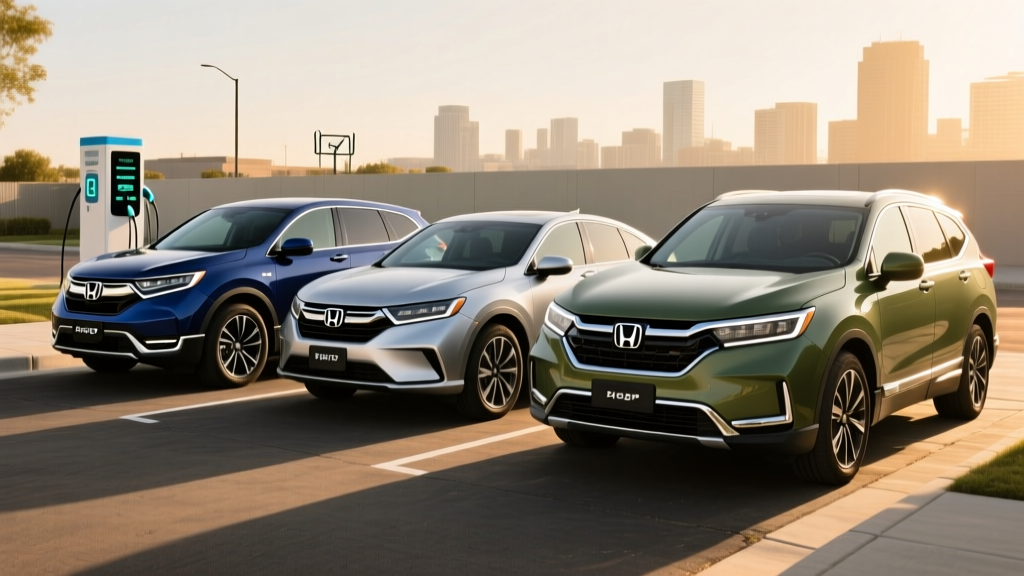
Honda's electrified SUV strategy in 2026 doesn't chase battery-electric hype. Instead, the automaker doubles down on what actually sells: conventional hybrid (HEV) powertrains across its core SUV lineup. If you've been searching for a Honda SUV hybrid, you now have three distinct options — the compact CR-V Hybrid, the midsize Passport (newly hybrid-equipped), and the three-row Pilot Hybrid. None require a plug. None demand lifestyle changes. But their MPG figures, pricing, and powertrain behavior differ enough that picking the right one matters.
This guide breaks down every current Honda SUV hybrid with exact EPA fuel economy, real-world efficiency observations, powertrain specs, battery warranty details, and pricing — so you can match the right model to your driving pattern and budget.
Every Honda SUV Hybrid for 2026: Quick Specs
Honda's hybrid system uses a two-motor setup paired with a 2.0-liter Atkinson-cycle four-cylinder engine. The system is a conventional hybrid (HEV), meaning the battery recharges through regenerative braking and the engine — you never plug it in. Here's how the three models stack up at a glance:
| Spec | CR-V Hybrid (AWD) | Passport Hybrid | Pilot Hybrid (AWD) |
|---|---|---|---|
| EPA Combined MPG | 40 MPG | 27 MPG | 27 MPG |
| City / Highway MPG | 43 city / 36 hwy | 28 city / 26 hwy | 28 city / 26 hwy |
| Combined Horsepower | 204 hp | 290 hp | 290 hp |
| Engine | 2.0L I4 + 2 motors | 3.5L V6 + 2 motors | 3.5L V6 + 2 motors |
| Drivetrain | AWD (standard) | AWD (standard) | AWD (standard) |
| Battery Type | Lithium-ion (~1.1 kWh) | Lithium-ion (~1.5 kWh) | Lithium-ion (~1.5 kWh) |
| 0–60 mph | ~7.6 sec | ~6.2 sec | ~6.4 sec |
| Cargo Volume | 36.3 cu ft (rear up) | 43.5 cu ft (rear up) | 18.6 cu ft (all rows up) |
| Starting MSRP | $36,395 (Sport) | $49,995 (RTL Hybrid) | $49,495 (Sport Hybrid) |
HEV vs. PHEV vs. EV: Which Honda SUV Fits You?
Conventional Hybrid (HEV) — Honda's current SUV hybrid approach. A small battery (1.1–1.5 kWh) captures energy from braking and the engine. The electric motor assists at low speeds and during acceleration. You never plug in. The engine still runs on gasoline, but uses less of it. Best for: drivers without reliable home charging access, road-trippers, and buyers who want better MPG without any behavioral change.
Plug-in Hybrid (PHEV) — Honda does not currently offer a PHEV SUV in the US market for 2026. (The Clarity PHEV sedan was discontinued.) If you want 30+ miles of electric-only driving before the engine kicks in, you'll need to look at competitors like the Toyota RAV4 Prime (42 mi EV range) or Hyundai Tucson PHEV (33 mi EV range).
Battery Electric (BEV) — The Honda Prologue is Honda's only all-electric SUV, built on GM's Ultium platform. It offers an EPA-estimated 296 miles of range but requires access to DC fast charging or home Level 2 charging for practical daily use.
The decision framework is straightforward: if you can charge at home nightly and drive under 40 miles daily, a BEV minimizes operating cost. If you want MPG improvement with zero infrastructure changes, Honda's HEV lineup is purpose-built for you. If you want electric-only commuting with gas backup for road trips, Honda currently has no answer — you need a competitor's PHEV.
Fuel Economy: EPA Ratings vs. Real-World MPG
Honda's hybrid system excels in stop-and-go city driving, where the electric motor handles low-speed propulsion and the engine shuts off frequently. Highway MPG is lower because the engine does most of the work at sustained speeds. Here's what the EPA says versus what owners and independent testers consistently report:
| Model | EPA City | EPA Highway | EPA Combined | Real-World Observed |
|---|---|---|---|---|
| CR-V Hybrid AWD | 43 | 36 | 40 | 38–44 MPG (city-biased driving yields higher) |
| Passport Hybrid AWD | 28 | 26 | 27 | 25–29 MPG |
| Pilot Hybrid AWD | 28 | 26 | 27 | 25–29 MPG |
Real-World MPG Note: The CR-V Hybrid routinely exceeds its EPA combined rating in city-heavy commuting. Owners in urban environments report 42–45 MPG consistently. Highway-only trips at 75+ mph drop efficiency to 33–35 MPG. Cold weather (below 30°F) reduces MPG by roughly 5–8% due to increased engine warm-up cycles and cabin heating demands. The Passport and Pilot, being heavier vehicles, track closer to their EPA estimates with less upside variance. Source: fueleconomy.gov.
The CR-V Hybrid's 43 MPG city figure is the standout. For a compact AWD crossover, that puts it within striking distance of a Toyota Corolla sedan's combined efficiency — while offering substantially more cargo room and ground clearance. The Passport and Pilot hybrids improve meaningfully over their gas-only counterparts (the non-hybrid Pilot AWD is rated at 21 MPG combined), but they aren't breaking 30 MPG barriers.
Powertrain Deep Dive: Honda's Two-Motor Hybrid System
Honda's hybrid architecture operates differently than Toyota's planetary-gear system. In most driving conditions below ~45 mph, the CR-V Hybrid runs as a series hybrid: the gasoline engine drives a generator, which produces electricity to power the drive motor. The engine isn't mechanically connected to the wheels. Above highway speeds, a lock-up clutch engages, and the engine drives the wheels directly — because electric motors become less efficient at high RPM.
CR-V Hybrid: The 2.0-liter Atkinson-cycle four-cylinder produces 146 hp on its own, but combined with the two electric motors, system output reaches 204 hp and 247 lb-ft of torque. The result is smooth, linear acceleration that feels stronger than the number suggests — electric motors deliver peak torque instantly.
Passport & Pilot Hybrid: These larger SUVs use a 3.5-liter V6 paired with Honda's two-motor system for 290 combined horsepower. The V6 provides the grunt needed for towing (up to 5,000 lbs for the Pilot), while the hybrid system smooths out stop-start traffic and trims fuel consumption by roughly 25% compared to the non-hybrid V6.
All three models use AWD as standard with the hybrid powertrain. Honda's AWD system can send up to 50% of torque to the rear axle, with a torque-vectoring rear differential on the Passport and Pilot that can shift power side-to-side for improved cornering traction.
Pricing, Trims, and Tax Credit Eligibility
Here's where Honda's hybrid SUVs land in the 2026 lineup, by starting MSRP for hybrid-equipped trims:
- CR-V Hybrid Sport: $36,395 — well-equipped with 19-inch wheels, wireless Apple CarPlay/Android Auto, heated front seats, and Honda Sensing suite.
- CR-V Hybrid Sport Touring: $41,395 — adds leather, Bose audio, wireless charging, heated steering wheel, and hands-free power tailgate.
- Passport Hybrid RTL: $49,995 — includes leather-trimmed seats, power moonroof, and heated front seats.
- Passport Hybrid TrailSport Elite: $56,995 — adds off-road tuning, all-terrain tires, heated/ventilated front seats, and premium audio.
- Pilot Hybrid Sport: $49,495 — three-row seating for up to eight, with the hybrid powertrain as standard on this trim.
- Pilot Hybrid Elite: $56,895 — panoramic roof, ventilated front seats, second-row captain's chairs, and hands-free access.
Federal Tax Credit (§30D) — Honda SUV Hybrids:
- ❌ Not eligible for the $7,500 federal EV tax credit. The §30D credit applies only to plug-in electric vehicles (BEVs and PHEVs) with minimum battery capacity of 7 kWh. Honda's conventional hybrids use ~1.1–1.5 kWh batteries and cannot be plugged in.
- ❌ No federal PHEV credit either — Honda has no PHEV SUV in its 2026 US lineup.
- ✅ Possible state/local incentives: Some states (e.g., Colorado, California) offer rebates or tax credits for conventional hybrids, though amounts and eligibility vary by jurisdiction and are subject to legislative change. Check your state's energy or DMV website for current programs.
Source: IRS §30D Clean Vehicle Credit rules. Consult a tax professional for personal eligibility.
Battery Warranty, Lifespan, and Replacement Costs
The hybrid battery is the number-one concern for buyers considering a used or new Honda SUV hybrid. Here's what Honda provides and what real-world data shows:
Honda Hybrid Battery Warranty: 8 years / 100,000 miles (whichever comes first) in all 50 states. In CARB states (California, New York, Massachusetts, and others that follow California emissions standards), the hybrid battery warranty extends to 10 years / 150,000 miles. This warranty covers battery capacity loss below a defined threshold and any manufacturing defects.
How long do Honda hybrid batteries actually last? Honda's lithium-ion hybrid batteries are designed for longevity. Because the battery is small (1.1–1.5 kWh) and the system never fully depletes or fully charges it (operating in a narrow state-of-charge window of roughly 40–80%), degradation is minimal. Real-world data from earlier-generation Honda hybrids (Insight, Accord Hybrid) shows battery packs routinely lasting 150,000–200,000+ miles before significant capacity loss.
Replacement cost if out of warranty: A Honda hybrid battery replacement runs approximately $2,000–$4,000 depending on the model and whether you use OEM or refurbished cells. This is substantially less than a full EV battery replacement ($8,000–$20,000+) because the pack is small. Independent hybrid battery shops can often refurbish individual cells for $1,000–$1,500.
General hybrid reliability: Honda's hybrid system has fewer moving parts than a traditional automatic transmission (no torque converter, no multi-gear shifting mechanism). The e-CVT design is inherently simple. Honda's overall brand reliability ratings remain strong, with the CR-V consistently earning top marks from IIHS for crash safety.
Who Should Buy a Honda SUV Hybrid — And Who Shouldn't
Choose a Honda SUV Hybrid if:
- You want 25–40 MPG without plugging in or changing your routine
- You don't have reliable access to home or workplace EV charging
- You take regular road trips exceeding 300 miles and don't want to plan charging stops
- You want AWD for snow/rain without the fuel penalty of a gas-only AWD SUV
- You plan to keep the vehicle 8+ years (well within the battery warranty period)
- You value Honda's resale value and dealer network for long-term ownership
Look elsewhere if:
- You want electric-only commuting — Honda has no PHEV SUV; consider the Toyota RAV4 Prime, Hyundai Tucson PHEV, or Ford Escape PHEV
- You want maximum fuel savings and have home charging — a full BEV like the Tesla Model Y, Hyundai Ioniq 5, or Honda Prologue will cost far less per mile
- You want the $7,500 federal tax credit — it only applies to plug-in vehicles with ≥7 kWh batteries
- You drive mostly highway miles — the MPG advantage of Honda's hybrid system shrinks at sustained high speeds; a diesel or efficient gas car might close the gap
Pros
- CR-V Hybrid achieves 40 MPG combined in a practical AWD compact SUV
- No plug-in charging required — zero infrastructure investment
- Smooth, quiet low-speed driving on electric motor power
- 8-year/100,000-mile hybrid battery warranty (10yr/150k in CARB states)
- Strong resale value and extensive dealer network
- Honda Sensing ADAS suite standard on all hybrid trims
Cons
- No PHEV option — can't commute on electric-only power
- Passport and Pilot hybrids only reach 27 MPG combined
- Not eligible for the $7,500 federal §30D tax credit
- Hybrid trims carry a $1,500–$3,000 premium over gas-only equivalents
- Highway MPG drops noticeably at speeds above 75 mph
- CVT-like powertrain drone under hard acceleration
Frequently Asked Questions
How many MPG does the Honda CR-V Hybrid get?
The 2026 Honda CR-V Hybrid AWD is EPA-rated at 43 MPG city, 36 MPG highway, and 40 MPG combined. In real-world city driving, many owners report 42–45 MPG. Highway-only trips at 75+ mph typically yield 33–35 MPG.
Does Honda make a plug-in hybrid SUV?
No. As of 2026, Honda does not offer a plug-in hybrid (PHEV) SUV in the United States. All Honda SUV hybrids (CR-V, Passport, Pilot) are conventional hybrids (HEV) that recharge their batteries through regenerative braking and the gasoline engine — no plug-in required.
Is the Honda hybrid battery expensive to replace?
Out of warranty, a Honda hybrid battery replacement costs approximately $2,000–$4,000 depending on model and parts sourcing. However, Honda's hybrid batteries are warrantied for 8 years/100,000 miles (10 years/150,000 miles in CARB states), and real-world data shows these packs regularly lasting 150,000–200,000+ miles.
Does the Honda CR-V Hybrid qualify for a tax credit?
No. The federal §30D Clean Vehicle Credit applies only to plug-in electric vehicles (battery-electric and plug-in hybrid) with battery capacities of at least 7 kWh. The CR-V Hybrid's ~1.1 kWh battery and conventional hybrid powertrain make it ineligible. Some state-level incentives may apply — check your state's energy office for current programs.
How does the Honda hybrid system compare to Toyota's?
Honda uses a two-motor series-parallel system that operates primarily as a series hybrid at low speeds (engine generates electricity, motor drives wheels) and engages a direct-drive clutch at highway speeds. Toyota uses a planetary gear power-split device that blends engine and motor power continuously. Both are proven and reliable. Honda's system tends to feel more like an EV at city speeds due to the motor-dominant operation, while Toyota's system is more seamlessly blended.
Can I tow with a Honda hybrid SUV?
Yes. The CR-V Hybrid is rated for 1,000 lbs of towing capacity. The Passport Hybrid and Pilot Hybrid are rated for up to 5,000 lbs when properly equipped. Towing will reduce fuel economy significantly — expect a 30–40% MPG drop when pulling a loaded trailer.
Hybrid vs EV — which saves more money?
Over 5 years and 75,000 miles, a BEV charged primarily at home (at $0.14/kWh national average) will save roughly $4,000–$6,000 in fuel versus a Honda hybrid. However, BEVs carry higher purchase prices, potentially higher insurance costs, and require home charging installation ($500–$2,000 for Level 2). The Honda hybrid saves money versus a gas-only SUV with zero infrastructure investment and no range planning.