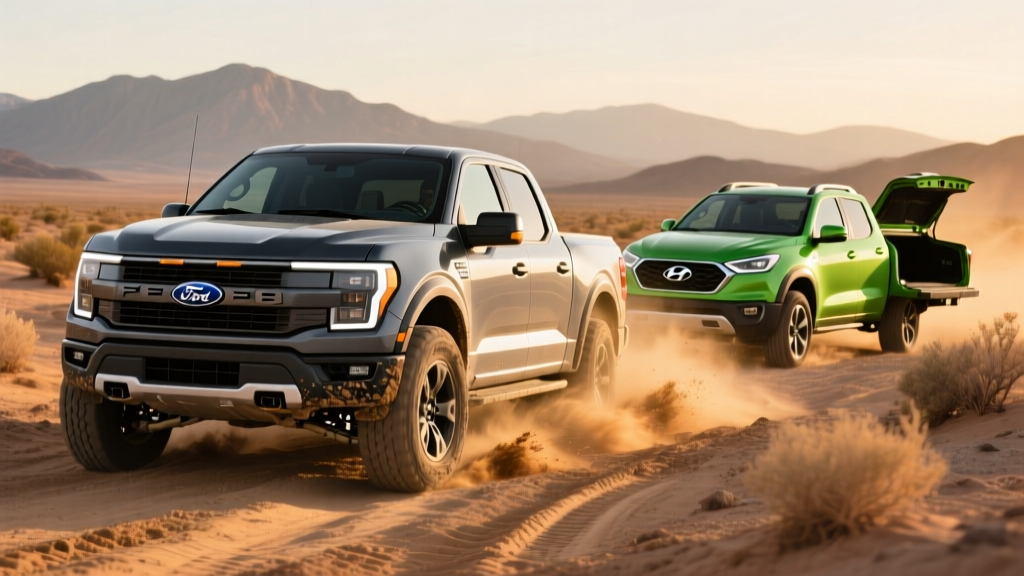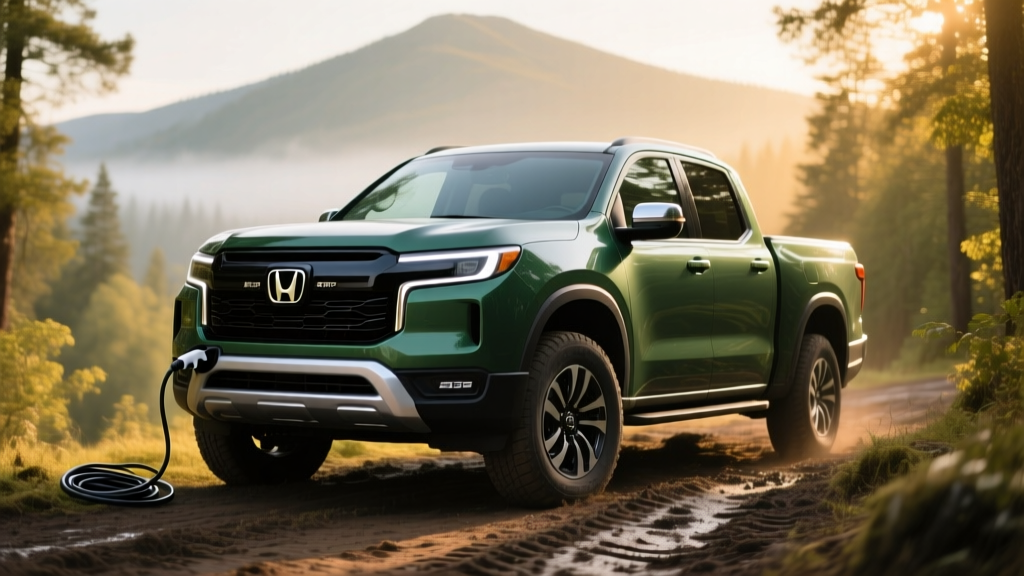
The midsize pickup segment is undergoing a quiet electrification revolution. The Ford Maverick hybrid proved that truck buyers will embrace fuel-efficient powertrains, and the Toyota Tacoma now offers a hybrid option. That leaves a glaring question for loyal Honda truck fans: is there a Honda Ridgeline hybrid?
As of early 2026, the short answer is no — Honda has not released a hybrid or plug-in hybrid version of the Ridgeline. But the longer answer involves Honda's shifting powertrain strategy, a concept truck that set the internet ablaze, and a very realistic path to a hybrid Ridgeline arriving before the decade is out. Here's everything we know, what the numbers would look like, and what you should buy today if you need a fuel-efficient midsize pickup.
The Honda Ridgeline Trailblazer Concept: What Honda Showed Us
In late 2025, Honda revealed the Ridgeline Trailblazer Concept at the SEMA Show — a rugged, overland-oriented pickup that signaled Honda's intent to push the Ridgeline further into the adventure-truck space. While the concept was not a hybrid (it retained the standard 3.5-liter V6), its debut was accompanied by Honda executives acknowledging that "electrified powertrains are under evaluation" for the next-generation Ridgeline.
This language matters. Honda has been methodically rolling out its two-motor hybrid system across its lineup — the Accord hybrid, CR-V hybrid, and Civic hybrid all use variations of the same architecture. Extending this technology to the Ridgeline's unibody platform is technically feasible and increasingly likely for the next generation, expected around 2027-2028.
| Spec | Value |
|---|---|
| Engine | 3.5L V6, naturally aspirated |
| Horsepower | 285 hp |
| Torque | 262 lb-ft |
| Transmission | 9-speed automatic |
| Drivetrain | AWD (i-VTM4) |
| EPA MPG (City / Hwy / Combined) | 18 / 24 / 21 |
| Towing Capacity | 5,000 lbs |
| Payload | 1,583 lbs |
| Starting MSRP | $41,120 (Sport AWD) |
Source: EPA Fuel Economy — Honda Ridgeline AWD
HEV vs PHEV: What a Hybrid Ridgeline Could Look Like
Before speculating on specs, it's important to understand the two types of hybrid powertrains Honda could deploy. This distinction affects everything from daily driving to tax-credit eligibility.
| Feature | HEV (Conventional Hybrid) | PHEV (Plug-In Hybrid) |
|---|---|---|
| Plugs in? | No — charges via regenerative braking and engine | Yes — requires plug-in charging for EV range |
| Battery Size | ~1-2 kWh | ~12-20 kWh (typical for trucks/SUVs) |
| Electric-Only Range | None (motor assists engine) | 25-50 miles (estimated for a truck) |
| Federal Tax Credit | Not eligible for §30D credit | Potentially eligible (up to $7,500, subject to MSRP/income/sourcing rules) |
| Best For | Drivers who can't charge at home | Drivers with home/workplace charging + short commutes |
| Complexity / Weight | Lower — minimal added weight | Higher — larger battery adds 200-400 lbs |
Honda's current two-motor hybrid system (as used in the Accord Hybrid and CR-V Hybrid) is an HEV architecture. It pairs a 2.0-liter four-cylinder engine with two electric motors and a small lithium-ion battery. This system produces 204 hp in the Accord and 204 hp in the CR-V — respectable, but below the Ridgeline's current 285 hp V6.
For a Ridgeline hybrid, Honda would likely need to either scale up this system (using a larger engine or more powerful motors) or develop a PHEV variant with a bigger battery pack that could deliver meaningful electric-only range while preserving towing capability. The Toyota Tacoma's i-FORCE MAX hybrid powertrain — which produces 326 hp and 465 lb-ft of torque — sets a high bar.
Projected MPG: What Could a Ridgeline Hybrid Achieve?
Since no official hybrid Ridgeline exists yet, we can estimate based on comparable vehicles and Honda's existing hybrid technology. The current gas-only Ridgeline returns a combined 21 MPG according to the EPA. Here's what hybridization could realistically deliver:
| Configuration | City MPG | Highway MPG | Combined MPG | Notes |
|---|---|---|---|---|
| 2026 Ridgeline AWD (current V6) | 18 | 24 | 21 | EPA official |
| Projected Ridgeline HEV (2-motor hybrid) | 26-30 | 27-31 | 27-30 | Based on Honda Accord Hybrid scaling + truck weight penalty |
| Projected Ridgeline PHEV (EV + hybrid) | 30-35 (hybrid mode) | 28-32 (hybrid mode) | 29-33 + 30-40 mi EV | Based on Toyota RAV4 Prime / Tacoma hybrid benchmarks |
Real-world caveat: Hybrid trucks, like hybrid cars, tend to exceed their EPA city estimates in stop-and-go driving (where regenerative braking shines) but may fall slightly short on sustained highway runs. The Ford Maverick Hybrid, for instance, is EPA-rated at 42 city / 33 highway / 37 combined — and many owners report matching or beating the city number while falling 1-2 MPG short on the highway. A heavier Ridgeline with AWD would see a similar pattern.
Towing, Payload, and the Hybrid Trade-Off
The biggest concern for truck buyers eyeing a hybrid is whether electrification compromises utility. Here's what the data tells us from existing hybrid trucks:
- Ford Maverick Hybrid: 2,000-lb towing (standard), 1,500-lb payload. The hybrid is FWD-only; AWD is gas-only.
- Toyota Tacoma i-FORCE MAX Hybrid: 6,000-lb towing, 1,709-lb payload. Hybrid actually increases torque and towing vs. the gas model.
- Ford F-150 PowerBoost Hybrid: 11,200-lb towing (max configuration), 2,120-lb payload. Onboard generator (Pro Power) is a unique advantage.
The pattern is clear: hybridization does not inherently reduce towing or payload. In fact, the instant torque from electric motors can improve low-speed pulling power. The Ridgeline's current 5,000-lb towing capacity is modest for the segment, and a well-engineered hybrid powertrain could maintain or even slightly improve that figure — especially if Honda moves to a turbocharged or higher-output hybrid setup.
The weight penalty of a PHEV battery (roughly 200-400 lbs for a 15-20 kWh pack) could reduce payload by a similar amount, which is a meaningful trade-off if you regularly max out the bed. An HEV, with its much smaller battery, would carry a negligible weight penalty.
Pricing and Tax Credit Outlook
The 2026 Honda Ridgeline starts at $41,120 for the Sport AWD trim and climbs to roughly $48,000 for the fully loaded Black Edition. A hybrid variant would carry a price premium — typically $2,000-$4,000 for an HEV and $5,000-$8,000 for a PHEV, based on Honda's current hybrid pricing strategy.
If Honda releases a Ridgeline PHEV, it could potentially qualify for the IRS §30D Clean Vehicle Credit of up to $7,500. However, eligibility depends on several factors that change frequently:
- MSRP cap: Trucks/vans/SUVs must be under $80,000 MSRP
- Buyer income cap: AGI must not exceed $150K (single) / $300K (joint)
- Battery sourcing: Critical minerals and battery components must meet escalating domestic-content thresholds (check current-year IRS guidance)
- Point-of-sale transfer: As of 2024+, eligible buyers can transfer the credit to the dealer for an immediate price reduction
Important: A conventional Ridgeline HEV would NOT qualify for the §30D credit. Only plug-in hybrids with at least 7 kWh of battery capacity are eligible. Always consult a tax professional and verify current rules at irs.gov before purchasing.
Projected pricing for a hybrid Ridgeline, whenever it arrives:
- Ridgeline HEV (estimated): $43,000-$50,000 depending on trim — no federal credit
- Ridgeline PHEV (estimated): $48,000-$56,000 depending on trim — potentially $3,750-$7,500 credit if sourcing rules are met
Battery Reliability and Warranty Expectations
Honda has an excellent track record with hybrid battery longevity. The company's hybrid systems in the Accord and CR-V have proven durable, with very few reports of premature battery failure. Federal law mandates that hybrid and EV battery packs carry a minimum warranty of 8 years / 100,000 miles, and in California Air Resources Board (CARB) states, that extends to 10 years / 150,000 miles for emissions-related components including the hybrid battery.
- 30-45% fuel economy improvement over the current 21 MPG combined
- Instant electric torque improves off-the-line acceleration and low-speed towing feel
- Regenerative braking reduces brake wear — a real cost saver for truck owners
- PHEV variant could enable 30-40 mile electric-only commutes (gas-free daily driving)
- Potential federal tax credit of up to $7,500 (PHEV only)
- Honda's proven two-motor hybrid reliability
- Not available yet — buyers need to wait for the next generation (est. 2027-2028)
- HEV variant won't qualify for federal purchase incentives
- PHEV battery weight may reduce payload capacity by 200-400 lbs
- Higher upfront cost vs. current gas model ($2K-$8K premium)
- Hybrid battery replacement out of warranty: estimated $3,000-$5,000 (based on current Honda hybrid packs)
- Unibody platform may limit how much power Honda can push through the hybrid system
Battery replacement cost: If a Honda hybrid battery does fail outside warranty, replacement typically runs $2,500-$5,000 for the battery module, plus labor. However, real-world data from Honda's hybrid fleet shows that most packs retain 85-90%+ capacity well past 150,000 miles. Many first-generation Insight and Civic Hybrid owners have reported original batteries lasting 200,000+ miles.
What to Buy Today: Alternatives to a Hybrid Ridgeline
If you need a fuel-efficient pickup now and can't wait for a hybrid Ridgeline that may be 2-3 years away, here are the best current alternatives:
| Truck | Powertrain | Combined MPG | Towing | Starting MSRP |
|---|---|---|---|---|
| Ford Maverick Hybrid | 2.5L 4-cyl HEV (FWD) | 37 | 2,000 lbs | $28,995 |
| Toyota Tacoma i-FORCE MAX | 2.4L Turbo Hybrid | 23-26 (varies by trim) | 6,000 lbs | $45,790 (TRD Off-Road) |
| Hyundai Santa Cruz (gas) | 2.5L Turbo 4-cyl | 23 | 5,000 lbs | $33,495 |
| Honda Ridgeline (gas AWD) | 3.5L V6 | 21 | 5,000 lbs | $41,120 |
Key takeaways:
- Best fuel economy: The Maverick Hybrid dominates at 37 MPG combined — but it's smaller, FWD-only in hybrid form, and limited to 2,000-lb towing.
- Best towing + hybrid: The Tacoma i-FORCE MAX offers 6,000-lb towing with a hybrid powertrain, but starts $4,600+ higher than the Ridgeline.
- Best Ridgeline alternative today: If you want the Ridgeline's unibody ride quality, AWD, and 5-foot bed but need better MPG, the Maverick Hybrid is the closest match — with the caveat that it's a segment smaller.
Hybrid vs. PHEV vs. Full EV: Which Truck Fits Your Life?
- You don't have access to home or workplace charging
- You want better MPG without changing your habits at all
- You regularly tow or haul and need maximum range without stops
- You want the simplest, most proven technology
Choose a plug-in hybrid (PHEV) truck if:
- You can charge at home (Level 2, 240V) and have a commute under 30-40 miles
- You want gas-free daily driving but need the flexibility of a gas engine for road trips and towing
- You want to reduce fuel costs significantly without range anxiety
- You may qualify for the federal §30D tax credit
Choose a full electric (BEV) truck if:
- You have reliable home charging and your daily driving is under 250 miles
- You want the lowest per-mile fuel cost and near-zero maintenance
- You don't regularly tow heavy loads (towing can cut EV range by 30-50%)
- You're ready for the charging-infrastructure realities of road trips
The Bottom Line: When Will We See a Hybrid Ridgeline?
Honda has not confirmed a production date for a hybrid Ridgeline, but all signals point to the next-generation model (expected 2027-2028) offering at least a conventional hybrid powertrain. The Trailblazer Concept, Honda's aggressive hybrid rollout across its car and SUV lineup, and competitive pressure from the Toyota Tacoma hybrid all make a hybrid Ridgeline a matter of "when," not "if."
Until then, the current gas-only Ridgeline remains one of the most comfortable and practical midsize trucks on the market — with best-in-class ride quality thanks to its unibody platform, a standard 5-foot bed with an innovative in-bed trunk, and Honda's strong reliability reputation. At 21 MPG combined, it's not the most fuel-efficient option, but for buyers who prioritize comfort and utility over MPG, it remains a strong choice today.
Frequently Asked Questions
Does the 2026 Honda Ridgeline have a hybrid option?
No. As of 2026, the Honda Ridgeline is only available with a 3.5-liter V6 gasoline engine and 9-speed automatic transmission. Honda has not announced an official hybrid or PHEV Ridgeline, though the Trailblazer Concept and Honda's broader hybrid strategy suggest one is likely for the next generation (estimated 2027-2028).
How many MPG does the Honda Ridgeline get?
The 2026 Honda Ridgeline AWD is EPA-rated at 18 MPG city, 24 MPG highway, and 21 MPG combined. In real-world driving, owners report similar numbers — typically 19-22 MPG in mixed driving. Highway-only trips at 70+ mph may yield 23-25 MPG, while heavy city traffic can drop to 16-17 MPG.
How far could a Ridgeline PHEV go on electric only?
Since no Ridgeline PHEV exists yet, this is speculative. Based on comparable PHEV trucks and SUVs (Toyota RAV4 Prime: 42 miles; Ford Escape PHEV: 37 miles), a Ridgeline PHEV with a 15-20 kWh battery could realistically deliver 30-40 miles of electric-only range — enough for most daily commutes without using any gasoline.
Would a hybrid Ridgeline qualify for a tax credit?
A conventional hybrid (HEV) Ridgeline would not qualify for the federal §30D Clean Vehicle Credit. Only a plug-in hybrid (PHEV) with at least 7 kWh of battery capacity could potentially qualify, subject to current-year MSRP caps ($80,000 for trucks/SUVs), buyer income limits ($150K single / $300K joint), and battery-sourcing requirements. Always verify eligibility at irs.gov and consult a tax professional.
Is the Honda Ridgeline reliable? What about hybrid battery costs?
The Honda Ridgeline has a strong reliability record, consistently earning above-average ratings from Consumer Reports and J.D. Power. Honda's hybrid battery packs carry a minimum warranty of 8 years / 100,000 miles (10 years / 150,000 miles in CARB states). Out-of-warranty replacement for a Honda hybrid battery typically costs $2,500-$5,000, though real-world data shows most packs last well beyond 150,000 miles without significant degradation.
What's the best fuel-efficient truck I can buy right now?
For maximum MPG, the Ford Maverick Hybrid (37 MPG combined, starting at ~$28,995) is the most fuel-efficient new pickup available. For a midsize truck with hybrid power and real towing capability, the Toyota Tacoma i-FORCE MAX (23-26 MPG, 6,000-lb towing) is the top pick. If you want the Ridgeline's ride comfort and AWD today, the gas-only Ridgeline at 21 MPG combined remains competitive with other V6 midsize trucks.