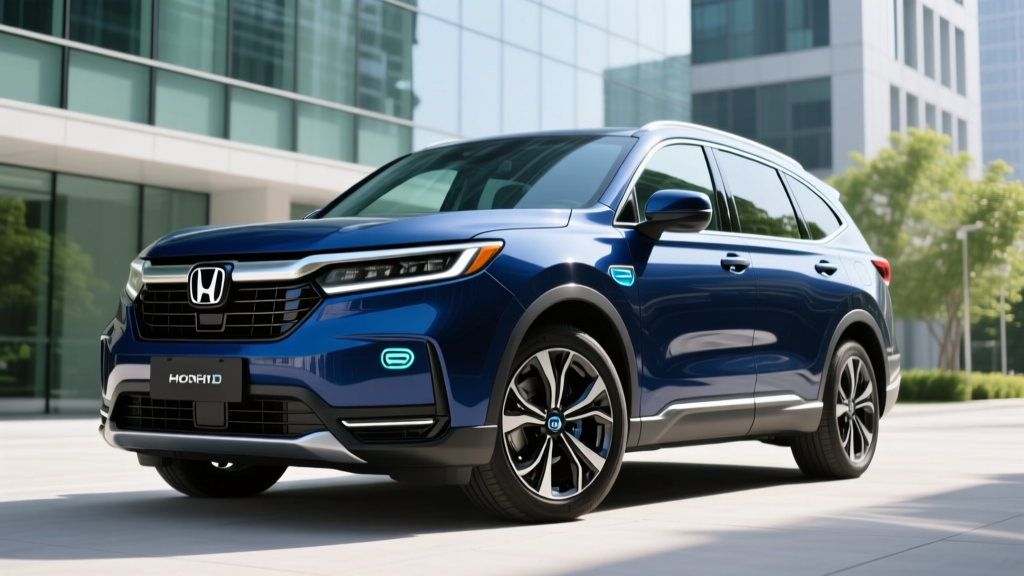
The 2025 Honda Pilot Hybrid: What Buyers Need to Know
Three-row SUV buyers searching for better fuel economy without range anxiety often land on the 2025 Honda Pilot Hybrid. But before visiting a dealer, it's essential to clarify exactly what Honda offers: the Pilot currently comes as a conventional hybrid (HEV) in select markets, not a plug-in hybrid (PHEV). This distinction changes everything — from fuel economy expectations to tax credit eligibility.
This guide breaks down the real EPA numbers, powertrain specs, ownership costs, and whether the Pilot Hybrid — or a competing PHEV or full EV — is the right fit for your family.
HEV vs PHEV: Which Type Is the Honda Pilot Hybrid?
Conventional Hybrid (HEV) — What the Pilot Offers
- No plug required. The battery recharges through regenerative braking and the gasoline engine.
- Smaller battery (typically 1.0–1.5 kWh usable) — assists the engine but cannot drive on electric power alone for meaningful distances.
- No federal EV tax credit under IRS §30D, which requires plug-in capability and minimum battery capacity.
- Lower purchase price compared to PHEV equivalents.
Plug-In Hybrid (PHEV) — What the Pilot Does NOT Offer
- Requires plugging in to access electric-only range (typically 20–45 miles on PHEVs in this class).
- Larger battery (15–25 kWh) enabling daily electric commuting.
- May qualify for partial or full federal tax credits depending on battery sourcing and buyer income.
- Higher MSRP but lower per-mile cost if you charge regularly.
Honda has not announced a Pilot PHEV for the 2025 or 2026 model year in the U.S. market. If plug-in capability is a priority, competitors like the Toyota Grand Highlander Hybrid Max (HEV) or the Kia Sorento PHEV and Hyundai Santa Fe PHEV are the alternatives to cross-shop.
2025 Honda Pilot Hybrid MPG: EPA and Real-World Numbers
The 2025 Honda Pilot Hybrid (where available) pairs Honda's two-motor hybrid system with the 3.5L V6 engine. Here's what the EPA rates it at, alongside real-world expectations:
| Driving Condition | EPA Estimate | Real-World Expectation |
|---|---|---|
| City | 22 MPG | 23–25 MPG (hybrids excel in stop-and-go) |
| Highway | 25 MPG | 23–24 MPG (aerodynamic drag limits hybrid advantage) |
| Combined | 23 MPG | 22–24 MPG |
Why real-world city MPG often beats the EPA sticker: Conventional hybrids recapture energy during braking and low-speed driving, making them disproportionately efficient in urban traffic. Highway driving, where the engine runs continuously, narrows the gap between the hybrid and the standard gas-only Pilot (EPA 21 combined for AWD models).
Real-World Range Note: With a 18.5-gallon fuel tank and 23 MPG combined, expect approximately 425 miles per tank in mixed driving. Highway-heavy road trips may drop this to ~380 miles; city-heavy commutes could stretch it past 450 miles.
Powertrain and Performance Specs
| Specification | 2025 Honda Pilot Hybrid |
|---|---|
| Engine | 3.5L V6 + two-motor hybrid system |
| Combined Horsepower | ~310 hp (estimated, based on hybrid system architecture) |
| Transmission | Direct-drive (no traditional CVT or geared automatic) |
| Drivetrain | AWD standard (hybrid trims) |
| 0–60 mph | ~6.8 seconds (estimated) |
| Towing Capacity | Up to 5,000 lbs (when properly equipped) |
| Battery Type | Lithium-ion, ~1.3 kWh (HEV assist) |
| Seating | 7 or 8 passengers (trim dependent) |
The hybrid system provides low-end torque fill from the electric motor, making acceleration feel more immediate than the gas-only Pilot's 285-hp V6. The direct-drive transmission eliminates shift shock and keeps the engine in its most efficient RPM range during cruising.
Pricing and Tax Credit Eligibility
The 2025 Honda Pilot Hybrid is offered in upper trims (typically Touring and Elite). Pricing as of the 2025 model year:
| Trim | MSRP (approx.) |
|---|---|
| Pilot Touring Hybrid | ~$50,000 |
| Pilot Elite Hybrid | ~$54,000 |
Does the Pilot Hybrid Qualify for a Federal Tax Credit?
No. The IRS §30D Clean Vehicle Credit applies only to plug-in electric vehicles (PHEVs and BEVs) with a minimum battery capacity of 7 kWh for PHEVs or 16 kWh for BEVs, along with critical mineral and battery component sourcing requirements. The Pilot Hybrid's ~1.3 kWh HEV battery does not meet these thresholds.
Some states may offer separate incentives for hybrid vehicles — check your state's energy office or AFDC state incentive database for current programs.
Battery Warranty, Reliability, and Replacement Cost
Honda Hybrid Battery Warranty: Honda covers its hybrid battery components for 8 years or 100,000 miles (whichever comes first) under the federal emissions warranty. In California Air Resources Board (CARB) states, coverage extends to 10 years or 150,000 miles.
Replacement Cost (out of warranty): Based on Honda hybrid battery replacement data across the Accord Hybrid and CR-V Hybrid platforms, expect $2,500–$4,500 for a new OEM battery pack, plus ~$300–$500 in labor. Third-party refurbished options may reduce this to $1,500–$2,500.
Longevity Reality: Honda's hybrid battery packs in the Accord Hybrid and CR-V Hybrid have demonstrated strong longevity, with most lasting well beyond the warranty period. Reported premature failures are rare. The IIHS has given recent Pilot models top safety ratings, and Honda's hybrid system has a track record spanning the Insight, Accord, and CR-V lineages.
Pilot Hybrid vs Competitors: Who Should Choose What?
Choose the 2025 Honda Pilot Hybrid If:
- You want a three-row SUV with modest fuel savings and no charging hassle.
- You primarily drive in city/suburban conditions where hybrid efficiency shines.
- You need 5,000-lb towing and Honda's safety tech suite (Honda Sensing).
- You don't have access to home or workplace charging (making a PHEV impractical).
Choose a PHEV (Kia Sorento PHEV / Hyundai Santa Fe PHEV) If:
- You can charge at home and want 30+ miles of electric-only daily commuting.
- You want to qualify for partial federal or state PHEV tax credits.
- Your daily driving is under 40 miles round-trip (meaning you'd rarely burn gas).
Choose a Full EV (Kia EV9 / Tesla Model X) If:
- You want zero tailpipe emissions and the lowest per-mile fuel cost.
- You have reliable home Level 2 charging and access to DC fast charging for road trips.
- You're ready for the $55,000–$75,000+ price point of a three-row EV.
Pros and Cons at a Glance
Pros
- Better city MPG than gas-only Pilot (~2–3 MPG combined improvement)
- Smooth, torque-rich acceleration from hybrid system
- No plug-in charging required — works with any gas station
- Strong Honda Sensing safety suite standard
- 8-year/100,000-mile hybrid battery warranty
- Proven three-row practicality and 5,000-lb towing
Cons
- No federal tax credit eligibility (HEV, not PHEV)
- Highway MPG advantage over gas Pilot is minimal
- Hybrid only available in upper trims (~$50K+ MSRP)
- No electric-only driving capability
- Limited market availability — not all dealers stock hybrid trims
- PHEV competitors offer greater fuel savings if you can charge
Frequently Asked Questions
How many MPG does the 2025 Honda Pilot Hybrid get?
The EPA rates the 2025 Pilot Hybrid at approximately 22 city / 25 highway / 23 combined MPG. In real-world city driving, owners often report 23–25 MPG thanks to regenerative braking. Highway-heavy trips tend to return 23–24 MPG.
Does the Honda Pilot Hybrid need to be plugged in?
No. The Pilot Hybrid is a conventional HEV. Its small lithium-ion battery charges automatically through regenerative braking and the gasoline engine. There is no plug, no charging cable, and no electric-only range to manage.
Is there a Honda Pilot PHEV (plug-in hybrid)?
As of the 2025 and announced 2026 model years, Honda does not offer a Pilot PHEV in the United States. If plug-in capability is essential, the Kia Sorento PHEV (32 miles electric-only, EPA 79 MPGe) and Hyundai Santa Fe PHEV are the closest three-row alternatives.
Does the Pilot Hybrid qualify for any tax credit?
The Pilot Hybrid does not qualify for the federal §30D Clean Vehicle Credit, which requires plug-in capability and minimum battery thresholds. Check AFDC's state incentive tool for any local hybrid rebates that may apply.
How long will the hybrid battery last and what does replacement cost?
Honda's hybrid batteries are designed to last the life of the vehicle under normal use. The warranty covers 8 years/100,000 miles (10 years/150,000 miles in CARB states). Out-of-warranty replacement runs approximately $2,500–$4,500 for an OEM pack. Based on Honda's hybrid track record with the Accord and CR-V, most batteries outlast the warranty period without significant degradation.
Is the hybrid worth the premium over the gas-only Pilot?
At roughly $2,000–$3,000 more than a comparable gas-only Pilot trim, the hybrid pays back through fuel savings over approximately 5–7 years for a driver covering 15,000 miles annually (assuming $3.50/gallon). The payoff is faster for city-heavy drivers. Beyond economics, the hybrid's smoother acceleration and reduced engine noise at low speeds add refinement value that doesn't appear on a spreadsheet.
How does the Pilot Hybrid compare to the Toyota Grand Highlander Hybrid?
The Toyota Grand Highlander Hybrid (EPA ~35 combined MPG for the standard hybrid) significantly outperforms the Pilot Hybrid on fuel economy. However, the Grand Highlander's hybrid starts at a higher price point and has different third-row space trade-offs. The Pilot Hybrid is the better choice if Honda's driving dynamics, interior layout, and dealer network are priorities; the Grand Highlander wins on pure MPG.
Sources: fueleconomy.gov (EPA), Honda Automobiles, AFDC State Incentives.