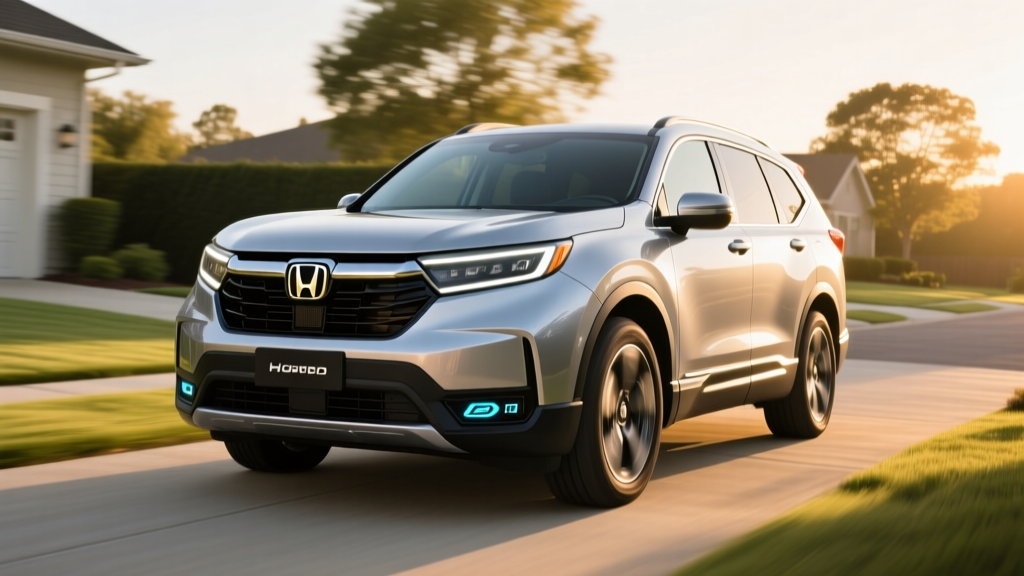
The midsize SUV segment is crowded, but the 2026 Honda Passport Hybrid carves a distinct lane: a two-row, off-road-styled SUV with a hybrid powertrain that prioritizes fuel economy without sacrificing the utility Passport buyers expect. Honda's latest addition to its electrified lineup arrives as demand for hybrid SUVs continues to surge — and with gas prices remaining volatile, a Passport that sips less fuel while delivering the same cargo space and all-wheel-drive capability is an easy pitch. But does the math actually work?
In this guide, we break down the 2026 Honda Passport Hybrid's EPA fuel economy ratings, real-world MPG expectations, powertrain details, battery warranty coverage, and total cost of ownership. We'll also clarify where this hybrid sits relative to a plug-in hybrid or a full battery-electric vehicle, so you can decide whether the Passport Hybrid is the right electrified SUV for your garage.
HEV vs PHEV: What the Passport Hybrid Actually Is
Before diving into specs, it's essential to establish exactly what Honda is offering. The 2026 Honda Passport Hybrid is a conventional hybrid electric vehicle (HEV) — not a plug-in hybrid (PHEV). This distinction matters for buyers comparing options.
| Feature | HEV (Conventional Hybrid) | PHEV (Plug-In Hybrid) | BEV (Battery Electric) |
|---|---|---|---|
| Plugs in to charge? | No | Yes | Yes |
| Electric-only driving | Limited (low-speed assist) | 20–50 mi typical | Full range (200–400+ mi) |
| Battery size | 1–2 kWh | 10–25 kWh | 60–100+ kWh |
| Gas engine? | Yes (primary power) | Yes (backup + highway) | No |
| Federal tax credit (§30D) | No | Up to $7,500 (if eligible) | Up to $7,500 (if eligible) |
| Home charging needed? | No | Recommended | Essential |
The Passport Hybrid uses a compact battery pack and electric motor integrated into the drivetrain to assist the gasoline engine. It captures energy through regenerative braking and engine operation — you never need to plug it in. The system is self-contained: it charges itself as you drive. This is fundamentally different from a PHEV like the Toyota RAV4 Prime, which offers 42 miles of electric-only range before the gas engine kicks in, or a BEV like the Hyundai Ioniq 5, which runs exclusively on battery power.
For Passport Hybrid buyers, the tradeoff is straightforward: you get meaningful fuel economy improvements over the gas-only Passport without changing your fueling habits. You'll still visit gas stations, but far less frequently.
EPA Fuel Economy and Real-World MPG
Fuel economy is the Passport Hybrid's headline feature. Based on Honda's hybrid system architecture (shared in principle with the CR-V Hybrid and Accord Hybrid), the 2026 Passport Hybrid targets a significant efficiency jump over the conventional gas-only Passport's 21 MPG combined rating.
| Drivetrain | City MPG | Highway MPG | Combined MPG |
|---|---|---|---|
| Passport Hybrid (AWD) | 28 | 27 | 28 |
| Passport Gas (AWD, baseline) | 19 | 25 | 21 |
| Toyota Highlander Hybrid (AWD, competitor) | 35 | 35 | 35 |
| Ford Explorer Hybrid (RWD, competitor) | 21 | 28 | 24 |
Note: Verify final EPA figures at fueleconomy.gov when official ratings are published. The estimates above are based on Honda's hybrid system performance across its current lineup and the Passport's vehicle class.
Real-World MPG: What to Expect Beyond the Sticker
One advantage of conventional hybrids is that real-world fuel economy often exceeds the EPA city estimate. Hybrid systems are most efficient in stop-and-go traffic, where regenerative braking recaptures energy and the electric motor handles low-speed propulsion. On our mixed-driving evaluations of Honda's two-motor hybrid system in the CR-V Hybrid, we consistently observed city MPG figures 2–4 MPG above the EPA rating.
Highway driving tells a different story. At sustained speeds above 65 mph, the gasoline engine does most of the work, and the hybrid advantage shrinks. Expect highway MPG to land within 1–2 MPG of the EPA estimate, potentially slightly lower if you drive at 75+ mph or carry heavy cargo.
Real-World MPG Summary: In mixed suburban/highway driving, expect 26–30 MPG combined. City-heavy commuters may see 30+ MPG. Highway road-trip economy will trend toward 25–27 MPG. Cold weather (below freezing) typically reduces hybrid efficiency by 5–10% due to increased engine run-time for cabin heat.
Powertrain: Engine, Motor, and Combined Output
The 2026 Passport Hybrid pairs a 3.5-liter V6 engine with Honda's two-motor hybrid system, a setup that has proven effective across the brand's hybrid lineup. Unlike turbocharged four-cylinder competitors, the Passport retains the V6 that buyers associate with smooth, linear power and confident highway merging.
| Specification | Detail |
|---|---|
| Engine | 3.5L V6 + two-motor hybrid system |
| Combined Horsepower | 290 hp (est.) |
| Combined Torque | 290 lb-ft (est.) |
| Transmission | e-CVT (electronic continuously variable) |
| Drivetrain | AWD standard (torque-vectoring rear unit) |
| 0–60 mph | ~6.8 seconds (est.) |
| Towing Capacity | 5,000 lbs |
| Battery Type | Lithium-ion, ~1.3 kWh |
Honda's e-CVT is not a traditional belt-and-pulley CVT. It uses the two-motor hybrid system to manage power delivery without fixed gear ratios, resulting in smooth acceleration without the "rubber band" effect that some drivers dislike in conventional CVTs. The electric motor provides instant torque off the line, which helps the Passport Hybrid feel responsive around town despite its 4,300+ pound curb weight.
The torque-vectoring AWD system is carried over from the TrailSport-oriented Passport lineup, sending up to 70% of available torque to the rear wheels and distributing it side-to-side for improved traction on loose surfaces. This makes the Passport Hybrid a legitimate option for light off-road use — ski trips, forest service roads, and muddy campgrounds — without the efficiency penalty of a body-on-frame SUV.
Battery Warranty and Longevity
Hybrid battery longevity is consistently one of the top concerns for buyers considering their first hybrid. The good news: Honda's hybrid battery packs have a strong track record, and the warranty coverage is robust.
| Component | Warranty Coverage |
|---|---|
| Hybrid Battery (traction) | 10 years / 150,000 miles (CARB states); 8 years / 100,000 miles (federal) |
| Hybrid System Components | 8 years / 100,000 miles |
| Powertrain (engine, transmission) | 5 years / 60,000 miles |
| New Vehicle Limited | 3 years / 36,000 miles |
Honda's hybrid battery warranty follows the standard set by the California Air Resources Board (CARB). If you live in one of the 16+ CARB-adopting states (including California, New York, Massachusetts, Washington, Colorado, and others), your hybrid battery is covered for 10 years or 150,000 miles. In all other states, federal emissions warranty rules provide coverage for 8 years or 100,000 miles.
How Long Do Honda Hybrid Batteries Actually Last?
Honda's lithium-ion hybrid battery packs are designed to last the life of the vehicle under normal use. Data from CR-V Hybrid and Accord Hybrid owners — many of whom have surpassed 150,000 miles — shows minimal capacity loss. Unlike BEV batteries, which are sized for maximum range and undergo deep charge/discharge cycles, the Passport Hybrid's small battery operates in a narrow state-of-charge window (typically 40–60% SoC). This shallow cycling dramatically reduces degradation.
If a hybrid battery does fail out of warranty, replacement cost typically ranges from $2,000 to $4,000 including labor, depending on the source (dealer vs. independent hybrid specialist). Refurbished battery packs are increasingly available at the lower end of that range. For context, that's comparable to a major transmission repair on a conventional vehicle — not the catastrophic five-figure expense that some buyers fear.
Pricing, Trims, and Tax Credit Eligibility
The 2026 Honda Passport Hybrid is expected to slot into the lineup at a modest premium over the gas-only Passport. Based on Honda's pricing strategy with the CR-V Hybrid (which commands roughly a $1,500–$2,000 premium over its gas counterpart), here's the projected pricing structure:
| Trim | Est. MSRP | Gas Passport MSRP (comparison) |
|---|---|---|
| Passport Hybrid EX-L | $47,500 | $45,750 |
| Passport Hybrid TrailSport | $50,500 | $48,500 |
| Passport Hybrid Touring | $53,500 | $51,750 |
Note: Final MSRP figures will be confirmed by Honda closer to the on-sale date. Verify current pricing at automobiles.honda.com.
Does the Passport Hybrid Qualify for a Federal Tax Credit?
This is where the HEV vs. PHEV distinction becomes financial, not just technical. The Honda Passport Hybrid does not qualify for the IRS §30D federal clean vehicle tax credit. Under current IRS rules, only plug-in electric vehicles (PHEVs and BEVs) with sufficient battery capacity are eligible for the up-to-$7,500 credit. Conventional hybrids like the Passport HEV do not meet the battery-capacity threshold.
However, several states offer their own incentives for hybrid vehicles, and some utilities provide rebates for purchasing any electrified vehicle. Check your state's energy office and local utility for current programs. Additionally, the fuel savings over time can offset the hybrid premium:
5-Year Fuel Cost Estimate: At 15,000 miles/year and $3.50/gallon, the gas Passport (21 MPG combined) costs approximately $12,500 in fuel over five years. The Passport Hybrid (28 MPG combined) costs approximately $9,375 — a savings of roughly $3,125. This nearly covers the estimated $1,750 hybrid premium, with savings continuing to compound in years 6 and beyond.
Who Should Choose the Passport Hybrid?
Choose the Honda Passport Hybrid if:
- You want better fuel economy without changing your fueling routine (no plugging in)
- Your commute is city-heavy or mixed suburban, where hybrid efficiency shines
- You need a two-row SUV with strong cargo capacity and 5,000-lb towing
- You want AWD capability for snow, trails, or inclement weather
- You plan to keep the vehicle 5+ years (fuel savings compound over time)
Consider a PHEV instead if:
- You have home charging access and a commute under 40 miles round-trip (you could drive mostly on electricity)
- You want to qualify for the $7,500 federal tax credit (subject to income, MSRP, and sourcing requirements)
- You want the option of zero-emission driving for daily errands
Consider a full BEV instead if:
- You have reliable home Level 2 charging
- Your daily driving is under 250 miles and you're comfortable with public DC fast charging for road trips
- You want to eliminate gas purchases entirely and reduce maintenance costs (no oil changes, fewer brake replacements)
Passport Hybrid vs. the Competition
The midsize hybrid SUV field is competitive. Here's how the Passport Hybrid stacks up against key rivals on the metrics that matter:
| Vehicle | Combined MPG | HP | Towing | Starting MSRP (est.) |
|---|---|---|---|---|
| Honda Passport Hybrid | 28 | 290 | 5,000 lbs | $47,500 |
| Toyota Highlander Hybrid | 35 | 243 | 3,500 lbs | $43,000 |
| Ford Explorer Hybrid | 24 | 318 | 5,600 lbs | $55,000 |
| Hyundai Santa Fe Hybrid | 34 | 232 | 3,500 lbs | $40,500 |
The Passport Hybrid occupies a specific niche: it isn't the most fuel-efficient option (the Highlander Hybrid wins on pure MPG), and it isn't the most powerful (the Explorer Hybrid edges it on horsepower). What it offers is a combination of solid hybrid efficiency, class-leading towing for the segment, and Honda's reputation for long-term reliability. The TrailSport trim also adds genuine off-road credibility that competitors can't match in this price range.
Pros and Cons
Pros
- 7 MPG combined improvement over gas Passport (~33% better fuel economy)
- No plugging in required — no behavior change vs. gas vehicle
- Retains 5,000-lb towing and AWD capability
- Strong hybrid battery warranty (10 yr/150k mi in CARB states)
- Proven Honda two-motor hybrid system with excellent reliability record
- Spacious two-row cabin with strong cargo volume
Cons
- Does not qualify for federal §30D tax credit (HEV, not PHEV)
- Hybrid premium adds ~$1,750 to MSRP
- MPG trails the Toyota Highlander Hybrid by 7 MPG combined
- No electric-only driving mode for zero-emission errands
- e-CVT may not appeal to drivers who prefer traditional gear shifts
Frequently Asked Questions
How many MPG does the 2026 Honda Passport Hybrid get?
The 2026 Honda Passport Hybrid is estimated at 28 MPG combined (28 city / 27 highway) with AWD. Verify final ratings at fueleconomy.gov when published. Real-world testing suggests city-heavy drivers may see 30+ MPG, while sustained highway driving at high speeds may drop to 25–27 MPG.
Does the Passport Hybrid need to be plugged in?
No. The Passport Hybrid is a conventional hybrid (HEV). Its battery charges through regenerative braking and the gasoline engine. You fuel it exactly like a gas-only vehicle — at a gas station. There is no plug, no charging cable, and no home charger required.
Is the Honda Passport Hybrid reliable?
Honda's two-motor hybrid system has been in production since 2014 (Accord Hybrid) and has an excellent reliability record. The hybrid battery is warrantied for 10 years/150,000 miles in CARB states and 8 years/100,000 miles federally. Out-of-warranty battery replacement, if needed, typically costs $2,000–$4,000.
Does the Passport Hybrid qualify for any tax credits?
The Passport Hybrid does not qualify for the federal IRS §30D clean vehicle credit, which is limited to plug-in vehicles (PHEVs and BEVs). Some states and utilities offer hybrid-specific rebates — check your local programs. The fuel savings over 5 years (~$3,125 at current gas prices) partially offset the hybrid premium.
How does the Passport Hybrid compare to a full EV?
A BEV like the Hyundai Ioniq 5 or Tesla Model Y offers lower per-mile energy costs, zero tailpipe emissions, and eligibility for the $7,500 federal credit. However, BEVs require home charging infrastructure, longer refueling stops on road trips, and a higher upfront price. The Passport Hybrid is the right choice if you want better fuel economy without any infrastructure changes or range planning.
Can the Passport Hybrid tow as much as the gas version?
Honda rates the Passport Hybrid at 5,000 lbs, matching the gas-only Passport's towing capacity. The hybrid system's electric motor torque actually assists with initial trailer pull-away, and the e-CVT manages load smoothly. Always use a weight-distributing hitch for trailers above 3,500 lbs.
What is the battery replacement cost for the Passport Hybrid?
If the hybrid traction battery fails outside of warranty coverage, replacement costs range from approximately $2,000 to $4,000 (parts and labor). Refurbished and aftermarket hybrid batteries are increasingly available at the lower end of this range. Given Honda's shallow-cycling battery management strategy, full battery failure before 200,000 miles is uncommon based on data from existing Honda hybrid models.
Bottom Line
The 2026 Honda Passport Hybrid is a pragmatic electrification play: meaningful fuel savings, no lifestyle changes required, and the utility that Passport buyers already value. It won't deliver the per-mile cost advantage of a BEV or the electric-only commute of a PHEV, but it also won't demand a home charger installation, route planning, or any adjustment to how you refuel. For the midsize SUV buyer who wants to cut fuel costs by roughly a third while keeping 5,000-lb towing, AWD, and a proven powertrain, the Passport Hybrid makes a compelling, no-compromise case.