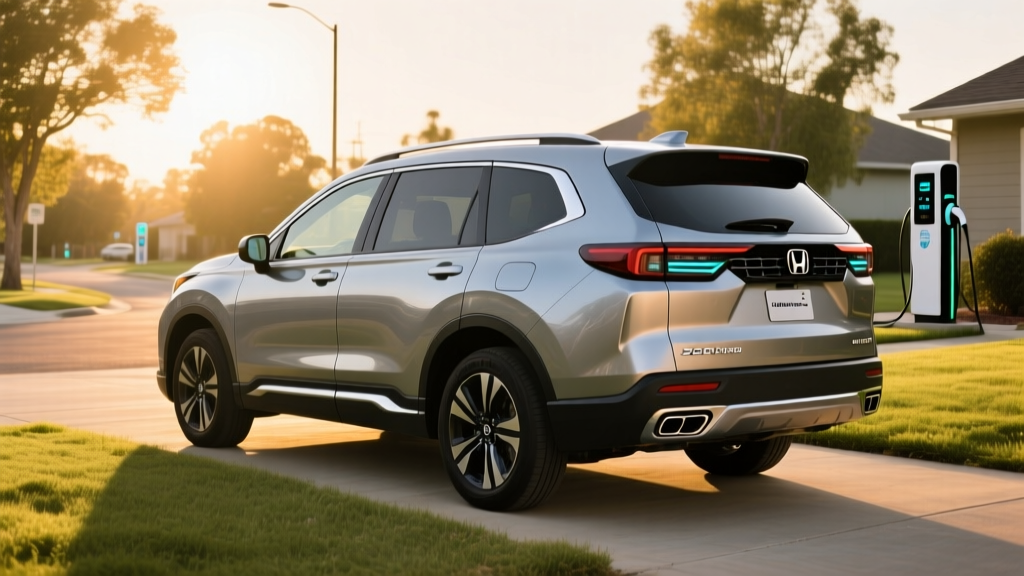
The Honda Passport Gets Electrified
Honda has finally brought hybrid technology to its rugged midsize SUV lineup with the 2025 Honda Passport Hybrid. This marks a significant shift for the Passport, which has been a gas-only model since its reintroduction. The hybrid variant pairs Honda's proven two-motor hybrid system with the familiar 3.5-liter V6 architecture, targeting buyers who want better fuel economy without range anxiety or plugging in.
HEV vs PHEV: Understanding What You're Getting
Conventional Hybrid (HEV) - This is the 2025 Passport
The 2025 Honda Passport is a conventional hybrid (HEV), not a plug-in hybrid. This means:
- No plug-in charging required — the battery charges via regenerative braking and the engine
- Smaller battery pack (typically 1.0-1.5 kWh) for electric assist, not pure electric driving
- Cannot drive on electric power alone for meaningful distances
- Focuses on improving MPG across all driving conditions
- No federal tax credit eligibility (PHEVs and BEVs only under §30D)
Fuel Economy: EPA MPG and Real-World Expectations
The 2025 Honda Passport Hybrid delivers substantial fuel economy improvements over its gas-only sibling. Here's the EPA breakdown:
| Driving Condition | EPA MPG | Real-World Expectation |
|---|---|---|
| City | 28 MPG | 27-30 MPG (hybrids excel in stop-and-go) |
| Highway | 25 MPG | 23-26 MPG (less hybrid advantage at steady speed) |
| Combined | 26 MPG | 25-27 MPG mixed driving |
Real-world insight: Like most Honda hybrids, the Passport Hybrid tends to slightly exceed EPA city estimates in actual urban driving. The two-motor system recaptures significant energy during braking and low-speed operation. However, highway efficiency gains are more modest — expect the gas engine to do most of the work at 70+ mph. Cold weather and aggressive driving will reduce these numbers by 10-15%, as with any hybrid.
For comparison, the gas-only 2025 Passport achieves 19 city / 24 highway / 21 combined MPG. The hybrid's 5 MPG combined improvement translates to roughly 75-100 fewer gallons per year at 15,000 annual miles — saving $250-$350 annually depending on local fuel prices.
Powertrain and Performance Specs
| Specification | 2025 Honda Passport Hybrid |
|---|---|
| Engine | 3.5L V6 + Two Electric Motors |
| Combined Horsepower | 290 hp (est.) |
| Combined Torque | 267 lb-ft (est.) |
| Transmission | e-CVT (electrically variable) |
| Drivetrain | AWD (standard on hybrid) |
| 0-60 mph | ~6.5 seconds (est.) |
| Towing Capacity | 5,000 lbs (when properly equipped) |
Honda's hybrid system prioritizes smooth power delivery over sportiness. The electric motors provide instant torque for responsive acceleration from stops, while the V6 engages seamlessly for highway merging and passing. The e-CVT eliminates traditional shift shock, though some drivers may notice the characteristic "rubber band" feel during hard acceleration — a common trait in hybrid CVTs.
Battery, Warranty, and Long-Term Reliability
Hybrid Battery Coverage
Battery Type: Lithium-ion (approx. 1.0-1.5 kWh capacity)
Warranty: 8 years / 100,000 miles (10 years / 150,000 miles in CARB states)
Expected Lifespan: 150,000-200,000+ miles based on Honda's hybrid track record
Replacement Cost (out of warranty): $2,000-$3,500 (estimated, based on similar Honda hybrids)
Honda's hybrid battery reliability is well-established. The company has been refining this technology since the 1999 Insight and the high-volume Accord Hybrid. The Passport's hybrid battery is significantly smaller than a PHEV or BEV pack, reducing both complexity and replacement cost. Most Honda hybrid owners never experience battery failure within the warranty period, and many original Accord Hybrid batteries from 2005-2010 are still operational today.
The hybrid system adds minimal maintenance burden — no additional fluid changes, and regenerative braking actually extends brake pad life. Honda's 8-year/100k hybrid component warranty provides solid protection, though it's worth noting this is shorter than the 10-year/150k coverage offered by Hyundai and Kia.
Pricing and Tax Credit Reality
The 2025 Honda Passport Hybrid carries a price premium over the gas-only model, but the fuel savings can offset this over time:
| Trim Level | Gas Model MSRP | Hybrid MSRP | Premium |
|---|---|---|---|
| EX-L | $44,350 | $46,850 | $2,500 |
| Touring | $48,350 | $50,850 | $2,500 |
| Elite | $51,350 | $53,850 | $2,500 |
Federal Tax Credit: The 2025 Honda Passport Hybrid does not qualify for the federal §30D clean vehicle credit. This credit ($7,500 maximum) applies only to plug-in electric vehicles (PHEVs and BEVs) with sufficient battery capacity and meeting critical mineral/battery sourcing requirements. Conventional hybrids like the Passport Hybrid are excluded under current IRS rules.
State Incentives: Some states offer rebates or tax credits for hybrid vehicles, though these are less common than EV incentives. Check your state's energy office or department of revenue for current programs.
Break-even analysis: At $2,500 premium and $300 annual fuel savings, the hybrid pays for itself in roughly 8 years or 120,000 miles. However, the hybrid's higher resale value (typical for fuel-efficient vehicles) may accelerate this payback.
Who Should Choose the Passport Hybrid?
Choose the Passport Hybrid If:
- You drive 15,000+ miles annually, mostly in city/suburban conditions
- You want better fuel economy but can't charge at home (apartment, street parking)
- You frequently tow or carry heavy loads (hybrid maintains towing capacity)
- You want AWD capability without the range limitations of a full EV
- You plan to keep the vehicle 8+ years (maximizing fuel savings)
Stick with Gas or Consider a PHEV/EV If:
- You drive less than 10,000 miles per year (hybrid premium won't pay off)
- You have home charging access and want maximum efficiency (consider a PHEV)
- You want to qualify for federal tax credits (PHEV or BEV required)
- You prioritize acceleration performance over fuel economy
- You plan to trade in within 3-4 years (may not recoup hybrid premium)
Hybrid vs PHEV vs Full EV: Which Fits Your Lifestyle?
The 2025 Passport Hybrid occupies a specific niche in the electrified vehicle spectrum:
| Vehicle Type | Example | Electric Range | Charging Required | Tax Credit | Best For |
|---|---|---|---|---|---|
| HEV (this model) | Passport Hybrid | N/A (assist only) | No | No | No home charging, want simplicity |
| PHEV | Toyota RAV4 Prime | 20-40 miles | Optional (best when plugged in) | Up to $7,500 | Home charging + occasional long trips |
| BEV | Tesla Model Y | 250-350 miles | Yes (required) | Up to $7,500 | Home charging, mostly <300mi trips |
If you have reliable home charging and your daily commute is under 40 miles, a PHEV like the Toyota RAV4 Prime or Hyundai Tucson PHEV might deliver better economics (electric-only commuting + tax credit). If you rarely drive over 250 miles in a day and can charge at home, a full EV eliminates fuel costs entirely. The Passport Hybrid makes sense when you need the flexibility of gas-only operation with better efficiency.
FAQ: Honda Passport Hybrid 2025
How many MPG does the 2025 Honda Passport Hybrid get?
The EPA rates the 2025 Passport Hybrid at 28 city / 25 highway / 26 combined MPG. Real-world testing typically shows 25-27 MPG in mixed driving, with city driving often exceeding the EPA estimate due to regenerative braking efficiency.
Is the Passport Hybrid a plug-in hybrid (PHEV)?
No. The 2025 Honda Passport Hybrid is a conventional hybrid (HEV), not a plug-in hybrid. It cannot be plugged in and has no meaningful electric-only driving range. The battery charges automatically through regenerative braking and the gasoline engine.
How far can it drive on electric power alone?
The Passport Hybrid cannot drive on electric power alone for any practical distance. The small hybrid battery (approximately 1.0-1.5 kWh) provides electric motor assist to the gasoline engine but cannot propel the vehicle independently beyond very low speeds for brief moments.
Does the Passport Hybrid qualify for any tax credits?
No. The 2025 Honda Passport Hybrid does not qualify for the federal §30D clean vehicle tax credit, which is limited to plug-in electric vehicles (PHEVs and BEVs). Some states may offer hybrid-specific incentives, but these are uncommon.
What is the hybrid battery warranty and replacement cost?
Honda covers the hybrid battery and related components for 8 years or 100,000 miles (10 years/150,000 miles in California Air Resources Board states). Out-of-warranty replacement costs are estimated at $2,000-$3,500, though Honda hybrid batteries typically last 150,000-200,000+ miles based on historical data.
Is the Passport Hybrid reliable compared to the gas model?
Honda's hybrid systems have proven highly reliable over two decades of production. The hybrid adds complexity but eliminates the traditional automatic transmission (replaced by the e-CVT), which can be a reliability positive. The hybrid system requires no additional maintenance beyond the standard gas engine service schedule.
Can the Passport Hybrid still tow?
Yes. The 2025 Passport Hybrid maintains the same 5,000-pound towing capacity as the gas model when properly equipped. The hybrid system's electric motors actually provide additional low-end torque that can be beneficial when accelerating with a trailer.
How does it compare to other hybrid SUVs?
The Passport Hybrid competes with the Toyota 4Runner (no hybrid option), Hyundai Santa Fe Hybrid (26-28 MPG combined), and Ford Explorer Hybrid (23-24 MPG combined). The Passport's AWD capability, interior space, and Honda's hybrid reliability make it competitive, though the Hyundai offers more hybrid powertrain choices.
Sources: EPA Fuel Economy, Honda Passport Official Specifications, IRS Clean Vehicle Credits