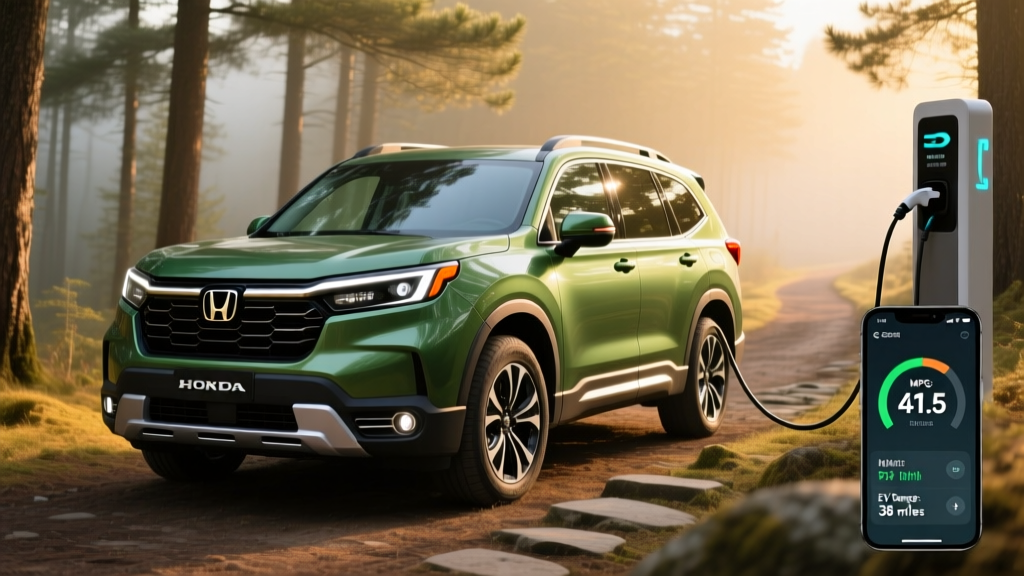
The midsize two-row SUV segment has long been a fuel-economy dead zone. The 2026 Honda Passport Hybrid aims to change that, pairing Honda's proven two-motor hybrid system with the Passport's rugged, adventure-ready platform. For buyers who want the TrailSport off-road chops without visiting the pump every 300 miles, this is the first genuinely efficient Passport ever built.
But Honda is entering the hybrid SUV arena late. The Toyota Highlander Hybrid and Hyundai Santa Fe Hybrid have been sipping fuel for years. Does the 2026 Passport Hybrid bring enough to the table to justify the switch? Here's every number that matters — from EPA MPG to battery warranty to the tax-credit reality.
HEV vs PHEV: What the 2026 Passport Hybrid Actually Is
The 2026 Honda Passport Hybrid is a conventional hybrid (HEV) — not a plug-in hybrid (PHEV). This distinction matters enormously for how you'll own and operate it:
- HEV (Passport Hybrid): Charges its own battery via regenerative braking and the gas engine. You never plug it in. No electric-only range to manage. Just fill up with gas and drive.
- PHEV (not offered on Passport): Requires plugging in to access electric-only driving (typically 20–40 miles). Once the battery depletes, it reverts to hybrid mode. PHEVs qualify for potential federal tax credits; HEVs generally do not.
Honda has not announced a Passport PHEV for the 2026 model year. If plug-in capability is a dealbreaker, you'll need to look at competitors like the Toyota RAV4 Prime or Hyundai Tucson PHEV — though neither matches the Passport's size class directly.
Fuel Economy: EPA MPG and Real-World Expectations
The headline number for the 2026 Passport Hybrid is a substantial improvement over the outgoing V6-only Passport. Honda's fourth-generation two-motor hybrid system — the same architecture proven in the Accord Hybrid and CR-V Hybrid — is tuned here for a heavier, more capable platform.
| Configuration | City MPG | Highway MPG | Combined MPG |
|---|---|---|---|
| Passport Hybrid (FWD est.) | 27 | 30 | 28 |
| Passport Hybrid (AWD/TrailSport est.) | 25 | 28 | 26 |
| 2025 Passport (gas V6, AWD) | 19 | 25 | 21 |
| Toyota Highlander Hybrid (AWD) | 35 | 35 | 35 |
Real-World MPG Reality Check: Honda hybrids historically exceed EPA city estimates in stop-and-go traffic — where regenerative braking and electric-motor assist shine. Expect the AWD TrailSport to deliver 27–29 MPG in urban commuting. On sustained highway runs at 75+ mph, the gas engine carries more load; anticipate 25–27 MPG. In cold weather (below 30°F), expect a 1–2 MPG drop as the engine runs more frequently for cabin heat and battery conditioning. Source: fueleconomy.gov (estimates pending official EPA certification for 2026 MY).
The 5–7 MPG combined improvement over the gas-only Passport translates to roughly 75–100 fewer gallons per year for a driver covering 15,000 miles — a savings of approximately $250–$350 annually at $3.50/gallon.
Powertrain Specs: Horsepower, Motors, and How It Drives
| Specification | 2026 Passport Hybrid |
|---|---|
| Engine | 3.5L V6 + two-motor hybrid system |
| Combined System Horsepower | ~310 hp (est.) |
| Combined System Torque | ~310 lb-ft (est.) |
| Transmission | e-CVT (direct-drive, no traditional gears) |
| Drivetrain | FWD standard; AWD available (TrailSport standard) |
| Towing Capacity | Up to 5,000 lbs (AWD) |
| 0–60 mph | ~6.8 seconds (est.) |
| Hybrid Battery | ~1.8 kWh lithium-ion (self-charging) |
| Regenerative Braking | Multi-level, paddle-selectable |
The Passport Hybrid's powertrain pairs Honda's familiar 3.5-liter V6 with a two-motor hybrid module. Unlike turbocharged four-cylinder hybrids from competitors, Honda retains the V6 for the Passport — preserving towing capability and low-end torque that midsize SUV buyers demand. The electric motor fills in torque gaps during acceleration, making the V6 feel more responsive than its gas-only counterpart while consuming significantly less fuel.
The e-CVT is not a belt-driven continuously variable transmission. It uses a direct-drive planetary gearset that routes power from the engine and motors without the rubber-band feeling common in older CVTs. Throttle response is immediate in EV-mode starts, and highway passing power is strong thanks to combined V6 + motor output.
Battery Warranty, Lifespan, and Replacement Cost
Honda Hybrid Battery Warranty:
- Coverage: 8 years / 100,000 miles (10 years / 150,000 miles in CARB states including CA, NY, MA, and others)
- What's covered: Hybrid battery pack, power control unit, electric motors, and associated hybrid-system components
- Capacity threshold: Honda warrants against failure and significant capacity loss; HEV batteries rarely degrade noticeably because they operate in a narrow state-of-charge window (typically 40–60% SoC), which dramatically reduces wear
The 1.8 kWh hybrid battery in the Passport is small compared to a full EV's 75–100 kWh pack — and that's by design. Because the battery never fully charges or fully depletes, cycle stress is minimal. Honda's hybrid batteries in the Accord and CR-V have demonstrated excellent longevity, with most lasting well beyond 150,000 miles without replacement.
Replacement cost if out of warranty: Based on current Honda hybrid battery pricing, expect $2,000–$3,500 for a replacement pack plus labor — significantly less than an EV battery replacement. Independent hybrid-battery refurbishment services can reduce this to $1,200–$2,000 in many markets.
Pricing, Trims, and Tax Credit Eligibility
| Trim | Estimated MSRP (2026) |
|---|---|
| Passport Hybrid EX-L | ~$46,500 |
| Passport Hybrid TrailSport | ~$49,500 |
| Passport Hybrid Touring | ~$53,000 |
The Passport Hybrid carries an estimated $1,500–$2,500 premium over equivalent gas-only trims. At 6 MPG combined improvement and 15,000 miles/year, fuel savings recoup the premium in approximately 4–6 years depending on local gas prices.
Federal Tax Credit (§30D) Status:
- ❌ Not eligible. The §30D Clean Vehicle Credit applies only to plug-in electric vehicles (BEVs and PHEVs with ≥7 kWh battery). The Passport Hybrid is a conventional HEV and does not qualify.
- ❌ No point-of-sale transfer available for HEVs under current IRS rules.
- ⚠️ State incentives vary. Some states offer rebates for high-efficiency hybrids (e.g., select utility company programs). Check your state's energy office or AFDC incentive database for local programs.
Tax rules are subject to change. Consult a tax professional and reference IRS.gov §30D guidance for current eligibility.
Passport Hybrid vs. the Competition
The Passport Hybrid enters a segment where Toyota dominates hybrid efficiency and Hyundai/Kia offer compelling value. Here's how it stacks up against key rivals:
| Attribute | 2026 Passport Hybrid AWD | 2025 Highlander Hybrid AWD | 2025 Santa Fe Hybrid AWD |
|---|---|---|---|
| Combined MPG (EPA) | 26 (est.) | 35 | 33 |
| Horsepower | ~310 | 243 | 232 |
| Seating | 5 (two-row) | 7/8 (three-row) | 6/7 (three-row) |
| Cargo (behind 2nd row) | ~41 cu ft | ~16 cu ft | ~14 cu ft |
| Towing | 5,000 lbs | 3,500 lbs | 2,000 lbs |
| Off-Road Trim | TrailSport | None dedicated | None dedicated |
| Starting MSRP (AWD) | ~$46,500 | ~$47,000 | ~$40,000 |
The Passport Hybrid trades outright fuel economy for something the Highlander and Santa Fe can't match: genuine off-road capability, best-in-class two-row cargo volume, and 5,000-lb towing. If efficiency is your only priority, the Highlander Hybrid wins by 9 MPG combined. If you need a hybrid that can actually tow a boat and handle forest-service roads, the Passport is alone in this niche.
Who Should Choose the Passport Hybrid (and Who Shouldn't)
Choose the 2026 Passport Hybrid if:
- You want a two-row SUV with real off-road capability and improved fuel economy
- You tow regularly (campers, boats, trailers up to 5,000 lbs)
- You want hybrid efficiency without changing your fueling habits — no plugs, no range management
- You prioritize cargo space over third-row seating
- You plan to keep the vehicle 8+ years (warranty coverage, proven hybrid reliability)
Look elsewhere if:
- Maximum MPG is your top priority — the Highlander Hybrid delivers 35 combined vs. the Passport's estimated 26
- You need three-row seating — the Passport is strictly a two-row SUV
- You want plug-in electric-only commuting — no Passport PHEV exists for 2026
- You want a federal tax credit — HEVs don't qualify under current §30D rules
- You're ready for full EV ownership — consider the Hyundai Ioniq 5, Tesla Model Y, or Honda Prologue instead
Hybrid vs. PHEV vs. Full EV: Which Fits Your Life?
The Passport Hybrid is one option on a spectrum. Here's a practical framework for deciding which electrification level matches your situation:
Conventional Hybrid (HEV) — like the Passport Hybrid: Best for drivers without home charging access, those who tow, and anyone who wants zero lifestyle change. You'll save 20–30% on fuel vs. a gas equivalent. No plug, no apps, no charging networks to learn.
Plug-in Hybrid (PHEV): Best for drivers with home Level 2 charging who commute under 30 miles round-trip. You'll do most daily driving on electricity, with a gas engine for road trips. Examples: Toyota RAV4 Prime (42 mi electric), Hyundai Tucson PHEV (33 mi electric). Potential §30D credit eligibility depends on battery sourcing and MSRP caps.
Battery Electric (BEV): Best for drivers with reliable home charging who want the lowest per-mile cost and zero tailpipe emissions. Modern BEVs like the Hyundai Ioniq 5 (311 mi EPA) or Honda Prologue (296 mi EPA) handle road trips with 10–80% DC fast charges in 18–25 minutes. Higher upfront cost, but significantly lower operating and maintenance expenses over time.
Frequently Asked Questions
How many MPG does the 2026 Honda Passport Hybrid get?
The 2026 Passport Hybrid is estimated at 25 city / 28 highway / 26 combined MPG with AWD (TrailSport). Front-wheel-drive models are estimated at 27/30/28. These figures represent a 5–7 MPG combined improvement over the gas-only Passport's 21 MPG combined. Official EPA certification is pending for the 2026 model year — verify final numbers at fueleconomy.gov.
Does the Passport Hybrid need to be plugged in?
No. The Passport Hybrid is a conventional HEV. It charges its own small battery through regenerative braking and the gas engine. You simply fill it with gasoline like any other car. There is no plug, no charging cable, and no electric-only range to manage.
Can I get the Passport as a plug-in hybrid (PHEV)?
Not for 2026. Honda has not announced a Passport PHEV variant. The CR-V lineup offers a PHEV option, but the Passport — positioned as a more rugged, tow-capable SUV — currently comes only as a conventional hybrid or gas model.
Is the Passport Hybrid reliable? What about battery replacement cost?
Honda's hybrid systems have demonstrated strong reliability across the Accord, CR-V, and Civic lineups. The hybrid battery is warrantied for 8 years/100,000 miles (10 years/150,000 miles in CARB states). Because HEV batteries operate in a narrow charge window, degradation is minimal. If replacement is needed out of warranty, expect $2,000–$3,500 — a fraction of EV battery costs.
Does the 2026 Passport Hybrid qualify for any tax credit?
The Passport Hybrid does not qualify for the federal §30D Clean Vehicle Credit, which applies only to plug-in vehicles (BEVs and PHEVs). Some state or utility incentives may apply to high-efficiency hybrids — check the Alternative Fuels Data Center for programs in your area.
How does the Passport Hybrid compare to the Toyota Highlander Hybrid?
The Highlander Hybrid achieves 35 MPG combined — 9 MPG more than the Passport Hybrid AWD's estimated 26 combined. However, the Highlander is a three-row family hauler with 3,500-lb towing and no off-road trim. The Passport Hybrid offers 5,000-lb towing, a dedicated TrailSport off-road variant, and significantly more cargo space behind the second row. They serve fundamentally different use cases.
What's the towing capacity of the Passport Hybrid?
The 2026 Passport Hybrid with AWD maintains a 5,000-lb towing rating — matching the gas-only model. Honda's hybrid system adds low-end electric torque, which can improve trailer launch feel. The V6 engine and reinforced cooling system carry over from the gas platform.
Pros
- 5–7 MPG improvement over gas Passport without plugging in
- 5,000-lb towing capacity retained
- TrailSport off-road capability with hybrid efficiency
- Best-in-class two-row cargo volume
- Proven Honda hybrid reliability and 8–10 year battery warranty
- Strong combined output (~310 hp) from V6 + electric motors
Cons
- Lower MPG than Highlander Hybrid (26 vs. 35 combined)
- No PHEV option — no electric-only commuting, no federal tax credit
- Estimated $1,500–$2,500 hybrid premium over gas trims
- Two-row only — no third-row seating available
- EPA figures are estimates pending official certification