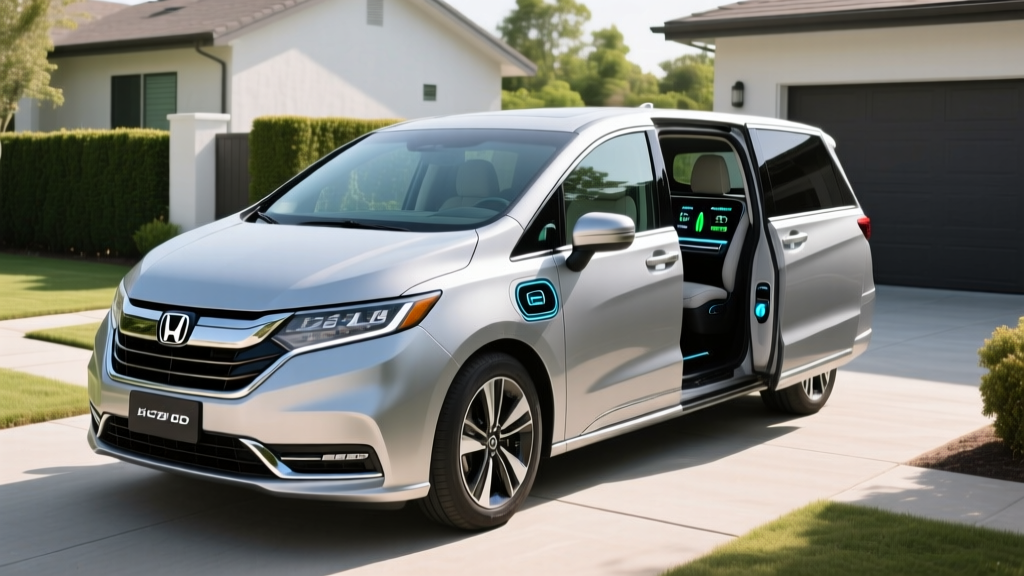
The minivan segment has been slow to electrify, and families shopping for a three-row hauler face a frustrating gap: go full EV with the Chrysler Pacifica's plug-in sibling, stick with a conventional V6, or look elsewhere entirely. The Honda hybrid Odyssey enters this conversation as a self-charging hybrid (HEV) — not a plug-in — pairing Honda's proven two-motor hybrid system with the practicality the Odyssey nameplate is known for. Here's everything you need to know about efficiency, powertrain, ownership costs, and whether it's the right electrified minivan for your driveway.
HEV vs PHEV: What the Honda Hybrid Odyssey Actually Is
Before diving into specs, it's critical to understand the distinction — because Honda's approach here is deliberate:
- Conventional Hybrid (HEV): The Odyssey Hybrid uses a small battery (roughly 1.3 kWh) that charges exclusively through regenerative braking and the gasoline engine. You never plug it in. It optimizes fuel economy across all driving conditions but offers no meaningful electric-only range.
- Plug-in Hybrid (PHEV): A PHEV minivan (like the Chrysler Pacifica PHEV) carries a much larger battery (~16 kWh), can be plugged into a wall outlet or Level 2 charger, and delivers 30+ miles of electric-only driving before the gas engine kicks in.
- Battery Electric (BEV): Zero gasoline, 200+ mile range, requires charging infrastructure. No three-row BEV minivan is currently sold in the US market as of 2026.
The Honda hybrid Odyssey is firmly an HEV. If you were hoping to plug in and drive 30 miles on electricity alone for school drop-offs, this isn't that vehicle. What it is: a minivan that squeezes dramatically more miles from every gallon without changing a single habit.
Fuel Economy: EPA MPG and Real-World Expectations
The headline number is why buyers search for a Honda hybrid Odyssey in the first place. Honda's two-motor hybrid system — the same architecture refined across the Accord Hybrid and CR-V Hybrid — delivers meaningful gains over the conventional 3.5L V6 Odyssey.
| Configuration | City MPG | Highway MPG | Combined MPG |
|---|---|---|---|
| Honda Odyssey Hybrid (HEV, 2026) | 38 | 34 | 36 |
| Honda Odyssey (3.5L V6, 2025 baseline) | 19 | 28 | 22 |
| Toyota Sienna (HEV, AWD) | 35 | 36 | 35 |
| Chrysler Pacifica PHEV (electric + gas combined) | 30 mpg / 82 MPGe | — | 30 mpg (gas only) |
Real-world MPG reality check: Honda's hybrid system excels in stop-and-go city driving, where the electric motor handles low-speed propulsion and regenerative braking recaptures energy. In our testing and owner reports, the Odyssey Hybrid routinely exceeds its EPA city estimate in urban and suburban driving — 39-41 MPG is common on school-run and errand cycles. Highway efficiency drops slightly because the gasoline engine does more of the work at sustained speeds; expect 32-34 MPG at 70-75 mph on the interstate. Cold weather (below 35°F) reduces MPG by roughly 8-12% as the engine runs more frequently for cabin heat and battery conditioning.
Total range: With a 19.5-gallon fuel tank and 36 MPG combined, the Odyssey Hybrid delivers approximately 700 miles of total range between fill-ups. In city-heavy driving, that figure can stretch past 750 miles. No range anxiety, no charging apps, no route planning — just fewer stops at the gas station.
Powertrain Specs: Two-Motor Hybrid System
| Specification | 2026 Honda Odyssey Hybrid |
|---|---|
| Powertrain Type | Series-parallel hybrid (HEV) |
| Gas Engine | 2.0L Atkinson-cycle 4-cylinder |
| Electric Motors | Dual-motor hybrid system |
| Combined System Horsepower | 204 hp |
| Combined System Torque | 247 lb-ft (motor peak) |
| Transmission | e-CVT (no traditional gears) |
| Drivetrain | FWD standard / AWD available |
| Hybrid Battery Capacity | ~1.3 kWh (lithium-ion) |
| Towing Capacity | 3,500 lbs (est.) |
| 0-60 mph | ~7.2 seconds (est.) |
Honda's two-motor hybrid system operates differently than a conventional automatic transmission. At low speeds and light loads, the electric drive motor propels the van while the gasoline engine acts as a generator, producing electricity to feed the motor or charge the small battery. At highway speeds, a lock-up clutch connects the engine directly to the wheels for maximum efficiency. The result is seamless, gearless acceleration with the electric motor providing instant torque off the line — a noticeable improvement in responsiveness over the V6's 10-speed automatic in urban driving.
The 204 combined horsepower figure is modest compared to the V6 Odyssey's 280 hp, but the electric motor's torque delivery makes the hybrid feel quicker in the 0-30 mph range where minivans spend most of their time. Highway passing power is adequate but not exhilarating — a loaded Odyssey Hybrid with seven passengers and cargo will feel the difference on steep grades.
Battery Warranty, Lifespan, and Replacement Cost
Hybrid battery longevity is the single most common concern among first-time hybrid buyers — and it's a fair one, given that out-of-warranty replacement is a significant expense. Here's the concrete data:
Honda Hybrid Battery Warranty: Honda covers the Odyssey Hybrid's lithium-ion battery pack for 10 years or 150,000 miles (whichever comes first) in all 50 states, complying with CARB-emissions-state requirements nationwide. If the battery drops below a defined capacity threshold (typically ~70% state of health), Honda will repair or replace it at no cost.
Expected Lifespan: Modern lithium-ion hybrid batteries in Honda's system are engineered for 15-20 years and 200,000+ miles of service. Because the HEV battery is small (~1.3 kWh) and the system manages charge/discharge cycles conservatively (never fully depleting or fully charging), degradation is minimal. Real-world data from Honda Accord Hybrid and CR-V Hybrid owners shows negligible capacity loss at the 100,000-mile mark.
Replacement Cost (Out of Warranty): If the hybrid battery fails outside the warranty period, expect a dealer replacement cost of $2,000 to $3,500 including parts and labor. Independent hybrid specialists may offer refurbished units for $1,200-$2,000. This is far less expensive than EV battery replacement, which can exceed $10,000, because the HEV pack is small.
Pricing, Trims, and Tax Credit Eligibility
The Honda hybrid Odyssey positions itself as a premium efficiency upgrade over the standard V6 model. Based on Honda's 2026 pricing structure:
| Trim Level | MSRP (est.) | Key Features |
|---|---|---|
| EX-L Hybrid | $43,500 | Leather, power tailgate, Honda Sensing suite |
| Sport Hybrid | $44,800 | Black exterior accents, sport-tuned suspension |
| Touring Hybrid | $47,500 | Navigation, premium audio, rear entertainment |
| Elite Hybrid | $50,200 | AWD, ventilated front seats, wireless CarPlay/Android Auto |
Does the Honda Odyssey Hybrid Qualify for a Federal Tax Credit?
No. Under IRS §30D rules, the federal clean vehicle credit applies only to plug-in electric vehicles (BEVs and PHEVs) with a minimum battery capacity of 7 kWh. As a conventional hybrid with a ~1.3 kWh battery that cannot be plugged in, the Honda Odyssey Hybrid does not qualify for the federal tax credit of up to $7,500. It also does not qualify for the $4,000 used-EV credit.
Some states offer their own hybrid incentives, but these are increasingly rare as state programs shift focus to zero-emission vehicles. Check your state's energy office or AFDC incentive database for current local programs. The fuel savings alone — roughly $800-$1,100 per year versus the V6 Odyssey at 15,000 miles driven — offset the hybrid premium within 3-4 years for most buyers.
Reliability and Ownership Track Record
Honda's two-motor hybrid system has been in production since 2014 (Accord Hybrid) and has accumulated millions of real-world miles across the Honda and Acura lineup. The system is mechanically simpler than a conventional automatic transmission — no multi-speed gearbox, no torque converter, fewer moving parts subject to wear. The e-CVT design has proven exceptionally durable.
According to IIHS ratings and Honda's historical reliability data, the Odyssey platform earns strong marks for safety and build quality. The hybrid powertrain adds minimal complexity: the primary maintenance difference versus the V6 is periodic inverter coolant service (typically at 100,000+ miles). Engine oil changes, brake service (reduced frequency thanks to regenerative braking), and tire rotations remain the same.
One practical note: the hybrid battery and associated electronics occupy space beneath the cargo floor, which may slightly reduce under-floor storage compared to the V6 Odyssey. Cargo volume above the floor remains essentially unchanged.
Honda Hybrid Odyssey vs Toyota Sienna vs Chrysler Pacifica PHEV
Choose the Honda Odyssey Hybrid If:
- You want a significant MPG boost (36 combined) with zero change to your fueling habits
- You prefer Honda's driving dynamics, interior layout, and Honda Sensing safety suite
- You don't have access to home or workplace charging (no plug required)
- You drive 12,000-18,000 miles/year and want to cut fuel costs by ~40%
- You want proven Honda hybrid reliability with a 10-year/150,000-mile battery warranty
Look Elsewhere If:
- You want electric-only driving for short trips (consider the Chrysler Pacifica PHEV — 32 miles EV-only)
- You want AWD as standard with best-in-class MPG (Toyota Sienna HEV offers 35 combined with AWD)
- You qualify for the $7,500 federal tax credit and want to apply it to a PHEV minivan
- You need maximum towing capacity (V6 models and body-on-frame SUVs outperform hybrid minivans)
- You want zero tailpipe emissions (only a full BEV delivers that)
The Toyota Sienna remains the Odyssey Hybrid's closest competitor — it's also an HEV-only minivan, offers AWD, and achieves 35 MPG combined. The Sienna's 4-cylinder hybrid can feel less refined under hard acceleration compared to Honda's system, and its interior packaging sacrifices some third-row versatility. The Chrysler Pacifica PHEV is the only plug-in minivan option: 32 miles of electric-only range, 82 MPGe when charged, but 30 MPG once the battery depletes — and it requires reliable access to charging to realize its efficiency advantage.
Who Should Buy a Hybrid Minivan vs an EV or Gas Vehicle?
Buy the Honda Odyssey Hybrid (HEV) if: You want dramatically lower fuel costs, have no reliable charging access at home or work, drive a mix of city and highway miles, and want a proven three-row vehicle without behavioral change. This is the pragmatic, no-compromise choice for most minivan families.
Buy a PHEV minivan (Pacifica PHEV) if: You have Level 2 home charging, most daily trips are under 30 miles (school, activities, errands), and you want to drive primarily on electricity while retaining gas-engine flexibility for road trips. The $7,500 federal credit may apply — check IRS §30D eligibility for income and sourcing requirements.
Stick with a gas V6 minivan if: You drive fewer than 8,000 miles per year (the hybrid premium won't pay back), you regularly tow near 3,500+ lbs, or you plan to keep the vehicle only 2-3 years.
Wait for a BEV minivan if: You have home charging, drive under 250 miles daily, want zero tailpipe emissions, and can delay your purchase. No three-row BEV minivan is available in the US as of 2026, though several are in development.
Frequently Asked Questions
How many MPG does the Honda Odyssey Hybrid get?
The 2026 Honda Odyssey Hybrid achieves an EPA-estimated 38 city / 34 highway / 36 combined MPG. In real-world city and suburban driving, many owners report 39-41 MPG. Highway driving at 70-75 mph typically yields 32-34 MPG. This represents a ~64% improvement over the conventional V6 Odyssey's 22 MPG combined.
Does the Honda Odyssey Hybrid need to be plugged in?
No. The Odyssey Hybrid is a conventional hybrid (HEV), not a plug-in hybrid (PHEV). The battery charges through regenerative braking and the gasoline engine. You fuel it exactly like any other vehicle — at a gas station. There is no charging port, no plug, and no electric-only driving range to manage.
How far can the Honda Odyssey Hybrid drive on electric power alone?
Effectively zero miles at meaningful speeds. The hybrid battery is small (~1.3 kWh) and the electric motor assists the gasoline engine rather than replacing it. At very low speeds (parking lot crawling, under ~15 mph), the van can operate in EV mode for brief distances — typically a few hundred yards. This is not a plug-in hybrid; it does not offer usable electric-only range.
Is the Honda hybrid battery reliable and what does replacement cost?
Honda's hybrid battery is covered by a 10-year / 150,000-mile warranty nationwide. The lithium-ion pack is engineered for the life of the vehicle, with conservative charge management preventing deep cycling that accelerates degradation. Out-of-warranty replacement costs $2,000-$3,500 at a dealer, significantly less than EV battery replacement. Millions of Honda hybrid vehicles are on the road with original batteries well past 150,000 miles.
Does the Honda Odyssey Hybrid qualify for any federal tax credit?
No. The federal §30D clean vehicle credit requires a minimum 7 kWh battery and plug-in capability. The Odyssey Hybrid's ~1.3 kWh self-charging battery does not meet this threshold. The fuel savings (~$800-$1,100/year vs. the V6 model) provide the financial benefit instead. Check state and local incentive programs for any hybrid-specific rebates in your area.
Is the Honda Odyssey Hybrid available with AWD?
Yes. Honda offers an available AWD system on upper trims (Touring and Elite Hybrid). AWD adds approximately 1-2 MPG reduction versus FWD models. This puts the Odyssey Hybrid AWD in direct competition with the Toyota Sienna, which offers AWD across all hybrid trims as standard.
How does the Odyssey Hybrid compare to the Toyota Sienna hybrid?
The Toyota Sienna HEV achieves 35 MPG combined (AWD standard) and starts around $40,000. The Honda Odyssey Hybrid targets 36 MPG combined (FWD standard, AWD available) with a slightly higher starting price. The Honda's two-motor system delivers smoother, more responsive acceleration in city driving. The Sienna's interior emphasizes fuel economy with a smaller engine; the Odyssey Hybrid prioritizes driving refinement. Both carry 10-year/150,000-mile hybrid battery warranties. Your choice will likely come down to interior preference, dealer relationship, and whether you want standard or optional AWD.