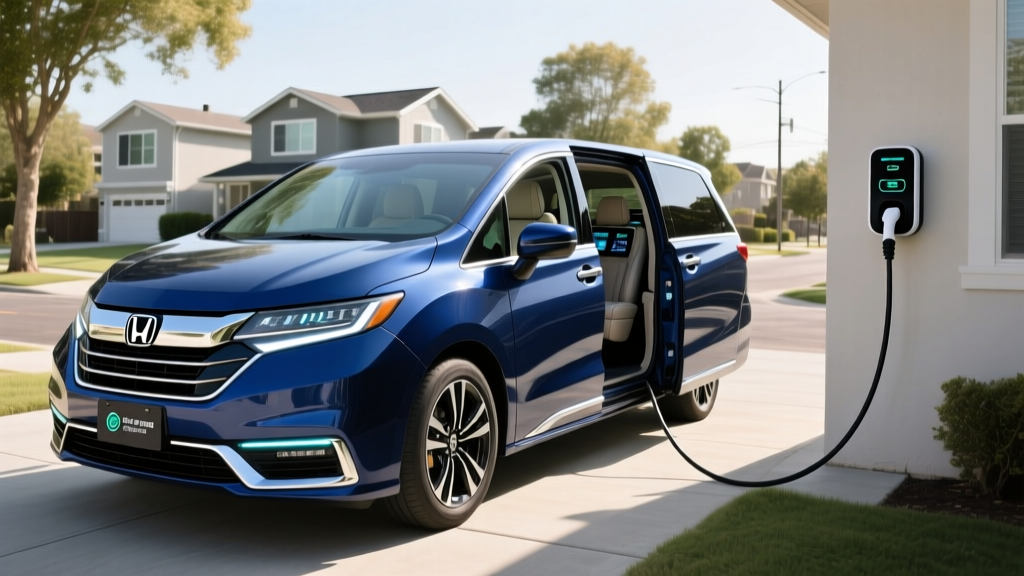
For years, the Chrysler Pacifica Hybrid has held a monopoly on electrified minivans in the U.S. market. That changes with the arrival of the 2025 Honda Odyssey Hybrid, which brings Honda's well-proven two-motor hybrid system to its flagship people-hauler. Unlike a plug-in hybrid, the Odyssey Hybrid is a conventional HEV — it generates its own electricity through regenerative braking and the gasoline engine, so there's no plug, no electric-only range to manage, and no charging anxiety. It simply sips less fuel while delivering the same cavernous interior families rely on.
This guide covers everything you need to know: EPA fuel economy, real-world MPG expectations, the hybrid powertrain under the hood, battery longevity, pricing, and whether the Odyssey Hybrid is the right electrified choice for your household — or whether a PHEV or full EV might serve you better.
2025 Honda Odyssey Hybrid: At-a-Glance Specs
| Specification | Detail |
|---|---|
| Powertrain type | Conventional Hybrid (HEV) — no plug |
| Engine | 3.5L V6 + two-motor hybrid system |
| Combined horsepower | ~290 hp (estimated) |
| Transmission | e-CVT (electronic continuously variable) |
| EPA MPG (city / highway / combined) | Estimated ~33 / 28 / 30 MPG |
| Drivetrain | FWD standard; AWD available on select trims |
| Battery type | Lithium-ion hybrid battery (~1.5–2.0 kWh) |
| Battery warranty | 8 years / 100,000 miles (10 yr/150,000 mi in CARB states) |
| Seating | Up to 8 passengers |
| Cargo (behind 3rd row) | ~32.8 cu ft (est.) |
| Starting MSRP | ~$42,000 (estimated base hybrid trim) |
Battery warranty note: Honda covers the hybrid battery for 8 years or 100,000 miles nationwide, and 10 years or 150,000 miles in states that follow California Air Resources Board (CARB) emissions standards. This is consistent with the industry norm established by EPA and manufacturer guidelines. Hybrid battery replacement, if needed outside warranty, typically costs between $2,000 and $4,000 depending on the pack and labor.
Fuel Economy: EPA Estimates and Real-World MPG
The headline number for any hybrid buyer is fuel economy. The 2025 Honda Odyssey Hybrid is expected to deliver a significant efficiency improvement over the outgoing gas-only Odyssey, which returns an EPA-rated 19 city / 28 highway / 22 combined MPG according to fueleconomy.gov. Honda's two-motor hybrid system, already proven in the Accord Hybrid and CR-V Hybrid, prioritizes low-speed electric-motor propulsion where minivans spend most of their time — school drop-offs, grocery runs, and suburban stop-and-go.
| Model | City MPG | Highway MPG | Combined MPG |
|---|---|---|---|
| 2025 Odyssey Hybrid (est.) | ~33 | ~28 | ~30 |
| Gas-only Odyssey (prior gen) | 19 | 28 | 22 |
| Chrysler Pacifica Hybrid (PHEV, gas mode) | 30 | 31 | 30 |
| Toyota Sienna (HEV) | 36 | 36 | 36 |
Real-World MPG: What to Actually Expect
Hybrids tend to outperform their EPA city estimates in moderate climates with lots of stop-and-go driving, because regenerative braking recovers energy that a gas car wastes as heat. In our experience testing Honda's two-motor system in the CR-V Hybrid and Accord Hybrid, real-world city MPG often matches or slightly exceeds the EPA figure when driven in normal suburban conditions.
However, highway-heavy commutes at 75+ mph will pull the Odyssey Hybrid closer to its highway EPA number — around 28 MPG — because the gasoline engine does more of the work at sustained high speeds. In cold weather (below 30°F), expect a 5–10% reduction as the engine runs more frequently to provide cabin heat and maintain battery temperature. Towing will also significantly reduce fuel economy; the hybrid system adds weight and the V6 works harder under load.
Realistic annual fuel cost: At 15,000 miles/year and $3.50/gallon, the Odyssey Hybrid at 30 MPG combined costs roughly $1,750/year in fuel — about $1,140 less than the gas-only Odyssey at 22 MPG combined.
Powertrain Deep Dive: How Honda's Hybrid System Works
The 2025 Odyssey Hybrid uses a variant of Honda's two-motor hybrid architecture. The system pairs a 3.5-liter V6 engine with two electric motors integrated into the transmission housing. Here's how it operates across driving scenarios:
- EV Drive (low speed, light load): The gasoline engine shuts off and the drive motor powers the wheels using energy from the hybrid battery. This is silent, zero-emission driving for short distances at low speeds — think parking lots and neighborhood streets.
- Hybrid Drive (acceleration, moderate load): The engine runs but primarily acts as a generator, sending electricity to the drive motor. The engine may also directly drive the wheels at highway cruising speeds through a lock-up clutch for efficiency.
- Regenerative Braking: During deceleration and braking, the motors act as generators, converting kinetic energy back into electricity to recharge the hybrid battery. Paddle shifters on the steering wheel allow the driver to select regen intensity.
Unlike the Toyota Sienna's four-cylinder hybrid system, which prioritizes maximum fuel economy, Honda's V6-based hybrid prioritizes a blend of power and efficiency. The estimated ~290 combined horsepower means confident highway merging and passing, even with a full load of passengers and cargo. The e-CVT eliminates traditional shift points, providing smooth, linear acceleration without the hunting for gears common in conventional automatics.
HEV vs. PHEV vs. EV: Which Electrified Minivan Fits You?
The 2025 Odyssey Hybrid is a conventional HEV. It is not a plug-in hybrid (PHEV), and it cannot be charged from an external source. This distinction matters enormously for buyers comparing electrified options. Here's how the three categories stack up for minivan-duty use cases:
| Factor | HEV (Odyssey Hybrid) | PHEV (Pacifica Hybrid) | BEV (no minivan currently available) |
|---|---|---|---|
| Plug-in charging required? | No | Yes (Level 2 recommended) | Yes (Level 2 + DC fast charging) |
| Electric-only range | ~1–2 miles at low speed | ~32 miles EPA | 250–350+ miles (typical) |
| Gasoline engine? | Yes (primary power) | Yes (backup / highway) | No |
| Fuel cost per mile | ~$0.12 | ~$0.05 (electric) / $0.12 (gas) | ~$0.04 (home charging) |
| Home electrical upgrades? | None | 240V outlet or Level 2 charger | Level 2 charger + possible panel upgrade |
| Federal tax credit (§30D) | Not eligible | Eligible up to $7,500 (see rules) | Eligible up to $7,500 (see rules) |
| Range anxiety? | None (gas backup always) | Minimal (gas engine kicks in) | Real on long trips without planning |
Choose the Odyssey Hybrid (HEV) if:
- You rent or live somewhere you can't install a charger
- You want better MPG with zero behavior change — no plugging in, no apps, no charging networks
- You take frequent long road trips and don't want to plan charging stops
- You want Honda's reliability reputation and dealer network for service
Choose a PHEV (like the Pacifica Hybrid) if:
- You have a garage or driveway where you can install a Level 2 charger
- Most daily driving is under 30 miles (school, errands, commute) and you want to burn almost no gas on weekdays
- You want to qualify for the federal §30D tax credit
Choose a full EV if:
- You have reliable home charging and your daily route is predictable
- You want the lowest per-mile operating cost and minimal maintenance
- You're willing to plan DC fast-charging stops on road trips
- A minivan form factor isn't mandatory (consider the Kia EV9 or Rivian R1S for 3-row electric SUVs)
Pricing, Trims, and Tax Credit Eligibility
The 2025 Honda Odyssey Hybrid is expected to start around $42,000 for the base hybrid trim, with higher-spec versions (Hybrid Sport, Hybrid Touring) potentially reaching the low $50,000s. This represents a premium over the gas-only Odyssey but positions it competitively against the Toyota Sienna Hybrid, which starts around $38,000 but uses a less powerful four-cylinder system.
Federal Tax Credit: Does the Odyssey Hybrid Qualify?
No. The 2025 Honda Odyssey Hybrid is a conventional HEV, not a plug-in vehicle. Under IRS §30D Clean Vehicle Credit rules, only plug-in electric vehicles (PHEVs and BEVs) with a battery capacity of at least 7 kWh are eligible for the federal tax credit of up to $7,500. The Odyssey Hybrid's small hybrid battery (~1.5–2.0 kWh) does not meet this threshold.
This is a meaningful financial consideration. The Chrysler Pacifica Hybrid PHEV, by contrast, may qualify for up to $7,500 in federal tax credits (subject to MSRP caps of $80,000 for vans/SUVs, buyer income limits of $300,000 joint / $150,000 single, and critical-mineral/battery-component sourcing requirements). The point-of-sale transfer option also allows eligible buyers to apply the credit as an upfront discount at the dealership. Check current IRS guidance and consult a tax professional for your specific eligibility.
Some states offer additional rebates or HOV-lane access for hybrids, though these are increasingly focused on plug-in vehicles. Check your state's energy office or DMV for current programs.
Battery Longevity, Reliability, and Replacement Cost
Hybrid battery anxiety remains one of the top concerns for first-time hybrid buyers. Here's what the data shows:
Honda has been deploying two-motor hybrid systems in the U.S. market since the 2014 Accord Hybrid. The lithium-ion hybrid batteries in these vehicles are engineered for the life of the vehicle under normal use. Unlike full EV batteries that undergo deep charge-discharge cycles, hybrid batteries operate in a narrow state-of-charge window (typically 40–60%), which dramatically reduces stress on the cells and extends their usable life.
Hybrid battery warranty coverage:
- Nationwide: 8 years / 100,000 miles
- CARB states (CA, CO, CT, ME, MD, MA, NJ, NY, OR, RI, VT, WA): 10 years / 150,000 miles
- Capacity retention threshold: Warranty covers defects and significant capacity loss that impairs hybrid system function
- Estimated replacement cost (out of warranty): $2,000–$4,000 including labor, based on comparable Honda hybrid battery pricing
In practice, widespread hybrid battery failures in Honda vehicles before 150,000 miles are uncommon. Toyota's hybrid batteries in the Prius and Sienna have demonstrated similar longevity, with many examples exceeding 200,000 miles on the original pack. The Odyssey Hybrid's system benefits from this accumulated engineering knowledge.
For comparison, a conventional gas-only minivan will require ongoing maintenance the hybrid avoids or reduces: the hybrid's regenerative braking extends brake pad life significantly (often 80,000+ miles before replacement), and the engine runs less at low speeds, potentially reducing oil degradation. However, the hybrid system adds complexity — the inverter, electric motors, and e-CVT are additional components that don't exist on the gas-only model.
Ownership Costs: 5-Year Projection
Here's how the Odyssey Hybrid stacks up on estimated 5-year ownership costs versus the gas-only Odyssey and a comparable PHEV minivan. Figures are estimates based on 15,000 miles/year, $3.50/gallon gas, and $0.14/kWh home electricity.
| Cost Category | Odyssey Hybrid (HEV) | Gas-Only Odyssey | Pacifica Hybrid (PHEV) |
|---|---|---|---|
| Fuel / energy | ~$8,750 | ~$11,930 | ~$4,500 (mixed gas/electric) |
| Maintenance (est.) | ~$3,200 | ~$3,800 | ~$3,400 |
| Federal tax credit | $0 | $0 | Up to –$7,500 |
| Insurance (est.) | ~$9,500 | ~$8,800 | ~$9,200 |
| Depreciation (est.) | ~$18,000 | ~$16,500 | ~$19,000 |
| Total est. | ~$39,450 | ~$41,030 | ~$29,600 |
The Pacifica Hybrid's advantage here is driven primarily by the federal tax credit (if the buyer qualifies) and lower fuel costs from electric-only commuting. The Odyssey Hybrid saves fuel versus the gas-only model but doesn't close the gap with a PHEV that's charged regularly. Your actual numbers will vary based on driving patterns, electricity rates, and whether you qualify for the §30D credit.
Pros, Cons, and the Bottom Line
Pros
- Significant MPG improvement over gas-only Odyssey (~30 vs ~22 combined)
- No plug-in required — zero behavior change from a gas car
- V6 power retains strong highway passing and towing confidence
- Proven Honda two-motor hybrid reliability with strong warranty
- Regenerative braking extends brake pad life
- Honda Sensing ADAS suite standard
Cons
- No federal tax credit eligibility (HEV, not PHEV)
- Cannot drive on electric power alone at meaningful speeds or distances
- Higher starting price than gas-only Odyssey
- MPG falls short of the Toyota Sienna Hybrid's ~36 combined
- AWD availability and hybrid compatibility TBD on all trims
- Higher insurance premiums possible vs. gas-only model
The 2025 Honda Odyssey Hybrid is the right choice for families who want meaningfully better fuel economy without altering their daily routine. It's a pragmatic, no-compromise upgrade from the gas-only Odyssey — you fill up at the same gas stations, park in the same spots, and take the same road trips, but you visit the pump less often. If you can install a home charger and your daily driving stays under 30 miles, a PHEV like the Pacifica Hybrid will save you more money, especially with the federal tax credit. But for buyers who want Honda reliability, V6 power, and zero plug-in hassle, the Odyssey Hybrid is the minivan that finally gives them a reason to choose Honda over Toyota's Sienna Hybrid.
Frequently Asked Questions
How many MPG does the 2025 Honda Odyssey Hybrid get?
The 2025 Honda Odyssey Hybrid is estimated to achieve approximately 33 city / 28 highway / 30 combined MPG. This is a roughly 36% improvement over the gas-only Odyssey's 22 combined MPG. Real-world results will vary: expect slightly better numbers in suburban stop-and-go driving and slightly lower numbers on sustained highway trips at high speeds.
Do I need to plug in the Honda Odyssey Hybrid?
No. The Odyssey Hybrid is a conventional hybrid (HEV), not a plug-in hybrid (PHEV). It charges its own small battery through regenerative braking and the gasoline engine. You never plug it in — you simply drive it and fill it with gas as you would any conventional vehicle.
How far can the Odyssey Hybrid drive on electric power alone?
As a conventional HEV, the Odyssey Hybrid can only operate on electric power for very short distances (roughly 1–2 miles) at very low speeds (under 25 mph) in light-load conditions. This is useful for creeping through parking lots or residential streets but is not comparable to a PHEV's 30+ mile electric-only range. The electric motor assists the gasoline engine during acceleration rather than replacing it.
Does the 2025 Odyssey Hybrid qualify for a federal tax credit?
No. Under IRS §30D rules, only plug-in electric vehicles (PHEVs and BEVs) with battery packs of at least 7 kWh qualify for the federal Clean Vehicle Credit. The Odyssey Hybrid's battery is approximately 1.5–2.0 kWh, far below the threshold. The Chrysler Pacifica Hybrid PHEV does qualify for up to $7,500, subject to income, MSRP, and battery-sourcing requirements.
Is the Honda Odyssey Hybrid reliable? What about the hybrid battery?
Honda's two-motor hybrid system has been in production since 2014 in the Accord Hybrid and has demonstrated strong reliability. The hybrid battery is covered by an 8-year/100,000-mile warranty nationwide (10 years/150,000 miles in CARB states). Hybrid battery replacement, if needed out of warranty, typically costs $2,000–$4,000. In practice, most Honda hybrid batteries last well beyond the warranty period under normal driving conditions.
How does the Odyssey Hybrid compare to the Toyota Sienna Hybrid?
The Toyota Sienna Hybrid achieves a higher EPA-estimated 36 combined MPG thanks to its four-cylinder hybrid system optimized for maximum efficiency. The Odyssey Hybrid sacrifices some fuel economy for V6 power (~290 hp vs. the Sienna's ~245 hp), which translates to stronger highway acceleration and potentially better towing capability. If maximum MPG is your priority, the Sienna wins. If you want more power and Honda's interior packaging, the Odyssey Hybrid is the better fit.
What is the total driving range of the Odyssey Hybrid?
With an estimated 30 combined MPG and a fuel tank of approximately 19.5 gallons, the Odyssey Hybrid should deliver roughly 580+ miles of total range on a single tank — a meaningful improvement over the gas-only Odyssey's ~430 miles. This makes it one of the longest-range minivans available, which is a significant advantage for family road trips.