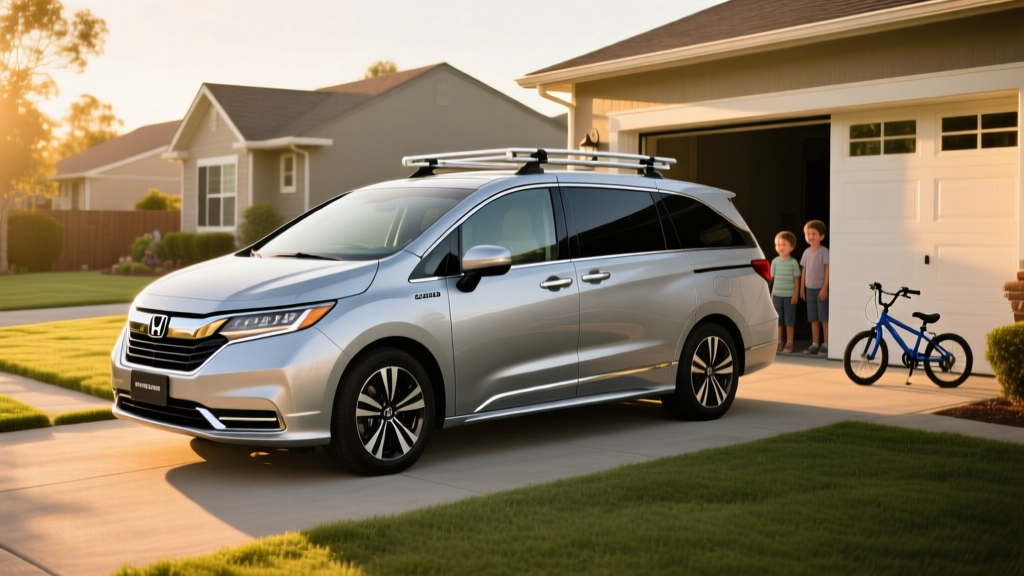
Quick Verdict: Is the 2025 Honda Odyssey Hybrid Worth the Wait?
Minivan buyers have been asking Honda for a hybrid Odyssey for years. The Toyota Sienna went full hybrid for 2021, and the Chrysler Pacifica offers both a conventional hybrid and a plug-in hybrid. For 2025, Honda has yet to confirm a production hybrid Odyssey for the U.S. market — the current-generation Odyssey remains a V6-only minivan. But with Honda committing to electrify its lineup and the competitive pressure intensifying, a hybrid Odyssey is one of the most anticipated additions to the family-hauler segment.
This guide covers everything we know about a potential 2025 Honda Odyssey Hybrid — including Honda's hybrid minivan plans, what the powertrain would likely look like based on Honda's existing two-motor hybrid system, projected fuel economy, pricing, and whether you should wait or look at alternatives like the Sienna Hybrid or Pacifica PHEV today.
HEV vs PHEV: What Kind of Hybrid Would the Odyssey Get?
Before diving into specs, it's essential to understand the two hybrid architectures Honda could choose — and why the distinction matters for your wallet and daily driving.
Conventional Hybrid (HEV)
How it works: A gasoline engine paired with one or more electric motors and a small battery (typically 1–2 kWh). The battery recharges through regenerative braking and the engine — no plug-in required.
Electric-only range: Minimal (under 2 miles at low speeds)
Best for: Drivers who want better MPG without changing their fueling habits
Example: Toyota Sienna Hybrid (36 MPG combined)
Plug-in Hybrid (PHEV)
How it works: A larger battery (typically 12–20 kWh) that you can plug in to charge, offering meaningful electric-only driving before the gas engine kicks in.
Electric-only range: 20–40+ miles depending on battery size
Best for: Drivers with home charging who do most trips on electricity but want gas-engine range for road trips
Example: Chrysler Pacifica PHEV (32 miles EV range, 30 MPG combined after)
Most likely scenario for the Odyssey: Honda's current minivan strategy and its two-motor e:HEV system (used in the CR-V Hybrid and Accord Hybrid) point toward a conventional hybrid (HEV) rather than a PHEV. Honda has not offered a plug-in hybrid minivan in any market, and the packaging/cost complexity of a PHEV system in a minivan is significant. If Honda enters the hybrid minivan space, expect an HEV first.
Projected Powertrain: Honda's Two-Motor Hybrid System
Honda's two-motor hybrid system is well-proven across the Accord Hybrid, CR-V Hybrid, and Civic Hybrid. Here's what a hybrid Odyssey powertrain would likely look like based on the system's scalable architecture:
| Specification | Projected (HEV) | Current Gas Odyssey |
|---|---|---|
| Engine | 2.0L Atkinson-cycle 4-cyl + 2 electric motors | 3.5L V6 |
| Combined Horsepower | ~204–240 hp (est.) | 280 hp |
| Transmission | e-CVT (direct-drive) | 10-speed automatic |
| Drivetrain | FWD (AWD possible) | FWD |
| Battery (traction) | ~1.5–2.0 kWh lithium-ion | N/A |
| Towing Capacity | ~3,000–3,500 lbs (est.) | 3,500 lbs |
| Plug-in Required? | No | N/A |
Honda's two-motor system operates primarily in EV mode at low speeds, with the engine acting as a generator. At highway speeds, a lockup clutch connects the engine directly to the wheels for efficiency. This architecture is particularly effective in city driving, where electric motor torque handles stop-and-go traffic while the engine runs at its most efficient RPM.
Fuel Economy: Projected MPG vs. the Competition
This is the number that matters most to hybrid minivan shoppers. Here's how a hybrid Odyssey would project against the current segment leaders:
| Vehicle | City MPG | Highway MPG | Combined MPG | Type |
|---|---|---|---|---|
| Honda Odyssey Hybrid (projected) | ~34–38 | ~33–36 | ~34–37 | HEV |
| Toyota Sienna Hybrid (FWD) | 36 | 36 | 36 | HEV |
| Toyota Sienna Hybrid (AWD) | 35 | 36 | 35 | HEV |
| Chrysler Pacifica Hybrid (PHEV) | 82 MPGe (EV) | 30 (gas only) | 30 (gas) / 82 MPGe | PHEV |
| Honda Odyssey (current V6 gas) | 19 | 28 | 22 | Gas |
Sources: fueleconomy.gov (EPA data for Sienna, Pacifica, and current Odyssey). Odyssey Hybrid figures are projected estimates based on Honda's hybrid system performance in the CR-V Hybrid and Accord Hybrid, adjusted for minivan weight and aerodynamics.
Pricing and Tax Credit Eligibility
Pricing for a hybrid Odyssey will depend on how Honda positions it relative to the current gas-only lineup. Here's what to expect:
| Trim (Projected) | Est. MSRP | Current Gas Odyssey MSRP |
|---|---|---|
| EX-L Hybrid | ~$42,000–$44,000 | $41,990 (EX-L) |
| Sport Hybrid | ~$43,000–$45,000 | $42,490 (Sport) |
| Touring Hybrid | ~$46,000–$48,000 | $45,490 (Touring) |
| Elite Hybrid | ~$49,000–$51,000 | $49,190 (Elite) |
Federal Tax Credit: Does a Hybrid Odyssey Qualify?
Under current IRS §30D Clean Vehicle Credit rules, conventional hybrids (HEVs) do NOT qualify for the federal $7,500 EV tax credit. That credit is reserved for battery electric vehicles (BEVs) and plug-in hybrids (PHEVs) that meet battery-sourcing, critical-mineral, MSRP, and buyer-income requirements.
If Honda were to offer the Odyssey as a PHEV, it could potentially qualify — but only if:
- The MSRP is at or below $80,000 (minivan/van/SUV cap)
- The buyer's adjusted gross income falls within IRS limits ($300K joint / $150K single)
- The battery components and critical minerals meet domestic-sourcing thresholds (which tighten annually through 2032)
For a conventional HEV Odyssey, the financial case rests on fuel savings rather than tax incentives. At $3.50/gallon and 15,000 miles/year, moving from 22 MPG (gas) to 36 MPG (hybrid) saves approximately $1,477 per year in fuel — enough to recoup a ~$2,000 hybrid premium in under two years.
Battery Warranty, Reliability, and Replacement Cost
Hybrid battery longevity remains a top concern for buyers transitioning from a conventional gas vehicle. Here's what the data shows:
🔋 Hybrid Battery Warranty & Lifespan
Honda Hybrid Battery Warranty: 8 years / 100,000 miles (10 years / 150,000 miles in CARB states including CA, NY, MA, and others)
Warranty Coverage: Honda covers the hybrid battery if capacity drops below approximately 70% of original capacity during the warranty period.
Expected Lifespan: Honda's lithium-ion hybrid batteries in the Accord and CR-V have demonstrated strong longevity, with most units lasting well beyond 150,000 miles with minimal degradation. The small (~1.5–2.0 kWh) battery in an HEV experiences shallow charge/discharge cycles, which is far less stressful than the deep cycles in a BEV or PHEV.
Replacement Cost (out of warranty): Estimated $2,500–$4,500 for a Honda HEV battery pack — significantly less than a BEV or PHEV battery replacement, which can run $8,000–$20,000+.
Honda's hybrid system has proven reliable across multiple model generations. The Accord Hybrid, now in its third generation of two-motor architecture, has accumulated substantial real-world mileage data with few systemic battery failures. The IIHS and NHTSA ratings for the current Odyssey are strong, and a hybrid variant would share the same crash structure and safety systems.
Hybrid vs. PHEV vs. Full EV: Which Minivan Fits You?
The minivan segment now offers all three electrification paths. Here's a decision framework to help you choose:
Choose a Hybrid (HEV) If:
- You can't charge at home or in your garage
- You want better MPG with zero behavior change
- You drive 15K+ miles/year in mixed city/highway
- You want the lowest purchase price among electrified options
Top pick: Toyota Sienna Hybrid (available now)
Choose a PHEV If:
- You have Level 2 home charging (240V outlet)
- Most daily trips are under 30 miles
- You want electric commuting + gas road-trip range
- You may qualify for the $7,500 federal tax credit
Top pick: Chrysler Pacifica PHEV (32 mi EV range)
Choose a Full EV If:
- You have reliable home charging
- You rarely drive 250+ miles without stopping
- You want the lowest cost-per-mile and zero tailpipe emissions
- You qualify for federal/state EV incentives
Top pick: Wait for upcoming electric minivans (VW ID. Buzz, etc.)
Should You Wait for the Odyssey Hybrid or Buy Now?
Here's the practical reality: Honda has not committed to a U.S. hybrid Odyssey for 2025. If Honda does announce one, expect availability in late 2025 at the earliest as a 2026 model — meaning you may not take delivery until mid-to-late 2026.
✅ Reasons to Wait
- You're loyal to Honda's interior packaging, Magic Slide seats, and Honda Sensing safety suite
- Your current vehicle has 12+ months of life left
- You want the best fuel economy Honda can deliver in a minivan
❌ Reasons to Buy Now
- You need a minivan in the next 3–6 months
- The Toyota Sienna Hybrid is available today with 36 MPG, AWD, and proven reliability
- You want PHEV capability (Pacifica) with tax-credit potential
- Honda may never bring a hybrid Odyssey to the U.S.
Frequently Asked Questions
How many MPG would a Honda Odyssey Hybrid get?
Based on Honda's two-motor hybrid system performance in the CR-V Hybrid (40/35/37 MPG city/highway/combined) and the larger, heavier minivan form factor, we project a hybrid Odyssey at approximately 34–38 MPG city, 33–36 MPG highway, and 34–37 MPG combined. The Toyota Sienna Hybrid achieves 36 MPG combined as a useful benchmark. Real-world city driving in a hybrid often exceeds the EPA estimate.
Would the Odyssey Hybrid need to be plugged in?
No. If Honda follows its established strategy, the Odyssey Hybrid would be a conventional hybrid (HEV), meaning the battery charges through regenerative braking and the gasoline engine. You'd never need to plug it in — just fill up at a gas station as you do today. This is fundamentally different from the Chrysler Pacifica PHEV, which requires plug-in charging to access its 32-mile electric-only range.
Is a hybrid minivan reliable? What about battery replacement cost?
Honda's two-motor hybrid system has demonstrated strong reliability across the Accord Hybrid and CR-V Hybrid over multiple model years. The hybrid battery warranty covers 8 years/100,000 miles (10 years/150,000 miles in CARB states). Out-of-warranty replacement for a Honda HEV battery is estimated at $2,500–$4,500 — far less than a full EV battery. Most hybrid batteries last well beyond the warranty period with the shallow charge cycles used in HEVs.
Does the Honda Odyssey Hybrid qualify for any tax credit?
A conventional hybrid (HEV) Odyssey would not qualify for the federal §30D Clean Vehicle Credit, which is limited to BEVs and PHEVs meeting battery-sourcing, MSRP, and income requirements per IRS guidelines. Some states offer separate rebates for hybrids, but these vary by jurisdiction — check your state's energy or environmental agency for current programs.
How does the Odyssey Hybrid compare to the Toyota Sienna Hybrid?
The Sienna Hybrid is the benchmark in this segment: 245 hp combined, 36 MPG, available AWD, and pricing starting around $37,000. A hybrid Odyssey would likely match or slightly trail the Sienna on MPG but could compete on Honda's strengths — interior versatility, driving dynamics, and the Honda Sensing safety suite. The Sienna has the advantage of availability; the Odyssey Hybrid remains unconfirmed.
Will Honda offer an all-wheel-drive hybrid Odyssey?
Honda's two-motor hybrid system currently powers FWD vehicles, but Honda has introduced AWD variants on the CR-V Hybrid. An AWD hybrid Odyssey is possible and would compete directly with the AWD Sienna Hybrid. However, AWD adds weight, cost, and a slight MPG penalty (~1 MPG combined based on Sienna data).