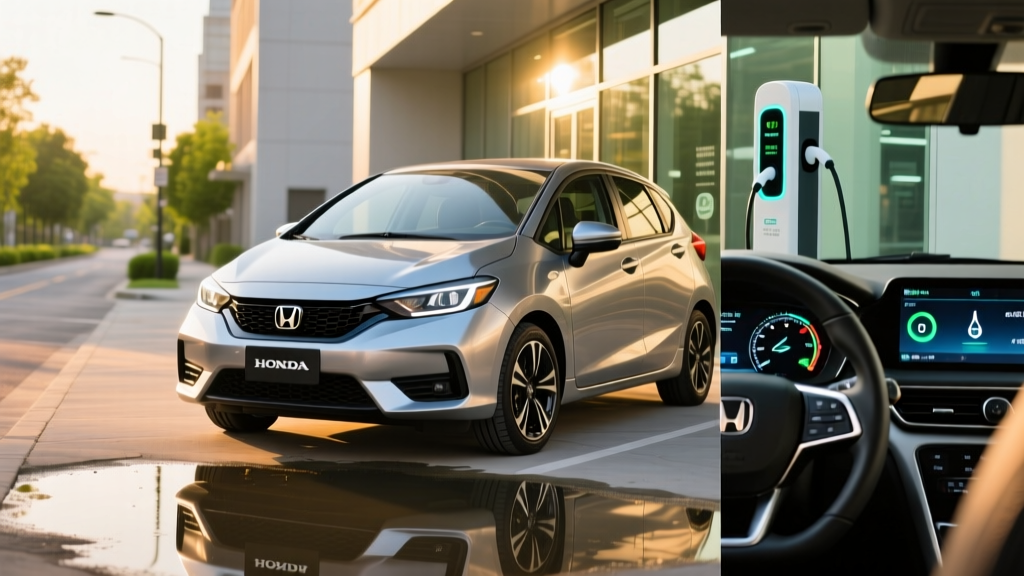
The Honda Jazz (sold as the Honda Fit in some markets) has long been a benchmark subcompact for packaging cleverness and low running costs. The current-generation Honda Jazz automatic hybrid—badged Jazz e:HEV in most global markets—pairs Honda's two-motor hybrid system with a continuously variable transmission, delivering strong city fuel economy without ever needing a plug. This guide breaks down everything buyers need to know about the Jazz automatic hybrid in 2026: real-world MPG, powertrain specs, battery longevity, and how it stacks up against plug-in hybrids and full EVs.
Powertrain & Specs at a Glance
| Specification | Value |
|---|---|
| Powertrain Type | e:HEV two-motor hybrid (series-parallel, HEV) |
| Engine | 1.5L Atkinson-cycle 4-cylinder |
| Combined System Output | ~109 hp (81 kW) / 187 lb-ft torque (drive motor) |
| Transmission | e-CVT (electric continuously variable) |
| Hybrid Battery | ~0.86 kWh lithium-ion (HEV buffer, not plug-chargeable) |
| Drivetrain | Front-wheel drive |
| 0–100 km/h (0–62 mph) | ~9.4 seconds |
| Top Speed | ~107 mph (172 km/h) |
| Curb Weight | ~2,700 lbs (1,225 kg) |
| Cargo Volume (seats up/down) | 10.5 cu ft / 42.4 cu ft (Magic Seats) |
The e:HEV system operates primarily as a series hybrid at low and medium speeds: the gasoline engine spins a generator motor that produces electricity, which then powers the drive motor that turns the wheels. At higher highway speeds, a lock-up clutch connects the engine directly to the wheels for efficiency. This means the Jazz drives like an EV most of the time—smooth, linear torque delivery—while the engine handles range extension. The small ~0.86 kWh battery acts as a buffer for regenerative braking energy and brief electric-only bursts at low speeds, typically under 1 mile at a time.
Fuel Economy: EPA MPG & Real-World Expectations
| Metric | City | Highway | Combined |
|---|---|---|---|
| WLTP (EU Official) | — | — | ~62.8 MPG (4.5 L/100km) |
| EPA Equivalent (est.)* | ~50–53 MPG | ~44–47 MPG | ~48–50 MPG |
| Real-World (mixed driving) | ~48–55 MPG | ~40–45 MPG | ~45–50 MPG |
*The Honda Jazz is not officially sold in the US market as of 2026. EPA figures are estimated equivalents based on WLTP data and comparable Honda e:HEV models tested by the EPA. Actual EPA certification may vary if the model returns to the US.
Like most Toyota and Honda hybrids, the Jazz e:HEV tends to exceed its combined rating in city driving. The series-hybrid architecture means stop-and-go traffic maximizes regenerative braking and electric-motor usage, while the Atkinson-cycle engine runs only at its most efficient RPM. On the highway, where the engine must work harder against aerodynamic drag and the electric-motor advantage diminishes, expect fuel economy to drop 5–8 MPG below the city figure.
In real-world European and Asian owner reports, the Jazz e:HEV regularly achieves 50+ MPG in urban commuting. Cold weather (below 40°F / 4°C) reduces efficiency by roughly 8–12% due to increased engine runtime for cabin heating and reduced battery buffer efficiency—still yielding a solid ~42–46 MPG combined in winter conditions.
How the e:HEV System Works (No Plug Required)
Honda's e:HEV (Intelligent Multi-Mode Drive, or i-MMD) operates in three modes automatically:
- EV Drive: Battery powers the drive motor alone. Used at low speeds, gentle acceleration, and coasting. Range is typically under 1 mile before the engine kicks in.
- Hybrid Drive: Engine powers the generator motor, which feeds electricity to the drive motor. Excess energy charges the battery. This is the primary mode for city and suburban driving.
- Engine Drive: At steady highway speeds (typically above 50 mph / 80 km/h), a lock-up clutch directly connects the gasoline engine to the wheels, bypassing the electric path for maximum efficiency.
The driver never selects these modes manually—the system optimizes seamlessly. The result is a driving feel closer to an EV than a traditional gasoline car, with smooth torque delivery and no gear shifts, while maintaining the 250+ mile total range of a conventional gas tank.
Hybrid vs PHEV vs EV: Which Fits You?
| Factor | HEV (Jazz e:HEV) | PHEV | BEV (Full EV) |
|---|---|---|---|
| Plug-in Required? | No | Yes (for max savings) | Yes |
| Electric-Only Range | <1 mile | 20–45 miles | 200–400 miles |
| Fuel Cost (per mile) | ~$0.07–0.09 | ~$0.03–0.08 | ~$0.03–0.05 |
| Home Charging Needed? | No | Recommended | Essential |
| Federal Tax Credit (§30D) | Not eligible | Up to $7,500* | Up to $7,500* |
| Best For | No home charging, city commuters | Short commutes + road trips | Home charging + daily driving |
*§30D credit eligibility depends on MSRP caps, buyer income limits, and battery critical-mineral sourcing requirements. See IRS guidelines for current-year rules.
Consider a PHEV instead if: You have home charging and a commute under 30 miles. A PHEV like the Toyota Prius Prime lets you drive most days on electricity alone, with the gas engine available for longer trips.
Consider a full EV instead if: You have reliable home Level 2 charging, drive under 250 miles daily, and want the lowest per-mile fuel cost plus §30D tax credit eligibility.
Pricing, Tax Credits & Running Costs
As of 2026, the Honda Jazz e:HEV is not officially sold in the United States. Honda discontinued the US-market Fit after the 2020 model year. The Jazz e:HEV is available in Europe, Japan, Australia, and Southeast Asian markets, with pricing varying by region:
- Europe (2026): Starting approximately €24,000–€28,000 (~$26,000–$30,500 USD) depending on trim and market
- Japan: Starting approximately ¥2,100,000 (~$14,000 USD) — significantly lower due to domestic market pricing
- Australia: Starting approximately AUD $30,000 (~$19,500 USD)
Federal tax credit: As a conventional hybrid (HEV), the Jazz e:HEV does not qualify for the IRS §30D New Clean Vehicle Credit, which applies only to plug-in electric vehicles (PHEVs and BEVs) meeting battery sourcing, MSRP, and buyer income requirements. Some US states offer modest rebates for hybrids, but these vary widely—check your state's energy office for current programs.
Running costs are where the Jazz e:HEV shines. At 50 MPG combined and $3.40/gallon gasoline (2026 US average), fuel cost works out to roughly $0.068 per mile. Compare this to a typical 30 MPG gasoline subcompact at $0.113/mile—that's a savings of approximately $450 per year for a driver covering 10,000 miles annually. Over five years, the fuel savings alone approach $2,250.
Battery Longevity, Warranty & Replacement Cost
Honda covers the Jazz e:HEV hybrid battery with an 8-year / 100,000-mile warranty (10 years / 125,000 miles in some markets including California-emissions states and the EU). The warranty guarantees the battery will retain sufficient capacity for normal hybrid operation. If the battery fails or degrades below functional thresholds within the warranty period, Honda replaces it at no cost.
Real-world longevity: Honda's e:HEV batteries are small (~0.86 kWh) and operate within a conservative state-of-charge window (roughly 20–80%), which dramatically reduces degradation stress. Owner reports from the Insight and Accord Hybrid—using similar i-MMD architecture—show minimal hybrid battery issues well past 150,000 miles.
Out-of-warranty replacement cost: A replacement hybrid battery pack for the Jazz e:HEV is estimated at $2,000–$3,500 including labor, based on comparable Honda hybrid battery pricing. This is significantly less than a full EV battery replacement because the pack is much smaller.
The Jazz's lithium-ion hybrid battery is fundamentally different from a full EV battery. Because it's small and never fully charged or fully depleted—the hybrid system manages a narrow charge window—degradation is minimal. Most Honda hybrid owners will never need a battery replacement during typical ownership. The 8–10 year warranty provides strong protection for the small percentage of units that do experience premature failure.
Reliability & Ownership Verdict
Honda's hybrid systems have proven among the most reliable in the industry. The e:HEV/i-MMD architecture has fewer moving parts than a conventional automatic transmission (no torque converter, no planetary gearset), and the electric drive motor requires no maintenance. The 1.5L Atkinson-cycle engine runs under lower stress than a typical gasoline engine because it primarily operates at its most efficient RPM as a generator.
- Excellent city MPG (50+ real-world)
- EV-like smooth acceleration, no gear shifts
- No plug-in required — zero behavior change
- Honda Magic Seats — class-leading cargo versatility
- Low hybrid battery replacement cost vs EV
- Strong reliability track record (i-MMD system)
- Lightweight (~2,700 lbs) aids efficiency
- Not sold in the US market (as of 2026)
- No federal §30D tax credit eligibility (HEV)
- Highway MPG drops vs city (series-hybrid trait)
- Modest 109 hp — adequate but not quick
- Small battery limits electric-only to <1 mile
- Road noise at highway speeds (thin insulation)
- No DC fast charging capability (not applicable to HEV)
Frequently Asked Questions
How many MPG does the Honda Jazz automatic hybrid get?
The Honda Jazz e:HEV achieves an estimated 48–50 MPG combined, with city driving often yielding 50–55 MPG thanks to the series-hybrid system's regenerative braking advantage. Highway driving drops to approximately 40–45 MPG. WLTP-certified European figures rate it at 62.8 MPG combined, though WLTP tends to overstate compared to real-world US-style driving.
Does the Honda Jazz hybrid need to be plugged in?
No. The Jazz e:HEV is a conventional hybrid (HEV), not a plug-in hybrid (PHEV). The battery charges through regenerative braking and the gasoline engine. You fuel it exactly like a regular gas car—just less often.
How far can the Jazz hybrid go on electric only?
Under 1 mile in most conditions. The ~0.86 kWh battery provides brief electric-only operation at very low speeds (parking lots, traffic crawls). This is by design—the system prioritizes efficiency through seamless engine-motor blending rather than extended electric-only range.
Is the Honda Jazz hybrid reliable and what does battery replacement cost?
Yes. Honda's i-MMD/e:HEV hybrid system has an excellent reliability record across the Accord Hybrid, Insight, and CR-V Hybrid. The hybrid battery is covered for 8 years/100,000 miles (10 years in some markets). Out-of-warranty replacement costs approximately $2,000–$3,500—far less than an EV battery.
Does the Honda Jazz hybrid qualify for any tax credit?
No. The IRS §30D New Clean Vehicle Credit applies only to plug-in vehicles (PHEVs and BEVs) meeting specific battery sourcing, MSRP, and income requirements. Conventional hybrids like the Jazz e:HEV are not eligible. Some state-level programs may offer small rebates—check local incentives.
Can I buy the Honda Jazz hybrid in the United States?
Not as of 2026. Honda discontinued the US-market Fit after 2020 and has not introduced the Jazz e:HEV stateside. US buyers seeking a similar Honda hybrid should consider the Honda Civic Hybrid (sedan) or Honda CR-V Hybrid, both of which use related e:HEV/i-MMD technology and are widely available.
How does the Jazz e:HEV compare to the Toyota Yaris Hybrid?
Both are subcompact hybrids with series-parallel architectures and similar combined MPG (low-to-mid 50s in city driving). The Jazz offers significantly more cargo versatility via Honda's Magic Seats, while the Yaris Hybrid (sold in Europe) tends to be slightly more efficient on the highway due to Toyota's power-split system. Neither is available as a PHEV, and neither qualifies for the federal EV tax credit.