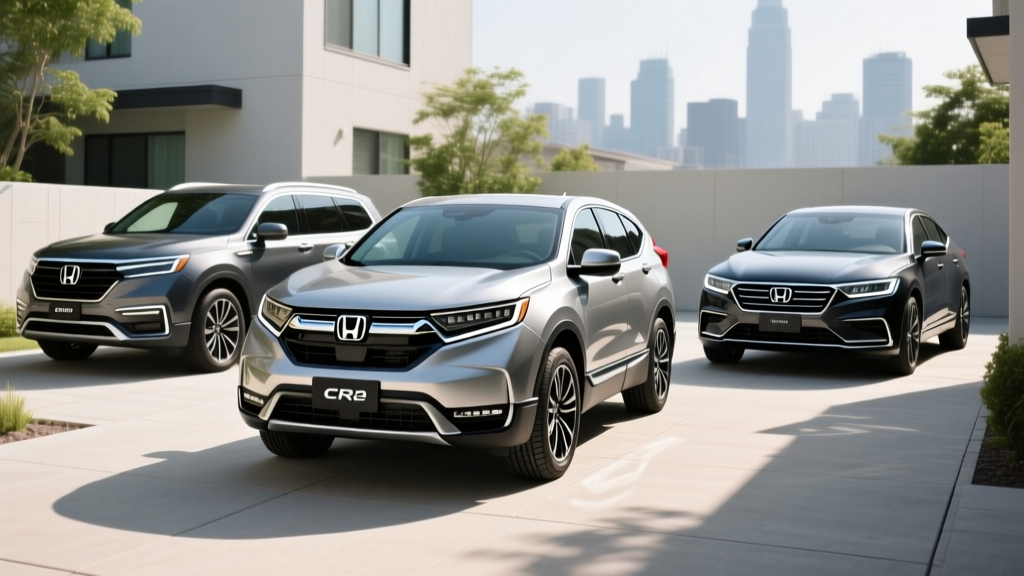
Honda's electrified SUV lineup has expanded considerably for the 2026 model year, and if you're shopping for Honda hybrid SUVs, the choices now span three distinct models with very different powertrain strategies. Whether you want a no-plug-needed conventional hybrid for daily commuting or a plug-in hybrid that covers school runs on pure electricity, Honda has an option — but the specs, pricing, and tax-credit eligibility vary dramatically between them.
This guide breaks down every current Honda hybrid and plug-in hybrid SUV with exact EPA figures, real-world expectations, battery warranty details, and a clear framework for deciding which one fits your driving life — or whether a full EV or gas model makes more sense.
Honda's 2026 Hybrid SUV Lineup at a Glance
For 2026, Honda offers hybrid powertrains across three SUV nameplates, but they are not interchangeable. Two are conventional hybrids (HEVs) that never need plugging in, and one is a plug-in hybrid (PHEV) with meaningful electric-only range. Here's the full lineup:
| Model | Type | EPA Combined MPG | Electric-Only Range | Combined HP | Starting MSRP |
|---|---|---|---|---|---|
| CR-V Hybrid (Sport/Sport Touring) | HEV | 40 MPG combined | N/A | 204 hp | $36,350 |
| CR-V e:PHEV (Sport Touring PHEV) | PHEV | 42 MPGe / 37 MPG gas-only | 37 miles | 204 hp | $44,995 |
| Pilot Hybrid (Sport Touring Hybrid) | HEV | 27 MPG combined | N/A | 290 hp | $48,350 |
Note: Honda discontinued the HR-V hybrid after the 2024 model year in the U.S., so the subcompact segment is no longer part of Honda's domestic hybrid SUV lineup. The Passport also remains gas-only for 2026.
HEV vs PHEV: Understanding Honda's Two Hybrid Approaches
PHEV (Plug-In Hybrid): The CR-V e:PHEV carries a larger 17.7 kWh battery pack that you plug in overnight. It delivers 37 miles of electric-only driving before the gas engine seamlessly takes over, functioning as a conventional hybrid for the rest of your trip.
This distinction matters enormously for your daily routine and your wallet. If you can charge at home and your commute is under 35 miles round-trip, the PHEV essentially functions as an EV on weekdays and a hybrid on road trips. If you live in an apartment without charging access or regularly drive long distances, the conventional HEV is simpler and still delivers strong fuel savings.
2026 Honda CR-V Hybrid: MPG, Powertrain & Real-World Efficiency
The CR-V Hybrid remains Honda's best-selling electrified vehicle and one of the most fuel-efficient compact SUVs on the market. It pairs a 2.0-liter Atkinson-cycle four-cylinder engine with two electric motors in Honda's fourth-generation two-motor hybrid system.
EPA Fuel Economy Breakdown
| Trim / Drivetrain | City MPG | Highway MPG | Combined MPG |
|---|---|---|---|
| CR-V Sport Hybrid (FWD) | 43 | 36 | 40 |
| CR-V Sport Hybrid (AWD) | 40 | 34 | 37 |
| CR-V Sport Touring Hybrid (AWD) | 40 | 34 | 37 |
Source: EPA Fuel Economy
Powertrain Specs
- Engine: 2.0L Atkinson-cycle DOHC 4-cylinder (148 hp, 139 lb-ft)
- Electric Motors: Dual-motor system (181 hp, 247 lb-ft combined motor output)
- Total System Output: 204 hp, 247 lb-ft torque
- Transmission: e-CVT (no traditional gears — direct drive with lock-up clutch)
- 0–60 MPH: 7.6 seconds (AWD)
- Hybrid Battery: ~1.06 kWh lithium-ion (not user-serviceable, sealed under rear seat)
- Towing: 1,000 lbs (not rated for heavy towing)
Pricing & Trims (2026)
- Sport Hybrid FWD: $36,350
- Sport Hybrid AWD: $37,850
- Sport Touring Hybrid AWD: $41,845
2026 Honda CR-V e:PHEV: Electric-Only Range & Charging Details
The CR-V e:PHEV (branded as the Sport Touring Plug-In Hybrid) is Honda's answer to buyers who want EV-like daily driving without range anxiety. It shares the same fundamental two-motor hybrid architecture as the CR-V Hybrid but adds a significantly larger battery and onboard charger.
Electric Range & Total Range
| Metric | Value |
|---|---|
| EPA Electric-Only Range | 37 miles |
| Total Combined Range (EV + Gas) | ~430 miles |
| MPGe (Electric Mode) | 92 MPGe combined |
| MPG (Gas-Only After Depletion) | 37 combined |
Source: EPA Fuel Economy — CR-V PHEV
Battery, Charging & Powertrain
- Battery Capacity: 17.7 kWh lithium-ion (NMC chemistry)
- Usable Capacity: ~14.2 kWh (Honda reserves a buffer to protect longevity)
- Level 1 Charging (120V): ~12 hours for a full charge
- Level 2 Charging (240V, 32A): ~2.5 hours for a full charge
- DC Fast Charging: Not available — the CR-V e:PHEV does not support DC fast charging
- Charge Port: J1772 (standard for Level 1/2)
- Total System Output: 204 hp, 247 lb-ft (same as HEV, but heavier curb weight)
- 0–60 MPH: 8.1 seconds (added battery weight)
Pricing & Tax Credit
- CR-V Sport Touring e:PHEV (AWD only): $44,995
- MSRP Cap: SUVs must be under $80,000 — the CR-V PHEV qualifies.
- Buyer Income Cap: Modified AGI must not exceed $150,000 (single), $225,000 (head of household), or $300,000 (joint).
- Battery Sourcing: Critical minerals and battery components must meet escalating domestic-content thresholds. Honda has been working to localize supply chains, but verify current-year compliance on fueleconomy.gov.
- Point-of-Sale Transfer: As of 2024+, eligible buyers can transfer the credit to the dealer at purchase, reducing the purchase price directly rather than waiting for a tax refund.
2026 Honda Pilot Hybrid: Three-Row Efficiency
The Pilot Hybrid (available exclusively in Sport Touring Hybrid trim) brings Honda's hybrid technology to the three-row SUV segment. It uses a different powertrain than the CR-V — a 3.5L V6 paired with a torque-vectoring hybrid system — prioritizing towing capability and highway passing power over maximum MPG.
EPA Fuel Economy
| Configuration | City MPG | Highway MPG | Combined MPG |
|---|---|---|---|
| Pilot Sport Touring Hybrid (AWD) | 26 | 28 | 27 |
Compared to the gas-only Pilot AWD (21 combined MPG), the hybrid delivers a 29% improvement in fuel economy — meaningful for a vehicle this size, though the numbers are modest compared to the CR-V Hybrid.
Powertrain & Capability
- Engine: 3.5L V6 + electric motor assist
- Total System Output: 290 hp, 290 lb-ft
- 0–60 MPH: 6.6 seconds
- Towing Capacity: 5,000 lbs (matching the gas Pilot)
- Hybrid Battery: ~1.3 kWh lithium-ion (under rear cargo floor)
- Seating: 8 passengers (standard second-row bench)
Pricing
- Pilot Sport Touring Hybrid AWD: $48,350
Like the CR-V Hybrid, the Pilot Hybrid is a conventional HEV and does not qualify for the federal §30D tax credit.
Battery Warranty, Reliability & Replacement Costs
Honda's hybrid systems have proven highly reliable in long-term ownership data. The CR-V Hybrid's two-motor system has fewer wear components than a traditional automatic transmission — there's no torque converter, no multi-speed gearset, and regenerative braking significantly reduces brake pad wear (owners often report 80,000+ miles on original brake pads).
Battery Replacement Cost Estimates
| Model | Battery Type | Estimated Replacement Cost |
|---|---|---|
| CR-V Hybrid | ~1.06 kWh HEV pack | $2,000–$3,500 |
| CR-V e:PHEV | 17.7 kWh PHEV pack | $8,000–$12,000 |
| Pilot Hybrid | ~1.3 kWh HEV pack | $2,500–$4,000 |
For the conventional hybrids (CR-V HEV, Pilot HEV), the small battery packs are relatively inexpensive to replace and rarely fail before 150,000+ miles based on historical Honda hybrid data (Insight, Accord Hybrid). The PHEV's larger 17.7 kWh pack is a more significant expense, but it's well-protected by Honda's warranty and thermal management system. Most PHEV batteries retain 85–90% capacity after 100,000 miles based on industry-wide degradation data for NMC packs with active cooling.
Hybrid vs PHEV vs EV: Which Honda Is Right for You?
Decision Framework
Choose the CR-V Hybrid (HEV) if:
- You cannot charge at home (apartment, street parking, no garage)
- You want maximum simplicity — no plugs, no charging apps, no behavior change
- Your budget is under $42,000
- You drive 12,000–18,000 miles/year and want consistently strong MPG
Choose the CR-V e:PHEV if:
- You have Level 2 charging at home (or can install it)
- Your daily round-trip commute is under 35 miles
- You want to drive mostly on electricity but need gas flexibility for road trips
- You may qualify for the federal tax credit, bringing effective price closer to the HEV
Choose the Pilot Hybrid if:
- You need three rows and 5,000-lb towing
- You want better MPG than the gas Pilot but don't need plug-in capability
- You regularly carry 5+ passengers and cargo
Consider a full EV (like the Honda Prologue) instead if:
- You have reliable home and workplace charging
- Your daily driving is under 250 miles
- You want to eliminate gas entirely and access the full $7,500 federal credit
- You're willing to plan for road-trip DC fast charging stops
Pros and Cons: Honda Hybrid SUVs
✓ Pros
- CR-V Hybrid achieves 40+ MPG in real-world city driving
- No behavior change needed for HEV models — just fill up with gas
- Strong reliability track record; Honda hybrid components are proven
- PHEV offers 37 miles EV range for gas-free commuting
- Generous 8-yr/100k-mi battery warranty (10/150k in CARB states)
- Honda Sensing ADAS suite standard on all trims
✗ Cons
- No DC fast charging on the PHEV — road-trip charging is Level 2 only
- Conventional hybrids get no federal tax credit
- Pilot Hybrid MPG improvement (27 vs 21) is modest for the price premium
- AWD CR-V Hybrid drops to 37 MPG combined (FWD required for 40 MPG)
- PHEV cargo space slightly reduced by larger battery pack
- No hybrid option in the HR-V or Passport for 2026
Frequently Asked Questions
How many MPG does the Honda CR-V Hybrid actually get in real driving?
The EPA rates the FWD CR-V Hybrid at 43 city / 36 highway / 40 combined MPG. In real-world ownership, city-heavy drivers routinely report 38–44 MPG thanks to the electric-dominant hybrid system. Highway-only driving at 75 MPH typically returns 32–35 MPG. Cold weather reduces these figures by 8–12%.
How far can the CR-V e:PHEV go on electric only?
The EPA rates the CR-V e:PHEV at 37 miles of electric-only range. Real-world results vary: expect 30–34 miles in mild weather with mixed driving, 25–28 miles at highway speeds, and 22–28 miles in winter conditions. Once the battery depletes, the vehicle operates as a conventional hybrid at 37 MPG combined.
Does any Honda hybrid SUV qualify for the federal tax credit?
Only the CR-V e:PHEV (plug-in hybrid) may qualify for the federal §30D clean vehicle credit of up to $7,500. Eligibility depends on buyer income limits, battery sourcing compliance, and MSRP caps — all subject to change. Check fueleconomy.gov for the current determination. The conventional CR-V Hybrid and Pilot Hybrid do not qualify for any federal credit.
Is the Honda hybrid system reliable? What does battery replacement cost?
Honda's two-motor hybrid system has demonstrated strong reliability since its introduction in the Accord Hybrid. The hybrid battery is warrantied for 8 years/100,000 miles (10 years/150,000 miles in CARB states). HEV battery replacement costs $2,000–$4,000; the PHEV's larger pack runs $8,000–$12,000 out of warranty. Most Honda hybrid batteries last well beyond 150,000 miles based on long-term fleet data.
Can I charge the CR-V e:PHEV at a DC fast charger?
No. The CR-V e:PHEV only supports Level 1 (120V) and Level 2 (240V) AC charging. There is no DC fast-charge port. A full Level 2 charge takes approximately 2.5 hours. This is typical for PHEVs in this class — the Toyota RAV4 Prime also lacks DC fast charging.
How does the Honda Pilot Hybrid compare to the gas Pilot?
The Pilot Hybrid delivers 27 MPG combined versus 21 MPG combined for the gas AWD Pilot — a 29% improvement. It also produces 290 hp (up from 285 hp) and maintains the same 5,000-lb towing capacity. The hybrid is only available in the top Sport Touring trim at $48,350, which represents roughly a $3,000 premium over the equivalent gas Sport Touring — a premium you'll recoup in fuel savings within 3–4 years at average mileage.