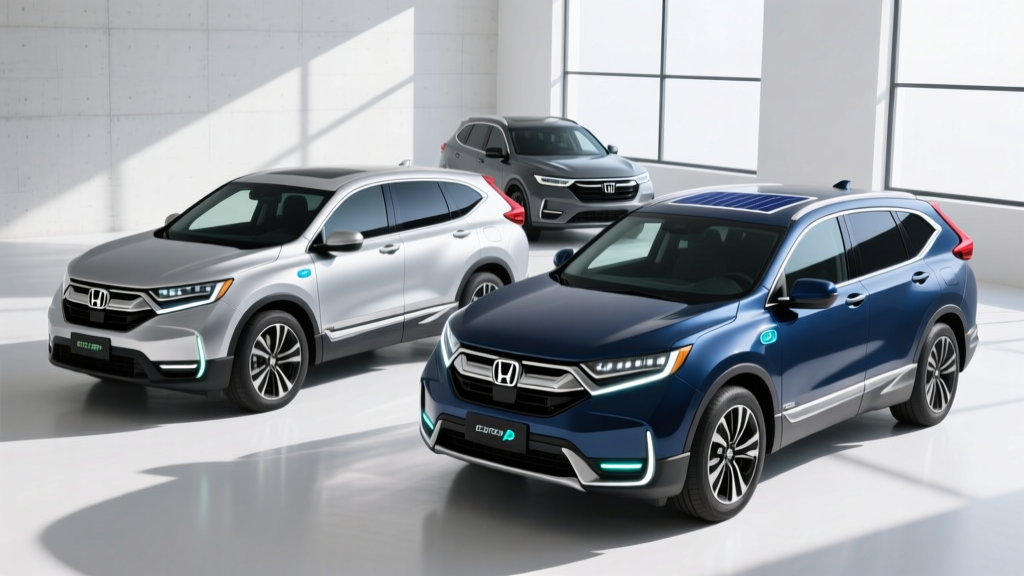
If you want SUV practicality without the range anxiety or home-charging hassle of a full battery-electric vehicle, Honda's 2026 hybrid SUV lineup is worth a hard look. Honda now offers hybrid powertrains across three SUVs — the compact CR-V Hybrid, the midsize two-row Passport Hybrid, and the three-row Pilot Hybrid. None of them require a plug. All use Honda's two-motor hybrid system to deliver meaningful fuel savings over their gas-only counterparts.
This guide breaks down every 2026 Honda hybrid SUV by the numbers: EPA MPG, powertrain output, pricing, battery warranty, and whether any qualify for federal tax credits. We'll also address the question every buyer eventually asks — hybrid, plug-in hybrid, or full EV?
2026 Honda Hybrid SUV Lineup at a Glance
| Spec | CR-V Hybrid | Passport Hybrid | Pilot Hybrid |
|---|---|---|---|
| Powertrain | 2.0L 4-cyl + 2 motors | 2.0L 4-cyl + 2 motors | 2.0L V6 + 2 motors |
| Combined HP | 204 hp | 290 hp | 290 hp |
| Drivetrain | FWD or AWD | AWD standard | AWD standard |
| EPA City MPG | 43 (FWD) / 40 (AWD) | 38 | 36 |
| EPA Highway MPG | 36 (FWD) / 34 (AWD) | 32 | 31 |
| EPA Combined MPG | 40 (FWD) / 37 (AWD) | 35 | 33 |
| Cargo Volume (rear seats up) | 36.3 cu ft | 41.4 cu ft | 18.6 cu ft (all rows up) |
| Towing Capacity | 1,000 lbs | 5,000 lbs | 5,000 lbs |
| Base MSRP | ~$36,395 (Sport) | ~$47,900 (TrailSport) | ~$48,500 (Sport) |
| Federal Tax Credit | Not eligible | Not eligible | Not eligible |
Sources: EPA Fueleconomy.gov, Honda Newsroom. MSRP figures are approximate for 2026 model year and subject to change.
HEV vs. PHEV vs. EV: Which Honda Fits Your Life?
Before diving into each model, it's critical to understand what Honda does — and doesn't — offer. All three Honda hybrid SUVs are conventional hybrids (HEVs). They charge their small battery packs through regenerative braking and the gasoline engine. You never plug them in. You simply fill up at a gas station and drive.
Conventional Hybrid (HEV)
- How it works: Small battery (~1–2 kWh) charged by engine and regen braking
- Plug in? No — gas only
- Electric-only range: Minimal (under 1 mile at low speeds)
- Best for: Drivers who want better MPG with zero lifestyle change
Plug-in Hybrid (PHEV)
- How it works: Larger battery (~12–20 kWh) with external charging capability
- Plug in? Yes — Level 1 or Level 2
- Electric-only range: Typically 25–45 miles
- Best for: Short-commute drivers with home charging who want EV-like daily driving with gas backup
Battery Electric (BEV)
- How it works: Large battery (60–100+ kWh), no gas engine
- Plug in? Yes — required
- Electric-only range: 250–400+ miles EPA
- Best for: Drivers with reliable home charging who want zero tailpipe emissions and lowest operating cost
Honda does not currently offer a PHEV SUV in the US market. The discontinued Clarity PHEV was a sedan, and Honda has focused its electrification strategy on conventional hybrids for SUVs and the Honda Prologue (a BEV) for full electric. If you need a PHEV SUV, you'll need to look at competitors like the Toyota RAV4 Prime (42 miles electric-only) or Hyundai Tucson PHEV (33 miles electric-only).
CR-V Hybrid: The Efficiency Champion
The 2026 Honda CR-V Hybrid remains the volume leader in Honda's hybrid SUV lineup, and for good reason. With up to 40 MPG combined (FWD Sport trim), it delivers roughly 35% better fuel economy than the gas-only CR-V AWD (29 MPG combined). The two-motor hybrid system pairs a 2.0-liter Atkinson-cycle four-cylinder with dual electric motors for a combined 204 horsepower.
In real-world driving, the CR-V Hybrid often exceeds its EPA city estimate. Hybrid systems shine in stop-and-go traffic where regenerative braking constantly recaptures energy. Owners report 42–45 MPG in city driving. Highway efficiency drops to the low-to-mid 30s at sustained 75 MPH speeds — this is normal for hybrids, which rely less on regen and more on the engine at steady high speeds.
CR-V Hybrid Trims and Pricing
- Sport (FWD): ~$36,395 — 40 MPG combined
- Sport (AWD): ~$38,395 — 37 MPG combined
- Sport Touring (AWD): ~$42,895 — 37 MPG combined, includes leather, Bose audio, wireless CarPlay/Android Auto
The CR-V Hybrid's 1,000-pound towing capacity is its main limitation. If you need to tow a small trailer or boat, look at the Passport or Pilot Hybrid instead.
Passport Hybrid: Two-Row Power Meets Hybrid Efficiency
New for the 2026 lineup, the Honda Passport Hybrid brings a two-motor hybrid system to Honda's rugged two-row midsize SUV. The result: 290 combined horsepower and 35 MPG combined — a substantial improvement over the previous V6-only Passport's 21 MPG combined. That's a 66% fuel economy gain while actually gaining horsepower.
The Passport Hybrid uses a 2.0-liter four-cylinder engine paired with two electric motors and standard all-wheel drive. With a 5,000-pound towing capacity and 41.4 cubic feet of cargo space behind the second row, it's the sweet spot for buyers who need more room and capability than the CR-V but don't need three rows.
Real-world MPG for the Passport Hybrid hovers around 33–34 in mixed driving, with city figures occasionally touching 37–38 in traffic-heavy commutes. Highway cruising at 70+ MPH yields roughly 30–31 MPG.
Pilot Hybrid: Three-Row Family Hauler, Now Electrified
The 2026 Honda Pilot Hybrid extends hybrid tech to Honda's largest SUV. The 2.0-liter V6-based hybrid system produces 290 horsepower with standard AWD, delivering 33 MPG combined. For context, the previous gas-only Pilot AWD achieved 21 MPG combined — the hybrid cuts fuel consumption by roughly 36%.
With 18.6 cubic feet of cargo space behind the third row (expandable to 87 cu ft with both rear rows folded), 5,000-pound towing, and seating for up to eight, the Pilot Hybrid competes directly with the Toyota Grand Highlander Hybrid (35 MPG combined) and Hyundai Palisade (no hybrid option).
Expect real-world Pilot Hybrid fuel economy in the 30–32 MPG range for mixed driving. City-heavy routes can push it to 35 MPG; sustained highway driving drops it to around 28–30 MPG.
Real-World MPG: What to Actually Expect
| Model | EPA Combined | Real-World City | Real-World Highway | Real-World Mixed |
|---|---|---|---|---|
| CR-V Hybrid (FWD) | 40 MPG | 42–45 MPG | 33–35 MPG | 37–39 MPG |
| CR-V Hybrid (AWD) | 37 MPG | 39–42 MPG | 31–33 MPG | 35–37 MPG |
| Passport Hybrid (AWD) | 35 MPG | 37–38 MPG | 30–31 MPG | 33–34 MPG |
| Pilot Hybrid (AWD) | 33 MPG | 34–35 MPG | 28–30 MPG | 30–32 MPG |
Key pattern: Hybrids consistently beat their EPA city estimates because regenerative braking recovers energy in stop-and-go driving. Highway MPG tends to fall slightly below EPA estimates, especially at speeds above 70 MPH or in cold weather (below 40°F), when the engine runs more frequently for cabin heat and battery conditioning.
Battery Warranty, Lifespan, and Replacement Costs
Honda Hybrid Battery Warranty
All 2026 Honda hybrid SUVs come with an 8-year / 100,000-mile hybrid battery warranty (10 years / 150,000 miles in CARB states including California, New York, Massachusetts, and others that follow California emissions standards). The warranty covers battery capacity loss that causes a significant drop in performance or fuel economy.
Expected lifespan: Honda's hybrid batteries are designed to last the life of the vehicle. Real-world data from earlier Honda hybrids (Insight, Accord Hybrid) shows batteries commonly exceeding 150,000–200,000 miles before any significant degradation. Unlike full EV batteries, hybrid batteries are small (~1–2 kWh) and operate within a narrow state-of-charge window (typically 40–60%), which dramatically reduces stress and extends cycle life.
Replacement cost (out of warranty): Based on current Honda hybrid battery pricing, a replacement pack runs approximately $2,000–$4,000 including labor — far less than a full EV battery replacement ($8,000–$20,000+). Individual module replacement may be possible for less.
The small battery size is a key advantage for hybrid longevity. Because the battery is never deeply discharged or charged to full capacity, degradation is minimal compared to BEVs. This is why hybrid battery failures remain rare even at high mileages.
Tax Credits and Incentives: What Honda Hybrid Buyers Should Know
Under the current IRS §30D Clean Vehicle Credit rules, conventional hybrids (HEVs) do not qualify for the federal $7,500 EV tax credit. The credit is reserved for plug-in electric vehicles — battery-electric (BEV) and plug-in hybrid (PHEV) models that meet battery sourcing, critical mineral, MSRP cap, and buyer income requirements.
Since Honda's SUV lineup consists entirely of conventional hybrids with no plug, none of the CR-V Hybrid, Passport Hybrid, or Pilot Hybrid qualify for the federal credit.
Other Potential Savings
- State incentives: Some states offer rebates or HOV lane access for hybrids — check your state's energy office or AFDC state incentive database for current programs.
- Fuel cost savings: At 40 MPG combined (CR-V Hybrid FWD) versus 29 MPG (gas CR-V AWD), a driver covering 15,000 miles/year at $3.50/gallon saves approximately $550–$650 annually in fuel costs.
- Insurance: Hybrid SUVs typically carry similar insurance premiums to their gas counterparts — unlike EVs, which often see 10–20% higher premiums due to repair costs.
Who Should Buy a Honda Hybrid SUV — And Who Shouldn't
Choose a Honda Hybrid SUV If:
- You want significantly better MPG without changing your fueling routine
- You don't have access to home or workplace charging
- You regularly drive in cold climates where EV range drops 20–30%
- You need proven reliability with minimal new technology risk
- You tow occasionally (Passport/Pilot Hybrid: 5,000 lbs)
- You want lower total cost of ownership without a large upfront price premium
Consider a Full EV or PHEV Instead If:
- You have reliable Level 2 home charging and want the lowest per-mile fuel cost
- You want access to the $7,500 federal tax credit (requires a BEV or PHEV)
- Your daily commute is under 40 miles and you want zero-emission electric driving (look at PHEV competitors)
- You want one-pedal driving and instant electric torque (BEV experience)
- You're motivated by eliminating tailpipe emissions entirely
Quick Decision Framework
CR-V Hybrid: Best for individuals or small families prioritizing maximum fuel efficiency (40 MPG) in a compact SUV. Ideal city commuter.
Passport Hybrid: Best for active couples or small families needing two rows, serious cargo space (41.4 cu ft), and 5,000-lb towing without the fuel penalty of a traditional V6.
Pilot Hybrid: Best for families of 5+ who need three rows and want to cut fuel costs by ~35% versus the gas Pilot.
Frequently Asked Questions
How many MPG does the Honda CR-V Hybrid get?
The 2026 CR-V Hybrid achieves 43 city / 36 highway / 40 combined MPG in FWD form, and 40 city / 34 highway / 37 combined MPG with AWD. Real-world city driving often yields 42–45 MPG thanks to regenerative braking.
Does Honda make a plug-in hybrid SUV?
No. As of 2026, Honda does not offer a plug-in hybrid (PHEV) SUV in the US market. All Honda hybrid SUVs are conventional hybrids (HEVs) that do not plug in. For a PHEV SUV, consider the Toyota RAV4 Prime, Hyundai Tucson PHEV, or Kia Sportage PHEV.
How far can Honda hybrid SUVs go on electric only?
Honda's conventional hybrid SUVs can travel less than 1 mile on electric power alone at very low speeds. They are not designed for meaningful electric-only driving — the electric motor assists the gas engine and enables brief engine-off coasting. For 25–45 miles of electric-only range, you need a PHEV.
Is the Honda hybrid battery reliable and expensive to replace?
Honda hybrid batteries have an excellent reliability track record, commonly lasting 150,000–200,000+ miles. They're covered by an 8-year/100,000-mile warranty (10 years/150,000 miles in CARB states). Out-of-warranty replacement costs approximately $2,000–$4,000 — far less than an EV battery.
Does the Honda CR-V Hybrid qualify for a tax credit?
No. The federal §30D Clean Vehicle Credit applies only to plug-in vehicles (BEVs and PHEVs). The CR-V Hybrid, Passport Hybrid, and Pilot Hybrid are conventional hybrids and do not qualify. Check your state's incentive programs for any hybrid-specific rebates.
How does Honda hybrid MPG change in winter?
Expect a 5–10% MPG drop in cold weather (below 40°F). The engine runs more frequently to provide cabin heat and warm the hybrid system. City MPG may drop from the low 40s to the mid-to-high 30s in the CR-V Hybrid. This is far less impactful than the 20–30% range loss EVs experience in cold weather.
What's the difference between the Honda hybrid system and Toyota's?
Both use two-motor series-parallel systems, but Honda's system tends to favor electric-motor-driven acceleration at low-to-medium speeds with the engine acting primarily as a generator. At highway speeds, the engine connects directly to the wheels via a lock-up clutch. Toyota's system blends engine and motor power more continuously through a planetary gearset. Both are proven and reliable; real-world efficiency is comparable within vehicle classes.