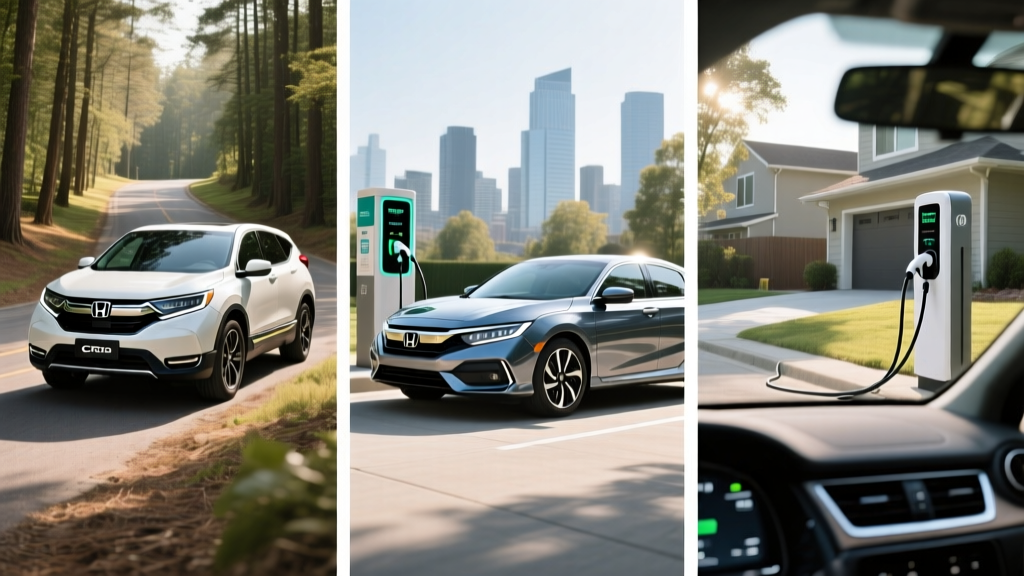
Honda's hybrid strategy in 2026 is straightforward: conventional hybrids (HEVs) that never need to be plugged in, paired with efficient four-cylinder engines and dual-motor systems. Unlike Toyota, Honda has largely stepped back from plug-in hybrids in the U.S. market, focusing instead on self-charging HEV technology across its most popular nameplates. If you've been searching for a Honda hybrid and wondering which model delivers the best real-world fuel economy, whether the battery will last, or how these stack up against a full EV, this guide covers every current model with exact numbers.
Honda's Hybrid Lineup at a Glance
For the 2026 model year, Honda offers three core hybrid models in the United States. All use Honda's fourth-generation two-motor hybrid system, which pairs an Atkinson-cycle gasoline engine with an electric motor primarily for propulsion (not just assist). Here's the complete spec breakdown:
| Model | Powertrain | Combined HP | EPA City/Hwy/Combined MPG | Starting MSRP |
|---|---|---|---|---|
| 2026 Honda Accord Hybrid | 2.0L 4-cyl + 2 motors | 204 hp | 51 / 44 / 48 | $33,995 |
| 2026 Honda CR-V Hybrid (FWD) | 2.0L 4-cyl + 2 motors | 204 hp | 43 / 36 / 40 | $36,395 |
| 2026 Honda CR-V Hybrid (AWD) | 2.0L 4-cyl + 2 motors | 204 hp | 40 / 34 / 37 | $38,395 |
| 2026 Honda Civic Hybrid (Sedan) | 2.0L 4-cyl + 2 motors | 200 hp | 50 / 47 / 49 | $29,845 |
Source: EPA Fuel Economy and Honda Newsroom. MPG figures reflect top-efficiency trims (Sport/LX). Higher trims with larger wheels may see 1-2 MPG reduction.
HEV vs. PHEV vs. EV: Which Honda Fits Your Driving?
Honda's current U.S. lineup centers on conventional hybrids (HEVs). Understanding the distinction matters before you shop:
| Feature | HEV (Honda's approach) | PHEV (e.g., Toyota RAV4 Prime) | BEV (e.g., Honda Prologue) |
|---|---|---|---|
| Plug-in required? | No — charges via regenerative braking and engine | Yes — plug in for electric-only miles | Yes — must plug in to recharge |
| Electric-only range | ~1 mile at low speed | 25-42 miles typical | 250-325+ miles |
| Fuel/energy source | Gasoline only | Gasoline + grid electricity | Grid electricity only |
| Federal tax credit (§30D) | No | Up to $7,500 (if eligible) | Up to $7,500 (if eligible) |
| Best for | No home charging access, long commutes, simplicity | Home charging + short daily commute | Home charging + mostly electric lifestyle |
Honda's decision to focus on HEVs means you'll never search for a charging station or worry about electric-only range depletion. The tradeoff: you'll always burn some gasoline, and you won't qualify for the federal EV tax credit. For drivers without Level 2 home charging access or those covering 400+ miles per week, this simplicity is a genuine advantage.
Real-World MPG: What Owners Actually Report
EPA estimates are a starting point, but Honda's hybrid system has a well-documented characteristic: it tends to exceed EPA city ratings in real-world stop-and-go driving while sometimes falling slightly short on sustained highway runs. This is because the two-motor system operates primarily in EV mode at low speeds, with the engine acting as a generator rather than a direct mechanical drive.
| Model | EPA Combined | Real-World City (owner avg) | Real-World Highway (owner avg) | Notes |
|---|---|---|---|---|
| Accord Hybrid | 48 MPG | 50-54 MPG | 42-46 MPG | Excels in urban driving; highway drops at 75+ mph |
| CR-V Hybrid FWD | 40 MPG | 41-44 MPG | 34-37 MPG | AWD adds ~3 MPG penalty; cold weather hits harder |
| Civic Hybrid | 49 MPG | 51-55 MPG | 44-48 MPG | Lightest platform; best overall efficiency in lineup |
Real-world figures aggregated from owner reports on Fuelly and Honda enthusiast forums. Individual results vary with climate, driving style, and tire selection.
Powertrain Deep Dive: How Honda's Hybrid System Works
All three 2026 Honda hybrids share the same fundamental architecture, tuned slightly differently per vehicle:
- Engine: 2.0-liter Atkinson-cycle inline-4 producing ~146 hp and 134 lb-ft of torque. The Atkinson cycle sacrifices peak power for superior thermal efficiency (~40%).
- Propulsion Motor: A single electric motor producing 181 hp and 247 lb-ft of torque, driving the front wheels. This motor provides the majority of acceleration force.
- Generator Motor: A second motor connected to the engine that generates electricity or acts as a starter. It does not drive the wheels directly.
- Lock-up Clutch: At highway speeds (typically above 55 mph), a clutch mechanically links the engine to the wheels for efficient direct drive, bypassing the electrical conversion loss.
- Battery: A compact lithium-ion pack (~1.0-1.3 kWh usable capacity). This is far smaller than a PHEV or BEV battery — it's a buffer, not a primary energy source.
The combined system output is 200 hp (Civic) or 204 hp (Accord/CR-V). The Civic Hybrid hits 0-60 mph in approximately 7.2 seconds, while the Accord Hybrid does it in roughly 7.0 seconds. The CR-V Hybrid trails at about 7.6 seconds — adequate for merging and passing, if not sporty.
Battery Longevity, Warranty & Replacement Cost
The number-one concern among hybrid shoppers is battery lifespan. Here's what Honda's track record and warranty structure tell us:
Honda Hybrid Battery Warranty (2026 Models)
- Coverage: 10 years / 150,000 miles (in CARB states including CA, NY, MA, NJ, CT, and others adopting California emissions standards)
- Coverage: 8 years / 100,000 miles (in all other U.S. states — federal minimum)
- What's covered: Hybrid battery pack, hybrid control unit, and related components against defects and excessive capacity loss
- Threshold: Honda does not publish a specific degradation percentage trigger, but warranty claims are honored when the battery cannot hold sufficient charge for normal hybrid operation
Real-world failure data is encouraging. Honda's hybrid systems, particularly the post-2020 generation, have shown strong durability. The small battery pack (~1 kWh) experiences relatively shallow charge-discharge cycles, which is far less stressful than the deep cycles a BEV battery endures. Many Honda hybrid owners exceed 150,000 miles on the original battery pack without significant degradation.
Replacement cost if out of warranty: A Honda hybrid battery replacement runs approximately $2,000-$3,500 including labor, based on current dealer pricing and aftermarket options. This is dramatically less than a BEV battery replacement ($8,000-$20,000+) because the pack is small and simpler. Third-party rebuild services are emerging at $1,200-$2,000 for some models.
Pricing, Trims & Tax Credit Eligibility
| Model | Available Hybrid Trims | MSRP Range | Federal §30D Credit | State Incentives |
|---|---|---|---|---|
| Accord Hybrid | Sport, Sport-L, EX-L, Sport Touring | $33,995 - $39,895 | Not eligible (HEV) | Varies by state |
| CR-V Hybrid | Sport, Sport Touring | $36,395 - $41,895 | Not eligible (HEV) | Varies by state |
| Civic Hybrid | Sport, Sport Touring | $29,845 - $33,045 | Not eligible (HEV) | Varies by state |
Because these are conventional hybrids — not plug-in hybrids or battery-electric vehicles — they do not qualify for the federal §30D Clean Vehicle Credit of up to $7,500. That credit is reserved for PHEVs and BEVs meeting battery sourcing, MSRP cap, and buyer income requirements under current IRS rules.
However, the lower upfront cost of Honda's hybrids partially offsets this. A Civic Hybrid at ~$29,845 is thousands less than a comparably equipped BEV, and the fuel savings versus a gas-only Civic (33 MPG combined) are substantial:
| Cost Factor | Civic Gas (33 MPG) | Civic Hybrid (49 MPG) | 5-Year Savings |
|---|---|---|---|
| Fuel (75,000 mi @ $3.40/gal) | $7,727 | $5,204 | $2,523 |
| Maintenance (est.) | $3,200 | $3,000 | $200 |
| Purchase price delta | Baseline | +$2,500 (Sport Hybrid vs Sport) | -$2,500 |
| Net 5-year position | +$223 net savings |
Assumes 15,000 miles/year, $3.40/gal average. Savings widen significantly if gas prices rise or annual mileage exceeds 15K. Source: fueleconomy.gov calculator.
Who Should Choose a Honda Hybrid (and Who Shouldn't)
Choose a Honda Hybrid if:
- You don't have access to home Level 2 charging (apartment, street parking, no garage)
- Your commute involves heavy stop-and-go traffic where hybrids excel
- You want 45-50 MPG without changing any habits — just fill up with gas
- You plan to keep the car 8-12 years and want proven powertrain simplicity
- You need AWD (CR-V Hybrid) for snow without the range anxiety of an EV in cold weather
Consider a PHEV or BEV instead if:
- You have home charging and a short daily commute (under 30 miles) — a PHEV could run 100% electric on weekdays
- You want to eliminate gasoline purchases entirely (BEV)
- You qualify for the full $7,500 federal tax credit and want to maximize incentive value
- You drive in a ZEV-mandate state with additional rebates for plug-in vehicles
Reliability Ratings & Owner Satisfaction
Honda's hybrid powertrains have earned strong reliability marks. The IIHS has awarded the Accord and CR-V (including hybrid variants) Top Safety Pick+ ratings for 2025-2026, and Consumer Reports consistently rates the Accord Hybrid and Civic Hybrid as "Recommended" with above-average predicted reliability.
Common owner praise points include seamless engine-motor transitions (the handoff is nearly imperceptible), strong low-end torque from the electric motor, and quiet operation at city speeds. The most frequent complaints center on road noise at highway speeds (a Honda-wide issue, not hybrid-specific) and the CVT-like engine drone under hard acceleration — the engine revs to a fixed RPM while the electric motor modulates speed, which takes adjustment if you're used to stepped gear changes.
Pros
- Class-leading city MPG (50+ real-world in Accord/Civic)
- No plug-in required — zero lifestyle change from a gas car
- Strong low-end electric torque makes city driving effortless
- 10-year/150K-mile battery warranty in CARB states
- Modest price premium over gas-only trims ($1,500-$2,500)
- Honda Sensing ADAS suite standard on all hybrid trims
Cons
- No federal tax credit eligibility (HEV, not PHEV/BEV)
- Highway MPG drops noticeably above 70 mph
- Engine drone under hard acceleration (fixed-RPM behavior)
- No PHEV option in Honda's U.S. lineup for electric-only commuting
- Cold-weather MPG penalty of 10-15%
- AWD only available on CR-V, not Accord or Civic
Frequently Asked Questions
How many MPG does a Honda hybrid get?
The 2026 Honda Civic Hybrid leads the lineup at 49 MPG combined (50 city / 47 highway). The Accord Hybrid achieves 48 MPG combined (51 city / 44 highway), while the CR-V Hybrid FWD delivers 40 MPG combined (43 city / 36 highway). In real-world city driving, owners commonly exceed EPA estimates by 2-5 MPG thanks to the electric-dominant low-speed operation.
Does Honda make a plug-in hybrid?
As of 2026, Honda does not offer a plug-in hybrid (PHEV) in the U.S. market. The Honda Clarity PHEV was discontinued after the 2021 model year. Honda's U.S. strategy focuses on conventional HEVs and, separately, the all-electric Prologue SUV. If you specifically want a PHEV with 30+ miles of electric-only range, you'll need to look at competitors like the Toyota RAV4 Prime (42 miles EV) or Hyundai Tucson PHEV (33 miles EV).
Is the Honda hybrid battery reliable, and what does replacement cost?
Honda's hybrid batteries have demonstrated strong longevity, with many owners surpassing 150,000 miles without replacement. The battery is warranted for 10 years/150,000 miles in CARB states and 8 years/100,000 miles elsewhere. Out-of-warranty replacement costs approximately $2,000-$3,500 at a dealer, significantly less than a full EV battery swap.
Do Honda hybrids qualify for any tax credit?
No. Conventional hybrids (HEVs) do not qualify for the federal §30D Clean Vehicle Credit, which is limited to plug-in hybrids and battery-electric vehicles. Some states offer modest incentives for hybrids, but these vary by jurisdiction. Check your state's energy office or IRS guidelines for current eligibility.
Hybrid vs. PHEV vs. EV — which is right for me?
Choose Honda's HEV if you lack home charging, drive long distances, or want maximum simplicity. Choose a PHEV (from another brand) if you have home charging and a sub-30-mile daily commute. Choose a BEV like the Honda Prologue if you want zero tailpipe emissions, have reliable charging access, and want to leverage the $7,500 federal credit. Honda's hybrid is the lowest-risk, lowest-change option — it just works.
How does AWD affect Honda hybrid fuel economy?
AWD is available only on the CR-V Hybrid. It reduces combined MPG from 40 (FWD) to 37 — a 3 MPG penalty that's meaningful over 15,000 miles per year (~$130 more in fuel at $3.40/gal). The AWD system uses a mechanical rear driveshaft rather than a dedicated rear electric motor, which is simpler but slightly less efficient than the torque-vectoring AWD systems in some competitors.