Quick Verdict: Honda's 2026 Hybrid Lineup at a Glance
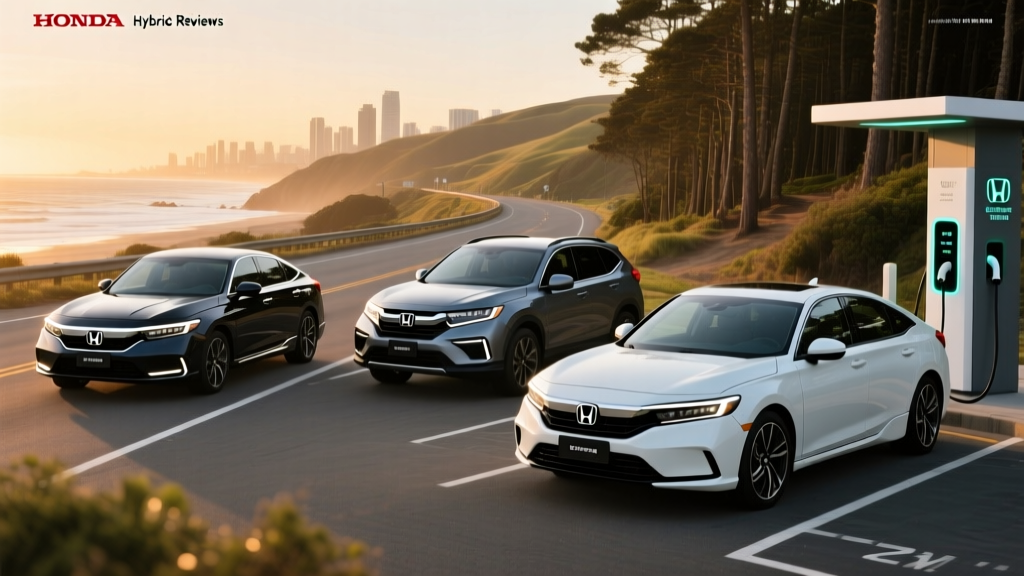
Honda's 2026 hybrid strategy is refreshingly straightforward: no plug-in hybrids, no range-extender gimmicks — just three conventional hybrids (HEVs) that never need a charging cable. The Accord Hybrid delivers midsize-sedan efficiency at 48 MPG combined, the CR-V Hybrid offers compact-SUV practicality at 40 MPG combined, and the Civic Hybrid squeezes out an impressive 50 MPG combined in a compact package. All three use Honda's two-motor hybrid system with no plug-in requirement, meaning you fuel up at any gas station and let the powertrain optimize the rest.
For buyers searching new Honda hybrid cars, the decision comes down to body style and budget — not charging infrastructure. Here's the complete breakdown with exact EPA figures, powertrain data, and real-world expectations.
HEV vs PHEV: Why Honda Sticks With Conventional Hybrids
Conventional Hybrid (HEV) — What Honda offers:
- No plug-in charging required; the gasoline engine and regenerative braking recharge a small battery (typically 1.0–1.5 kWh)
- Seamless electric assist at low speeds; engine handles highway cruising
- No electric-only range to manage — you simply drive and refuel normally
- Lower upfront cost; no home charging installation needed
Plug-in Hybrid (PHEV) — What Honda does NOT currently offer in the US:
- Larger battery (15–20+ kWh) providing 25–45 miles of electric-only driving
- Requires regular plug-in charging to realize fuel savings
- Higher purchase price; may qualify for federal tax credits under §30D
- More complex ownership: charging habits directly affect real-world efficiency
Honda discontinued the Clarity Plug-In Hybrid after the 2021 model year and has not introduced a US-market PHEV successor as of 2026. If plug-in capability is a priority, you'll need to look at competitors like the Toyota RAV4 Prime or Hyundai Tucson PHEV. But if you want simplicity — no cables, no charging apps, no range management — Honda's HEV approach is purpose-built for you.
2026 Honda Accord Hybrid: 48 MPG Midsize Efficiency
The Accord Hybrid pairs a 2.0-liter Atkinson-cycle four-cylinder engine with Honda's two-motor hybrid system for a combined output of 204 horsepower and 247 lb-ft of torque. The e-CVT transmission delivers smooth, stepless acceleration without the rubber-band feel of older CVTs.
| Spec | 2026 Accord Hybrid |
|---|---|
| EPA MPG (City / Highway / Combined) | 51 / 44 / 48 |
| Combined Horsepower | 204 hp |
| Combined Torque | 247 lb-ft |
| Engine | 2.0L Atkinson-cycle I-4 |
| Hybrid Battery | ~1.3 kWh lithium-ion |
| 0–60 mph | ~7.2 seconds |
| Cargo Volume | 16.7 cu ft |
| Base MSRP (Sport Hybrid) | ~$34,500 |
| Battery Warranty | 8 years / 100,000 miles (10 yr/150,000 mi in CARB states) |
Real-world MPG note: Honda hybrids consistently match or exceed EPA city estimates in stop-and-go driving because the electric motor handles low-speed propulsion where gasoline engines are least efficient. On the highway, expect 40–43 MPG at 70–75 mph — slightly below the EPA highway figure, which is typical for all hybrids at sustained speed. In mixed suburban driving, 46–50 MPG is achievable without hypermiling.
2026 Honda CR-V Hybrid: 40 MPG Compact SUV Practicality
The CR-V Hybrid uses the same two-motor architecture as the Accord but tuned for SUV duty. Combined output is 204 horsepower and 247 lb-ft of torque from the 2.0-liter engine and dual electric motors. Available in Sport and Sport Touring trims, with standard all-wheel drive on the Sport Touring.
| Spec | 2026 CR-V Hybrid |
|---|---|
| EPA MPG (City / Highway / Combined) | 43 / 36 / 40 (FWD) · 40 / 34 / 37 (AWD) |
| Combined Horsepower | 204 hp |
| Combined Torque | 247 lb-ft |
| Engine | 2.0L Atkinson-cycle I-4 |
| Hybrid Battery | ~1.3 kWh lithium-ion |
| 0–60 mph | ~7.8 seconds |
| Cargo Volume | 36.3 cu ft (rear seats up) / 76.5 cu ft (folded) |
| Base MSRP (Sport Hybrid FWD) | ~$36,500 |
| Battery Warranty | 8 years / 100,000 miles (10 yr/150,000 mi in CARB states) |
Real-world MPG note: The CR-V Hybrid excels in city driving where regenerative braking and electric motor assist shine. Owners report 42–46 MPG in urban commuting. Highway efficiency drops to 33–36 MPG at 75 mph, reflecting the SUV's taller profile and AWD drivetrain losses. For the AWD Sport Touring, plan on 35–38 MPG combined in mixed driving — about 2 MPG below the EPA combined figure.
2026 Honda Civic Hybrid: 50 MPG Compact Champion
Reintroduced for the current generation, the Civic Hybrid is the efficiency leader in Honda's lineup. Using the same 2.0-liter two-motor system, it produces 200 horsepower and 232 lb-ft of torque — brisk for a compact sedan. The lighter curb weight and lower aerodynamic drag push combined efficiency to 50 MPG.
| Spec | 2026 Civic Hybrid |
|---|---|
| EPA MPG (City / Highway / Combined) | 50 / 47 / 49 (Sedan) · 50 / 45 / 48 (Hatchback) |
| Combined Horsepower | 200 hp |
| Combined Torque | 232 lb-ft |
| Engine | 2.0L Atkinson-cycle I-4 |
| Hybrid Battery | ~1.0 kWh lithium-ion |
| 0–60 mph | ~6.8 seconds |
| Cargo Volume | 14.8 cu ft (sedan) / 24.4 cu ft (hatchback) |
| Base MSRP (Sport Hybrid Sedan) | ~$30,500 |
| Battery Warranty | 8 years / 100,000 miles (10 yr/150,000 mi in CARB states) |
Real-world MPG note: The Civic Hybrid is the easiest of the three to push above its EPA numbers. City drivers regularly see 52–55 MPG in traffic-heavy commutes. Highway cruising at 65–70 mph yields 44–47 MPG. For the hatchback variant, subtract roughly 1 MPG across the board due to the slightly less aerodynamic rear profile.
Hybrid Battery Longevity, Warranty, and Replacement Cost
Honda Hybrid Battery Warranty:
- Standard coverage: 8 years / 100,000 miles (all 50 states)
- CARB-state coverage: 10 years / 150,000 miles (California, New York, Massachusetts, and other states adopting CARB emissions standards)
- Capacity threshold: Honda warrants the hybrid battery against defects and abnormal degradation; there is no published minimum capacity-retention percentage as with EV batteries
Honda's hybrid battery packs are small (roughly 1.0–1.3 kWh) and experience shallow charge-discharge cycles, which is ideal for lithium-ion longevity. The battery management system keeps the state of charge in a narrow band — typically 40–80% — avoiding the deep cycles that accelerate degradation in full EVs. Real-world failure data from previous-generation Accord and Civic Hybrids shows most original batteries lasting 150,000–200,000+ miles without replacement.
Replacement cost if out of warranty: A Honda hybrid battery replacement runs approximately $2,000–$4,000 including labor, depending on the model and whether you source a new OEM pack or a refurbished unit. This is a fraction of EV battery replacement costs ($8,000–$20,000+) because the pack is small and the labor is less invasive. Third-party refurbishers can often replace individual failed cells within the pack for $500–$1,500, extending the pack's life at lower cost.
Pricing, Trims, and Tax Credit Eligibility
| Model | Trim | MSRP (approx.) | Federal Tax Credit |
|---|---|---|---|
| 2026 Civic Hybrid | Sport Sedan | $30,500 | Not eligible (§30D applies to PHEVs/BEVs only) |
| 2026 Civic Hybrid | Sport Hatchback | $31,500 | Not eligible |
| 2026 CR-V Hybrid | Sport FWD | $36,500 | Not eligible |
| 2026 CR-V Hybrid | Sport Touring AWD | $41,500 | Not eligible |
| 2026 Accord Hybrid | Sport | $34,500 | Not eligible |
| 2026 Accord Hybrid | Sport-L | $36,800 | Not eligible |
| 2026 Accord Hybrid | Sport Touring | $40,500 | Not eligible |
Federal tax credit reality: Under current IRS §30D rules, the federal clean vehicle credit of up to $7,500 applies only to battery electric vehicles (BEVs) and plug-in hybrids (PHEVs) with a minimum battery capacity of 7 kWh. Honda's conventional hybrids use ~1.0–1.3 kWh packs and do not qualify. No federal purchase incentive is available for HEVs in 2026.
State incentives: Some states offer rebates or reduced registration fees for hybrids, but these vary widely and change frequently. Check your state's energy or environmental agency website for current programs. Honda's hybrids do not qualify for HOV lane access stickers in most states (a benefit typically reserved for PHEVs and BEVs).
Hybrid vs PHEV vs EV: Which Honda Buyer Are You?
Choose a Honda HEV (Accord, CR-V, or Civic Hybrid) if:
- You don't have access to home or workplace charging
- You want maximum fuel savings with zero behavior change — no plugging in, no apps, no route planning
- Your budget is $30,000–$42,000 and you want a mainstream vehicle with strong resale value
- You drive 10,000–15,000 miles per year in a mix of city and highway
Consider a PHEV (from Toyota, Hyundai, or others) if:
- You can charge at home (Level 1 or Level 2) and want 25–45 miles of daily electric-only driving
- Your commute is under 40 miles round-trip and you want to minimize gasoline use
- You want occasional electric-only operation for short trips while retaining gas-engine range for road trips
Go full BEV (Honda Prologue or other EVs) if:
- You have reliable home Level 2 charging and want zero tailpipe emissions
- You want to qualify for the $7,500 federal tax credit (subject to MSRP, income, and sourcing rules)
- Your daily driving is under 250 miles and you're comfortable with public DC fast charging for road trips
Pros and Cons of Honda's 2026 Hybrid Lineup
Pros
- Class-leading MPG in the Civic Hybrid (50 combined)
- No charging infrastructure required — works with existing gas stations
- Smooth two-motor system with strong low-end torque (247 lb-ft in Accord/CR-V)
- Proven Honda reliability; 8–10 year battery warranty
- Lower purchase price than equivalent PHEVs or BEVs
- Strong resale value; Honda hybrids hold value well
Cons
- No plug-in hybrid option — can't drive on electric only beyond ~1 mile at low speed
- No federal tax credit eligibility
- AWD availability limited to CR-V Sport Touring Hybrid (not Accord or Civic)
- Highway MPG drops noticeably at 75+ mph (physics, not a Honda flaw)
- No DC fast charging capability (not applicable to HEVs, but worth noting vs PHEVs)
Frequently Asked Questions
How many MPG does the 2026 Honda Accord Hybrid get?
The EPA rates the 2026 Accord Hybrid at 51 city / 44 highway / 48 combined MPG. In real-world city driving, owners typically see 48–52 MPG. Highway cruising at 75 mph yields approximately 40–43 MPG.
How many MPG does the 2026 Honda Civic Hybrid get?
The Civic Hybrid sedan is EPA-rated at 50 city / 47 highway / 49 combined MPG. Real-world city driving frequently produces 52–55 MPG thanks to aggressive regenerative braking and electric motor assist at low speeds.
Does any 2026 Honda hybrid qualify for the $7,500 federal tax credit?
No. The IRS §30D clean vehicle credit requires a minimum battery capacity of 7 kWh and plug-in capability. Honda's conventional hybrids use ~1.0–1.3 kWh batteries and do not plug in. Only BEVs and PHEVs qualify.
How long will a Honda hybrid battery last and what does replacement cost?
Honda hybrid batteries are warranted for 8 years/100,000 miles (10 years/150,000 miles in CARB states). Real-world data shows most packs lasting 150,000–200,000+ miles. Out-of-warranty replacement costs $2,000–$4,000 for an OEM pack, or $500–$1,500 for cell-level refurbishment by a third party.
Do Honda hybrids need to be plugged in?
No. Honda's 2026 hybrids are conventional HEVs. The battery recharges through the gasoline engine and regenerative braking during deceleration. You never plug them in — just refuel at any gas station.
Is the Honda CR-V Hybrid available with all-wheel drive?
Yes, the CR-V Hybrid Sport Touring trim comes standard with AWD. The Sport Hybrid FWD trim is front-wheel drive only. AWD reduces combined MPG from 40 to 37 EPA-rated.
How does the Honda Prologue fit into Honda's electrified lineup?
The Honda Prologue is Honda's only fully electric vehicle (BEV) for the US market, built on GM's Ultium platform. It offers approximately 296 miles of EPA range and qualifies for federal tax credits (subject to current-year eligibility rules). It sits alongside the hybrid lineup as Honda's zero-emission option for buyers with charging access.
Which Honda hybrid is best for a long highway commute?
The Accord Hybrid is the strongest highway cruiser of the three, with the most refined ride, best sound insulation, and a comfortable 44 MPG EPA highway rating (expect 40–43 real-world at 70–75 mph). The Civic Hybrid is more efficient on paper but offers a firmer ride and less cabin isolation at highway speed.
Sources: EPA Fuel Economy (fueleconomy.gov), Honda Automobiles Official Specifications, IRS §30D Clean Vehicle Credit Guidelines. All MSRP figures are approximate and may vary by dealer. Verify current pricing and incentive eligibility before purchase.