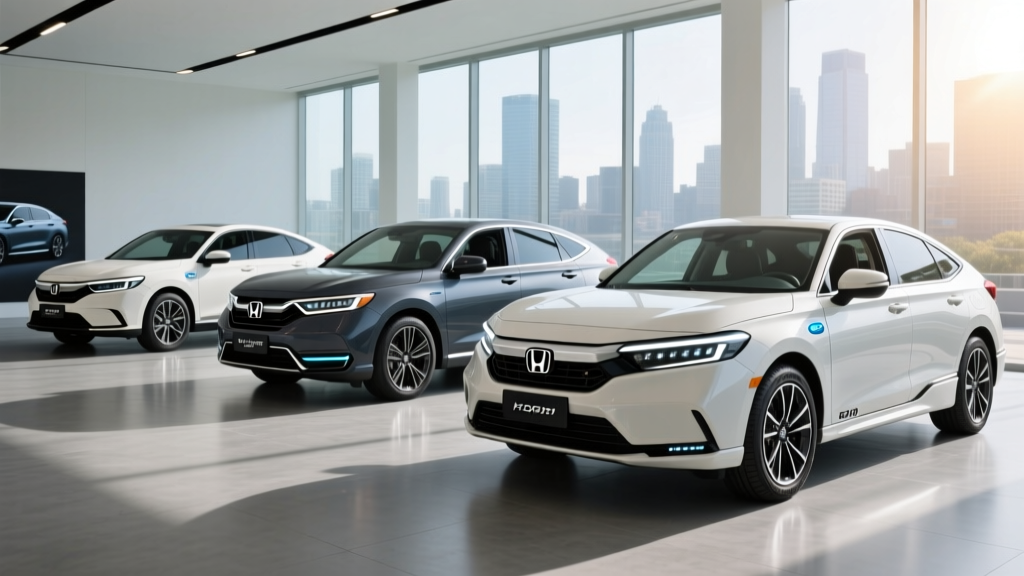
If you're researching a hybrid car Honda offers in 2026, you're looking at one of the most mature hybrid lineups in the industry. Honda now equips its three highest-volume models — the Accord sedan, CR-V compact SUV, and Civic compact — with variants of its two-motor hybrid system. No plug-in hybrids are currently sold in the US, meaning every Honda hybrid is a conventional HEV: it charges its own battery through regenerative braking and the gasoline engine, never needing an outlet.
This guide breaks down each model's EPA fuel economy, real-world MPG behavior, powertrain output, battery warranty, and pricing to help you pick the right Honda hybrid — or decide whether a full EV makes more sense for your driving pattern.
HEV vs PHEV: Where Honda Stands in 2026
Conventional Hybrid (HEV): All current Honda hybrids are HEVs. A small battery (typically 1.0–1.5 kWh) is recharged by the engine and regen braking. No plug, no electric-only range to manage. You just fill up with gas and drive. EPA MPG is high, especially in city driving where the electric motor handles low-speed propulsion.
Plug-In Hybrid (PHEV): Honda's last US-market PHEV, the Clarity Plug-In Hybrid, was discontinued after the 2021 model year. As of 2026, Honda does not sell a PHEV in the United States. If you want electric-only commuting with a gas backup from Honda, you'd need to look at a full BEV (like the Prologue) or consider a competitor's PHEV such as the Toyota RAV4 Prime or Hyundai Tucson PHEV.
This matters for your purchase decision: Honda's hybrid strategy prioritizes simplicity. You get excellent fuel economy without any charging infrastructure consideration, but you also get zero electric-only miles and no eligibility for the federal §30D new-vehicle EV tax credit (which requires plug-in capability with at least 7 kWh of battery capacity).
2026 Honda Accord Hybrid: MPG, Specs, and Trims
The Accord Hybrid remains Honda's efficiency flagship among its sedans. For 2026, it uses a 2.0-liter Atkinson-cycle four-cylinder paired with Honda's fourth-generation two-motor hybrid system, producing a combined 204 horsepower and 247 lb-ft of torque from the electric motors.
| Spec | 2026 Accord Hybrid |
|---|---|
| Powertrain | 2.0L I-4 + two-motor hybrid |
| Combined HP | 204 hp |
| Motor Torque | 247 lb-ft |
| EPA City / Hwy / Combined | 51 / 44 / 48 MPG |
| Fuel Tank | 12.8 gal |
| Total Range | ~614 miles |
| 0–60 mph | ~7.0 sec |
| Hybrid Battery | ~1.06 kWh lithium-ion |
| Base MSRP (Sport Hybrid) | $34,995 |
| Top Trim MSRP (Sport Touring Hybrid) | $40,395 |
Real-world MPG: The Accord Hybrid's EPA rating of 48 MPG combined is conservative for city-heavy commutes. In real-world driving with significant stop-and-go traffic, owners regularly report 50–54 MPG. Highway-only trips at 75+ mph tend to drop to 40–43 MPG, since the gasoline engine is doing more direct work at sustained speed. Cold weather (below 30°F) can shave 3–5 MPG off city figures as the engine runs more frequently for cabin heat.
2026 Honda CR-V Hybrid: Compact SUV Efficiency
The CR-V Hybrid applies the same two-motor system to Honda's best-selling SUV. The 2026 CR-V Hybrid pairs a 2.0-liter Atkinson-cycle engine with dual motors for 204 combined horsepower. All-wheel drive is standard on Hybrid trims, using a rear-mounted electric motor rather than a mechanical driveshaft.
| Spec | 2026 CR-V Hybrid (AWD) |
|---|---|
| Powertrain | 2.0L I-4 + two-motor hybrid (AWD) |
| Combined HP | 204 hp |
| EPA City / Hwy / Combined | 40 / 34 / 37 MPG |
| Fuel Tank | 14.0 gal |
| Total Range | ~518 miles |
| 0–60 mph | ~7.8 sec |
| Cargo (behind rear seats) | 36.3 cu ft |
| Base MSRP (Sport Hybrid AWD) | $36,995 |
| Top Trim MSRP (Sport Touring Hybrid) | $42,395 |
Real-world MPG: The CR-V Hybrid's 37 MPG combined EPA rating is achievable in mixed suburban driving. City-dominant routes can push it to 39–41 MPG thanks to the electric motor handling low-speed acceleration. Sustained highway driving at 70–80 mph typically yields 32–35 MPG. The AWD system's rear motor adds slight efficiency drag compared to a FWD-only hybrid, but the tradeoff is all-weather traction.
2026 Honda Civic Hybrid: The Entry-Level Efficiency Pick
Reintroduced for the 2025 model year, the Civic Hybrid continues into 2026 as Honda's most affordable hybrid. It uses a slightly smaller-displacement 2.0-liter direct-injection engine with the two-motor hybrid system, tuned for 200 combined horsepower — notably more than the non-hybrid Civic's 158 hp.
| Spec | 2026 Civic Hybrid |
|---|---|
| Powertrain | 2.0L I-4 + two-motor hybrid |
| Combined HP | 200 hp |
| EPA City / Hwy / Combined | 50 / 47 / 49 MPG |
| Fuel Tank | 10.6 gal |
| Total Range | ~519 miles |
| 0–60 mph | ~6.5 sec |
| Base MSRP (Sport Hybrid) | $30,595 |
| Top Trim MSRP (Sport Touring Hybrid) | $33,595 |
Real-world MPG: The Civic Hybrid is the easiest Honda hybrid to exceed EPA estimates with. City commuters regularly see 52–55 MPG, and gentle highway driving at 65 mph can still return 46–48 MPG. It's the most efficient Honda you can buy short of a full EV, and its lighter curb weight gives it an edge over the Accord Hybrid in real-world mixed driving.
Fuel Economy Comparison: All Honda Hybrids Side by Side
| Model | City MPG | Highway MPG | Combined MPG | Total Range |
|---|---|---|---|---|
| Civic Hybrid | 50 | 47 | 49 | ~519 mi |
| Accord Hybrid | 51 | 44 | 48 | ~614 mi |
| CR-V Hybrid AWD | 40 | 34 | 37 | ~518 mi |
Source: fueleconomy.gov, EPA estimates for 2026 model year. Your mileage will vary with driving style, temperature, and terrain.
Notice that Honda's hybrids earn higher city MPG than highway MPG — the opposite of most gas-only cars. This is because the electric motor handles low-speed acceleration (the least efficient operating range for a gas engine), while at sustained highway speed, the gasoline engine does most of the work directly. If your commute is primarily urban or suburban with frequent stops, a Honda hybrid's advantage over a conventional car is at its maximum.
Battery Warranty, Reliability, and Replacement Costs
Honda Hybrid Battery Warranty: All 2026 Honda hybrids carry an 8-year / 100,000-mile hybrid battery warranty (10 years / 150,000 miles in CARB states including California, New York, Massachusetts, and others that follow California emissions standards). This covers defects and capacity loss below a functional threshold.
Longevity data: Honda's two-motor hybrid system has been in production since 2014 (Accord Hybrid), with the current-generation architecture dating to 2023. The lithium-ion hybrid batteries in these systems are small (around 1 kWh) and operate in a narrow state-of-charge window — typically between 20% and 80% — which dramatically reduces degradation stress compared to a full EV battery that cycles through a wider range. It's common for Honda hybrid batteries to exceed 150,000 miles with minimal capacity loss.
Replacement cost if out of warranty: Based on current parts pricing and independent hybrid shop data, a Honda hybrid battery replacement runs approximately $2,000–$3,500 including labor. This is significantly less than an EV traction battery replacement ($8,000–$20,000+) because the hybrid battery is small. Additionally, the hybrid inverter and electric motors carry the same 8-year / 100,000-mile powertrain warranty coverage.
Reliability track record: The CR-V and Accord have consistently earned above-average reliability ratings from major evaluators. The hybrid powertrain adds complexity (two motor-generators, an inverter, a high-voltage battery), but Honda's system eliminates the conventional transmission entirely — the e-CVT has no belts, pulleys, or fluid under pressure — removing one of the most common failure points in traditional drivetrains. According to NHTSA recall databases, Honda's hybrid-specific components have had minimal recall activity.
Tax Credits and Incentives: What Honda Hybrid Buyers Should Know
Here's the straightforward answer: conventional hybrids do not qualify for the federal §30D new clean vehicle tax credit. The IRS requires a vehicle to have a plug-in capable battery of at least 7 kWh to be eligible. Honda's hybrid batteries are approximately 1 kWh — well below the threshold. This applies to the Accord Hybrid, CR-V Hybrid, and Civic Hybrid equally.
However, there are still financial considerations:
- State incentives: Some states offer rebates or HOV lane access for hybrids, though these are increasingly targeted toward PHEVs and BEVs. Check your state's energy office or DMV for current programs.
- Lower fuel cost: At 48 MPG combined (Accord Hybrid) versus 30 MPG combined (a typical midsize gas sedan), you save roughly $600–$900 per year in fuel at 15,000 miles/year and $3.40/gallon, depending on your local gas prices.
- Insurance: Honda hybrids typically carry insurance premiums within 5–10% of their gas-only equivalents — far less of a premium than EVs, which can see 15–25% higher rates.
- Resale value: Honda hybrids have held strong residual values, with the Accord Hybrid and CR-V Hybrid retaining approximately 55–62% of MSRP after 3 years, per industry depreciation data.
For current federal incentive rules, always verify on IRS.gov's §30D page, as sourcing requirements and eligibility criteria are subject to legislative change.
Honda Hybrid vs Full EV vs Gas: Which Should You Choose?
Choose a Honda Hybrid If:
- You want 40–50 MPG without changing your fueling routine
- You lack access to home or workplace charging (no garage, apartment living)
- You take frequent road trips over 300 miles and don't want to plan charging stops
- You want lower upfront cost — Honda hybrids start at ~$30,595 vs $40,000+ for most EVs
- You live in an area with limited public DC fast-charging infrastructure
Choose a Full EV Instead If:
- You can install a Level 2 home charger and your commute is under 60 miles round-trip
- You want to eliminate gasoline entirely and lock in electricity costs (~$0.04–$0.06/mi at home)
- You qualify for the $7,500 federal tax credit (income and sourcing requirements apply)
- You want zero tailpipe emissions and lower maintenance (no oil changes, fewer brake replacements due to regen)
- You're considering the Honda Prologue (EPA range ~296 mi, starting ~$49,995 before credits)
The decision framework is simple: if charging access is your bottleneck, a Honda hybrid gives you 80% of the fuel-cost benefit of an EV with zero infrastructure change. If you have reliable home charging, a full EV's per-mile energy cost ($0.04–$0.06/mi) beats even a 48 MPG hybrid at $0.07–$0.09/mi, and the tax credit can close the purchase-price gap.
Frequently Asked Questions
How many MPG does a Honda hybrid get?
It depends on the model. The 2026 Civic Hybrid earns an EPA-estimated 49 MPG combined (50 city / 47 highway). The Accord Hybrid gets 48 MPG combined (51 city / 44 highway). The CR-V Hybrid AWD earns 37 MPG combined (40 city / 34 highway). Real-world city driving often exceeds EPA estimates by 2–5 MPG, while sustained highway driving above 75 mph can fall 3–5 MPG below.
Do Honda hybrids need to be plugged in?
No. All current Honda hybrids are conventional HEVs. The battery recharges through regenerative braking and the gasoline engine. You never plug them in — you simply refuel at a gas station like any other car.
Does Honda make a plug-in hybrid (PHEV)?
Not in the US market as of 2026. The Honda Clarity Plug-In Hybrid was discontinued after 2021. If you want a Honda with plug-in electric-only range, the closest option is the fully electric Honda Prologue. For a PHEV from another brand, the Toyota RAV4 Prime (42 miles electric-only) and Hyundai Tucson PHEV (33 miles electric-only) are strong alternatives.
How long will the Honda hybrid battery last?
Honda covers the hybrid battery for 8 years / 100,000 miles (10 years / 150,000 miles in CARB states). In practice, the small lithium-ion batteries in Honda's hybrid system operate in a narrow charge window that minimizes degradation. Many Honda hybrid batteries from earlier generations have exceeded 150,000–200,000 miles without replacement. If a replacement is needed out of warranty, expect to pay approximately $2,000–$3,500.
Is the Honda Hybrid reliable compared to a gas-only model?
Yes. Honda's two-motor hybrid system eliminates the conventional automatic transmission, replacing it with an e-CVT that has fewer moving parts and no transmission fluid under high pressure. The hybrid components (battery, inverter, motor-generators) are covered under the same 8-year / 100,000-mile warranty. Long-term reliability data from the 2023+ generation is still accumulating, but earlier-generation Honda hybrids have strong track records.
Does a Honda hybrid qualify for any tax credit?
No. The federal §30D new clean vehicle credit requires a plug-in vehicle with at least 7 kWh of battery capacity. Honda's hybrid batteries are approximately 1 kWh, making them ineligible. Some states may offer minor incentives for hybrids — check your state energy office. The fuel savings themselves (roughly $600–$900/year vs a gas equivalent) serve as the primary financial benefit.
Which Honda hybrid gets the best gas mileage?
The 2026 Civic Hybrid at 49 MPG combined (50 city / 47 highway) is the most fuel-efficient Honda available. The Accord Hybrid follows closely at 48 MPG combined. If cargo space is a priority, the CR-V Hybrid at 37 MPG combined is the best SUV option in Honda's lineup.