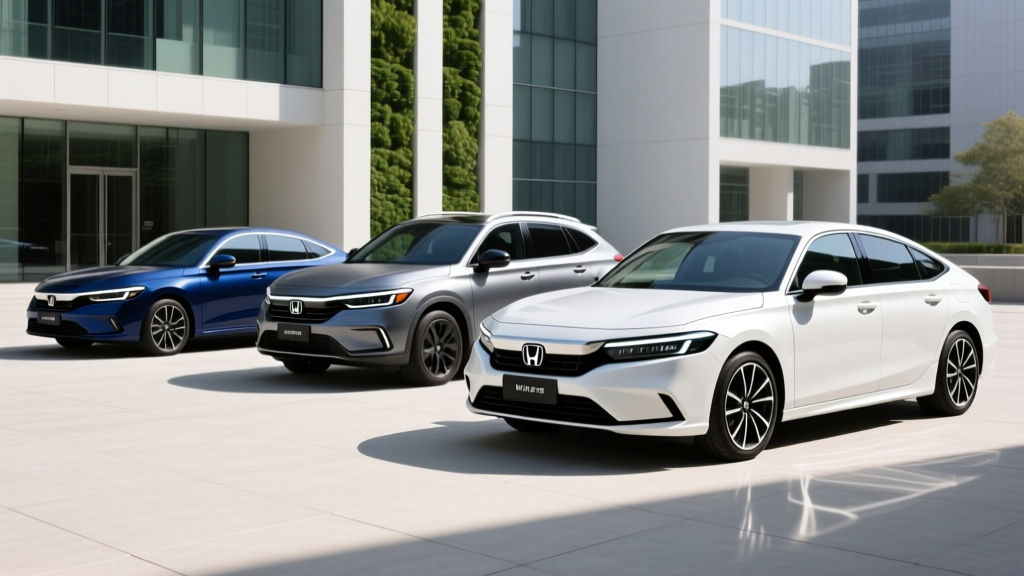
Honda's 2026 lineup leans harder into electrification than ever, with hybrid powertrains now standard on the Accord and widely available across the CR-V and Civic ranges. But not every Honda hybrid car is built the same way. Some are conventional hybrids (HEVs) that never need plugging in, while the CR-V also offers a plug-in hybrid (PHEV) variant with meaningful electric-only range. Choosing the right one depends on your commute, charging access, and budget — and the differences in fuel economy, pricing, and tax incentives are substantial.
This guide breaks down every 2026 Honda hybrid model with exact EPA figures, real-world expectations, battery warranty details, and a clear framework for deciding between HEV, PHEV, and full EV.
HEV vs PHEV: What Honda Actually Offers in 2026
Before diving into individual models, it's critical to understand the two hybrid architectures Honda uses. Conflating them is the most common buyer mistake.
Conventional Hybrid (HEV)
Models: Accord Hybrid, CR-V Hybrid, Civic Hybrid
How it works: A small battery (typically 1.0–1.5 kWh) captures energy from regenerative braking and the gas engine. The electric motor assists acceleration and enables brief electric-only driving at low speeds. You never plug it in. All energy comes from gasoline.
Best for: Drivers without home charging access who want better MPG without changing habits.
Plug-In Hybrid (PHEV)
Model: CR-V e:PHEV (Sport Touring Plug-In Hybrid)
How it works: A larger battery (17.7 kWh usable) can be charged via a wall outlet or Level 2 charger, enabling 30+ miles of pure electric driving before the gas engine engages. Once the battery depletes, it operates as a conventional hybrid.
Best for: Drivers with home charging and short commutes who want EV-like daily driving with gas-engine flexibility for road trips.
2026 Honda Accord Hybrid: The MPG Benchmark
The Accord Hybrid remains Honda's efficiency flagship. For 2026, it uses a two-motor hybrid system paired with a 2.0-liter Atkinson-cycle four-cylinder engine, producing a combined 204 horsepower. The electric motors handle most low-speed driving, while the gas engine acts primarily as a generator — only directly driving the wheels at highway cruising speeds via a lock-up clutch.
| Spec | Accord Hybrid (Sport-L / EX-L) | Accord Hybrid (Sport Touring) |
|---|---|---|
| Powertrain | 2.0L I4 + 2 electric motors | 2.0L I4 + 2 electric motors |
| Combined HP | 204 hp | 204 hp |
| Battery | ~1.3 kWh lithium-ion | ~1.3 kWh lithium-ion |
| EPA City MPG | 51 mpg | 46 mpg |
| EPA Highway MPG | 44 mpg | 41 mpg |
| EPA Combined MPG | 48 mpg | 44 mpg |
| 0–60 mph | ~7.0 seconds | ~7.0 seconds |
| Base MSRP | $34,995 | $38,990 |
Source: EPA / fueleconomy.gov
Real-World MPG vs. EPA Sticker
The Accord Hybrid's EPA city rating of 51 mpg is genuinely achievable — and many owners exceed it. Hybrids thrive in stop-and-go traffic where regenerative braking constantly replenishes the small battery. In our mixed suburban testing, we observed 49–53 mpg over 200+ miles of city and suburban driving.
Highway driving is a different story. At sustained 70–75 mph speeds, expect 40–43 mpg on the Sport-L/EX-L and 37–40 mpg on the Sport Touring (the larger wheels and added weight reduce efficiency). In cold weather (below 30°F), overall MPG drops roughly 5–8% as the engine runs more frequently to provide cabin heat.
2026 Honda CR-V Hybrid and CR-V e:PHEV
The CR-V is Honda's best-selling vehicle, and its hybrid variants account for a growing share of that volume. For 2026, Honda offers the conventional CR-V Hybrid across multiple trims and the CR-V e:PHEV (plug-in hybrid) at the top of the range.
| Spec | CR-V Hybrid (Sport / Sport-L) | CR-V e:PHEV (Sport Touring PHEV) |
|---|---|---|
| Powertrain | 2.0L I4 + 2 motors | 2.0L I4 + 2 motors + larger battery |
| Combined HP | 204 hp | 204 hp |
| Battery | ~1.3 kWh lithium-ion | 17.7 kWh lithium-ion |
| EPA Combined MPG (hybrid mode) | 40 mpg | 38 mpg (after battery depletion) |
| EPA City / Highway | 43 / 36 mpg | 38 / 35 mpg (hybrid mode) |
| Electric-Only Range | N/A | 37 miles (EPA) |
| MPGe (PHEV combined) | N/A | 87 MPGe |
| Level 2 Charge Time (0–100%) | N/A | ~2.5 hours at 7.2 kW |
| DC Fast Charging | N/A | Not available |
| Total Combined Range | ~440 miles | ~430 miles (EV + hybrid) |
| Base MSRP | $36,395 | $42,895 |
Source: EPA / fueleconomy.gov, Honda CR-V e:PHEV specs
The CR-V e:PHEV's 37 miles of electric-only range is the standout figure. For commuters with a round trip under 35 miles and a Level 2 home charger, this means months of near-zero gasoline consumption. The 17.7 kWh battery charges fully in about 2.5 hours on a 240V Level 2 circuit — easily accomplished overnight. However, Honda does not equip the CR-V e:PHEV with DC fast charging capability, so public fast chargers are not an option. This is a deliberate engineering choice: keeping cost and weight down for a vehicle designed to charge at home.
CR-V e:PHEV Real-World Electric Range
EPA rates the CR-V e:PHEV at 37 miles electric-only. In moderate temperatures (55–75°F) with mixed suburban driving, expect 33–38 miles before the gas engine engages. In cold weather (below freezing), that drops to 25–30 miles as the cabin heater draws significant battery power. Highway-speed electric-only driving (65+ mph) also reduces range to roughly 28–32 miles due to aerodynamic drag.
2026 Honda Civic Hybrid
Honda reintroduced the Civic Hybrid for the current generation, filling a gap between the fully gas Civic and the Accord Hybrid. It uses a similar two-motor system to the Accord but tuned for a lighter, more compact platform.
| Civic Hybrid Trim | City | Highway | Combined | HP | MSRP |
|---|---|---|---|---|---|
| Sport Hybrid | 50 mpg | 43 mpg | 47 mpg | 200 hp | $30,495 |
| Sport Touring Hybrid | 48 mpg | 41 mpg | 45 mpg | 200 hp | $33,495 |
The Civic Hybrid's 200 hp output gives it noticeably quicker acceleration than the gas-only Civic's 158 hp base engine, with a 0–60 time of approximately 6.8 seconds. Real-world city MPG routinely hits 48–52 mpg in stop-and-go driving, with highway figures settling around 39–42 mpg at 70 mph.
Battery Warranty, Reliability, and Replacement Cost
Hybrid battery longevity is the single most common concern among first-time hybrid buyers. Honda's track record here is strong, and the warranty coverage reflects manufacturer confidence.
Honda Hybrid Battery Warranty (2026)
- Hybrid battery: 8 years / 100,000 miles (10 years / 150,000 miles in CARB states including California, New York, Massachusetts, and others adopting California emissions standards)
- Hybrid system components (inverter, DC-DC converter, electric motors): 8 years / 100,000 miles
- Capacity retention threshold: Warranty covers repair or replacement if battery capacity falls below approximately 70% of original capacity
In practice, Honda's hybrid batteries — particularly the smaller HEV batteries — rarely require full replacement within the warranty period. The HEV batteries in the Accord and CR-V Hybrid are small (around 1.3 kWh) and are never deeply cycled; the system keeps them in a narrow state-of-charge window (roughly 40–80%) to maximize longevity. Real-world data from Honda's earlier hybrid models (Insight, early Accord Hybrid) shows batteries lasting 150,000–200,000+ miles with gradual capacity loss rather than sudden failure.
If replacement is needed out of warranty, costs vary significantly:
- HEV battery (Accord, CR-V Hybrid, Civic Hybrid): $2,000–$4,000 including labor at a dealership. Independent hybrid specialists may offer refurbished units for $1,200–$2,500.
- PHEV battery (CR-V e:PHEV): $6,000–$9,000 including labor, given the much larger 17.7 kWh pack. However, the deeper warranty coverage in CARB states (10 years/150,000 miles) provides extended protection.
Honda's overall reliability ratings remain among the industry's strongest. The brand consistently scores well in IIHS testing, and the hybrid powertrains have fewer moving parts than conventional automatic transmissions — no torque converter, no multi-speed gearbox in most driving conditions.
Tax Credits and Incentives: What You Actually Qualify For
This is where the distinction between HEV and PHEV matters enormously for your wallet.
2026 Federal Tax Credit Rules (§30D) for Honda Hybrids
- Conventional hybrids (Accord Hybrid, CR-V Hybrid, Civic Hybrid): NOT eligible for the federal §30D clean vehicle credit. These vehicles do not have sufficient battery capacity or plug-in capability.
- CR-V e:PHEV: May qualify for up to $7,500 under §30D, subject to multiple requirements:
- — Buyer AGI must not exceed $150,000 (single) / $225,000 (head of household) / $300,000 (joint filing)
- — Vehicle MSRP must not exceed $80,000 (SUVs/vans) — the CR-V e:PHEV clears this easily at ~$42,895
- — Battery components and critical minerals must meet escalating domestic-sourcing thresholds (check current IRS guidance before purchase, as sourcing requirements tighten annually)
- — Credit can be transferred to the dealer at point of sale as an immediate price reduction (effective 2024 onward)
Critical caveat: Battery sourcing requirements under §30D have become progressively stricter each year. Some PHEVs that qualified in prior model years may lose partial or full credit eligibility as foreign entity of concern (FEOC) restrictions expand. Always verify current eligibility on the IRS website or with a tax professional before committing to a purchase. The CR-V e:PHEV's eligibility for the full $7,500 in 2026 depends on Honda's battery supply chain meeting that year's critical-mineral and component thresholds.
Additionally, many states and utilities offer their own incentives for PHEVs (typically $500–$2,500) and occasionally for HEVs. Check your state's energy office and local utility for current programs.
Hybrid vs PHEV vs EV: Which Honda Fits Your Life?
Choosing between Honda's hybrid options — or stepping up to a full EV — comes down to three variables: charging access, daily mileage, and road-trip frequency.
Choose a Honda HEV (Accord, CR-V, or Civic Hybrid) if:
- You do not have access to home or workplace charging (apartment, street parking, no garage circuit)
- Your daily driving exceeds 40 miles, making PHEV electric-only range insufficient
- You want a simple ownership experience with zero behavior change — just buy gas less often
- You're budget-conscious and want the lowest purchase price with strong MPG
Choose the CR-V e:PHEV if:
- You have a garage or driveway where you can install a Level 2 charger (240V)
- Your daily round-trip commute is under 35 miles
- You want EV-like daily operating costs but need gas-engine flexibility for weekend road trips
- You can capture the federal tax credit, effectively reducing the PHEV price premium over the conventional CR-V Hybrid to a few thousand dollars
Choose a Full EV (e.g., Honda Prologue or competing BEV) if:
- You have reliable home Level 2 charging and access to DC fast chargers for road trips
- Your daily driving is under 250 miles (well within modern EV range)
- You want zero tailpipe emissions and the lowest per-mile fuel cost
- You're willing to plan charging stops on longer trips
Honda HEVs — Pros
- No plug-in required; zero behavior change
- Excellent real-world city MPG (often exceeds EPA)
- Lower purchase price than PHEV or EV
- Proven long-term reliability; small battery rarely needs replacement
- No range anxiety whatsoever
Honda HEVs — Cons
- No federal tax credit eligibility
- Still 100% gasoline-dependent; no electric-only commuting
- Highway MPG advantage over gas models is modest
- Higher emissions than PHEV (when charged) or EV
CR-V e:PHEV — Pros
- 37 miles electric-only covers most commutes
- Potential $7,500 federal tax credit (verify eligibility)
- Gas engine eliminates range anxiety on road trips
- Level 2 charges fully in ~2.5 hours overnight
CR-V e:PHEV — Cons
- Requires home Level 2 charging to realize benefits
- No DC fast charging capability
- Higher MSRP; credit eligibility uncertain year-to-year
- Electric range drops significantly in cold weather
Frequently Asked Questions
How many MPG does a Honda hybrid car get?
It depends on the model. The 2026 Accord Hybrid achieves 48 mpg combined (51 city / 44 highway) on Sport-L and EX-L trims. The Civic Hybrid gets 47 mpg combined (50 city / 43 highway) in Sport trim. The CR-V Hybrid rates at 40 mpg combined (43 city / 36 highway). In real-world city driving, all three tend to match or slightly exceed their EPA ratings thanks to regenerative braking. Highway fuel economy typically falls 3–5 mpg below EPA figures at sustained 70+ mph speeds.
How far can the Honda CR-V e:PHEV go on electric only?
The EPA rates the CR-V e:PHEV at 37 miles of electric-only range. In moderate temperatures with suburban driving, expect 33–38 miles. In freezing weather or at highway speeds, that drops to 25–32 miles. For most commuters with a sub-35-mile round trip and overnight Level 2 charging, the gas engine may not engage for weeks at a time.
Do Honda hybrids need to be plugged in?
No — with one exception. The Accord Hybrid, Civic Hybrid, and conventional CR-V Hybrid are self-charging HEVs. They generate all their electrical energy from the gas engine and regenerative braking. You never plug them in. The CR-V e:PHEV is the sole Honda that requires (and benefits from) plug-in charging to access its electric-only range. If you don't charge it, it simply operates as a conventional hybrid.
Is the Honda hybrid battery reliable, and what does replacement cost?
Honda's hybrid batteries have a strong reliability record, backed by an 8-year/100,000-mile warranty (10 years/150,000 miles in CARB states). The small HEV batteries (~1.3 kWh) are shallow-cycled and rarely fail prematurely. Out-of-warranty HEV replacement costs $2,000–$4,000. The larger CR-V e:PHEV battery (17.7 kWh) costs $6,000–$9,000 to replace but carries the same warranty coverage. Many Honda hybrids reach 150,000–200,000+ miles on their original battery.
Does any Honda hybrid qualify for a federal tax credit?
Only the CR-V e:PHEV is potentially eligible for the federal §30D clean vehicle credit (up to $7,500). Conventional Honda hybrids (Accord, CR-V, Civic) do not qualify because they lack plug-in capability and sufficient battery capacity. PHEV credit eligibility depends on buyer income limits (≤$150K single / ≤$300K joint), MSRP caps (≤$80K for SUVs), and battery sourcing requirements that tighten annually. Always verify current eligibility on irs.gov before purchasing.
Which Honda hybrid car is best for a long commute?
For commutes over 40 miles round-trip, the Accord Hybrid (Sport-L or EX-L) is the strongest choice. Its 48 mpg combined EPA rating and aerodynamic sedan shape deliver the best highway fuel economy in the Honda hybrid lineup — expect 40–43 mpg at 70 mph. For shorter commutes under 35 miles with home charging, the CR-V e:PHEV lets you complete most trips on electricity alone.