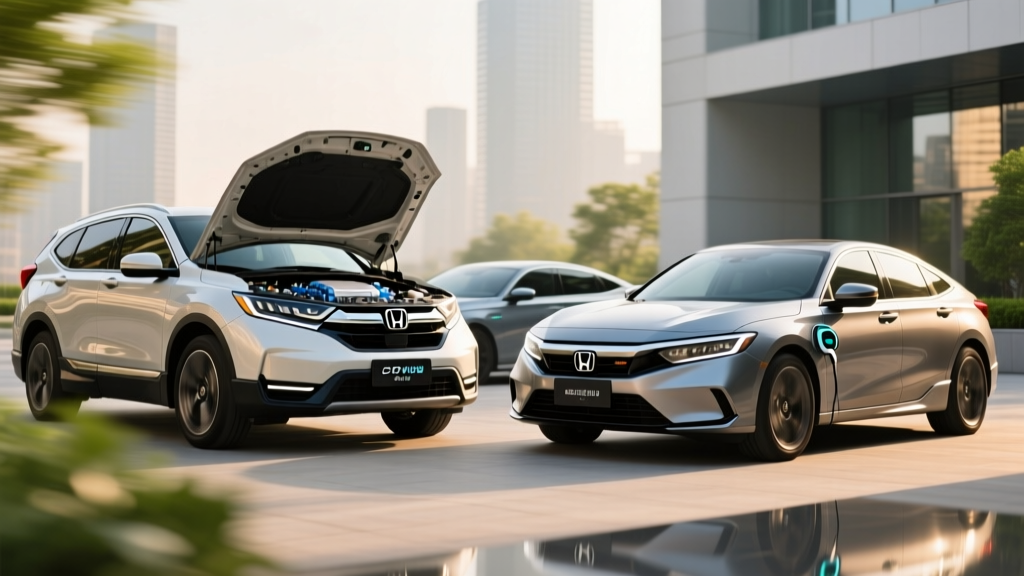
Honda's 2025 hybrid lineup spans three core models — the CR-V Hybrid, Accord Hybrid, and Civic Hybrid — all using the brand's two-motor e:HEV system. None of these are plug-in hybrids. They never need to be plugged in, they regenerate energy through braking and engine operation, and they deliver 40+ MPG in real-world driving without any change in driver habits. For buyers weighing a honda hybrid 2025 purchase against a full EV or a conventional gas car, this guide covers every spec, efficiency figure, warranty detail, and ownership cost you need to decide.
2025 Honda Hybrid Lineup at a Glance
Honda simplified its hybrid strategy for 2025: three models, all conventional hybrids (HEVs), all using variants of the fourth-generation two-motor hybrid system. There is no plug-in hybrid (PHEV) option in Honda's US lineup for 2025 — the Clarity PHEV was discontinued after 2021, and Honda has committed to the e:HEV architecture for its mainstream models while reserving full BEV platforms for the Prologue and upcoming 0 Series.
| Spec | 2025 CR-V Hybrid | 2025 Accord Hybrid | 2025 Civic Hybrid |
|---|---|---|---|
| Powertrain | 2.0L 4-cyl + 2 motors | 2.0L 4-cyl + 2 motors | 2.0L 4-cyl + 2 motors |
| Combined HP | 204 hp | 204 hp | 200 hp |
| Combined Torque | 247 lb-ft | 247 lb-ft | 232 lb-ft |
| EPA City MPG | 43 (FWD) / 40 (AWD) | 51 | 50 |
| EPA Highway MPG | 36 (FWD) / 34 (AWD) | 44 | 47 |
| EPA Combined MPG | 40 (FWD) / 37 (AWD) | 48 | 49 |
| Drivetrain | FWD or AWD | FWD | FWD |
| 0-60 mph (est.) | ~7.6 sec | ~7.0 sec | ~7.2 sec |
| Battery Type | Lithium-ion | Lithium-ion | Lithium-ion |
| Starting MSRP | $36,395 (Sport) | $33,655 (Sport) | $29,845 (Sport) |
Source: fueleconomy.gov and Honda Newsroom. Pricing reflects 2025 base hybrid trims including destination.
How the e:HEV Two-Motor System Works (HEV vs PHEV)
Every 2025 Honda hybrid uses the e:HEV system, which is a conventional hybrid (HEV) — not a plug-in hybrid (PHEV). Understanding this distinction is essential before you buy.
Conventional Hybrid (HEV) — What Honda Offers
- Battery recharges via regenerative braking and the gasoline engine
- No plug, no charging cable, no home charger needed
- Smaller battery (~1.0-1.5 kWh usable) — assists the engine, doesn't drive solo for long
- Electric-only driving limited to low-speed, short-distance creep (under ~1 mile)
- Fuel economy benefit: 30-50% better MPG than a gas-only equivalent
Plug-in Hybrid (PHEV) — What Honda Does NOT Offer in 2025
- Larger battery (typically 15-20 kWh) that can be plugged in to recharge
- 20-40 miles of electric-only range before the gas engine engages
- Can qualify for the federal §30D tax credit (up to $7,500) if battery sourcing rules are met
- Requires access to Level 1 or Level 2 charging for maximum benefit
Honda's US lineup does not include a PHEV for 2025. If you need plug-in electric range for short commutes, you'll need to look at competitors like the Toyota RAV4 Prime (42 miles EV range) or the Hyundai Tucson PHEV (33 miles EV range). Honda's strategy is to maximize HEV efficiency across its volume sellers and reserve electrification investment for full BEVs.
Fuel Economy: EPA Ratings vs Real-World MPG
Hybrid fuel economy behaves differently than gas-car MPG. Because the electric motor handles low-speed driving — where gas engines are least efficient — hybrids often exceed their EPA city ratings in stop-and-go traffic while falling short on sustained highway driving. Here's what to expect from each 2025 Honda hybrid.
| Model | EPA City | EPA Highway | EPA Combined | Real-World Expectation |
|---|---|---|---|---|
| CR-V Hybrid FWD | 43 | 36 | 40 | 38-44 MPG (city-biased driving can hit 45+) |
| CR-V Hybrid AWD | 40 | 34 | 37 | 35-40 MPG (AWD system adds parasitic loss) |
| Accord Hybrid | 51 | 44 | 48 | 46-54 MPG (city commuters regularly report 50+) |
| Civic Hybrid | 50 | 47 | 49 | 47-53 MPG (lighter weight = consistent efficiency) |
For a driver covering 15,000 miles annually with an Accord Hybrid at a real-world 48 MPG, annual fuel consumption is approximately 312 gallons. At $3.40/gallon (2025 national average), that's roughly $1,060/year in fuel. A comparable gas-only midsize sedan at 30 MPG combined would burn 500 gallons — about $1,700/year. The hybrid saves roughly $640 annually in fuel.
Powertrain Deep Dive: Engine, Motors, and Battery
The 2025 Honda hybrids all use a 2.0-liter Atkinson-cycle four-cylinder engine paired with two electric motors — one functioning primarily as a generator and the other as the drive motor. This is a series-parallel hybrid architecture, meaning the car can operate in three modes:
- EV Drive: Battery powers the drive motor alone (low speeds, gentle acceleration)
- Hybrid Drive: Engine spins the generator motor, which feeds electricity to the drive motor (most driving conditions)
- Engine Drive: Engine connects directly to the wheels via a lock-up clutch (steady highway cruising)
The lithium-ion battery packs in these vehicles are relatively small — approximately 1.0 to 1.5 kWh of usable capacity. This is by design. The battery doesn't need to store large amounts of energy because it's constantly being cycled: capturing regenerative braking energy and receiving charge from the generator motor. The small size keeps weight down and packaging simple — the battery sits under the rear seats or cargo floor without compromising interior space.
Combined system output is 204 horsepower and 247 lb-ft of torque in the CR-V and Accord, and 200 hp / 232 lb-ft in the Civic. These are competitive figures — the CR-V Hybrid's torque output actually exceeds the turbocharged 1.5T gas model (190 hp, 179 lb-ft), giving it noticeably stronger low-end acceleration from stops.
Pricing, Trims, and Tax Credit Eligibility
Honda positions its hybrid trims as the sport-oriented variants, making the hybrid powertrain the upgrade rather than a budget option. Here's the 2025 pricing breakdown:
| Model | Hybrid Trim | MSRP (incl. destination) | Key Features |
|---|---|---|---|
| Civic Hybrid | Sport Hybrid | $29,845 | 200 hp, 49 MPG combined, Honda Sensing suite |
| Accord Hybrid | Sport Hybrid | $33,655 | 204 hp, 48 MPG combined, 12.3" touchscreen |
| Accord Hybrid | Sport-L Hybrid | $36,055 | Leather-trimmed seats, wireless CarPlay/Android Auto |
| CR-V Hybrid | Sport Hybrid | $36,395 | 204 hp, 40 MPG combined (FWD), 18" wheels |
| CR-V Hybrid | Sport Touring Hybrid | $42,195 | AWD standard, Bose audio, heated rear seats, hands-free liftgate |
The hybrid premium over a gas-only equivalent is modest. A Civic Sport (gas) starts around $26,745, making the hybrid upgrade roughly $3,100. At $640/year in fuel savings, the payback period is approximately five years — shorter if gas prices rise or if your driving is city-heavy where the hybrid's advantage is greatest.
Battery Warranty, Reliability, and Replacement Cost
Honda Hybrid Battery Warranty
Standard coverage: 8 years / 100,000 miles (whichever comes first)
CARB-state coverage: 10 years / 150,000 miles in states that follow California Air Resources Board emissions standards (includes CA, NY, MA, NJ, CT, RI, VT, ME, OR, WA, CO, MD, DE, and others)
What's covered: Defects in materials/workmanship and capacity loss below functional thresholds that impair vehicle operation
Honda's hybrid battery reliability record is strong. The company has been selling hybrids in the US since the 2000 Insight, and the current lithium-ion packs have shown minimal degradation issues in fleet data. Unlike full EVs where battery replacement can cost $10,000-$20,000, Honda hybrid battery packs are smaller and less expensive to replace.
Estimated out-of-warranty replacement cost: $2,000-$4,000 for the hybrid battery pack (parts and labor), depending on the model. This is a fraction of BEV battery replacement costs because the pack is roughly 1/50th the capacity of a typical EV battery. Independent hybrid repair shops can often replace individual cells or modules for even less — typically $1,000-$2,500.
The hybrid system's other components — the power control unit (inverter), the two motor-generators, and the transmission — are covered under the standard 5-year/60,000-mile powertrain warranty, with the hybrid-specific components covered for 8 years/100,000 miles. Honda's official specifications detail the full hybrid system warranty terms by model.
Who Should Choose a Honda Hybrid vs a Full EV or Gas Car
Choose a Honda Hybrid (HEV) If:
- You don't have access to home or workplace charging (apartment, street parking)
- You want 40-50 MPG without changing any habits — no plugs, no apps, no route planning
- Your budget is $29,000-$42,000 and you want a mainstream brand with wide dealer support
- You take frequent road trips and don't want to plan around charging stops
- You live in a cold climate where EV range loss is a concern (hybrids lose far less efficiency in winter)
Choose a Full EV (BEV) If:
- You can install a Level 2 home charger (240V) and most of your driving is under 250 miles/day
- You want to eliminate fuel costs entirely and qualify for the $7,500 federal tax credit (income and sourcing rules apply)
- You prioritize instant torque, one-pedal driving, and zero tailpipe emissions
- You're willing to plan longer road trips around DC fast-charging networks
Choose a Gas-Only Car If:
- Your budget is strictly under $26,000 and every dollar of upfront cost matters
- You drive very few miles per year (under 5,000) — the hybrid fuel savings won't offset the price premium
- You plan to keep the car for only 2-3 years and want the lowest possible purchase price
For the majority of US drivers covering 10,000-15,000 miles per year without reliable charging access, the Honda hybrid lineup offers the lowest-friction path to significantly better fuel economy. The Civic Hybrid at $29,845 and 49 MPG combined is arguably the best value in the entire lineup — it's one of the most efficient non-plug-in vehicles sold in America.
✓ Pros
- Class-leading MPG — Accord and Civic near 50 combined
- No charging infrastructure needed whatsoever
- Strong low-end torque from electric motors (feels quicker than HP suggests)
- Competitive pricing with hybrid as a premium sport trim
- 8yr/100k battery warranty (10yr/150k in CARB states)
- Proven Honda Sensing ADAS suite standard on all trims
✗ Cons
- No PHEV option — can't drive on electric-only for commutes
- No federal tax credit eligibility
- AWD only available on CR-V (not Accord or Civic)
- Highway MPG drops noticeably at 75+ mph
- CVT-like driving feel under hard acceleration (engine drones at fixed RPM)
- Hybrid trims start at Sport level — no base-price hybrid option
Frequently Asked Questions
How many MPG does the 2025 Honda hybrid lineup get?
The 2025 Civic Hybrid leads at 49 MPG combined (50 city / 47 highway). The Accord Hybrid achieves 48 combined (51 city / 44 highway). The CR-V Hybrid delivers 40 combined with FWD (43 city / 36 highway) and 37 combined with AWD. In real-world city driving, all three models frequently exceed their EPA combined ratings due to the electric motor's dominance at low speeds.
Do Honda hybrids need to be plugged in?
No. All 2025 Honda hybrids are conventional hybrids (HEVs), not plug-in hybrids (PHEVs). The battery recharges entirely through regenerative braking and the gasoline engine. There is no plug, no charging cable, and no need for any charging infrastructure.
Does the 2025 Honda hybrid qualify for any tax credit?
Not at the federal level. The IRS §30D clean vehicle credit requires plug-in capability and a minimum battery capacity of 7 kWh — Honda's hybrid batteries are well under 2 kWh. Some states may offer efficiency-based incentives, but there is no federal tax credit for conventional hybrids. Check IRS.gov for current credit rules.
How long will the Honda hybrid battery last?
Honda warrants its hybrid batteries for 8 years/100,000 miles (10 years/150,000 miles in CARB states). In practice, Honda's lithium-ion hybrid packs have shown excellent longevity, with many first-generation Insight and Accord Hybrid owners reporting well over 150,000 miles on original batteries. The smaller battery size and constant shallow cycling (rather than deep charge/discharge) contribute to long life.
What does a Honda hybrid battery replacement cost?
Out-of-warranty replacement typically runs $2,000-$4,000 at a Honda dealer (parts and labor). Independent hybrid specialists may offer repairs for $1,000-$2,500 by replacing individual modules rather than the entire pack. This is far less expensive than EV battery replacement, which can exceed $15,000.
Is the 2025 Honda hybrid reliable?
Honda's e:HEV system has been in production since 2020 (third generation) and entered its fourth generation for 2023-2025 models. The system has fewer moving parts than a conventional automatic transmission — there's no multi-speed gearbox, just a single fixed-ratio connection for highway cruising. IIHS safety ratings are strong across the lineup, with the Accord and CR-V earning Top Safety Pick designations. Long-term reliability data from Consumer Reports and owner forums shows the hybrid powertrain to be among Honda's most dependable systems.
Hybrid vs PHEV vs EV — which Honda should I buy?
Honda only offers conventional hybrids in 2025 — there is no PHEV and the Prologue BEV is a separate, larger, more expensive vehicle ($47,400 starting). If you want a Honda and can't charge at home, the hybrid is the clear choice. If you want plug-in capability, you'll need to cross-shop Toyota (RAV4 Prime, Prius Prime) or Hyundai/Kia PHEVs. If you want a full EV from Honda, the Prologue is the current option, with the 0 Series sedans and SUVs expected for 2026-2027.