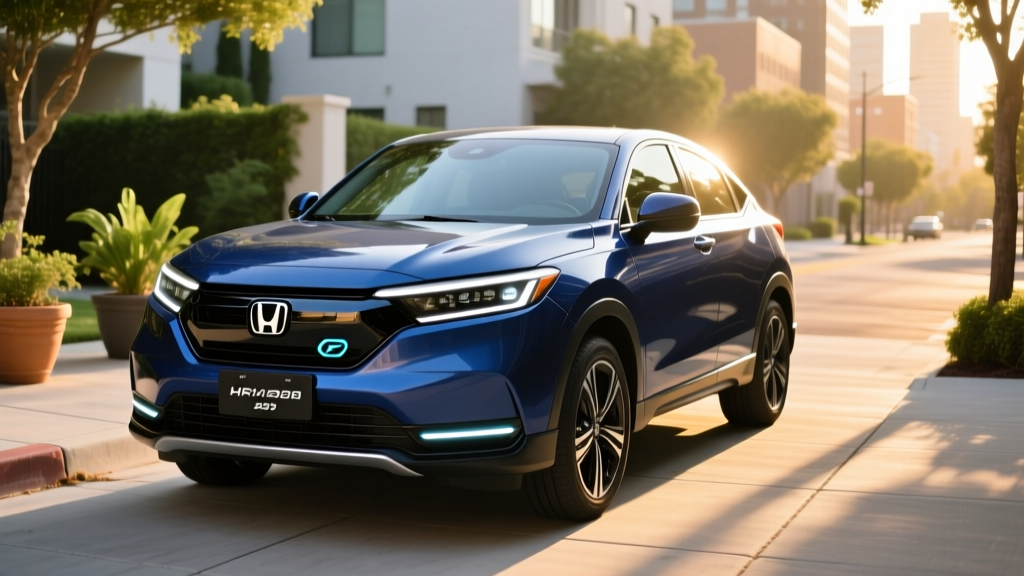
If you've been searching for a Honda HR-V 2025 hybrid, you've likely noticed something confusing: Honda's smallest SUV doesn't currently offer a hybrid powertrain in the United States. While Honda sells hybrid versions of the CR-V, Accord, and Civic, the HR-V remains a conventional gas-only model for the 2025 model year. That doesn't mean electrified subcompact SUV shoppers are out of luck — it just means you need to look at the full picture before making a purchase decision.
This guide breaks down exactly what Honda offers for 2025, clarifies the hybrid (HEV) versus plug-in hybrid (PHEV) distinction, and points you toward the most efficient alternatives that actually exist today.
Does a 2025 Honda HR-V Hybrid Exist?
As of the 2025 model year, Honda does not sell a hybrid HR-V in the US market. The HR-V is built on Honda's global small-car platform and is powered exclusively by a 2.0-liter naturally aspirated four-cylinder engine producing 158 horsepower, paired with a continuously variable transmission (CVT). Front-wheel drive is standard; all-wheel drive is available.
Internationally, Honda has offered hybrid variants of the HR-V (badged as the Vezel in Japan) using the e:HEV system. However, that powertrain has not been certified or marketed for US consumers. Honda's US hybrid strategy concentrates on larger, higher-volume models where the fuel-economy payoff and sales volume justify the engineering investment.
2025 Honda HR-V Gas Model: Fuel Economy and Specs
Since the HR-V is the vehicle you'll actually find at US dealerships, here are the official EPA fuel economy figures for the 2025 model:
| Drivetrain | City MPG | Highway MPG | Combined MPG |
|---|---|---|---|
| FWD | 26 | 32 | 28 |
| AWD | 25 | 30 | 27 |
Real-world expectations: In mixed city/highway driving, owners commonly report 26–29 MPG combined with the FWD model. Highway-only trips at 70+ mph may drop to 28–30 MPG. In stop-and-go city traffic, the CVT keeps the engine in its efficient range, but without a hybrid system to recapture braking energy, you won't see the city-MPG boost that hybrids deliver.
Hybrid (HEV) vs Plug-In Hybrid (PHEV) vs Full EV: What's the Difference?
Before evaluating alternatives, it's critical to understand the three electrified powertrain types. Honda uses different systems across its lineup, and confusing them leads to bad purchase decisions.
| Feature | HEV (Hybrid) | PHEV (Plug-In Hybrid) | BEV (Full Electric) |
|---|---|---|---|
| Plugs in? | No | Yes | Yes |
| Electric-only range | None (motor assists engine) | 20–50 miles typical | 200–400+ miles |
| Gas engine? | Yes (primary) | Yes (backup) | No |
| Battery size | 1–2 kWh | 10–25 kWh | 60–100+ kWh |
| Federal tax credit | No | Up to $7,500 (if eligible) | Up to $7,500 (if eligible) |
| Home charging needed? | No | Recommended for full benefit | Essential |
Conventional hybrids (HEVs) like the Toyota Corolla Cross Hybrid or Honda CR-V Hybrid never plug in. A small battery captures energy from regenerative braking and assists the gas engine during acceleration, boosting MPG — especially in city driving where the electric motor handles low-speed movement.
Plug-in hybrids (PHEVs) like the Toyota RAV4 Prime or Hyundai Tucson PHEV have a larger battery you charge from a wall outlet or public charger. They deliver 20–50 miles of pure electric driving before the gas engine kicks in. If your commute is short and you charge nightly, you may burn almost no gasoline on weekdays.
Full EVs (BEVs) have no gas engine at all. They offer the lowest operating costs but require reliable charging access — ideally a Level 2 home charger.
Best Hybrid Alternatives to the HR-V for 2025
If hybrid fuel economy is a priority and you want something in Honda's ecosystem or the subcompact/compact SUV segment, here are the strongest options currently on sale:
2025 Honda CR-V Hybrid
Honda's most popular hybrid is the CR-V Hybrid, which uses a two-motor hybrid system with a 2.0-liter Atkinson-cycle engine. Combined output is 204 horsepower and 247 lb-ft of torque. The CR-V Hybrid is a half-size larger than the HR-V but delivers dramatically better efficiency.
| Drivetrain | City MPG | Highway MPG | Combined MPG |
|---|---|---|---|
| FWD | 43 | 36 | 40 |
| AWD | 40 | 34 | 37 |
Real-world MPG: Honda's two-motor hybrid system excels in city driving, where owners regularly report 38–44 MPG combined. Highway efficiency drops somewhat because the engine must directly drive the wheels at higher speeds without the same regenerative benefit. Expect 34–38 MPG on long highway trips.
Starting MSRP: Approximately $34,050 (Sport Hybrid FWD), rising to ~$40,000 for the Sport Touring Hybrid AWD. The CR-V Hybrid does not qualify for the federal §30D tax credit because it is a conventional HEV — only PHEVs and BEVs are eligible under current IRS rules.
2025 Toyota Corolla Cross Hybrid
The closest direct competitor to an "HR-V Hybrid" that actually exists is the Toyota Corolla Cross Hybrid. It uses Toyota's fifth-generation hybrid system with a 2.0-liter engine and three electric motors for a combined 196 horsepower. AWD is standard.
EPA fuel economy: 46 city / 43 highway / 44 combined MPG. In real-world testing, the Corolla Cross Hybrid frequently exceeds its EPA city estimate, with some owners reporting 48–50 MPG in urban stop-and-go conditions — a hallmark of Toyota's hybrid system, which uses the electric motor heavily at low speeds.
Starting MSRP: Approximately $29,350 for the S Hybrid trim, making it one of the most affordable hybrid SUVs on the market. Like the CR-V Hybrid, it is a conventional HEV and does not qualify for the federal EV tax credit.
2025 Kia Niro Hybrid
Another strong subcompact hybrid SUV is the Kia Niro, which offers both HEV and PHEV variants. The hybrid model delivers an EPA-estimated 53 city / 48 highway / 50 combined MPG with a 1.6-liter engine and 32 kW electric motor producing a combined 139 horsepower.
The Niro PHEV variant offers approximately 33 miles of electric-only range on a full charge from its 11.1 kWh battery pack. Level 2 charging (240V) replenishes the battery in roughly 3 hours. It does not support DC fast charging — a common limitation for PHEVs, which have smaller batteries that don't justify the cost of DC hardware.
The Niro PHEV may qualify for a partial federal tax credit depending on current-year battery sourcing and critical mineral requirements. Check the latest fueleconomy.gov tax credit database for up-to-date eligibility.
Hybrid Battery Reliability and Warranty: What Buyers Need to Know
One of the most common concerns among first-time hybrid buyers is battery longevity. The good news: modern hybrid batteries are among the most durable components in the vehicle.
Real-World Hybrid Battery Longevity
Conventional hybrid batteries (1–2 kWh) experience relatively shallow charge/discharge cycles. The battery management system keeps the state of charge (SoC) between roughly 40% and 80%, avoiding the deep cycles that accelerate degradation. As a result, most hybrid batteries last 150,000–200,000+ miles before capacity loss becomes noticeable.
Toyota Prius taxis routinely exceed 300,000 miles on original hybrid batteries. Honda's two-motor system in the CR-V Hybrid uses a similar conservative management strategy.
Battery Replacement Cost
If a hybrid battery does fail outside warranty, replacement costs vary by model:
- Honda CR-V Hybrid: $3,000–$5,000 (dealer-installed, including labor)
- Toyota Corolla Cross Hybrid: $2,500–$4,500
- Kia Niro HEV: $2,500–$4,000
- PHEV batteries (larger packs): $5,000–$9,000 depending on kWh capacity
For context, a conventional gas vehicle's transmission replacement often costs $3,000–$7,000, so a hybrid battery failure is not the catastrophic expense some buyers fear — especially given the 8–10 year warranty coverage.
Federal Tax Credits: Do Hybrids Qualify?
This is a frequent source of confusion, so let's be precise:
- Conventional hybrids (HEVs): Do NOT qualify for the federal §30D New Clean Vehicle Credit. The CR-V Hybrid, Corolla Cross Hybrid, and Niro HEV are ineligible regardless of price or buyer income.
- Plug-in hybrids (PHEVs): MAY qualify for up to $7,500 under the §30D credit, subject to MSRP caps ($80,000 for SUVs), buyer income limits ($150,000 single / $300,000 joint modified AGI), and battery component/critical mineral sourcing requirements that tighten each year.
- Full EVs (BEVs): Same §30D rules as PHEVs, with the same caps and sourcing requirements.
As of 2025, the battery sourcing rules have eliminated eligibility for many models that previously qualified. Always verify current eligibility on the IRS clean vehicle credit page before purchasing. Point-of-sale transfer is available, allowing you to apply the credit as a down payment reduction at the dealer rather than waiting for a tax refund.
Who Should Choose a Hybrid vs a PHEV vs a Full EV?
Choose a Hybrid (HEV) If:
- You want better MPG with zero lifestyle change
- You can't install a home charger (apartment, street parking)
- Your budget is under $35,000
- You drive mostly in the city (where hybrids shine)
- You want maximum simplicity — no plugs, no charging apps
Choose a PHEV If:
- You have a garage or driveway for a Level 2 charger
- Your daily commute is under 30–40 miles round trip
- You want electric driving weekdays, gas flexibility on weekends
- You want to reduce fuel use without range anxiety on road trips
- You may qualify for the §30D tax credit
Choose a Full EV If:
- You have reliable home charging (Level 2 strongly recommended)
- You want the lowest per-mile fuel cost (electricity at $0.12/kWh ≈ $0.04/mile vs gas at $0.12+/mile)
- You want minimal maintenance (no oil changes, no transmission fluid, fewer moving parts)
- Your daily driving is within the vehicle's real-world range
- You want to maximize federal/state incentives
Pricing Comparison: HR-V Gas vs Hybrid Alternatives
| Model | Type | Combined MPG | Starting MSRP | Tax Credit |
|---|---|---|---|---|
| Honda HR-V (AWD) | Gas | 27 | ~$26,400 | None |
| Toyota Corolla Cross Hybrid | HEV | 44 | ~$29,350 | None |
| Kia Niro Hybrid | HEV | 50 | ~$28,000 | None |
| Honda CR-V Hybrid (AWD) | HEV | 37 | ~$35,550 | None |
| Kia Niro PHEV | PHEV | 48 MPG + 33 mi EV | ~$35,000 | Partial* |
*PHEV tax credit eligibility depends on current-year battery sourcing rules, MSRP caps, and buyer income limits. Verify at irs.gov.
Will Honda Add a Hybrid HR-V in the Future?
Honda has committed to expanding its hybrid lineup as a bridge technology while EV adoption grows. The company has confirmed hybrid versions of the Civic (already on sale) and the next-generation CR-V lineup. However, Honda has made no official announcement regarding a hybrid HR-V for the US market.
If Honda does introduce an HR-V Hybrid, it would likely use a version of the two-motor e:HEV system adapted for the smaller platform, targeting 40+ MPG combined. Based on Honda's product cadence, the earliest realistic window would be the next-generation HR-V redesign, likely for the 2027 or 2028 model year. Until then, the models listed above are your best options.
Frequently Asked Questions
How many MPG does the 2025 Honda HR-V get?
The 2025 Honda HR-V is gas-only and gets an EPA-estimated 28 MPG combined (26 city / 32 highway) with front-wheel drive, or 27 MPG combined (25 city / 30 highway) with all-wheel drive. Real-world fuel economy typically falls in the 26–29 MPG range depending on driving conditions.
Is there a plug-in hybrid version of the Honda HR-V?
No. Honda does not offer a PHEV or conventional hybrid HR-V in the United States for the 2025 model year. Honda's US PHEV options are extremely limited — the company has focused its plug-in strategy on other markets. If you want a Honda hybrid, the CR-V Hybrid is the closest alternative.
Which hybrid SUV gets the best MPG in 2025?
Among subcompact/compact SUVs, the Kia Niro Hybrid leads at 50 MPG combined, followed by the Toyota Corolla Cross Hybrid at 44 MPG combined. Both significantly outperform the gas-only Honda HR-V's 27–28 MPG combined.
Are hybrid batteries expensive to replace?
Hybrid battery replacement typically costs $2,500–$5,000 for conventional HEVs and $5,000–$9,000 for PHEVs. However, all hybrid batteries carry a minimum 8-year/100,000-mile warranty (10 years/150,000 miles in CARB states), and real-world data shows most last 150,000–200,000+ miles before significant degradation. For most owners, the battery will outlast their ownership period.
Does any hybrid SUV qualify for the $7,500 federal tax credit?
Only plug-in hybrids (PHEVs) and full EVs (BEVs) qualify for the §30D federal tax credit — conventional hybrids (HEVs) do not. Among PHEV SUVs, eligibility varies based on MSRP caps, buyer income, and battery sourcing requirements that tighten annually. Always verify current eligibility on the IRS website before purchasing.
Should I wait for a hybrid HR-V or buy now?
If hybrid efficiency is a priority, waiting for a potential HR-V Hybrid means a 2–3 year gap with no guarantee Honda will offer one. The Toyota Corolla Cross Hybrid (44 MPG, ~$29,350) and Kia Niro Hybrid (50 MPG, ~$28,000) are available now and deliver the fuel economy an HR-V Hybrid would likely target. If you specifically want a Honda, the CR-V Hybrid is the best current option despite its larger size and higher price.