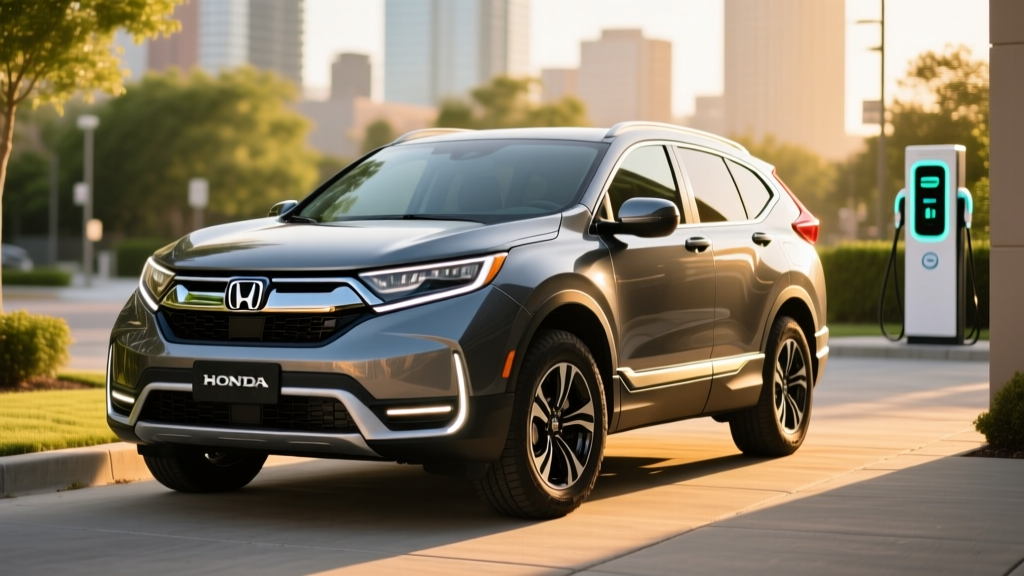
The Honda CR-V has long been a benchmark compact SUV, but the TrailSport Hybrid trim occupies a specific niche: buyers who want the fuel-sipping efficiency of a conventional hybrid (HEV) paired with genuine all-weather capability — without ever plugging in. For 2026, the CR-V TrailSport Hybrid continues with Honda's proven two-motor hybrid system, rugged styling cues, and a standard all-wheel-drive layout that sets it apart from the more pavement-oriented Sport and Sport Touring Hybrid trims.
This is not a plug-in hybrid. There is no electric-only driving mode and no charging port. The TrailSport Hybrid generates its own electricity through regenerative braking and the onboard gasoline engine, storing a small amount in a lithium-ion battery to assist acceleration and enable brief low-speed electric assists. If you need plug-in capability, you'll want to look elsewhere — Honda does not currently offer a PHEV variant of the CR-V in the United States.
HEV vs PHEV: Where the TrailSport Hybrid Fits
Before examining the numbers, it's critical to understand what this vehicle is — and what it is not.
Conventional Hybrid (HEV) — Honda CR-V TrailSport Hybrid
- No plug required. The battery charges via regenerative braking and the gasoline engine.
- No electric-only range to track. The electric motor assists the engine but cannot propel the vehicle alone at highway speeds.
- No federal §30D tax credit. Only plug-in vehicles with sufficient battery capacity qualify.
- Lower upfront cost compared to PHEVs and BEVs with similar capability.
Plug-In Hybrid (PHEV) — e.g., Toyota RAV4 Prime
- Requires plugging in to access full benefits (typically 30-42 miles electric-only).
- Eligible for federal tax credit (up to $7,500, subject to income, MSRP, and battery-sourcing rules under IRS §30D).
- Larger battery (18-20+ kWh) adds weight and cost but enables daily EV-mode commuting.
The TrailSport Hybrid is firmly an HEV. It's designed for drivers who want set-it-and-forget-it efficiency without lifestyle changes — no home charger installation, no route planning around charging stations, no battery-sourcing headaches at tax time.
Fuel Economy: EPA Ratings and Real-World MPG
The headline number for the CR-V TrailSport Hybrid is its EPA-estimated fuel economy. According to fueleconomy.gov, the AWD TrailSport Hybrid achieves:
| Driving Cycle | EPA Estimated MPG |
|---|---|
| City | 40 MPG |
| Highway | 34 MPG |
| Combined | 37 MPG |
Those figures apply specifically to the TrailSport Hybrid with its standard AWD system. The Sport Hybrid FWD variant edges slightly higher at 43/36/40 MPG (city/highway/combined), but the TrailSport's all-terrain tires and revised suspension tuning introduce a small efficiency penalty in exchange for off-pavement capability.
Real-World MPG: What to Actually Expect
Honda's two-motor hybrid system excels in stop-and-go city driving, where regenerative braking recaptures energy and the electric motor handles low-speed propulsion. In real-world testing, many owners report exceeding the EPA city estimate — 42-45 MPG is achievable in dense urban traffic with frequent stops.
Highway driving tells a different story. At sustained 70-80 MPH speeds, the gasoline engine does most of the work, and the boxy SUV aerodynamics work against efficiency. Expect 31-34 MPG on the highway in real-world conditions, particularly with roof racks, crosswinds, or cold temperatures. In sub-freezing winter weather, plan for a 2-4 MPG drop across the board as the engine runs more frequently to provide cabin heat and the battery's charge-discharge efficiency decreases.
With a 15.3-gallon fuel tank, the TrailSport Hybrid delivers a practical total range of approximately 500-570 miles depending on your driving mix — enough for most road trips without a fuel stop.
Powertrain Specs: Two-Motor Hybrid System
| Specification | Detail |
|---|---|
| Engine | 2.0L DOHC Atkinson-cycle 4-cylinder |
| Engine Output | 145 hp @ 6,100 rpm / 134 lb-ft @ 4,500 rpm |
| Electric Motors | Two-motor hybrid system (propulsion + generator) |
| Electric Motor Output | 181 hp / 247 lb-ft |
| Combined System Output | 204 hp / 247 lb-ft |
| Drivetrain | Real Time AWD™ (standard on TrailSport) |
| Transmission | Electronically controlled CVT (e-CVT) |
| 0-60 MPH | ~7.8 seconds (estimated) |
| Towing Capacity | 1,000 lbs |
| Fuel Tank | 15.3 gallons |
| Hybrid Battery | Lithium-ion, ~1.1 kWh (nominal) |
Honda's two-motor system operates differently from Toyota's planetary-gear hybrid setup. In most driving scenarios, the propulsion motor drives the wheels directly while the gasoline engine spins the generator motor to produce electricity. At highway cruising speeds, a lock-up clutch engages to connect the engine directly to the wheels for improved efficiency. The result is smooth, linear acceleration that feels more like an EV than a traditional hybrid — particularly from a stop, where the electric motor's 247 lb-ft of torque is immediately available.
The TrailSport trim adds specific tuning for light off-road use: all-terrain tires, revised damper tuning, and a unique AWD calibration that can send up to 50% of torque to the rear axle. It also includes Hill Descent Control and enhanced underbody protection. This is not a rock crawler, but it handles gravel roads, muddy campsite approaches, and snowy driveways with more confidence than a standard CR-V Hybrid.
Pricing, Trims, and Tax Credit Eligibility
The 2026 Honda CR-V TrailSport Hybrid carries an MSRP starting at approximately $39,845 (including destination charge). This positions it between the Sport Hybrid (~$36,545) and the Sport Touring Hybrid (~$42,445).
Federal Tax Credit: Does It Qualify?
No. The CR-V TrailSport Hybrid is a conventional hybrid (HEV), not a plug-in vehicle. Under IRS §30D rules, only new plug-in electric vehicles (BEVs and PHEVs) with battery capacities of at least 7 kWh are eligible for the federal clean vehicle credit. The TrailSport Hybrid's ~1.1 kWh battery falls far short of this threshold.
Per IRS guidelines, the §30D credit requires:
- Plug-in capability with ≥7 kWh battery capacity
- Vehicle MSRP below $80,000 (SUVs) or $55,000 (sedans)
- Buyer modified adjusted gross income below $300,000 (joint) / $150,000 (single)
- Battery components and critical minerals meeting North American sourcing thresholds
The TrailSport Hybrid meets none of the plug-in or battery-capacity requirements. However, some states and utilities offer rebates for purchasing any hybrid vehicle — check your local Department of Energy or utility provider for programs that may apply.
Battery Warranty, Reliability, and Replacement Cost
Honda Hybrid Battery Warranty
Coverage: 8 years / 100,000 miles (10 years / 150,000 miles in CARB states including CA, CT, ME, MA, NJ, NY, OR, RI, VT, WA)
What's covered: Hybrid battery pack and hybrid system components including the power control unit, electric motors, and related wiring.
Capacity threshold: Honda warrants the battery against defects and abnormal degradation. Unlike BEVs, there is no published minimum state-of-health percentage — hybrid batteries are smaller and experience shallower charge-discharge cycles, resulting in minimal measurable degradation over the vehicle's life.
Long-Term Reliability Outlook
Honda's two-motor hybrid system is now in its third generation in the CR-V, and the powertrain has proven durable. The lithium-ion hybrid battery is small (~1.1 kWh) and operates within a narrow state-of-charge window — typically between 20% and 80% — which dramatically reduces stress on the cells compared to a BEV battery that cycles through its full capacity daily.
Real-world data from earlier-generation Honda hybrids (Insight, Accord Hybrid) shows hybrid batteries routinely lasting 150,000-200,000+ miles before requiring replacement. The CR-V Hybrid's larger thermal management system and updated cell chemistry should equal or exceed that track record.
Battery Replacement Cost
If the hybrid battery does fail outside of warranty, expect a replacement cost of approximately $2,000-$4,000 (parts and labor at a Honda dealer). This is dramatically less than a BEV battery replacement ($8,000-$20,000+) because the hybrid battery pack is physically small and contains far fewer cells. Third-party hybrid battery refurbishers offer reconditioned units for $1,200-$2,500, though availability varies for newer models.
The broader hybrid system — electric motors, power control unit, e-CVT — is covered under the same 8-year/100,000-mile warranty and has proven reliable in Honda's fleet. The e-CVT contains no belts, bands, or traditional friction components; it's essentially a pair of motor-generators connected by a planetary gearset, with very little that can wear out.
TrailSport-Specific Features: What You Get for the Premium
The TrailSport badge isn't just an appearance package. Over the Sport Hybrid, the TrailSport Hybrid adds:
- All-terrain tires (Continental CrossContact A/T) on 17-inch wheels — tuned for gravel and dirt-road grip with acceptable highway noise
- Revised suspension tuning with unique damper valving for rough-surface compliance
- Real Time AWD™ with TrailSport calibration — optimized torque distribution for low-traction surfaces
- Hill Descent Control — maintains set speed on steep downhill grades without brake pedal input
- Enhanced underbody protection — additional skid plates for the oil pan and rear differential
- Unique interior — orange contrast stitching, TrailSport badging, all-season rubber floor mats
- Amber DRLs and rugged exterior trim — matte-finish grille, black cladding, orange tow-hook accents
The trade-off for these off-road-oriented features is a slight efficiency penalty versus the Sport Hybrid FWD (37 MPG combined vs. 40 MPG combined) and a firmer ride on smooth pavement. If your driving is 100% suburban and highway, the Sport Hybrid delivers better fuel economy and a more compliant ride at a lower price. The TrailSport earns its premium when you regularly encounter unpaved roads, snow, or trails.
Hybrid vs PHEV vs EV: Which Powertrain Fits Your Life?
Choose the CR-V TrailSport Hybrid (HEV) if:
- You lack access to home or workplace charging (apartment, street parking, no garage outlet)
- You want better fuel economy without changing any habits — just fill up with gas
- Your daily driving is a mix of city and highway with no single dominant pattern
- You regularly drive in areas with sparse charging infrastructure (rural routes, national parks)
- You want AWD capability without the weight and cost penalty of a large battery pack
Choose a PHEV (e.g., Toyota RAV4 Prime, Mitsubishi Outlander PHEV) if:
- You can install a Level 2 home charger and your commute is under 40 miles round-trip
- You want daily electric-only driving for most trips but gas flexibility for road trips
- You qualify for the federal §30D tax credit (income, MSRP, and sourcing requirements met)
- You're willing to pay a $5,000-$8,000 premium over a comparable HEV for plug-in capability
Choose a Full EV (e.g., Hyundai Ioniq 5, Tesla Model Y) if:
- You have reliable home Level 2 charging and your daily driving is under 250 miles
- You want zero tailpipe emissions and the lowest per-mile "fuel" cost
- You qualify for the full $7,500 federal tax credit, offsetting the higher purchase price
- You're comfortable planning road trips around DC fast-charging stops
The CR-V TrailSport Hybrid occupies the pragmatic middle ground. It won't deliver the $0.04/mile electricity cost of a home-charged EV, nor the 35-mile electric commute of a PHEV. But it will deliver consistent 35-40 MPG with zero infrastructure requirements, zero behavior change, and zero range anxiety — regardless of temperature, terrain, or charging-station availability.
Pros and Cons at a Glance
Pros
- 40 MPG city EPA — class-leading for an AWD compact SUV
- No plug-in required — zero lifestyle change from a gas vehicle
- Standard AWD with genuine light off-road capability
- Smooth, EV-like acceleration from the electric motor (247 lb-ft from 0 rpm)
- Proven Honda hybrid reliability with 8-yr/100,000-mi battery warranty
- Spacious cabin: 36.3 cu ft cargo behind rear seats, 76.5 cu ft with seats folded
- Honda Sensing suite standard (adaptive cruise, lane-keeping, collision mitigation)
Cons
- No plug-in option — cannot drive on electric-only power at meaningful speeds
- Not eligible for the $7,500 federal EV tax credit
- Highway MPG drops to ~31-34 in real-world driving at 75+ MPH
- 1,000-lb towing capacity is low for the segment (RAV4 Hybrid: 1,750 lbs)
- Firmer ride than Sport Hybrid due to TrailSport suspension and A/T tires
- Apple CarPlay/Android Auto wireless only on higher trims; TrailSport requires USB
Frequently Asked Questions
How many MPG does the Honda CR-V TrailSport Hybrid get?
The EPA rates the CR-V TrailSport Hybrid at 40 MPG city, 34 MPG highway, and 37 MPG combined. In real-world driving, expect to exceed the city estimate in stop-and-go traffic (42-45 MPG achievable) but fall slightly short on the highway at sustained speeds above 70 MPH (31-34 MPG typical). Cold weather reduces efficiency by 2-4 MPG across the board.
Does the Honda CR-V come as a plug-in hybrid (PHEV)?
No. Honda does not offer a plug-in hybrid version of the CR-V in the US market. All CR-V Hybrid trims, including the TrailSport, are conventional hybrids (HEVs) that generate electricity internally. If you need a compact SUV PHEV, consider the Toyota RAV4 Prime (42 miles electric-only), Mitsubishi Outlander PHEV (38 miles), or Hyundai Tucson PHEV (33 miles).
Does the CR-V TrailSport Hybrid qualify for any tax credit?
It does not qualify for the federal §30D clean vehicle credit, which is reserved for plug-in vehicles with ≥7 kWh batteries. The TrailSport Hybrid's ~1.1 kWh battery makes it ineligible. Some states and local utilities offer hybrid purchase rebates — check afdc.energy.gov for programs in your area.
Is the Honda hybrid system reliable? What does a battery replacement cost?
Honda's two-motor hybrid system has demonstrated strong long-term reliability across multiple model lines. The hybrid battery is warrantied for 8 years/100,000 miles (10 years/150,000 miles in CARB states) and typically lasts 150,000-200,000+ miles. Out-of-warranty replacement costs approximately $2,000-$4,000 at a dealer — far less than a BEV battery replacement.
Can the TrailSport Hybrid actually go off-road?
Within reason, yes. The TrailSport Hybrid's all-terrain tires, retuned AWD system, Hill Descent Control, and additional underbody protection make it capable on gravel forest roads, muddy campsite trails, and snow-covered driveways. It is not designed for rock crawling, deep mud, or technical trails. Ground clearance remains at 8.2 inches — adequate for most unpaved situations but less than a dedicated off-roader like a Subaru Outback Wilderness (9.5 inches).
How does the TrailSport Hybrid compare to the Toyota RAV4 Hybrid?
The RAV4 Hybrid (Woodland Edition for off-road focus) achieves a slightly higher 39 MPG combined EPA with AWD and offers 1,750 lbs of towing capacity versus the CR-V's 1,000 lbs. However, the CR-V TrailSport Hybrid provides a more refined interior, more cargo volume (36.3 vs 37.5 cu ft is comparable), and a smoother hybrid powertrain feel. The RAV4 Prime PHEV variant is the Toyota to cross-shop if you want plug-in capability.
What maintenance does the hybrid system require?
Essentially none beyond standard vehicle maintenance. The hybrid battery, electric motors, and e-CVT are sealed units requiring no fluid changes or inspections beyond what's in the normal Honda maintenance schedule. The gasoline engine still requires regular oil changes (every 7,500-10,000 miles with synthetic), and the AWD system has a rear differential fluid change interval. Honda's hybrid components are designed to last the life of the vehicle.