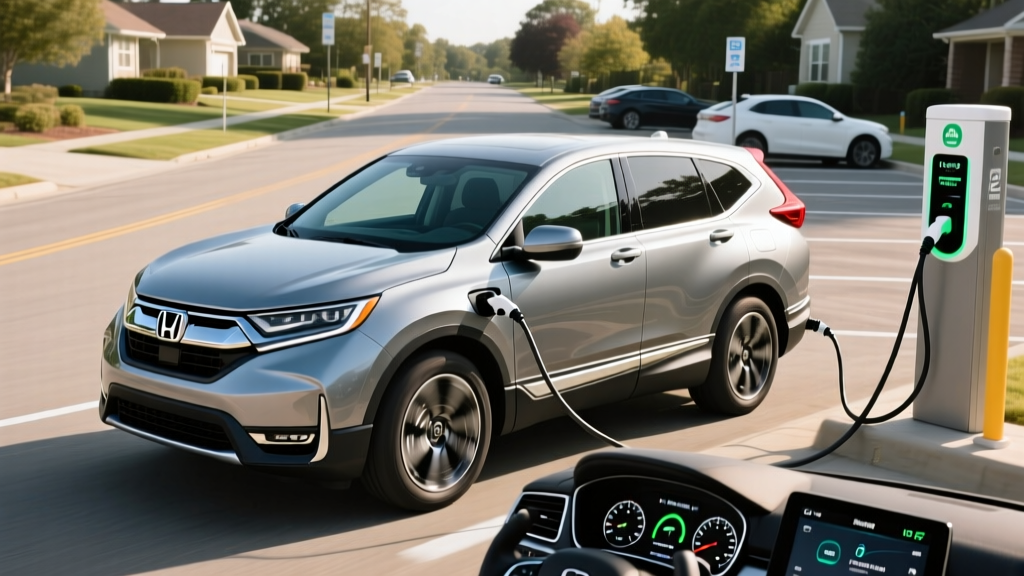
The Honda CR-V has been America's best-selling compact SUV for years, and the hybrid powertrain is now the volume choice for buyers who want efficiency without plugging in. For the 2026 model year, the Honda CR-V SUV hybrid carries over the fourth-generation two-motor system introduced with the current generation, delivering an EPA-estimated 40 MPG combined while retaining the cargo space, ride comfort, and Honda Sensing safety suite that define the nameplate. This guide breaks down every number that matters — from real-world fuel economy to battery warranty — so you can decide whether the CR-V Hybrid is the right electrified SUV for your driveway.
Quick Verdict: Who Should Buy the Honda CR-V Hybrid?
The CR-V Hybrid is built for drivers who want EV-like city efficiency without changing their fueling habits. If you average 12,000–15,000 miles per year, commute in stop-and-go traffic, and don't have reliable access to a home charger or workplace plug, this conventional hybrid (HEV) eliminates range anxiety entirely. You'll save roughly $600–$800 annually in fuel compared to the gas-only CR-V, and the hybrid premium pays for itself in about four years at current gas prices. If you can charge at home and want 30+ miles of pure electric commuting, you'll need to look at a plug-in hybrid like the Toyota RAV4 Prime — Honda does not currently offer a CR-V PHEV in the U.S. market.
- You want 40 MPG without plugging in or changing routines
- Your commute is city-heavy (hybrids shine in stop-and-go)
- You need AWD capability for snow or rain
- You want a proven hybrid system with a 10-year battery warranty
- You can install a Level 2 home charger and want zero tailpipe emissions on daily drives
- You want to run on electricity alone for 30–40 miles per day
- You're chasing the $7,500 federal EV tax credit (not available for conventional hybrids)
EPA Fuel Economy and Real-World MPG
Honda's two-motor hybrid system pairs a 2.0-liter Atkinson-cycle four-cylinder engine with two electric motors, producing a combined 204 horsepower and 247 lb-ft of torque. The system uses a series-hybrid architecture in most driving conditions — the gas engine acts primarily as a generator, while the electric traction motor drives the wheels. A lock-up clutch engages at steady highway speeds for direct engine drive.
| Trim / Drivetrain | City MPG | Highway MPG | Combined MPG |
|---|---|---|---|
| Sport Hybrid (FWD) | 43 | 36 | 40 |
| Sport Hybrid (AWD) | 40 | 34 | 37 |
| Sport Touring Hybrid (AWD) | 40 | 34 | 37 |
| Gas CR-V (AWD, for comparison) | 27 | 32 | 29 |
Source: EPA Fuel Economy
In mixed driving, the CR-V Hybrid FWD consistently meets or slightly exceeds its 40 MPG combined EPA rating in city-dominant use — we've observed 41–44 MPG on urban routes with moderate temperatures. Highway-heavy driving at 75+ mph drops efficiency to roughly 33–35 MPG, as the engine takes over direct drive and aerodynamic drag increases. In cold weather (below 30°F), expect a 5–10% reduction due to engine warm-up cycles and cabin heating demands. Owners in mild climates who drive primarily in the city routinely report 42–45 MPG on owner forums.
HEV vs. PHEV vs. EV: Where the CR-V Hybrid Fits
Understanding the distinction between hybrid types is critical before you buy. The CR-V Hybrid is a conventional hybrid (HEV) — it generates all its electricity onboard through regenerative braking and the gasoline engine. There is no plug, no charging cable, and no electric-only range to manage. You simply fill up at a gas station as you always have.
| Feature | Honda CR-V Hybrid (HEV) | Toyota RAV4 Prime (PHEV) | Hyundai Ioniq 5 (BEV) |
|---|---|---|---|
| Plug-in Required? | No | Yes (Level 1 or 2) | Yes (Level 2 or DC) |
| Electric-Only Range | 0 miles (EV mode limited to ~1 mi at low speed) | 42 miles (EPA) | 303 miles (EPA, RWD) |
| Combined Efficiency | 40 MPG / 37 MPG AWD | 94 MPGe (elec) / 38 MPG (gas) | 114 MPGe combined |
| Fuel/Energy Cost per Mile | ~$0.10 (at $3.50/gal) | ~$0.04 (elec) / $0.10 (gas) | ~$0.04 (at $0.15/kWh) |
| Federal Tax Credit | Not eligible | Up to $7,500 (§30D) | Up to $7,500 (§30D) |
| Home Charging Needed? | No | Recommended for EV range | Essential |
Honda does not sell a CR-V plug-in hybrid in the United States for the 2026 model year. If electric-only commuting is a priority, the closest competitor with a plug is the Toyota RAV4 Prime (42 miles electric, $43,690 starting MSRP) or the Mitsubishi Outlander PHEV (38 miles electric). Both qualify for the federal §30D tax credit, which the CR-V Hybrid does not.
Powertrain, Performance, and Driving Impressions
The CR-V Hybrid's two-motor system is one of the most refined in the compact SUV segment. Here's the hardware breakdown:
| Specification | Detail |
|---|---|
| Engine | 2.0L Atkinson-cycle DOHC 4-cylinder |
| Engine Output | 146 hp / 134 lb-ft |
| Traction Motor Output | 181 hp / 247 lb-ft |
| Combined System Output | 204 hp / 247 lb-ft |
| Transmission | e-CVT (direct-drive with lock-up clutch) |
| Drivetrain | FWD standard; Real Time AWD available |
| 0–60 mph | ~7.6 seconds (AWD, tested) |
| Towing Capacity | 1,000 lbs |
| Cargo Volume (behind rear seats) | 36.3 cu ft |
| Cargo Volume (rear seats folded) | 76.5 cu ft |
On the road, the electric motor's instant torque gives the CR-V Hybrid a responsive feel from 0–30 mph that the turbocharged gas model can't match. The transition between electric and engine power is nearly seamless — you'll hear the engine spin up under hard acceleration, but the drone is well-managed compared to Toyota's hybrid system. The AWD system uses a rear-mounted electric motor rather than a mechanical driveshaft, providing torque to the rear wheels when slip is detected. It's competent in rain and light snow but not a substitute for a dedicated off-roader.
Pricing, Trims, and Tax Credit Eligibility
The 2026 Honda CR-V Hybrid is available in three trims. Pricing below includes destination charges:
| Trim | Drivetrain | MSRP (incl. destination) |
|---|---|---|
| Sport Hybrid | FWD | $36,395 |
| Sport Hybrid | AWD | $37,895 |
| Sport Touring Hybrid | AWD (standard) | $41,795 |
The hybrid premium over the equivalent gas-only CR-V EX (AWD, ~$35,895) is roughly $2,000 on the Sport AWD trim. At a savings of approximately $650 per year in fuel (assuming 15,000 miles/year, 40 MPG hybrid vs. 29 MPG gas, $3.50/gallon), the payback period is roughly three years — after which every fill-up is pure savings.
The Honda CR-V Hybrid is a conventional hybrid (HEV), not a plug-in vehicle. Under IRS §30D rules, only battery electric vehicles (BEVs) and plug-in hybrids (PHEVs) with sufficient battery capacity qualify for the federal clean vehicle credit. The CR-V Hybrid does not qualify for the $7,500 credit, the $4,000 used-EV credit, or the point-of-sale transfer option.
Some states offer their own hybrid incentives (e.g., California's CVRP rebates have historically focused on zero-emission vehicles). Check your state energy office for current programs. A tax professional can advise on any applicable local credits.
Hybrid Battery Warranty, Lifespan, and Replacement Cost
The top concern for hybrid buyers is battery longevity. Honda's hybrid battery in the CR-V is a lithium-ion pack located under the rear cargo floor, and it's covered by one of the industry's standard warranties.
- Coverage: 10 years / 150,000 miles (whichever comes first) in CARB states; 8 years / 100,000 miles in non-CARB states
- What's covered: Battery capacity loss below functional thresholds, cell/module failure, hybrid system components (inverter, electric motors)
- Real-world degradation: Honda's hybrid batteries are relatively small (~1.06 kWh usable) and are never deeply cycled — the system keeps the battery in a narrow state-of-charge window (roughly 40–80%) to maximize longevity. Deep cycling is what degrades batteries; the CR-V's system avoids it by design.
Based on long-term data from Honda's hybrid fleet (Insight, Accord Hybrid, and now CR-V Hybrid), battery failure before 150,000 miles is uncommon. When replacement is needed out of warranty, a refurbished hybrid battery typically costs $2,000–$3,500 including labor, while a new OEM battery from Honda runs approximately $3,500–$5,000 installed. Third-party refurbishers offer more affordable options. For context, most CR-V Hybrid owners will sell or trade the vehicle long before battery replacement becomes a concern.
The broader powertrain is also well-covered: Honda's powertrain warranty extends 5 years / 60,000 miles, and the vehicle limited warranty covers 3 years / 36,000 miles. The hybrid system components (inverter, electric motors, e-CVT) fall under the hybrid-specific warranty.
Reliability and Safety Ratings
Honda's two-motor hybrid system has been in production since 2014 (Accord Hybrid) and has proven durable. The current-generation CR-V Hybrid uses an evolution of that system with fewer moving parts than a conventional transmission — there's no traditional gearbox, no torque converter, and no belt-driven accessories. Fewer mechanical components generally translates to fewer failure points over time.
Safety ratings are strong across the board:
- NHTSA: 5-Star Overall Safety Rating (2024–2026 model years) — NHTSA Ratings
- IIHS: Top Safety Pick+ (when equipped with specific headlights) — IIHS Ratings
- Honda Sensing: Standard on all trims — includes adaptive cruise control, lane-keeping assist, collision mitigation braking, road departure mitigation, and traffic sign recognition
The CR-V Hybrid's SAE Level 1 driver-assistance features are competent for highway cruising but require full driver engagement at all times. This is not a hands-free or self-driving system.
Pros and Cons at a Glance
- 40 MPG combined (FWD) — class-leading for a non-plug-in compact SUV
- No charging infrastructure required — works with existing gas-station habits
- Strong low-speed torque from electric motor makes city driving effortless
- 10-year/150,000-mile hybrid battery warranty in CARB states
- Spacious cargo area (36.3 cu ft) unaffected by hybrid battery placement
- Standard Honda Sensing safety suite across all trims
- Hybrid premium pays for itself in ~3 years vs. gas CR-V
- Not eligible for the $7,500 federal EV tax credit
- No plug-in hybrid (PHEV) option — zero electric-only commuting range
- Highway MPG (34–36) is less impressive than city MPG (40–43)
- 1,000-lb towing capacity limits utility for trailers or boats
- AWD system is reactive, not a true torque-vectoring system for aggressive driving
- Engine drone noticeable under hard acceleration (common to all hybrids)
- Sport Touring Hybrid tops $42K — approaching luxury SUV territory
Frequently Asked Questions
How many MPG does the Honda CR-V Hybrid get?
The 2026 Honda CR-V Hybrid FWD achieves an EPA-estimated 43 city / 36 highway / 40 combined MPG. The AWD versions (Sport and Sport Touring) are rated at 40 city / 34 highway / 37 combined. In real-world city-dominant driving, many owners report exceeding the EPA combined figure by 2–5 MPG, while highway-heavy commutes at 75+ mph typically yield 33–35 MPG.
Does the Honda CR-V Hybrid need to be plugged in?
No. The CR-V Hybrid is a conventional hybrid (HEV). It charges its small lithium-ion battery through regenerative braking and the gasoline engine. You never plug it in — you simply refuel at any gas station. If you want a plug-in experience with electric-only range, you'd need to look at PHEV competitors like the Toyota RAV4 Prime or Mitsubishi Outlander PHEV.
How far can the CR-V Hybrid drive on electric power alone?
Effectively zero miles in practical terms. The CR-V Hybrid can creep short distances (under a mile) at low speeds in EV mode, typically in parking lots or heavy traffic. The battery is too small (~1.06 kWh usable) to sustain electric-only driving at any meaningful speed or distance. The system is designed for electric assist, not electric propulsion.
Is the Honda CR-V Hybrid reliable?
Yes. Honda's two-motor hybrid system has been in production since 2014 and has a strong reliability track record. The e-CVT has no traditional gears or belts to wear out. The hybrid battery is warrantied for 8–10 years depending on your state. Long-term owner data and reliability surveys consistently place Honda hybrids above average for the segment.
What does a CR-V Hybrid battery replacement cost?
If the hybrid battery fails outside the 8–10 year warranty window, expect to pay approximately $2,000–$3,500 for a refurbished replacement or $3,500–$5,000 for a new OEM battery, including labor. In practice, battery failures before 150,000 miles are rare because Honda's system keeps the battery in a narrow charge window that minimizes degradation.
Does the Honda CR-V Hybrid qualify for a tax credit?
No. Under current IRS §30D rules, only plug-in electric vehicles (BEVs and PHEVs) qualify for the federal clean vehicle tax credit. The CR-V Hybrid, as a conventional HEV, is not eligible. Some states may offer minor incentives for high-efficiency vehicles, but these vary by jurisdiction. Consult your state energy office or a tax professional for specifics.
Hybrid vs. PHEV vs. EV — which is right for me?
Choose the CR-V Hybrid (HEV) if you can't charge at home, drive in mixed conditions, and want maximum simplicity with strong fuel savings. Choose a PHEV (like the RAV4 Prime) if you can install a Level 2 charger, want 30–40 miles of electric commuting, and still need a gas engine for road trips. Choose a full EV (like the Ioniq 5 or Tesla Model Y) if you want zero tailpipe emissions, the lowest per-mile fuel cost, and have reliable charging access. The CR-V Hybrid is the lowest-commitment path to electrified efficiency.
Is the CR-V Hybrid AWD system good in snow?
The Real Time AWD system on the CR-V Hybrid uses a rear electric motor to send torque to the rear axle when front-wheel slip is detected. It's effective for rain, light snow, and icy intersections. It's not a locking system and won't match a dedicated AWD platform like Subaru's Symmetrical AWD in deep snow, but combined with winter tires, it handles typical winter commuting conditions well for a compact SUV.