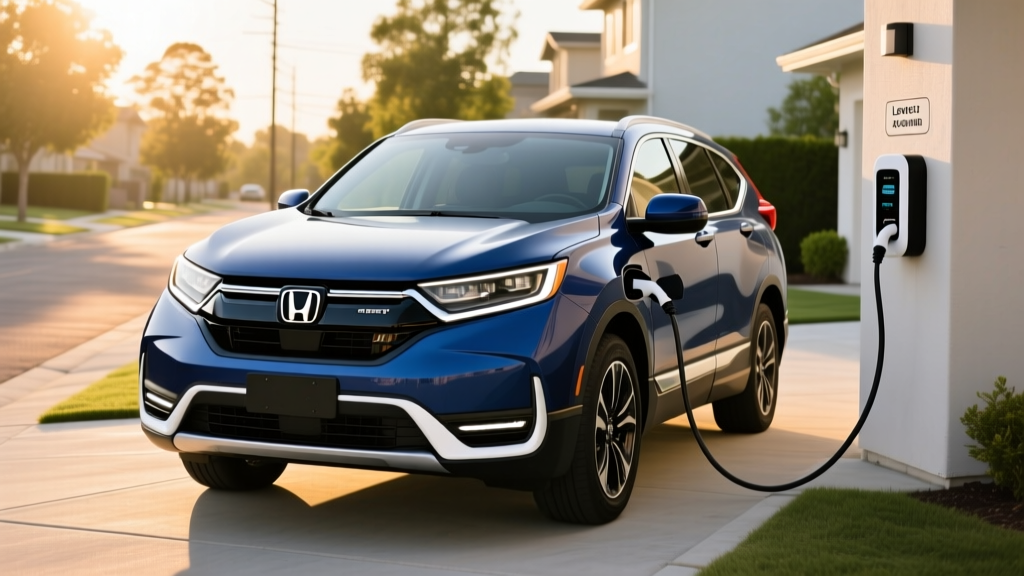
Honda's CR-V has been one of America's best-selling compact SUVs for years, but the 2026 Honda CR-V Plug-In Hybrid (PHEV) represents a significant pivot. With 33 miles of EPA-rated electric-only range and the flexibility of a gasoline backup, it targets drivers who want daily EV commuting without range anxiety. But does the math work? Let's break down the real-world efficiency, charging requirements, and whether this PHEV justifies its premium over the conventional CR-V Hybrid.
Quick Verdict: Who Should Buy the CR-V Plug-In Hybrid?
Choose the CR-V PHEV if: You can charge at home, your daily commute is under 35 miles round-trip, and you want to drive electric most days while keeping gas flexibility for road trips.
Stick with the CR-V Hybrid (HEV) if: You lack home charging access, drive mostly highway miles, or want to save $6,000+ upfront.
Consider a full BEV if: Your commute exceeds 40 miles daily, you have reliable home Level 2 charging, and you rarely take long road trips.
HEV vs PHEV: What's the Difference?
Before diving into specs, it's critical to understand the distinction between Honda's two CR-V hybrid options:
Conventional Hybrid (HEV): CR-V Hybrid
- No plug-in charging required
- Small battery (~1.1 kWh) charged via regenerative braking and engine
- Electric motor assists gas engine but cannot drive the vehicle alone for meaningful distances
- EPA: 43 city / 36 highway / 40 combined MPG
- Lower MSRP, no tax credit eligibility
Plug-In Hybrid (PHEV): CR-V Plug-In Hybrid
- Requires plug-in charging for electric-only operation
- Larger 17.7 kWh battery with 33-mile electric-only range
- Can operate as a pure EV for short trips, then switches to hybrid mode
- EPA: 95 MPGe (electric + gas combined), 40 MPG combined (gas-only hybrid mode)
- Higher MSRP, potential §30D tax credit eligibility
Both use Honda's two-motor hybrid system, but the PHEV's larger battery enables genuine zero-emission commuting. If you never plug in the PHEV, you're carrying 400+ lbs of dead battery weight and paying a premium for capability you're not using.
EPA Range, MPGe, and Real-World Efficiency
| Metric | EPA Rating | Real-World Expectation |
|---|---|---|
| Electric-only range | 33 miles | 28-35 miles (weather/terrain dependent) |
| MPGe (electric + gas) | 95 MPGe combined | 85-100 MPGe (depends on charging frequency) |
| Gas-only hybrid mode (city) | 42 MPG | 38-44 MPG (hybrids often exceed EPA in stop-and-go) |
| Gas-only hybrid mode (highway) | 37 MPG | 34-38 MPG (highway efficiency drops with battery weight) |
| Gas-only hybrid mode (combined) | 40 MPG | 37-41 MPG |
| Total range (electric + gas) | 430 miles | 400-450 miles |
Real-world electric range caveat: The EPA's 33-mile electric range assumes moderate temperatures and mixed driving. In cold weather (below 40°F), expect 20-25% range loss, dropping to 25-27 miles. Highway driving at 70+ mph also reduces electric efficiency; plan for 28-30 miles on the battery at sustained speeds.
The CR-V PHEV's strength is its dual personality. Charge it nightly and you'll rarely visit a gas station for daily commuting. Forget to charge and it operates as a 40-MPG hybrid—still excellent for a 3,900-lb SUV. According to fueleconomy.gov, the PHEV's annual fuel cost is $1,150 (assuming 15,000 miles/year, 45% highway, $3.50/gallon gas, and $0.14/kWh electricity), compared to $1,750 for the conventional CR-V Hybrid.
Battery, Charging, and Powertrain Specs
| Specification | 2026 CR-V Plug-In Hybrid |
|---|---|
| Battery capacity (gross) | 17.7 kWh (lithium-ion) |
| Battery capacity (usable) | ~14.5 kWh |
| Electric motor output | 181 hp / 232 lb-ft torque |
| Gas engine | 2.0L 4-cylinder Atkinson cycle, 143 hp |
| Combined system output | 204 hp |
| 0-60 mph | ~8.0 seconds |
| Level 1 charging (120V) | ~12 hours (0-100%) |
| Level 2 charging (240V, 32A) | ~2.5 hours (0-100%) |
| DC fast charging | Not available |
| Charge port | J1772 (Level 2) |
The CR-V PHEV's 17.7 kWh battery (14.5 kWh usable) is modest compared to full EVs, but it's optimized for daily commuting rather than road trips. Honda deliberately omits DC fast charging—a cost and weight decision that makes sense given the battery size. At 7.7 kW Level 2 charging, you'll add roughly 10-12 miles of electric range per hour, so overnight charging fully replenishes the pack.
For home charging, a Level 2 (240V) wall connector costs $500-$700 for the unit plus $800-$2,000 for electrician installation (assuming a 200-amp panel with available capacity). If you need a panel upgrade, add $1,500-$3,000. Level 1 (120V) charging via a standard outlet is possible but painfully slow at ~4 miles of range per hour—adequate only if you drive under 15 miles daily.
Pricing, Trims, and Tax Credit Eligibility
| Trim | MSRP | After Potential §30D Credit |
|---|---|---|
| CR-V Hybrid Sport (HEV) | $36,395 | $36,395 (no credit) |
| CR-V Plug-In Hybrid Sport (PHEV) | $42,895 | $39,145 (if eligible) |
| CR-V Plug-In Hybrid Sport Touring (PHEV) | $46,895 | $43,145 (if eligible) |
Federal §30D Tax Credit Eligibility (2026 rules):
- Credit amount: Up to $3,750 (not $7,500—the CR-V PHEV's battery sourcing does not meet critical mineral requirements for the full credit)
- MSRP cap: Vehicle must be under $80,000 (CR-V PHEV qualifies)
- Income cap: Modified AGI under $150,000 (single) or $300,000 (married filing jointly)
- Battery sourcing: Must meet North American assembly and battery component requirements (varies by model year—verify with dealer)
- Point-of-sale transfer: Credit can be applied at purchase, reducing upfront cost
Source: IRS.gov §30D rules. Tax credit eligibility changes frequently and depends on battery sourcing, which Honda updates periodically. Consult a tax professional before purchase.
The PHEV carries a $6,500 premium over the conventional CR-V Hybrid. If you qualify for the $3,750 federal credit and save ~$600/year in fuel costs (assuming 12,000 miles/year and frequent charging), the payback period is roughly 5-6 years. For high-mileage drivers or those in states with additional PHEV incentives (California, Colorado, New York), the math improves significantly.
Reliability and Battery Warranty
Honda Hybrid Battery Warranty: 8 years / 100,000 miles (10 years / 150,000 miles in California and states adopting CARB standards)
Powertrain warranty: 5 years / 60,000 miles
Battery replacement cost (out of warranty): $4,000-$6,000 (estimated based on 2024-2025 Honda hybrid battery pricing)
Honda's hybrid system has proven exceptionally reliable over two decades, from the original Insight to the current CR-V lineup. The PHEV's larger battery operates in a shallower state-of-charge window (typically 20-80% to extend lifespan), reducing degradation stress. Real-world data from Consumer Reports shows Honda hybrids ranking in the top tier for long-term reliability, with battery failures rare before 150,000 miles.
Unlike full EVs, PHEV batteries are smaller and less expensive to replace. Even if you face a $5,000 battery replacement at 150,000 miles (unlikely given the warranty), the cumulative fuel savings over that lifespan would likely offset the cost. For comparison, a conventional CR-V's transmission replacement at similar mileage could cost $3,000-$4,000.
Pros and Cons
Pros
- 33-mile electric range covers most daily commutes
- 95 MPGe when regularly charged; 40 MPG even without charging
- No range anxiety—gas engine provides 430-mile total range
- Smooth, quiet electric operation in EV mode
- Honda Sensing safety suite standard
- Strong resale value (CR-V historically retains 55-60% at 5 years)
Cons
- $6,500 premium over conventional CR-V Hybrid
- No DC fast charging (limits road-trip electric operation)
- Only $3,750 federal credit (not full $7,500)
- Cargo space reduced by 3 cu ft due to battery placement
- Level 1 charging is impractically slow (12 hours)
- Electric range drops to 25-27 miles in cold weather
FAQ: Common CR-V Plug-In Hybrid Questions
How many MPG does the CR-V Plug-In Hybrid get?
The 2026 CR-V PHEV achieves 95 MPGe combined when operating in electric + gas mode, and 40 MPG combined (42 city / 37 highway) when running purely as a hybrid after the battery depletes. Real-world testing shows city driving often yields 42-44 MPG in hybrid mode, while highway cruising drops to 34-38 MPG due to the battery's weight penalty.
How far can the CR-V PHEV go on electric only?
The EPA rates the CR-V PHEV at 33 miles of electric-only range. In real-world conditions, expect 28-35 miles depending on temperature, terrain, and driving style. Cold weather (below 40°F) reduces this to 25-27 miles, while gentle city driving in moderate temperatures can stretch it to 35 miles.
Do I need to plug in the CR-V PHEV every day?
No. If you don't plug it in, the CR-V PHEV operates as a conventional hybrid, achieving 40 MPG combined. However, you're paying a $6,500 premium for electric capability you're not using. To maximize value, plug in nightly (or whenever possible) to capture the 33-mile electric range for daily commuting.
Does the CR-V PHEV qualify for a tax credit?
As of 2026, the CR-V PHEV qualifies for up to $3,750 in federal §30D tax credits (not the full $7,500 due to battery sourcing requirements). Eligibility depends on your income (under $150,000 single / $300,000 married), the vehicle's MSRP (under $80,000), and battery component sourcing. The credit can be transferred at point-of-sale to reduce your purchase price. Verify current eligibility with your dealer and consult a tax professional.
Is the CR-V PHEV reliable? What's the battery replacement cost?
Honda's hybrid systems have an excellent reliability track record over 20+ years. The PHEV battery carries an 8-year / 100,000-mile warranty (10 years / 150,000 miles in CARB states). Out-of-warranty battery replacement costs $4,000-$6,000, though failures before 150,000 miles are rare. The smaller PHEV battery is less expensive to replace than a full EV's 60-100 kWh pack.
Can the CR-V PHEV DC fast charge?
No. The CR-V PHEV supports only Level 1 (120V, ~12 hours) and Level 2 (240V, ~2.5 hours) charging. Honda omitted DC fast charging to reduce cost and weight, reasoning that PHEV owners will charge at home overnight. This limits the PHEV's electric utility on road trips—you'll operate primarily in hybrid mode for long drives.
Hybrid vs PHEV vs EV: Which should I choose?
Choose the CR-V Hybrid (HEV) if you lack home charging, drive mostly highway miles, or want to minimize upfront cost. It delivers 40 MPG with no plug-in requirement.
Choose the CR-V PHEV if you can charge at home, commute under 35 miles daily, and want electric operation for most trips while retaining gas flexibility for road trips.
Choose a full EV (like the Honda Prologue or Hyundai Ioniq 5) if you have reliable home Level 2 charging, drive under 250 miles daily, and want zero tailpipe emissions with minimal maintenance.
The 2026 Honda CR-V Plug-In Hybrid occupies a pragmatic middle ground: genuine electric commuting without the range commitment of a full EV. For drivers with home charging and sub-35-mile commutes, it delivers on its promise—silent electric operation most days, with a gas safety net for road trips. The $6,500 premium over the conventional hybrid stings, and the $3,750 tax credit (not $7,500) softens the blow only partially. But if your driving pattern aligns with the PHEV's strengths, the CR-V Plug-In Hybrid is one of the most sensible electrified SUVs on the market.