Quick Verdict: The CR-V Plug-In Hybrid Explained
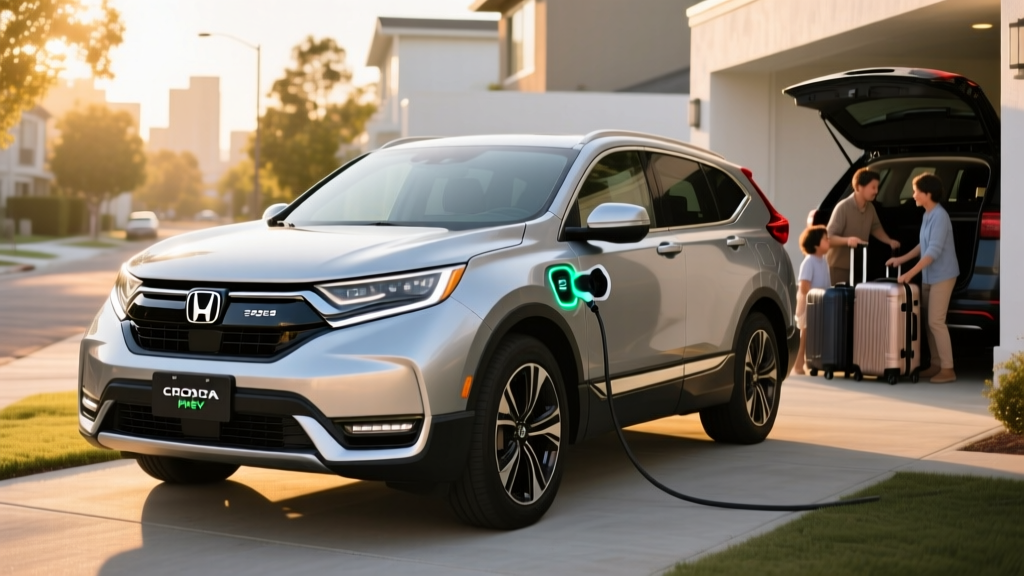
The Honda CR-V has long been one of America's best-selling compact SUVs, and for the 2026 model year, Honda continues to offer it in three distinct powertrains: a conventional turbocharged gas model, a standard hybrid (HEV), and the plug-in hybrid variant — the CR-V PHEV (badged in the U.S. as the CR-V e:PHEV or CR-V Sport Touring Plug-In Hybrid, depending on trim and model year). This guide focuses squarely on the plug-in variant, because it occupies a unique middle ground: enough electric-only range to cover most daily commutes without burning a drop of gas, plus a gasoline engine that eliminates range anxiety on longer road trips.
If you're searching for a "CR-V PHEV," you likely already know Honda's reputation for reliability and practicality. What you need now are the hard numbers — real electric range, actual MPG once the battery depletes, charging logistics, pricing, and whether the federal tax credit applies. We'll cover all of that below, drawing on EPA data from fueleconomy.gov, Honda's official specifications, and IRS §30D tax credit rules.
HEV vs. PHEV: Which CR-V Hybrid Are We Talking About?
Before diving into specs, it's critical to distinguish the two electrified CR-V models, because they serve different buyers and carry different price tags.
| Attribute | CR-V Hybrid (HEV) | CR-V PHEV (Plug-In) |
|---|---|---|
| Plug-in required? | No — self-charging via regen & engine | Yes — plug in to access EV range |
| Battery size | ~1.06 kWh (small buffer) | 17.7 kWh usable (NMC lithium-ion) |
| Electric-only range | ~1–2 miles at very low speed | 34 miles (EPA) |
| EPA combined MPG | 40 MPG combined | 42 MPG combined (charge-sustaining) / 92 MPGe (with charge) |
| DC fast charging | N/A | No — Level 2 AC only |
| Combined HP | 204 HP | 204 HP |
| Starting MSRP (2025/2026) | ~$34,650 | ~$40,850 |
| Federal tax credit | Not eligible (§30D requires plug-in) | Eligibility varies — see tax section below |
The conventional hybrid is a strong choice if you can't charge at home. The PHEV rewards those who can plug in nightly with 30+ miles of silent, zero-tailpipe-emission driving that covers the average American's daily commute of roughly 29 miles round-trip.
Powertrain and Performance Specs
The CR-V PHEV pairs Honda's proven 2.0-liter Atkinson-cycle four-cylinder engine with two electric motors in a series-parallel hybrid configuration. This is the same architecture found in the Accord Hybrid and the standard CR-V HEV, but with a substantially larger battery pack enabling meaningful electric-only operation.
| Specification | 2026 Honda CR-V PHEV |
|---|---|
| Engine | 2.0L Atkinson-cycle inline-4 |
| Electric motors | Two-motor hybrid system (drive + generator) |
| Combined system output | 204 HP / 247 lb-ft torque |
| Battery capacity | 17.7 kWh usable (NMC chemistry) |
| EPA electric-only range | 34 miles |
| Total combined range (EV + gas) | ~430 miles |
| 0–60 mph | ~7.8 seconds (est.) |
| Drivetrain | FWD standard; AWD available on select trims |
| Transmission | e-CVT (electronically controlled) |
| Towing capacity | 1,000 lbs (not rated for heavy towing) |
On the road, the CR-V PHEV starts in EV mode by default, delivering smooth, quiet acceleration up to roughly 62 mph before the gas engine intervenes. When the battery depletes, the system seamlessly transitions to hybrid mode — there's no jarring handoff, which is one of Honda's strengths in hybrid calibration. The 204 HP combined output provides adequate passing power on highways, though it won't feel sporty. Expect a comfortable, composed ride tuned for commuting and family duty rather than canyon carving.
Fuel Economy: EPA Numbers vs. Real-World MPG
This is where PHEV math gets nuanced. The EPA reports two separate figures for plug-in hybrids, and understanding both is essential for predicting your actual fuel costs.
| Driving Mode | City | Highway | Combined |
|---|---|---|---|
| Charge-sustaining (battery depleted, gas engine) | 40 MPG | 43 MPG | 42 MPG |
| Charge-depleting (battery charged, EV + gas blend) | 92 MPGe combined | ||
| Electric-only efficiency | ~3.0–3.3 kWh/mile (equiv.) | ||
What this means in practice: If you charge nightly and your daily driving stays under 34 miles, you may go weeks without visiting a gas station. Your effective fuel cost drops dramatically because electricity at the national average of ~$0.16/kWh costs roughly $0.04–$0.05 per mile in the CR-V PHEV, compared to $0.12–$0.14 per mile for a 30 MPG gas SUV at $3.50/gallon.
On a 400-mile road trip with no charging stops, expect the CR-V PHEV to settle into its charge-sustaining mode and deliver 38–42 MPG combined, depending on speed and terrain. Hybrids typically exceed their EPA city rating in stop-and-go traffic thanks to regenerative braking, while highway MPG can dip slightly above 75 mph due to aerodynamic drag. In cold weather (below 30°F), expect a 15–25% reduction in electric-only range — the battery is less efficient and cabin heating draws additional energy. Real-world EV range in winter may drop to 25–28 miles.
Charging the CR-V PHEV: Times, Levels, and Logistics
One of the most common buyer questions is how long charging takes and whether DC fast charging is available. Here's the complete picture.
| Charging Level | Power (kW) | Connector | 0–100% Time | Miles Added/Hour |
|---|---|---|---|---|
| Level 1 (120V household outlet) | ~1.4 kW | Standard J1772 | ~12–14 hours | ~4–5 miles |
| Level 2 (240V home/public) | ~6.6 kW | J1772 | ~2.5–3 hours | ~15–18 miles |
| DC Fast Charge | Not supported | N/A | N/A | N/A |
The CR-V PHEV uses a J1772 connector for AC charging and does not support DC fast charging — a common limitation among compact PHEVs. The onboard charger is rated at 6.6 kW, meaning a full Level 2 charge from empty takes roughly 2.5 to 3 hours. For daily use, this is entirely sufficient: most PHEV owners plug in when they get home and wake up to a full battery every morning. The 17.7 kWh battery is small enough that even Level 1 (standard 120V outlet) can replenish the pack overnight, though it'll be tight if you fully deplete it.
Home charging setup: A Level 2 home charger (240V, 32-amp circuit) typically costs $500–$700 for the unit plus $800–$2,000 for professional installation, depending on your electrical panel capacity and the distance from panel to garage. If your panel needs an upgrade to 200A, add $1,500–$3,000. For a PHEV with a small battery, many owners find Level 1 adequate and skip the Level 2 install entirely.
Pricing, Trims, and Federal Tax Credit Eligibility
The 2026 Honda CR-V PHEV is offered in a single well-equipped Sport Touring Plug-In Hybrid trim, reflecting Honda's strategy of keeping the PHEV as a premium option within the CR-V lineup.
- Base MSRP: ~$40,850 (including destination charge)
- AWD surcharge: Available on select model years at ~$1,500 additional
- Standard features: Leather seats, 9-inch touchscreen with wireless Apple CarPlay/Android Auto, Bose premium audio, Honda Sensing ADAS suite, heated front and rear seats, wireless phone charging, power liftgate
Does the CR-V PHEV Qualify for the Federal Tax Credit?
This is where things get complicated, and it's essential to check current rules before purchasing. Under IRS §30D Clean Vehicle Credit rules (current for 2025–2026), the credit can reach up to $7,500, split into two $3,750 halves based on battery component manufacturing and critical mineral sourcing requirements. However, several caveats apply:
- MSRP cap: SUVs must be priced at or below $80,000 — the CR-V PHEV clears this easily
- Buyer income cap: AGI must not exceed $150,000 (single), $225,000 (head of household), or $300,000 (joint)
- Battery sourcing: The battery must meet critical mineral and component sourcing thresholds that tighten annually — Honda's supply chain compliance varies by model year
- North American assembly: The vehicle must be assembled in North America — Honda CR-V PHEVs for the U.S. market are assembled in Indiana or Ohio, satisfying this requirement
- Point-of-sale transfer: As of 2024, the credit can be transferred to the dealer at purchase, reducing your out-of-pocket cost immediately (rather than waiting for tax filing)
Bottom line: The CR-V PHEV may qualify for a partial or full $7,500 credit depending on your income, the specific model year's battery sourcing compliance, and current IRS guidance. Always verify with your tax professional and check the IRS's current eligible vehicle list before purchasing. State incentives may also apply — check your state's energy office or DSIRE (Database of State Incentives for Renewables & Efficiency) for local rebates.
Reliability, Battery Warranty, and Long-Term Costs
Honda's hybrid system is among the most proven in the industry, with over two decades of real-world deployment since the original Insight. The two-motor architecture is simpler than traditional transmissions — there are no gear shifts to wear out, and the e-CVT has fewer moving parts than a conventional automatic.
| Warranty Coverage | Duration |
|---|---|
| Hybrid battery (high-voltage) | 8 years / 100,000 miles (10 yr / 150,000 mi in CARB states) |
| Hybrid system components | 8 years / 100,000 miles |
| Powertrain (engine + transmission) | 5 years / 60,000 miles |
| Bumper-to-bumper | 3 years / 36,000 miles |
| Battery capacity retention threshold | ~60–70% of original capacity (per Honda warranty terms) |
PHEV battery degradation is typically modest over the first 5–7 years. Based on industry data from similar Honda hybrid systems, expect 85–92% state of health (SoH) at 100,000 miles under normal use. The 17.7 kWh pack is liquid-cooled, which significantly extends longevity compared to passively cooled packs.
Battery replacement cost: If the high-voltage battery fails outside warranty, replacement currently runs $4,000–$7,000 including labor, depending on the dealer and whether refurbished cells are available. However, out-of-warranty failures remain rare based on long-term data from Honda's hybrid fleet. The 12V auxiliary battery (a standard lead-acid or AGM unit) will need replacement every 4–6 years at typical costs of $150–$300.
Long-term maintenance savings over a gas-only CR-V include no transmission fluid changes (the e-CVT uses a smaller volume checked at longer intervals), no spark plug replacements on the Atkinson-cycle engine's extended schedule, and reduced brake wear thanks to regenerative braking — many hybrid owners report original brake pads lasting 80,000+ miles.
CR-V PHEV vs. Full EV vs. Gas: Which Should You Choose?
The CR-V PHEV occupies a specific niche. Here's a practical decision framework:
Choose the CR-V PHEV if:
- You can charge at home (Level 1 or Level 2) and your daily commute is under 35 miles
- You take road trips of 200+ miles regularly and don't want to plan around DC fast chargers
- You want EV-like daily driving without committing to a full BEV's range limitations in cold weather
- You live in an area with limited public charging infrastructure
Choose the CR-V Hybrid (HEV) instead if:
- You cannot charge at home (apartment, street parking, no garage outlet)
- Your budget is tighter and the ~$6,000 PHEV premium isn't justified by your mileage
- You want simpler ownership with no charging cables or plug-in routine
Choose a full EV (e.g., Tesla Model Y, Hyundai Ioniq 5, Honda Prologue) if:
- You have reliable Level 2 home charging and your longest regular trips are under 250 miles
- You want zero tailpipe emissions, minimal maintenance, and access to the full $7,500 federal credit (model-dependent)
- You want stronger acceleration and a lower center of gravity from a dedicated EV platform
Pros
- 34 miles EV range covers most daily commutes gas-free
- 42 MPG in charge-sustaining mode — excellent for a compact SUV
- Seamless EV-to-hybrid transition with no driver intervention
- Honda Sensing ADAS suite standard (adaptive cruise, lane keep, collision mitigation)
- Strong reliability track record; 8–10 year battery warranty
- Level 1 charging adequate for many owners (no install needed)
- Spacious cargo area only slightly reduced vs. gas CR-V (~36.3 cu ft rear seats up)
Cons
- No DC fast charging — road-trip EV charging not practical
- ~$6,000 premium over CR-V Hybrid HEV with long payback period at low mileage
- Federal tax credit eligibility uncertain — depends on battery sourcing rules
- Only one trim level (Sport Touring) — limited configuration options
- AWD availability varies by model year — check current specs
- Electric-only top speed limited to ~62 mph
- Towing capacity limited to 1,000 lbs
Frequently Asked Questions
How many MPG does the Honda CR-V PHEV get?
The EPA rates the CR-V PHEV at 42 MPG combined (40 city / 43 highway) in charge-sustaining mode — that is, after the battery is depleted and the gas engine does all the work. When you factor in electric-only driving with a charged battery, the combined rating is 92 MPGe. In real-world city driving, many owners report 43–46 MPG in hybrid mode thanks to frequent regenerative braking opportunities.
How far can the CR-V PHEV go on electric power only?
The EPA rates it at 34 miles of electric-only range. In real-world conditions with mild weather and moderate speeds, expect 30–34 miles. In cold weather (below 30°F) or at sustained highway speeds, expect 25–28 miles. This is sufficient for the average American commute of roughly 29 miles round-trip.
Can I charge the CR-V PHEV at a DC fast charger?
No. The CR-V PHEV only supports AC charging (Level 1 at 120V and Level 2 at 240V via J1772 connector). DC fast charging (CCS, NACS, or CHAdeMO) is not available. This is typical for compact PHEVs with smaller battery packs. A full Level 2 charge takes approximately 2.5–3 hours.
Is the CR-V PHEV reliable? What about battery replacement costs?
Honda's hybrid system has an excellent reliability record spanning two decades. The high-voltage battery is covered by an 8-year/100,000-mile warranty (10 years/150,000 miles in CARB-emission states including California, New York, Massachusetts, and others). Out-of-warranty replacement costs $4,000–$7,000, but failures are uncommon. Battery degradation is typically 8–15% over the first 100,000 miles.
Does the CR-V PHEV qualify for the $7,500 federal tax credit?
Eligibility depends on several factors under IRS §30D rules: your income must be below the AGI caps ($150K single / $300K joint), the vehicle must meet battery critical-mineral and component sourcing requirements (which tighten annually), and it must be assembled in North America (the CR-V is). The credit amount may be partial or full depending on the model year's battery compliance. Always consult a tax professional and check the current IRS eligible vehicle list before purchasing. The credit can now be transferred at point of sale, reducing your purchase price directly.
How does the CR-V PHEV compare to the Toyota RAV4 Prime?
The RAV4 Prime (RAV4 PHEV) offers 42 miles of EPA-rated EV range and 302 HP — more electric range and significantly more power than the CR-V PHEV. However, the RAV4 Prime carries a higher starting price (~$44,000+) and has faced persistent availability constraints due to high demand. The CR-V PHEV offers a more accessible price point, a slightly more refined ride, and Honda's strong dealer network. If raw EV range and performance are priorities and you can find one in stock, the RAV4 Prime leads; for value and availability, the CR-V PHEV is competitive.
Should I buy the CR-V PHEV or just get a full electric SUV?
If you have reliable home charging and rarely drive more than 250 miles in a day, a full EV like the Honda Prologue, Tesla Model Y, or Hyundai Ioniq 5 will offer lower running costs, less maintenance, and a smoother driving experience. Choose the CR-V PHEV if you frequently take longer road trips, live in an area with sparse DC fast-charging infrastructure, or want the flexibility of gasoline without range planning. The PHEV is the pragmatic bridge for buyers not yet ready to go fully electric.