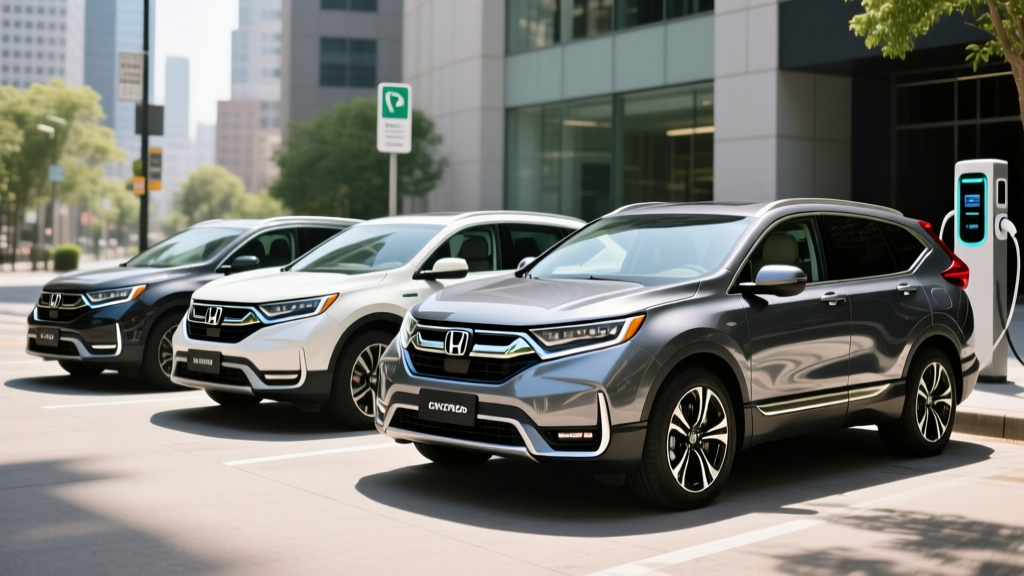
The Honda CR-V Hybrid has become one of the best-selling electrified SUVs in America, and for good reason: it delivers diesel-rivaling efficiency without a plug, a charge port, or any change to your daily routine. But Honda now offers the CR-V Hybrid across multiple trims — and in 2026, the lineup includes both a conventional hybrid (HEV) and a plug-in hybrid (PHEV) variant. Choosing the right one depends on your commute, your charging access, and your budget.
This guide breaks down every 2026 Honda CR-V Hybrid trim level with exact EPA fuel economy figures, real-world MPG expectations, powertrain specifications, pricing, tax-credit eligibility, and the battery warranty details every hybrid buyer needs before signing.
HEV vs PHEV: Which CR-V Hybrid Are You Actually Looking At?
Before diving into trims, it's critical to understand that Honda sells two fundamentally different CR-V Hybrid powertrains:
Conventional Hybrid (HEV): The standard CR-V Hybrid uses a 2.0-liter Atkinson-cycle four-cylinder engine paired with two electric motors and a small lithium-ion battery (approximately 1.1 kWh). It charges itself through regenerative braking and the engine — you never plug it in. It operates as a seamless blend of gas and electric, with the electric motors handling low-speed driving and the engine kicking in for higher loads.
Plug-In Hybrid (PHEV) — CR-V e:PHEV: The CR-V e:PHEV carries a much larger battery pack (17.7 kWh usable) that can be charged from a wall outlet or Level 2 charger. It offers roughly 34–37 miles of pure electric driving before the gasoline engine engages, functioning as a conventional hybrid afterward. This variant is aimed at drivers with short commutes and access to home or workplace charging.
2026 Honda CR-V Hybrid (HEV) Trim Levels and Pricing
For the 2026 model year, Honda offers the conventional CR-V Hybrid in four trims. All use the same two-motor hybrid system, and all are available with either front-wheel drive (FWD) or Honda's Real Time AWD. Here's the full breakdown:
| Trim | Drivetrain | EPA MPG (City/Hwy/Combined) | Combined HP | MSRP (incl. destination) |
|---|---|---|---|---|
| Sport Hybrid | FWD | 43 / 36 / 40 | 204 hp | $36,395 |
| Sport Hybrid | AWD | 40 / 34 / 37 | 204 hp | $37,895 |
| Sport-L Hybrid | FWD | 43 / 36 / 40 | 204 hp | $39,695 |
| Sport-L Hybrid | AWD | 40 / 34 / 37 | 204 hp | $41,195 |
| Sport Touring Hybrid | AWD (std) | 40 / 34 / 37 | 204 hp | $44,895 |
Source: EPA fueleconomy.gov and Honda Newsroom. Prices include $1,395 destination charge. Verify current pricing with your local dealer as mid-year adjustments can occur.
The Sport is the entry point and offers the best fuel economy when equipped with FWD. The Sport Touring is AWD-only and bundles premium features: a Bose 12-speaker audio system, wireless Apple CarPlay and Android Auto, heated rear seats, a heated steering wheel, and Honda's full Honda Sensing suite with low-speed braking control and traffic jam assist.
2026 CR-V e:PHEV (Plug-In Hybrid): Trims, Electric Range, and Charging
The plug-in CR-V e:PHEV is sold in a single, well-equipped trim in the U.S. market for 2026:
| Specification | CR-V e:PHEV (Sport Touring PHEV) |
|---|---|
| MSRP (incl. destination) | $47,295 |
| Drivetrain | AWD standard |
| Combined Horsepower | 204 hp (system total) |
| Engine | 2.0L Atkinson-cycle I4 + dual electric motors |
| Battery (usable) | 17.7 kWh lithium-ion |
| EPA Electric-Only Range | 34–37 miles (depending on conditions) |
| EPA MPGe (electric + gas) | 81 MPGe combined |
| EPA MPG (gas-only, after battery depletes) | 35 combined (36 city / 33 hwy) |
| Total Combined Range | ~430 miles (electric + gas tank) |
| Level 1 Charging (120V) | ~12 hours (full charge) |
| Level 2 Charging (240V, 32A) | ~2.5 hours (full charge) |
| DC Fast Charging | Not available |
The e:PHEV's 17.7 kWh battery is large enough to cover most daily commutes on electricity alone. Charge it overnight on a standard 120V outlet, or install a 240V Level 2 charger to replenish the pack in roughly 2.5 hours. Note that the CR-V e:PHEV does not support DC fast charging — this is common for PHEVs, which prioritize smaller batteries and simpler charging hardware.
Source: EPA fueleconomy.gov PHEV listings and Honda press materials.
Real-World MPG: What to Actually Expect
EPA numbers are a starting point, not a guarantee. Here's what real-world driving tends to yield with the CR-V Hybrid:
CR-V Hybrid (HEV) — Real-World MPG Expectations:
- City driving: 41–45 MPG (hybrids often exceed EPA city estimates because stop-and-go traffic maximizes regenerative braking and electric-motor use)
- Highway driving (70+ mph): 32–35 MPG (aerodynamic drag and sustained engine operation reduce the hybrid advantage)
- Cold weather (below 30°F): Expect a 5–10 MPG reduction as the engine runs more frequently for cabin heat and battery warm-up
- Combined real-world average: 36–40 MPG for most drivers
For the e:PHEV, real-world electric range depends heavily on temperature and driving style. In mild weather (55–75°F) with moderate speeds, expect the full 34–37 miles. In winter, that can drop to 25–28 miles of electric range due to cabin heating demands and reduced battery efficiency.
If your daily commute is under 30 miles round-trip and you charge nightly, the e:PHEV can operate almost entirely on electricity for months at a time — with the gas engine only engaging for longer weekend trips.
Powertrain Deep Dive: How Honda's Two-Motor Hybrid System Works
Both the HEV and e:PHEV versions of the CR-V use Honda's fourth-generation two-motor hybrid system, but they're tuned differently:
CR-V Hybrid (HEV): The 2.0-liter Atkinson-cycle engine produces 146 hp on its own, while the primary drive motor contributes 181 hp. System output is capped at 204 hp due to how the motors and engine share load. The smaller ~1.1 kWh battery acts as a buffer — it captures energy from braking and engine excess, then deploys it for acceleration assist and low-speed electric-only crawling (typically under 1 mile at low speeds).
CR-V e:PHEV: The same 2.0L engine is paired with a more powerful electric motor setup and the 17.7 kWh battery. In EV mode, the drive motor delivers its full 181 hp independently. Once the battery depletes, the system transitions seamlessly to hybrid operation with the same 204 hp combined output.
Neither variant uses a traditional automatic or CVT transmission in the conventional sense. Honda's e:CVT system uses a direct-drive clutch mechanism that connects the engine to the wheels only at higher cruising speeds, eliminating the "rubber band" feel that older CVTs produced.
Battery Warranty, Lifespan, and Replacement Cost
Honda Hybrid Battery Warranty (2026 Models):
- HEV (CR-V Hybrid): 8 years / 100,000 miles (10 years / 150,000 miles in CARB states including CA, CO, CT, ME, MD, MA, NJ, NY, OR, RI, VT, WA)
- PHEV (CR-V e:PHEV): 8 years / 100,000 miles (10 years / 150,000 miles in CARB states)
- Warranty coverage: Defects and capacity loss below approximately 60–70% of original capacity (exact threshold per Honda's warranty documentation)
Expected Battery Lifespan: Honda's lithium-ion hybrid batteries are engineered for 150,000–200,000+ miles under normal conditions. The HEV's small battery experiences shallow charge cycles, which is less stressful than the deeper cycles in a full EV. Real-world data from earlier Honda hybrid models (Insight, Accord Hybrid) shows batteries routinely lasting 150,000+ miles without significant degradation.
Replacement Cost (out of warranty):
- HEV battery replacement: $2,000–$4,000 (parts + labor at a Honda dealer)
- PHEV battery replacement: $8,000–$12,000 (larger pack, more complex integration)
For context, hybrid battery failures before 100,000 miles are rare. The HEV battery is small and inexpensive relative to a full EV pack. The PHEV battery is more costly but still significantly cheaper than a long-range BEV battery replacement.
Tax Credits and Incentives: Does the CR-V Hybrid Qualify?
This is where many buyers get confused. Here are the facts for 2026:
- CR-V Hybrid (HEV): Does NOT qualify for the federal §30D new clean vehicle tax credit. Conventional hybrids are excluded — the credit requires a minimum 7 kWh battery and plug-in capability.
- CR-V e:PHEV: May qualify for up to $7,500 under §30D, but eligibility depends on multiple factors:
- Battery components must meet North American manufacturing thresholds (phasing in through 2026–2029)
- Critical minerals must meet sourcing requirements
- Buyer income caps apply: $150K single / $300K joint MAGI
- MSRP cap: $80,000 for SUVs (CR-V e:PHEV is well under this)
- Credit can be transferred to the dealer at point of sale for an immediate price reduction
Always verify current eligibility on IRS.gov before purchasing, as battery-sourcing rules tighten annually. A tax professional can confirm your personal eligibility.
Some states offer additional rebates for PHEVs (typically $1,000–$2,500), and a handful of utility companies provide incentives for installing Level 2 chargers. Check your state energy office and local utility for current programs.
CR-V Hybrid vs CR-V e:PHEV vs Full EV: Which Fits You?
Choose the CR-V Hybrid (HEV) if:
- You don't have access to home or workplace charging
- You want maximum simplicity — no plug, no behavior change
- Your budget is under $42,000
- You drive a mix of city and highway and want consistent 36–40 MPG
- You want the lowest upfront cost among electrified SUVs in this class
Choose the CR-V e:PHEV if:
- You have Level 1 or Level 2 charging at home or work
- Your daily commute is under 35 miles round-trip
- You want to drive mostly on electricity but need gas-engine flexibility for road trips
- You may qualify for the $7,500 federal tax credit (effectively reducing price to ~$39,800)
- You want to reduce your gasoline consumption by 70–90% on typical weekdays
Choose a full EV (like the Honda Prologue or Hyundai Ioniq 5) if:
- You have reliable home Level 2 charging
- You rarely drive more than 250 miles without stopping
- You want zero tailpipe emissions and the lowest per-mile fuel cost
- You're ready to plan around DC fast charging on road trips
Reliability: What Owners and Data Show
Honda's hybrid system has a strong reliability track record. The two-motor architecture has fewer wear components than a conventional automatic transmission — there are no traditional gear shifts, torque converters, or clutch packs that degrade over time. The e:CVT direct-drive mechanism is mechanically simple.
According to IIHS, the 2026 CR-V continues to earn top safety ratings, which matters for family SUV buyers. Long-term reliability data from Consumer Reports and J.D. Power consistently ranks Honda's hybrid powertrains above average, with the hybrid-specific components (inverter, motor, battery) showing low failure rates.
The most common maintenance items remain standard: brake pads last longer thanks to regenerative braking (often 80,000+ miles), engine oil changes follow the standard 7,500–10,000 mile interval, and the transmission fluid requires attention at the manufacturer-recommended interval (typically 30,000–60,000 miles).
Pros
- Best-in-class city MPG (43 EPA city for FWD HEV)
- No plug required (HEV) — zero behavior change
- Strong AWD availability across all trims
- Spacious cargo area (36.3 cu ft behind rear seats, 76.5 cu ft max)
- 8–10 year hybrid battery warranty
- e:PHEV offers 34+ miles electric for short commuters
- Smooth, quiet electric-motor operation at low speeds
Cons
- AWD reduces combined MPG by ~3 (37 vs 40)
- HEV does not qualify for federal tax credit
- e:PHEV lacks DC fast charging
- Sport Touring Hybrid pricing approaches $45K
- No third-row seat (competitors like the Toyota Highlander Hybrid offer one)
- Highway MPG drops noticeably at sustained 75+ mph speeds
Frequently Asked Questions
How many MPG does the 2026 Honda CR-V Hybrid get?
The FWD CR-V Hybrid achieves 43 city / 36 highway / 40 combined MPG per the EPA. AWD models drop to 40 city / 34 highway / 37 combined. In real-world driving, expect 36–40 MPG combined, with city driving often exceeding the EPA estimate and highway driving falling slightly below it.
How far can the CR-V e:PHEV go on electric only?
The CR-V e:PHEV delivers 34–37 miles of EPA-rated electric-only range from its 17.7 kWh battery. In mild weather with moderate driving, expect the full range. In cold weather (below freezing), plan for 25–28 miles of electric range due to heating demands and reduced battery efficiency.
Does the CR-V Hybrid need to be plugged in?
No. The conventional CR-V Hybrid (HEV) charges its own battery through regenerative braking and the gasoline engine. You never plug it in. Only the CR-V e:PHEV requires plugging in to access its electric-only range — if you don't plug in the e:PHEV, it simply operates as a conventional hybrid.
Is the Honda CR-V Hybrid reliable, and what does a battery replacement cost?
Yes, Honda's hybrid system has a strong long-term reliability record. The hybrid battery is covered for 8 years/100,000 miles (10 years/150,000 miles in CARB states). Out-of-warranty HEV battery replacement costs approximately $2,000–$4,000. PHEV battery replacement runs $8,000–$12,000. Most hybrid batteries last well beyond 150,000 miles.
Does the 2026 CR-V Hybrid qualify for a federal tax credit?
The conventional CR-V Hybrid (HEV) does not qualify for the §30D federal tax credit because it lacks plug-in capability and its battery is below the 7 kWh minimum. The CR-V e:PHEV may qualify for up to $7,500, depending on battery-sourcing compliance, your income, and current-year IRS rules. Check IRS.gov for the latest eligibility details.
Which CR-V Hybrid trim is the best value?
The Sport-L Hybrid with FWD at $39,695 offers the strongest value proposition: you get leather-trimmed seats, a power liftgate, wireless charging, and the full 43/36/40 MPG rating without paying the AWD premium. If you need AWD for snow or rain, the Sport Hybrid AWD at $37,895 is the most affordable entry point with the same powertrain.
How does the CR-V Hybrid compare to the Toyota RAV4 Hybrid?
The RAV4 Hybrid is the CR-V Hybrid's primary rival. The RAV4 Hybrid achieves 41/38/41 MPG (AWD standard) starting around $35,395, making it slightly more efficient on the highway and marginally cheaper at the base trim. The CR-V Hybrid counters with a more refined interior, slightly more cargo space, and a more car-like driving feel. Both are excellent choices — the decision often comes down to brand preference, dealer proximity, and which styling you prefer.