Quick Verdict: The TrailSport Hybrid Is Honda's Most Efficient Adventure-Ready SUV
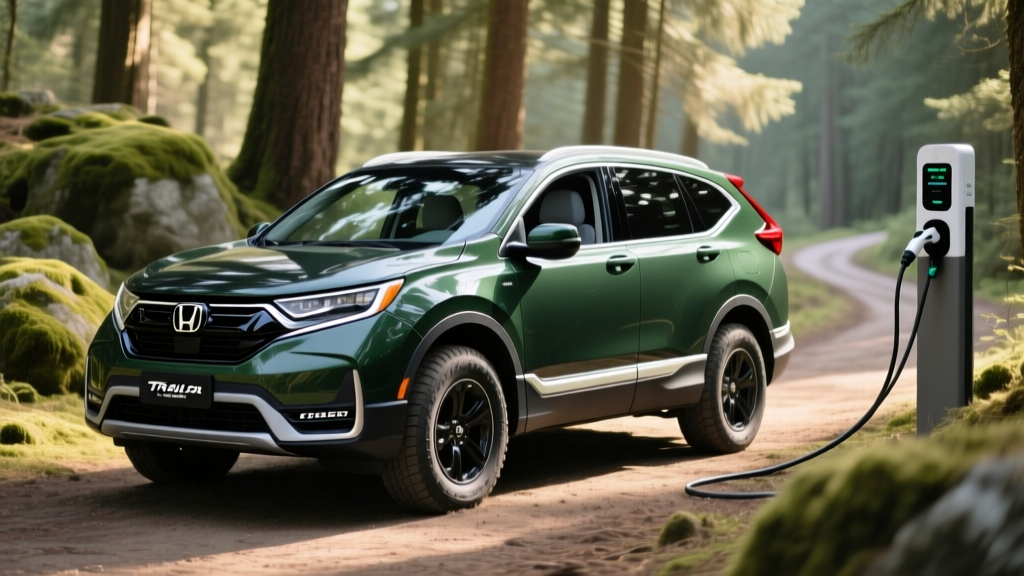
The 2026 Honda CR-V Hybrid TrailSport occupies a specific niche: buyers who want all-weather capability and rugged styling cues without sacrificing fuel economy. Honda pairs its fourth-generation two-motor hybrid system with standard real-time AWD, yielding an EPA-estimated 40 MPG combined — a number that holds up remarkably well in real-world mixed driving. This is a conventional hybrid (HEV), not a plug-in, meaning you never need to search for a charger. You just fill up with gas and drive.
For 2026, the TrailSport trim adds upgraded all-terrain tires, increased ground clearance, revised damper tuning for rough surfaces, and distinctive exterior cladding. It sits above the Sport Hybrid and below the Sport Touring Hybrid in the lineup, making it the value-oriented choice for outdoorsy buyers who don't need leather and premium audio.
HEV vs. PHEV: What the CR-V Hybrid Actually Is
Before diving into specs, it's critical to understand what you're buying. The CR-V Hybrid is a conventional hybrid electric vehicle (HEV). It cannot plug in. There is no electric-only driving mode with meaningful range. Instead, a small lithium-ion battery (roughly 1.1 kWh usable) works in concert with the gas engine and two electric motors to recapture braking energy, assist acceleration, and enable brief low-speed electric-only movement in stop-and-go traffic.
HEV vs. PHEV vs. BEV — Which Fits You?
| Feature | HEV (CR-V Hybrid) | PHEV (e.g., RAV4 Prime) | BEV (e.g., Ioniq 5) |
|---|---|---|---|
| Plugs in? | No | Yes (120V/240V) | Yes (120V/240V/DC) |
| Electric-only range | ~1 mi (low-speed) | 25–42 mi | 250–350+ mi |
| Battery size | ~1.1 kWh | 13–18 kWh | 60–100 kWh |
| Federal tax credit | None | Up to $7,500* | Up to $7,500* |
| Best for | No home charging access | Short commutes + road trips | Home charging + low running cost |
*§30D credit eligibility depends on MSRP caps, buyer income limits, and battery-sourcing requirements. See IRS.gov for current rules.
Honda does not currently offer a CR-V plug-in hybrid in the US market. If you need electric-only commuting capability, you'll need to look at competitors like the Toyota RAV4 Prime (PHEV) or transition to a full battery-electric vehicle.
Fuel Economy: EPA Ratings and Real-World MPG
The 2026 CR-V Hybrid TrailSport carries the same EPA ratings as other AWD CR-V Hybrid trims, since the powertrain is identical. The all-terrain tires add a negligible rolling-resistance penalty versus the standard all-season rubber on lower trims.
| Metric | EPA Estimate | Real-World Expectation |
|---|---|---|
| City | 40 MPG | 41–44 MPG |
| Highway | 34 MPG | 31–34 MPG |
| Combined | 37 MPG | 36–40 MPG |
Real-world note: Honda's hybrid system excels in city driving, where regenerative braking and electric-motor assist do the heavy lifting. Many owners report exceeding the EPA city estimate by 2–4 MPG in stop-and-go traffic. Highway efficiency is less impressive — at sustained 75+ MPH, the 2.0-liter Atkinson-cycle engine runs more frequently, and the boxy SUV aerodynamics work against you. Expect 31–34 MPG on long interstate trips. In cold weather (below 30°F), plan for a 5–10% reduction as the engine runs more often to provide cabin heat and maintain battery temperature.
Source: fueleconomy.gov
Powertrain Specs: 204 HP Two-Motor Hybrid with AWD
| Specification | 2026 CR-V Hybrid TrailSport |
|---|---|
| Engine | 2.0L DOHC Atkinson-cycle 4-cylinder |
| Engine power | 145 hp @ 6,100 rpm |
| Electric motors | Two (one propulsion, one generator/starter) |
| Motor power | 181 hp / 247 lb-ft torque |
| Combined system output | 204 hp / 247 lb-ft torque |
| Drivetrain | Real-Time AWD™ (standard) |
| Transmission | e-CVT (no traditional gears) |
| 0–60 mph | ~7.6 seconds |
| Towing capacity | 1,000 lbs |
| Ground clearance | 8.3 inches (TrailSport-tuned) |
| Fuel tank | 14.0 gallons |
| Total range | ~518 miles (EPA combined) |
Honda's hybrid system uses the electric motor as the primary propulsion source in most driving conditions, with the gas engine acting primarily as a generator. At highway cruising speeds, a lock-up clutch connects the engine directly to the front wheels for improved efficiency. The rear axle receives torque via a mechanical driveshaft from the front-mounted powertrain — this is not a through-the-road hybrid with a separate rear motor. The TrailSport's AWD system can route up to 50% of available torque rearward when slip is detected.
Pricing, Trims, and Tax Credit Eligibility
The 2026 Honda CR-V Hybrid TrailSport carries an MSRP of approximately $38,350 (including destination charge). This positions it roughly $2,500 above the Sport Hybrid and $3,000 below the Sport Touring Hybrid.
Federal Tax Credit: Not Eligible
Because the CR-V Hybrid is a conventional HEV (not a plug-in), it does not qualify for the IRS §30D New Clean Vehicle Credit. That credit — up to $7,500 — is reserved for plug-in hybrids (PHEVs) and battery-electric vehicles (BEVs) that meet battery-sourcing, MSRP, and buyer-income requirements. No federal purchase incentive applies to conventional hybrids.
Some states offer hybrid-specific rebates or reduced registration fees. Check your state energy office for local programs. Always consult a tax professional for personal eligibility.
For buyers who prioritize tax-credit eligibility, the Toyota RAV4 Prime PHEV (if available in your area) may qualify for partial federal credit, and fully electric alternatives like the Hyundai Ioniq 5 or Tesla Model Y may qualify for up to $7,500 depending on sourcing and income rules.
Battery Warranty, Lifespan, and Replacement Cost
Honda Hybrid Battery Warranty
- Hybrid battery (IMA system): 8 years / 100,000 miles (10 years / 150,000 miles in CARB states including CA, NY, MA, WA, OR, and others)
- Powertrain warranty: 5 years / 60,000 miles
- Hybrid system components: Covered under the 8-year/100,000-mile hybrid warranty
The CR-V Hybrid's lithium-ion traction battery is small (~1.1 kWh) and operates within a narrow state-of-charge window — Honda's battery management system keeps it roughly between 40% and 80% SoC to minimize degradation. This shallow-cycling strategy is why hybrid batteries routinely last 150,000–200,000+ miles with minimal capacity loss.
Battery replacement cost: If the hybrid battery fails outside warranty, expect to pay between $2,000 and $4,000 for a replacement pack plus labor at a Honda dealer. Independent hybrid specialists may offer refurbished packs for $1,500–$2,500. In practice, premature hybrid battery failure on Honda's fourth-generation system is rare — the chemistry and thermal management are proven across millions of vehicles globally.
The 12V auxiliary battery (a separate, conventional lead-agency or AGM unit) will need replacement every 3–5 years like any other car, at a cost of roughly $150–$250.
TrailSport-Specific Features: What You Get for the Premium
The TrailSport badge on the CR-V Hybrid isn't just an appearance package. For 2026, Honda includes:
- All-terrain tires: 18-inch wheels wrapped in all-terrain rubber with reinforced sidewalls — slightly more road noise than standard all-season tires, but noticeably better traction on gravel, mud, and snow
- Revised damper tuning: Softer low-speed damping for improved compliance on washboard roads and trail obstacles
- 8.3 inches of ground clearance: Same as other CR-V trims but with optimized approach/departure angles via revised bumper fascias
- Underbody skid plates: Front and rear skid-plate garnishes (cosmetic on the CR-V — not full armor plating)
- TrailSport interior: Orange contrast stitching, all-season rubber floor mats, and heated front seats
- Standard AWD: Real-Time AWD with intelligent torque distribution
This is a soft-roader, not a body-on-frame off-roader. It excels at forest service roads, snowy driveways, and gravel campsites — not rock crawling or deep mud. The 1,000-lb towing limit also means no boat or camper trailers; this SUV is for gear, not hauling.
Who Should Buy the CR-V Hybrid TrailSport — and Who Shouldn't
Choose the CR-V Hybrid TrailSport If:
- You lack access to home or workplace charging (apartment, street parking)
- Your daily driving is a mix of city and highway with no predictable charging routine
- You want AWD capability for snow, rain, or light trails
- You prioritize proven reliability and low maintenance over EV technology
- You drive 12,000–18,000 miles/year and want to minimize fuel spend without plug-in hassle
Look Elsewhere If:
- You have home Level 2 charging and a short commute — a PHEV or BEV will save more per mile
- You want federal tax credit eligibility ($7,500 potential savings)
- You need serious off-road capability (consider a 4Runner or Bronco Sport Badlands)
- You tow more than 1,000 lbs regularly
- You want electric-only silent driving for neighborhood or campground use
Bottom line: The CR-V Hybrid TrailSport is the pragmatic choice for buyers who want hybrid efficiency without changing their fueling habits. You'll spend roughly $1,400–$1,600/year on gas at 15,000 miles and $3.50/gallon — about $600–$800 less than the gas-only CR-V AWD. But you'll miss out on the $7,500 federal credit that a comparable BEV could deliver, which takes years of fuel savings to recoup.
Frequently Asked Questions
How many MPG does the Honda CR-V Hybrid TrailSport get?
The 2026 CR-V Hybrid TrailSport is EPA-rated at 40 MPG city, 34 MPG highway, and 37 MPG combined with standard AWD. In real-world city driving, many owners see 41–44 MPG thanks to aggressive regenerative braking. Highway driving at 75+ MPH typically yields 31–34 MPG.
Can you plug in the CR-V Hybrid to charge?
No. The CR-V Hybrid is a conventional HEV — it charges its small battery exclusively through regenerative braking and the gasoline engine. There is no plug, no charging port, and no meaningful electric-only range. If you want plug-in capability, look at PHEV competitors like the Toyota RAV4 Prime or a full EV.
Is the CR-V Hybrid reliable? What about battery replacement?
Honda's fourth-generation two-motor hybrid system has an excellent reliability track record. The hybrid battery is warrantied for 8 years/100,000 miles (10 years/150,000 miles in CARB states). Real-world data shows these batteries commonly last 150,000–200,000+ miles. Out-of-warranty replacement costs $2,000–$4,000 at a dealer.
Does the CR-V Hybrid qualify for any tax credits?
No federal purchase tax credit applies to the CR-V Hybrid because it is not a plug-in vehicle. The IRS §30D New Clean Vehicle Credit (up to $7,500) requires a plug port and minimum battery capacity. Some states may offer small hybrid rebates — check your local energy office.
How does the TrailSport compare to the CR-V Sport Touring Hybrid?
Both share the identical 204 hp hybrid AWD powertrain and 37 MPG combined rating. The TrailSport adds all-terrain tires, retuned dampers, and rugged styling at a lower price (~$38,350 vs. ~$41,350 for Sport Touring). The Sport Touring adds leather, Bose audio, wireless CarPlay/Android Auto, and a hands-free tailgate. Choose TrailSport for function; Sport Touring for comfort.
Is the TrailSport good in snow?
Yes. The standard Real-Time AWD system, combined with the TrailSport's all-terrain tires, provides confident traction in moderate snow and ice. The hybrid system's instant electric torque at low speeds is an advantage over turbo-gas competitors that need revs to build boost. For severe winter conditions, dedicated winter tires remain the best upgrade.