Quick Verdict: The CR-V Hybrid Tax Credit Situation
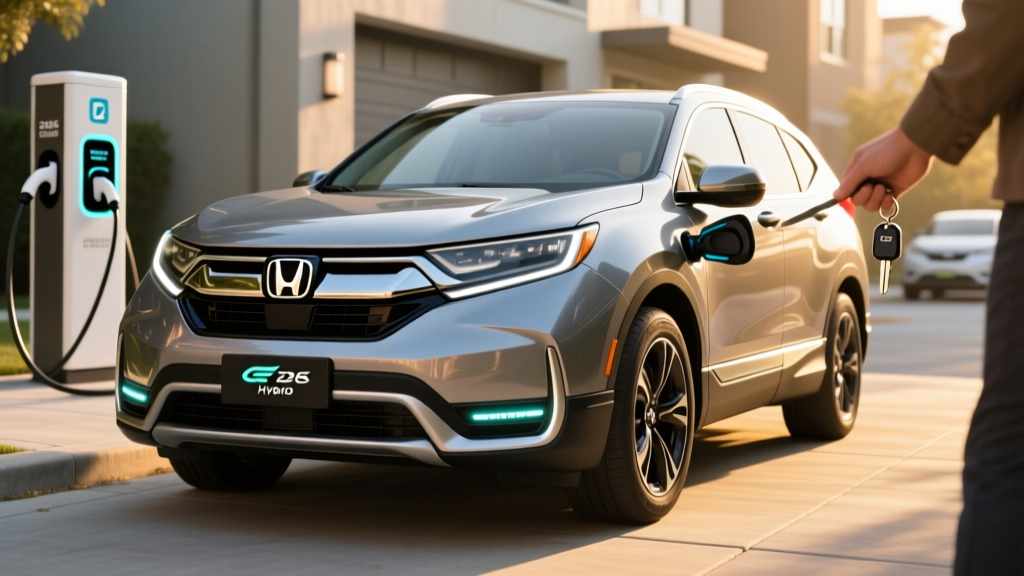
If you've been searching for "Honda CR-V Hybrid tax credit," here's the direct answer: the conventional Honda CR-V Hybrid (HEV) does not qualify for the federal §30D Clean Vehicle tax credit of up to $7,500. That credit is reserved for plug-in electric vehicles — battery-electric vehicles (BEVs) and plug-in hybrids (PHEVs) with sufficient battery capacity and compliant battery sourcing. The CR-V Hybrid is a self-charging conventional hybrid; it has no plug and no large traction battery, so it falls outside IRS §30D eligibility entirely.
That doesn't make it a bad buy. The 2026 CR-V Hybrid remains one of the most efficient compact SUVs on the market, and Honda's hybrid system is proven over millions of miles. But if a tax credit is central to your purchase math, you'll need to look at PHEV or BEV alternatives — or factor in state-level incentives that occasionally cover conventional hybrids.
HEV vs PHEV: What the CR-V Hybrid Actually Is
Honda currently sells the CR-V with two electrified options, and confusing them is the most common mistake shoppers make:
| Feature | CR-V Hybrid (HEV) | Plug-In Hybrid (PHEV) — General |
|---|---|---|
| Plug required? | No — self-charging via regen + engine | Yes — plug in to charge battery |
| Battery size | ~1.06 kWh (small buffer) | Typically 12–20 kWh |
| Electric-only driving | Brief low-speed assist only | 25–50 miles typical |
| Federal tax credit (§30D) | Not eligible | Up to $7,500 if requirements met |
| Home charging needed? | No | Yes, for full benefit |
Honda does not currently sell a CR-V PHEV in the United States. If you want a Honda plug-in, you'd need to look at prior-model-year Clarity PHEV inventory (discontinued) or wait for future Honda PHEV announcements. For now, the CR-V Hybrid is strictly an HEV — no plug, no electric-only range to speak of, and no federal credit.
2026 Honda CR-V Hybrid: EPA MPG and Real-World Efficiency
The CR-V Hybrid's two-motor system pairs a 2.0-liter Atkinson-cycle four-cylinder with two electric motors for a combined system output of 204 horsepower and 247 lb-ft of torque. Power routes through an e-CVT to either front-wheel drive or all-wheel drive (AWD is standard on most trims for 2026).
| Drivetrain | City MPG | Highway MPG | Combined MPG |
|---|---|---|---|
| FWD (Sport trim) | 43 | 36 | 40 |
| AWD (Sport Touring, Sport-L) | 40 | 34 | 37 |
Source: fueleconomy.gov
Pricing, Trims, and What About Tax Credits?
The 2026 Honda CR-V Hybrid is available across several trims, with pricing starting in the mid-$30,000s:
| Trim | Drivetrain | Starting MSRP |
|---|---|---|
| Sport | FWD | $36,395 |
| Sport | AWD | $37,895 |
| Sport-L | AWD | $40,395 |
| Sport Touring | AWD | $43,295 |
Federal Tax Credit: Not Eligible
Under IRS §30D rules, the Clean Vehicle Credit applies only to vehicles with a plug — BEVs and qualifying PHEVs with at least 7 kWh of battery capacity, meeting critical-mineral and battery-component sourcing thresholds, MSRP caps ($55,000 for SUVs), and buyer income limits ($300,000 joint / $150,000 single). The CR-V Hybrid has a ~1.06 kWh battery, no charging port, and no plug-in capability. It simply does not meet the statutory definition of a "new clean vehicle" under §30D.
State and Local Incentives
A handful of states and utilities offer modest rebates for conventional hybrids — typically $250 to $1,000 — though these programs have become less common as policy shifts toward plug-in vehicles. Check your state energy office or utility provider for current programs. These vary by jurisdiction and change frequently, so always verify with official state sources before counting on them in your budget.
Battery Warranty, Reliability, and Replacement Cost
Hybrid battery longevity is the top concern for first-time hybrid buyers. Here's what Honda covers:
In practice, Honda's two-motor hybrid system has proven extremely durable. The battery in the CR-V Hybrid is small (~1.06 kWh) and operates within a narrow state-of-charge window — it never fully charges or fully depletes — which dramatically reduces degradation stress compared to a large BEV or PHEV battery. Real-world failure rates on Honda hybrid batteries are very low. Independent data from sources like Consumer Reports consistently rate the CR-V Hybrid as average to above-average in predicted reliability.
Battery Replacement Cost
If your hybrid battery does fail outside warranty, replacement costs for the CR-V Hybrid typically range from $2,000 to $4,000 (parts and labor) at a Honda dealer. This is far less than a BEV battery replacement ($10,000–$20,000+) because the pack is small. Third-party hybrid battery refurbishers can sometimes offer replacements for $1,500–$2,500. Given the warranty coverage and low failure rate, this is a manageable risk for most owners.
Who Should Buy the CR-V Hybrid vs a PHEV or Full EV?
The CR-V Hybrid occupies a specific niche. Here's a decision framework to determine if it's right for you:
- You cannot install a home charger (apartment, street parking, no garage)
- You want better fuel economy with zero change to your refueling habits
- You regularly drive 300+ miles between stops and don't want to plan around chargers
- You live in an area with sparse public charging infrastructure
- Your budget is under $40,000 and you want AWD
- You can charge at home and want 30–42 miles of electric-only daily driving
- You want to qualify for the federal tax credit (if the specific model meets §30D sourcing rules)
- Most of your driving is under 40 miles round-trip
- You have reliable home Level 2 charging
- You want to eliminate gas purchases entirely
- You want the full $7,500 federal credit (point-of-sale) on a qualifying model
- Your daily driving is under 250 miles and you road-trip infrequently
CR-V Hybrid Ownership Economics: 5-Year Cost Snapshot
Even without a tax credit, the CR-V Hybrid saves money at the pump. Here's a rough 5-year / 75,000-mile comparison assuming $3.40/gallon regular unleaded:
| CR-V Hybrid AWD (37 mpg) | CR-V Gas AWD (29 mpg) | |
|---|---|---|
| Gallons consumed | 2,027 | 2,586 |
| Fuel cost (@ $3.40/gal) | $6,892 | $8,793 |
| 5-year fuel savings | $1,901 in favor of Hybrid | |
The Hybrid typically carries a $1,200–$1,500 price premium over the equivalent gas CR-V trim. That premium is recovered through fuel savings in roughly 3–4 years for an average driver (15,000 miles/year). Factor in potentially higher resale value for the hybrid and the economics work without any tax credit.
Frequently Asked Questions
Does the Honda CR-V Hybrid qualify for any federal tax credit?
No. The conventional CR-V Hybrid (HEV) does not qualify for the IRS §30D Clean Vehicle Credit. That credit requires a plug-in vehicle (BEV or PHEV) with at least 7 kWh of battery capacity and compliant sourcing. The CR-V Hybrid has a ~1 kWh battery and no charging port.
How many MPG does the CR-V Hybrid actually get?
The EPA rates the FWD model at 43 city / 36 highway / 40 combined, and the AWD at 40/34/37. In real-world driving, city MPG often matches or exceeds the EPA number, while highway MPG at sustained speeds tends to run 2–3 mpg below the sticker.
Can the CR-V Hybrid drive on electric power alone?
Only at very low speeds (under ~25 mph) for short distances — think crawling through a parking lot. It has no meaningful electric-only range like a PHEV. The engine is always available and frequently runs to generate electricity for the drive motors.
How long will the CR-V Hybrid battery last?
Honda warrants the hybrid battery for 8 years/100,000 miles (10/150,000 in CARB states). Based on historical data from Honda's hybrid fleet, these batteries routinely last 150,000+ miles without significant issues. The small battery size and conservative charge window contribute to longevity.
Is the CR-V Hybrid reliable?
Honda's two-motor hybrid system has been in production since 2014 (Accord Hybrid) and has a strong reliability record. The CR-V Hybrid earns average to above-average reliability scores from major evaluators. The e-CVT has no traditional gears or belts, reducing mechanical failure points.
Should I wait for a CR-V PHEV?
Honda has not announced a CR-V PHEV for the U.S. market as of 2026. Honda's global electrification strategy has focused on BEVs (Prologue) and conventional hybrids. If a PHEV is essential to your needs, the Toyota RAV4 Prime (42 miles electric, ~$44,000) or Hyundai Tucson PHEV (33 miles electric, ~$38,000) are the closest competitors to watch.