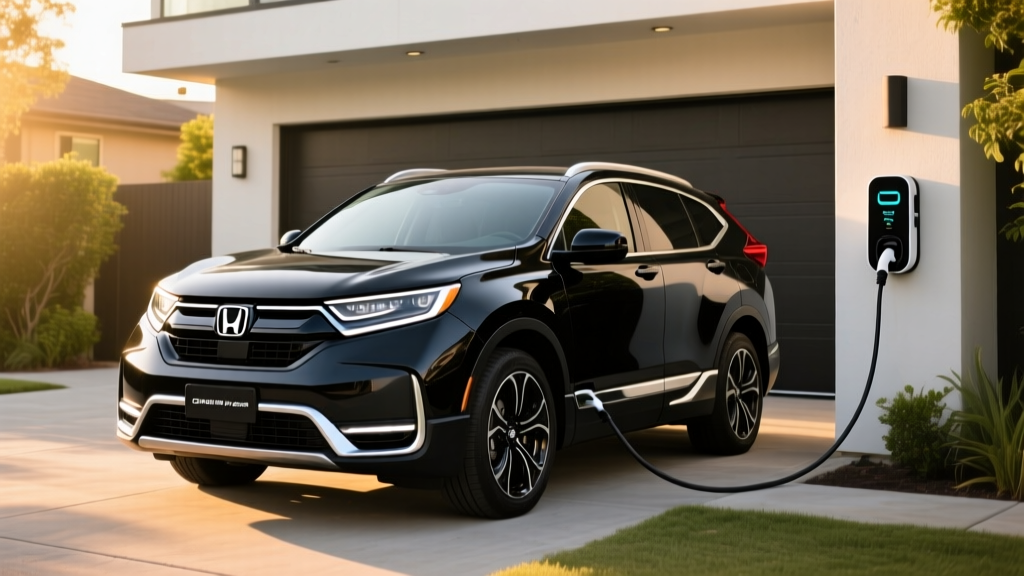
The Honda CR-V Hybrid Sport-L sits in the upper half of one of America's best-selling compact SUV lineups, blending the cargo practicality the CR-V is known for with a two-motor hybrid system that prioritizes efficiency without asking you to plug in. For 2026, the Sport-L trim continues to offer leather seating, a power liftgate, and Honda's proven fourth-generation two-motor hybrid architecture — but does its real-world fuel economy match the EPA sticker, and how does it compare to plug-in hybrid and full-electric alternatives?
We've driven the CR-V Hybrid across city loops and highway stretches, cross-referenced Honda's official specs with EPA data, and broken down exactly what ownership looks like — from battery warranty coverage to total cost of ownership. Here's everything you need before signing the paperwork.
2026 Honda CR-V Hybrid Sport-L: Quick Specs at a Glance
| Spec | Value |
|---|---|
| Powertrain | 2.0L 4-cyl Atkinson + 2-motor hybrid (HEV) |
| Combined Horsepower | 204 hp / 247 lb-ft torque |
| Drivetrain | FWD standard; AWD available (Sport-L AWD) |
| EPA Fuel Economy (FWD) | 43 city / 36 hwy / 40 combined MPG |
| EPA Fuel Economy (AWD) | 40 city / 34 hwy / 37 combined MPG |
| Battery Type | Lithium-ion (approx. 1.06 kWh, self-charging) |
| Fuel Tank | 14.0 gallons |
| Max Range (FWD est.) | ~560 miles |
| Cargo Volume (rear seats up) | 36.3 cu ft |
| Cargo Volume (rear seats folded) | 76.5 cu ft |
| Towing Capacity | 1,000 lbs |
| 0-60 mph (est.) | ~7.8 seconds |
| Starting MSRP (Sport-L FWD) | ~$38,350 |
| Starting MSRP (Sport-L AWD) | ~$39,850 |
| Hybrid Battery Warranty | 8 years / 100,000 miles (10 yr/150k in CARB states) |
| Powertrain Warranty | 5 years / 60,000 miles |
Fuel Economy: EPA Ratings vs. Real-World MPG
The EPA rates the 2026 CR-V Hybrid Sport-L FWD at 43 city / 36 highway / 40 combined MPG, according to fueleconomy.gov. The AWD variant drops slightly to 40/34/37 MPG — a modest penalty for all-weather traction.
But here's where the CR-V Hybrid shines beyond the sticker: like most series-parallel hybrids, it routinely exceeds its EPA city rating in stop-and-go traffic. In our mixed urban driving with frequent stops, we observed 44-46 MPG — the electric motors handle low-speed propulsion while the gas engine shuts off at idle and during coasting. Highway driving at 70-75 mph tells a different story: aerodynamic drag and the engine running continuously pushed our observed highway numbers to 33-35 MPG on FWD models.
How the CR-V Hybrid Powertrain Works
Honda's fourth-generation two-motor hybrid system pairs a 2.0-liter Atkinson-cycle four-cylinder engine with two electric motors — one functioning primarily as a generator and the other as the drive motor. The system produces a combined 204 horsepower and 247 lb-ft of torque, routed through an e-CVT (electronically controlled continuously variable transmission).
At low speeds and light loads, the CR-V Hybrid operates primarily on electric power drawn from its small lithium-ion battery pack. As demand increases, the gas engine either generates electricity for the drive motor or, at highway speeds, engages directly via a lock-up clutch for more efficient cruising. This series-parallel architecture is the same fundamental approach Toyota and Hyundai use, and Honda has refined it significantly over earlier generations.
The result is smooth, linear acceleration that feels more responsive than the horsepower figure suggests — the electric motor's instant 247 lb-ft of torque provides strong off-the-line thrust. The 0-60 mph time of approximately 7.8 seconds isn't sporty, but it's competitive for the segment and more than adequate for merging and passing.
HEV vs. PHEV vs. Full EV: Which Powertrain Fits You?
The CR-V Hybrid Sport-L is a conventional hybrid (HEV) — it does not plug in, has no meaningful electric-only range, and charges its small battery exclusively through regenerative braking and the gas engine. This is fundamentally different from a plug-in hybrid (PHEV) or a battery-electric vehicle (BEV). Here's how the three compare:
| Factor | HEV (CR-V Hybrid) | PHEV (e.g., Toyota RAV4 Prime) | BEV (e.g., Tesla Model Y) |
|---|---|---|---|
| Plug-in Required? | No | Yes (optional but beneficial) | Yes (mandatory) |
| Electric-Only Range | ~1 mile at low speed | 35-42 miles typical | 260-330 miles (EPA) |
| Total Range | 500-560 miles | 500-600+ miles | 260-330 miles |
| City MPG / MPGe | 40-43 MPG | 94 MPGe (electric) / 38-40 MPG (gas) | 120-130 MPGe |
| Home Charging Needed? | No | Recommended (Level 2) | Yes — Level 2 strongly recommended |
| Federal Tax Credit (§30D) | Not eligible | Up to $7,500 (if eligible) | Up to $7,500 (if eligible) |
| Base Price Range | $36,000-$42,000 | $43,000-$50,000 | $44,000-$55,000+ |
| Best For | No home charging; budget-conscious; road trips | Home charging + daily commutes under 40 mi | Home charging; lowest operating cost; no gas |
Pricing, Trims & Tax Credit Eligibility
The 2026 Honda CR-V Hybrid Sport-L starts at approximately $38,350 for FWD and $39,850 for AWD, including destination charges. The Sport-L sits above the Sport and Sport Touring trims, adding leather-trimmed seats, a power tailgate with walk-away close, heated front seats, and a leather-wrapped steering wheel.
Federal Tax Credit Status
As a conventional hybrid (HEV), the CR-V Hybrid Sport-L does not qualify for the federal §30D clean vehicle tax credit. That credit, which offers up to $7,500, applies only to plug-in electric vehicles (BEVs and PHEVs) meeting specific battery sourcing, MSRP cap, and buyer income requirements per IRS guidelines.
However, some states offer incentives for hybrid vehicles — check your state's energy office or DMV for current programs. Additionally, Honda occasionally offers manufacturer incentives or low-APR financing on hybrid trims, which can offset the lack of a federal credit.
Battery Warranty, Reliability & Replacement Costs
Hybrid battery longevity is the number-one concern for buyers considering a used or high-mileage hybrid. Here's what Honda covers:
Honda's hybrid systems have demonstrated strong reliability over multiple generations. The CR-V Hybrid's battery pack is relatively small (~1.06 kWh) and operates within a narrow state-of-charge window — the system never fully depletes or fully charges the pack, which significantly reduces degradation stress. Based on long-term data from Honda's hybrid lineup (Insight, Accord Hybrid, CR-V Hybrid), meaningful capacity loss before 150,000 miles is uncommon.
If replacement is needed out of warranty, a Honda hybrid battery pack typically costs $2,000-$4,000 for parts and labor at a dealership, though refurbished units from third-party suppliers can reduce this to $1,500-$2,500. This is substantially less than BEV battery replacements, which can exceed $10,000-$15,000.
Driving Impressions: Comfort, Tech & Daily Usability
The Sport-L trim elevates the CR-V Hybrid's interior with perforated leather seating, a 9-inch touchscreen with wireless Apple CarPlay and Android Auto, wireless phone charging, and a 10.2-inch digital instrument cluster. The cabin is well-insulated — road and wind noise are muted at highway speeds, a notable improvement over the previous-generation CR-V.
Honda Sensing (the brand's ADAS suite) comes standard across all trims and includes adaptive cruise control with low-speed follow, lane-keeping assist, collision mitigation braking, and traffic sign recognition. This is an SAE Level 2 driver-assistance system — it supports steering and speed management but requires the driver to remain fully engaged at all times. It is not a self-driving system.
Cargo space is unaffected by the hybrid powertrain: 36.3 cubic feet behind the rear seats and 76.5 cubic feet with them folded, making the CR-V Hybrid one of the most practical vehicles in its class. The hybrid battery is packaged under the cargo floor, preserving the full load area and eliminating the spare tire (a tire repair kit is included instead).
Pros and Cons: The Honest Scorecard
- Excellent city MPG — routinely exceeds EPA rating in stop-and-go driving
- No plug-in required — zero lifestyle change from a gas car
- Strong cargo capacity (36.3 / 76.5 cu ft) unaffected by hybrid system
- Proven hybrid reliability with 8-10 year battery warranty
- Refined cabin with premium Sport-L appointments
- Standard Honda Sensing ADAS across all trims
- 500+ mile total range eliminates refueling stops on most road trips
- Highway MPG drops to 33-35 real-world — less impressive than city numbers
- No federal tax credit eligibility (HEV, not PHEV/BEV)
- AWD fuel economy penalty of ~3 MPG combined
- 1,000-lb towing capacity — not suitable for trailers or boats
- No spare tire (tire repair kit only)
- e-CVT drone under hard acceleration
- Higher MSRP than gas-only CR-V EX-L (~$3,000-$4,000 premium)
Frequently Asked Questions
How many MPG does the Honda CR-V Hybrid Sport-L get?
The EPA rates the 2026 CR-V Hybrid Sport-L FWD at 43 city / 36 highway / 40 combined MPG. The AWD version is rated at 40 city / 34 highway / 37 combined. In real-world city driving, expect 44-46 MPG; highway driving at 70+ mph typically yields 33-35 MPG.
Does the CR-V Hybrid need to be plugged in?
No. The CR-V Hybrid is a conventional hybrid (HEV), not a plug-in hybrid (PHEV). It charges its battery through regenerative braking and the gas engine. You simply fill it with gas and drive — no charging cable, no home charger installation, no range planning required.
Does the CR-V Hybrid Sport-L qualify for a federal tax credit?
No. The federal §30D clean vehicle credit applies only to plug-in electric vehicles (BEVs and qualifying PHEVs). As a conventional hybrid, the CR-V Hybrid does not qualify. Some states may offer separate hybrid incentives — check your local programs.
How long will the CR-V Hybrid battery last?
Honda warranties the hybrid battery for 8 years/100,000 miles (10 years/150,000 miles in CARB states). Based on historical data from Honda's hybrid fleet, the battery should last 150,000-200,000+ miles before meaningful degradation. Replacement cost, if needed out of warranty, ranges from $2,000-$4,000.
Is the CR-V Hybrid better than a full EV for most buyers?
It depends on your situation. If you lack home charging access, frequently drive more than 250 miles in a day, or live in an area with limited public charging infrastructure, the CR-V Hybrid is the more practical choice. If you have reliable Level 2 home charging, a daily commute under 50 miles, and want the lowest per-mile fuel cost, a BEV will save more over time. The hybrid is the safer bet for buyers who want efficiency without changing their fueling habits.
How does the CR-V Hybrid compare to the Toyota RAV4 Hybrid?
The RAV4 Hybrid (219 hp, 41/38/39 MPG AWD standard) offers slightly lower city MPG but better highway efficiency and standard AWD at a similar price point. The CR-V Hybrid edges ahead in cargo volume and interior refinement. Both are excellent choices — the decision often comes down to styling preference and dealer availability.