Quick Verdict: The CR-V Hybrid Sport-L in 2026
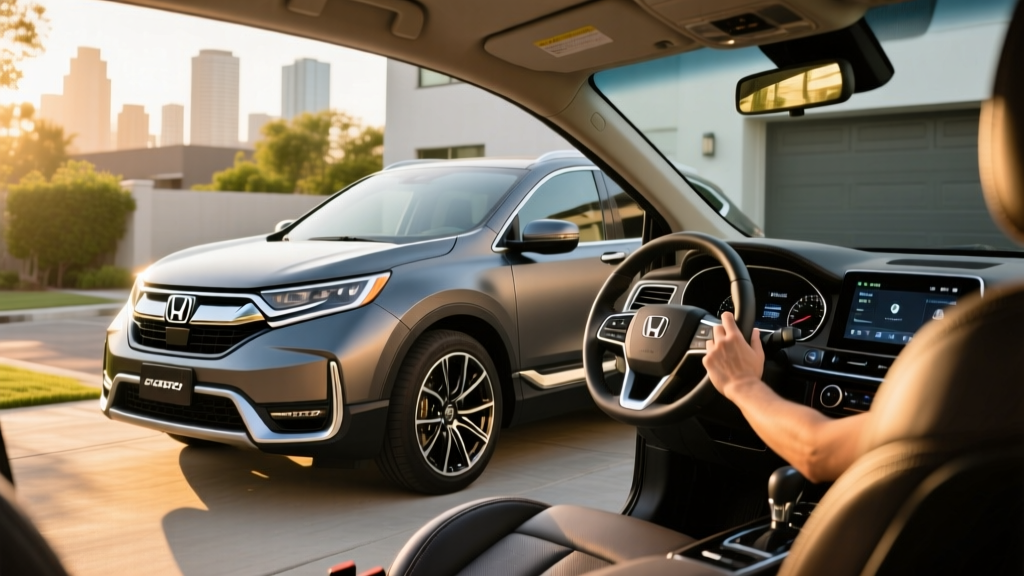
The 2026 Honda CR-V Hybrid Sport-L occupies a precise niche: it's the top-tier conventional hybrid (HEV) trim in Honda's best-selling compact SUV lineup, blending leather-trimmed comfort with a 204-horsepower two-motor hybrid system that returns an EPA-estimated 40 MPG combined. If you want the efficiency of electrification without ever plugging in, this is one of the most refined options on the market. But it's critical to understand what the Sport-L is—and isn't—before signing a purchase order.
The Sport-L is a conventional hybrid (HEV), not a plug-in hybrid (PHEV). That means it generates all its electricity internally through regenerative braking and its gasoline engine. You will never plug it in. If you're looking for electric-only driving range, you want the CR-V e:FHEV (sold in other markets) or a competing PHEV like the Toyota RAV4 Prime. For U.S. buyers in 2026, Honda does not offer a plug-in CR-V.
| Spec | Value |
|---|---|
| Powertrain | 2.0L 4-cyl Atkinson + 2-motor hybrid system |
| Combined Horsepower | 204 hp |
| Combined Torque | 247 lb-ft (electric motor) |
| Drivetrain | AWD (standard on Sport-L) |
| EPA MPG (City / Hwy / Combined) | 40 / 34 / 37 |
| Fuel Tank | 14.0 gallons |
| Total Range | ~518 miles |
| 0–60 mph | ~7.6 seconds |
| Cargo Volume (rear seats up / down) | 36.3 / 76.5 cu ft |
| Towing Capacity | 1,000 lbs |
| Hybrid Battery Warranty | 8 years / 100,000 miles |
| MSRP (Sport-L AWD) | ~$39,350 (incl. destination) |
| Federal Tax Credit (§30D) | Not eligible (HEV, not PHEV/BEV) |
HEV vs. PHEV: What the CR-V Sport-L Actually Is
One of the most common buyer mistakes in the hybrid segment is conflating conventional hybrids with plug-in hybrids. Here's how they differ, and where the CR-V Hybrid Sport-L fits:
| Attribute | HEV (CR-V Hybrid Sport-L) | PHEV (e.g., RAV4 Prime) | BEV (e.g., Ioniq 5) |
|---|---|---|---|
| Plug in to charge? | No — self-charging | Yes — Level 1 or Level 2 | Yes — Level 2 or DC fast |
| Electric-only range | ~1 mile at low speed | 30–42 miles typical | 250–350+ miles |
| Gasoline engine? | Yes (primary power) | Yes (backup + highway) | No |
| Typical combined MPG / MPGe | 37–40 MPG | 38 MPG + 94 MPGe | 110–132 MPGe |
| Federal tax credit (§30D) | Not eligible | Up to $7,500 (if eligible) | Up to $7,500 (if eligible) |
| Home charging needed? | No | Recommended for EV range | Essential |
| Best for | No garage/outlet access; simplicity | Short commutes + road trips | Home charging + low running cost |
The CR-V Hybrid Sport-L is firmly in the HEV column. Its hybrid system uses a small lithium-ion battery pack (approximately 1.1 kWh, not plug-accessible) to buffer energy recaptured from braking and to assist the gasoline engine during acceleration. The electric motors can propel the vehicle at very low speeds for brief distances—think creeping through a parking lot—but this is not meaningful "electric-only range." The gasoline engine is always doing the heavy lifting.
Fuel Economy: EPA Numbers vs. Real-World MPG
The EPA rates the 2026 CR-V Hybrid AWD at 40 city / 34 highway / 37 combined MPG. These numbers come from fueleconomy.gov, and they reflect the AWD Sport-L trim specifically.
| Driving Condition | EPA Estimate | Real-World Expectation |
|---|---|---|
| City | 40 MPG | 38–44 MPG (hybrids often exceed EPA in stop-and-go) |
| Highway | 34 MPG | 30–34 MPG (aero drag and speed reduce hybrid advantage) |
| Combined | 37 MPG | 34–40 MPG (depends on driving mix) |
| Cold weather (below 32°F) | Not rated separately | 30–34 MPG combined (engine runs more for cabin heat) |
Here's what the data tells us in practice: conventional hybrids shine in city driving. The two-motor system recaptures braking energy at every stoplight, and the engine shuts off frequently at idle and low speeds. Many owners report exceeding the 40 MPG city figure on suburban commutes with moderate traffic. Highway driving is a different story—at 75+ mph, the CR-V Hybrid operates mostly on its gasoline engine, and the aerodynamic penalty of an SUV shape erodes efficiency. Expect 30–33 MPG on sustained interstate trips at 75 mph.
Cold weather is the other variable. Below freezing, the gasoline engine must run more frequently to provide cabin heat (unlike a BEV with a heat pump, the HEV relies on engine waste heat). Owners in northern climates should budget for a 10–15% fuel economy penalty in winter months, bringing combined figures to roughly 30–34 MPG.
With a 14.0-gallon fuel tank and 37 MPG combined, total range lands around 518 miles—enough for most road trips without excessive fuel stops.
Powertrain and Performance: 204 HP, Two Motors, AWD
Honda's fourth-generation two-motor hybrid system pairs a 2.0-liter Atkinson-cycle four-cylinder engine with two electric motors: one primarily functions as a generator, and the other drives the front wheels. Combined system output is 204 horsepower and 247 lb-ft of torque—the torque figure coming almost entirely from the electric drive motor, which delivers it instantly from zero RPM.
The Sport-L comes standard with AWD, which uses a rear-mounted electric motor (not a mechanical driveshaft) to power the rear axle when traction demands it. This is a key engineering detail: the rear motor engages seamlessly during acceleration, slippery conditions, or when the system detects front-wheel slip. It's not a full-time AWD system, but it's effective for rain, light snow, and gravel roads.
The 0–60 mph time of approximately 7.6 seconds is adequate for merging and passing but won't feel sporty despite the "Sport" badge. Where the hybrid system impresses is in low-speed responsiveness—the electric motor's instant torque makes the CR-V feel quicker around town than its 0–60 number suggests. The continuously variable transmission (e-CVT) is smooth and avoids the rubber-band sensation of older CVTs, though it still drones under hard acceleration.
One practical limitation: towing capacity is just 1,000 pounds. If you need to tow a small trailer, jet ski, or bike rack with a heavy load, the CR-V Hybrid falls short of body-on-frame competitors. Honda rates the non-hybrid CR-V at 1,500 lbs, and the Toyota RAV4 Hybrid manages 1,750 lbs.
Battery Longevity, Warranty, and Replacement Costs
Hybrid battery anxiety is the number-one concern we hear from first-time hybrid buyers. Here's the reality for the CR-V Hybrid Sport-L:
Honda Hybrid Battery Warranty: 8 years or 100,000 miles (whichever comes first), covering defects and capacity loss below functional thresholds. In California and states adopting CARB emissions standards, hybrid battery coverage extends to 10 years / 150,000 miles.
The CR-V Hybrid's lithium-ion battery pack is small (~1.1 kWh) and operates within a conservative state-of-charge window—Honda's battery management system never fully charges or fully depletes it. This shallow-cycling strategy dramatically extends cell life. Based on long-term data from Honda's hybrid fleet (Insight, Accord Hybrid, prior-gen CR-V Hybrid), most hybrid batteries outlast the warranty period by a wide margin, with many reaching 150,000–200,000+ miles without significant degradation.
If a replacement is needed out of warranty, expect a cost between $2,000 and $4,000 for a new OEM hybrid battery pack, plus labor. Refurbished or aftermarket packs are available for $1,000–$2,000. This is far less expensive than a BEV traction battery replacement, which can run $10,000–$20,000.
Beyond the hybrid battery, Honda's broader powertrain warranty covers the engine, motors, and e-CVT for 5 years / 60,000 miles, with the limited vehicle warranty at 3 years / 36,000 miles.
Pricing, Trims, and Tax Credit Eligibility
The 2026 Honda CR-V Hybrid is available in four trims: Sport, Sport Touring, Sport-L, and (in some configurations) a base Hybrid. The Sport-L sits near the top of the lineup, adding leather-trimmed seats, a leather-wrapped steering wheel, heated front seats, a power-adjustable driver's seat, and a 9-inch touchscreen with wireless Apple CarPlay and Android Auto over the cloth-equipped Sport trim.
Estimated pricing for the 2026 CR-V Hybrid Sport-L AWD starts at approximately $39,350 including destination charges. Key competitors price similarly: the Toyota RAV4 Hybrid XLE Premium AWD starts around $38,500, while the Hyundai Tucson Hybrid Limited AWD lands near $40,200.
Federal Tax Credit (§30D): The CR-V Hybrid Sport-L does not qualify for the federal §30D Clean Vehicle Credit. That credit applies only to plug-in electric vehicles (BEVs and PHEVs) meeting battery sourcing, MSRP, and buyer income requirements as outlined by the IRS. Conventional hybrids (HEVs) have never been eligible for §30D.
However, some states offer modest rebates or HOV-lane access for hybrid vehicles. Check your state's energy or DMV website for current programs. These vary widely by jurisdiction and change frequently.
Who Should Buy the CR-V Hybrid Sport-L — And Who Shouldn't
The CR-V Hybrid Sport-L is a targeted solution. Here's our decision framework:
Choose the CR-V Hybrid Sport-L if:
- You don't have access to home or workplace charging (apartment, street parking, no garage outlet)
- Your commute is mostly city/suburban with frequent stops (where hybrid efficiency peaks)
- You want lower fuel costs without changing your refueling habits
- You value Honda's reliability reputation and strong resale value
- You want leather and premium features without stepping to the Sport Touring (~$42,000)
Look elsewhere if:
- You have home charging and a short commute — a PHEV (RAV4 Prime, Tucson PHEV) or BEV will save more on fuel
- You need to tow more than 1,000 lbs
- You want electric-only driving for emissions-free local trips
- You qualify for the $7,500 federal tax credit — that credit dramatically changes the value equation for PHEVs and BEVs
- Highway miles dominate your driving — the hybrid advantage shrinks to just 2–3 MPG over the non-hybrid CR-V at sustained speed
Pros
- 40 MPG city in a spacious, practical compact SUV
- No plug-in charging required — zero lifestyle change
- Strong reliability record; 8-year/100K-mile hybrid battery warranty
- Smooth, responsive low-speed driving from electric motor torque
- Leather interior and premium features at a reasonable price point
- Excellent cargo space (36.3 cu ft behind rear seats)
Cons
- Highway MPG (34) is unremarkable — less advantage over gas models
- No federal tax credit eligibility
- 1,000-lb towing limit is below segment average
- e-CVT drones under hard acceleration
- No PHEV or EV-only option in the U.S. CR-V lineup
- Cold-weather fuel economy drops 10–15%
How the CR-V Hybrid Sport-L Compares
Three competitors deserve cross-shopping consideration:
Toyota RAV4 Hybrid (XLE Premium AWD, ~$38,500): EPA-rated at 41 city / 38 highway / 40 combined. The RAV4 Hybrid beats the CR-V on highway MPG and towing (1,750 lbs) but trails on interior material quality and cargo volume. If highway miles dominate your driving, the RAV4 Hybrid's higher highway rating is meaningful.
Toyota RAV4 Prime (PHEV, ~$44,500): If you can plug in at home, the RAV4 Prime offers 42 miles of electric-only range, 302 combined hp, and eligibility for the full $7,500 federal tax credit (subject to IRS §30D income and sourcing rules). After the credit, effective price drops to ~$37,000—undercutting the CR-V Hybrid Sport-L while offering vastly lower fuel costs on short commutes. The tradeoff: longer wait times at dealers, and you need a Level 2 home charger to maximize value.
Hyundai Tucson Hybrid Limited AWD (~$40,200): EPA-rated at 38 city / 38 highway / 38 combined. The Tucson Hybrid matches the CR-V on features and price but falls slightly short on city MPG. It offers a conventional 6-speed automatic instead of a CVT, which some drivers prefer for its more natural feel.
Frequently Asked Questions
How many MPG does the 2026 CR-V Hybrid Sport-L get?
The EPA rates it at 40 city / 34 highway / 37 combined MPG. In real-world driving, expect 38–44 MPG in city conditions and 30–34 MPG on sustained highway trips. Cold weather reduces combined economy to approximately 30–34 MPG.
Does the CR-V Hybrid Sport-L need to be plugged in?
No. The CR-V Hybrid Sport-L is a conventional hybrid (HEV). It charges its small battery pack internally through regenerative braking and the gasoline engine. You will never plug it in—just fill it with gas like any other vehicle.
How far can the CR-V Hybrid drive on electric power alone?
Effectively zero meaningful distance. The electric motors can move the vehicle at very low speeds (parking lot creeping) for a fraction of a mile, but the gasoline engine starts almost immediately under any real driving load. If you want electric-only range, you need a PHEV or BEV.
Is the CR-V Hybrid reliable, and what does battery replacement cost?
Honda's hybrid system has an excellent long-term reliability record. The hybrid battery is warrantied for 8 years/100,000 miles (10 years/150,000 miles in CARB states). Based on fleet data, most Honda hybrid batteries last 150,000–200,000+ miles. Out-of-warranty replacement runs $2,000–$4,000 for an OEM pack—far less than a BEV battery.
Does the CR-V Hybrid Sport-L qualify for any tax credit?
Not the federal §30D Clean Vehicle Credit, which applies only to plug-in vehicles (PHEVs and BEVs). Some states offer small hybrid rebates or incentives—check your state's energy office or DMV for current programs.
Hybrid vs. PHEV vs. EV — which should I choose?
If you lack home charging access or don't want to change your refueling routine, the CR-V Hybrid (HEV) is ideal. If you have a garage with a 240V outlet and a commute under 40 miles, a PHEV like the RAV4 Prime gives you electric-only daily driving plus a gas engine for road trips—and may qualify for a $7,500 federal credit. If you have reliable home charging and rarely drive over 250 miles between stops, a BEV like the Hyundai Ioniq 5 or Tesla Model Y offers the lowest operating costs and strongest acceleration.
Is the CR-V Hybrid Sport-L good in snow?
The AWD system uses an electric rear motor that engages when front wheels slip, providing confident traction in light to moderate snow. Ground clearance is 8.2 inches. It's not a substitute for dedicated winter tires in severe conditions, but it outperforms FWD-only competitors in winter weather.