Quick Verdict: The 2026 Honda CR-V Hybrid Sport
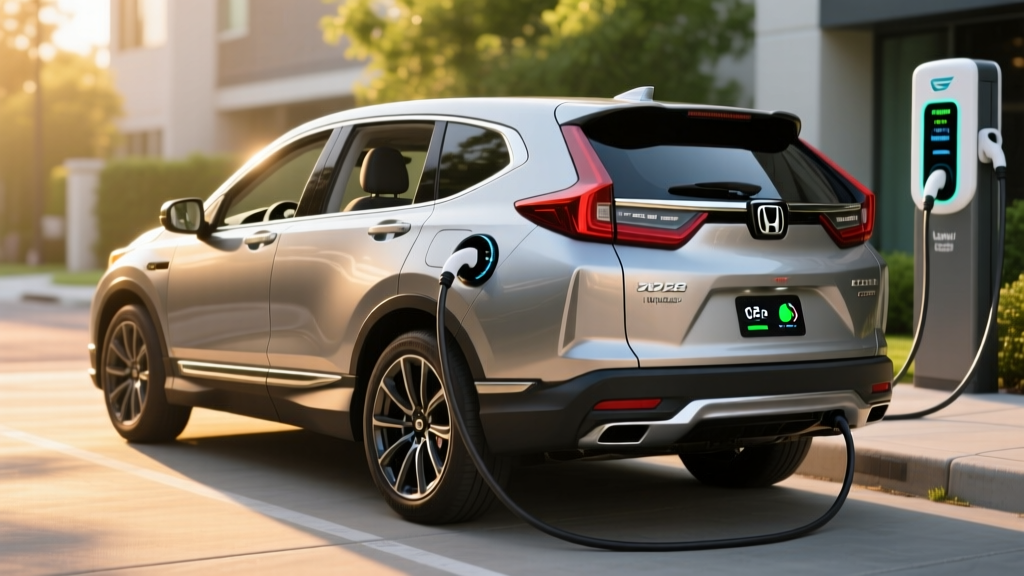
The 2026 Honda CR-V Hybrid Sport occupies a specific niche in the compact crossover market: it's a conventional hybrid electric vehicle (HEV) — meaning it never plugs in — that delivers meaningful fuel savings over its gas-only sibling without the price premium or charging logistics of a plug-in hybrid (PHEV) or battery electric vehicle (BEV). With an EPA-estimated 40 MPG combined and standard all-wheel drive, the Sport trim targets buyers who want efficiency gains without changing their fueling habits.
This is not a plug-in vehicle. The CR-V Hybrid cannot drive on electric power alone at highway speeds for meaningful distances, and it does not qualify for the federal §30D EV tax credit. What it does offer is a proven two-motor hybrid system, competitive cargo space, and a starting price that undercuts many PHEV rivals by several thousand dollars.
HEV vs. PHEV: What the CR-V Hybrid Sport Actually Is
Before diving into specs, it's essential to understand what you're buying — and what you're not.
Conventional Hybrid (HEV) — This Car
- No plug required. The battery recharges through regenerative braking and the gasoline engine.
- Small battery (~1.1 kWh usable). The electric motor assists the engine but cannot propel the car alone for more than roughly one mile at very low speeds.
- No electric-only range claim. Efficiency comes from the engine operating in its optimal RPM range more often, plus energy recaptured during braking.
- No federal EV tax credit. The §30D credit applies only to plug-in vehicles with ≥7 kWh of battery capacity.
Plug-In Hybrid (PHEV) — Not This Car
- Plugs into a wall or charger. A larger battery (typically 12–20 kWh) provides 25–45 miles of electric-only driving.
- Requires home charging access to realize most of its efficiency advantage.
- May qualify for federal/state incentives depending on battery size, sourcing, and buyer income.
- Higher purchase price — typically $5,000–$10,000 more than an equivalent HEV.
Honda does not currently offer a CR-V PHEV in the United States. If you need electric-only commuting capability, you'll need to look at competitors like the Toyota RAV4 Prime (302 hp, 42 miles electric-only, ~$44,000) or the Hyundai Tucson PHEV (261 hp, 33 miles electric-only, ~$39,000).
Fuel Economy: EPA Estimates and Real-World MPG
| Metric | EPA Estimate | Real-World Expectation |
|---|---|---|
| City | 43 MPG | 42–46 MPG (hybrids excel in stop-and-go) |
| Highway | 36 MPG | 33–37 MPG (less electric assist at sustained speed) |
| Combined | 40 MPG | 37–42 MPG depending on driving mix |
Source: EPA Fuel Economy
The CR-V Hybrid's city MPG exceeds its highway rating — a hallmark of series-parallel hybrid systems. In urban driving, the electric motor handles low-speed propulsion while the engine operates as a generator, avoiding the inefficient low-RPM range that plagues conventional engines at stoplights. On the highway, the engine directly drives the wheels through a single fixed gear ratio, and the electric motor contributes less.
Real-World MPG Notes: In mixed suburban and highway driving, owners commonly report 38–41 MPG. Cold weather (below 35°F) reduces fuel economy by roughly 5–10% due to increased engine warm-up time and cabin heating demand. Short trips under 3 miles hurt MPG most — the engine runs rich during cold starts before the hybrid system reaches optimal operating temperature.
Powertrain: Engine, Motors, and Performance
| Specification | 2026 CR-V Hybrid Sport |
|---|---|
| Engine | 2.0L Atkinson-cycle 4-cylinder |
| Engine Output | 145 hp / 134 lb-ft torque |
| Electric Motors | Dual-motor system (traction + generator) |
| Traction Motor Output | 181 hp / 247 lb-ft torque |
| Combined System Output | 204 hp / 247 lb-ft torque |
| Transmission | Direct-drive (no traditional gearbox) |
| Drivetrain | AWD standard (rear motor-driven) |
| 0–60 mph | ~7.6 seconds |
| Towing Capacity | 1,000 lbs |
Honda's fourth-generation two-motor hybrid system pairs the 2.0L Atkinson-cycle engine with two electric motors: one primarily drives the wheels, and the other functions as a generator and starter. Under most driving conditions below ~45 mph, the engine generates electricity that feeds the traction motor — the car drives like an EV with the engine running as a range extender. Above highway speeds, a lock-up clutch connects the engine directly to the wheels for better efficiency at sustained RPM.
The AWD system uses a rear-mounted electric motor rather than a mechanical driveshaft, eliminating drivetrain losses and allowing precise torque distribution. Total rear motor output is modest — roughly 40 hp — but it engages instantly when front-wheel slip is detected.
Battery, Warranty, and Longevity
Hybrid Battery Specifications
- Battery Chemistry: Lithium-ion (NMC-type)
- Usable Capacity: ~1.1 kWh
- Federal Warranty: 8 years / 100,000 miles (10 years / 150,000 miles in CARB states including CA, NY, MA, and others)
- Warranty Coverage: Capacity retention and defect coverage; Honda replaces or repairs to restore function
- Replacement Cost (out of warranty): $3,000–$5,000 including labor, based on current dealer pricing
The CR-V Hybrid's battery is small by EV standards — roughly 1/60th the size of a typical BEV pack — and it operates within a narrow state-of-charge window (roughly 40–60% SoC most of the time). This shallow-cycling strategy dramatically extends cycle life. Honda's hybrid battery systems in the Accord and CR-V have demonstrated strong longevity in fleet data, with most units lasting well beyond 150,000 miles before significant degradation.
The Honda CR-V Hybrid carries the federally mandated hybrid component warranty, and in states that follow California Air Resources Board (CARB) emissions standards, that extends to 10 years / 150,000 miles. The 12V auxiliary battery is covered under the standard 3-year / 36,000-mile new-vehicle warranty.
Battery replacement reality: Out-of-pocket hybrid battery replacement for the CR-V Hybrid typically runs $3,000–$5,000 at a Honda dealer. Independent hybrid specialists often offer refurbished units for $1,500–$2,500. Given the narrow SoC operating window and Honda's track record, premature failure is uncommon — but it's a cost to budget for if you plan to keep the vehicle past the warranty period.
Pricing, Trims, and Tax Credit Eligibility
| Trim | MSRP (AWD) | Federal §30D Credit |
|---|---|---|
| Sport | $38,345 | Not eligible |
| Sport Touring | $42,345 | Not eligible |
Prices include destination charge. Verify current MSRP at Honda.com.
Tax credit status: The CR-V Hybrid is a conventional HEV, not a plug-in vehicle. The federal §30D Clean Vehicle Credit requires a minimum battery capacity of 7 kWh and plug-in charging capability. The CR-V Hybrid's ~1.1 kWh battery does not meet this threshold. No federal purchase incentive applies.
Some states offer modest rebates or HOV lane access for conventional hybrids, but these programs are increasingly rare as incentives shift toward PHEVs and BEVs. Check your state's energy office or department of environmental quality for current programs. The IRS §30D guidelines are explicit: only plug-in electric vehicles qualify.
Total cost context: At 40 MPG combined and $3.40/gallon regular unleaded, the CR-V Hybrid Sport costs roughly $0.085 per mile in fuel. A gas-only CR-V AWD (29 MPG combined) costs about $0.117 per mile. Over 15,000 miles annually, the hybrid saves approximately $480/year in fuel — meaning the hybrid premium over a gas CR-V EX-L (~$36,000) pays back in roughly 5 years at current fuel prices.
Pros and Cons
Pros
- 40 MPG combined with no plug-in requirement or behavior change
- Standard AWD with instant electric torque to rear wheels
- Strong city fuel economy — often exceeds EPA in stop-and-go driving
- Competitive cargo space (36.3 cu ft behind rear seats)
- 8-year / 100,000-mile hybrid battery warranty (10/150k in CARB states)
- Smooth, linear acceleration from electric motor dominance at low speeds
Cons
- No electric-only driving range — always uses gasoline
- No federal or most state tax incentives
- Highway MPG (36) trails city (43) — less efficient on long road trips
- 1,000-lb towing capacity limits utility for trailer or boat hauling
- Engine noise under hard acceleration (CVT-like drone at high RPM)
- Sport trim lacks premium features found in Sport Touring (leather, Bose audio, navigation)
Who Should Buy the CR-V Hybrid Sport — and Who Shouldn't
Choose the CR-V Hybrid Sport if:
- You drive 12,000–18,000 miles per year with a mix of city and highway driving
- You cannot install a home Level 2 charger (apartment, street parking, no garage)
- You want fuel savings without the complexity or cost of a PHEV or BEV
- You live in a region with extreme cold where BEV range loss is a concern
- You plan to keep the vehicle 8+ years and value Honda's reliability record
Look at a PHEV or BEV instead if:
- Your daily commute is under 35 miles round-trip and you have home charging — a PHEV like the RAV4 Prime could eliminate most gasoline use
- You want to qualify for the federal $7,500 tax credit (requires a qualifying BEV or PHEV)
- You want zero tailpipe emissions during daily driving
- Your total daily mileage is under 80 miles — a BEV like the Hyundai Ioniq 5 or Tesla Model Y may have lower total operating cost
Frequently Asked Questions
How many MPG does the 2026 Honda CR-V Hybrid Sport get?
The EPA rates it at 43 city / 36 highway / 40 combined. In real-world mixed driving, most owners report 37–42 MPG. City-heavy commutes tend to beat the EPA estimate; highway-dominant driving falls slightly below it.
Does the CR-V Hybrid need to be plugged in?
No. The CR-V Hybrid is a conventional HEV. Its small battery recharges exclusively through regenerative braking and the gasoline engine. There is no plug, no charging cable, and no electric-only range to manage.
Can the CR-V Hybrid drive on electric power alone?
Only at very low speeds (under ~25 mph) for roughly one mile or less — such as creeping through a parking lot or in heavy stop-and-go traffic. The engine engages frequently to maintain battery charge. This is not comparable to a PHEV's 25–45 miles of electric-only range.
Does the 2026 CR-V Hybrid qualify for any tax credit?
No federal tax credit applies. The IRS §30D Clean Vehicle Credit requires plug-in capability and at least 7 kWh of battery capacity. The CR-V Hybrid has neither. Some states may offer small hybrid incentives, but these are increasingly uncommon.
How reliable is the CR-V Hybrid system, and what does battery replacement cost?
Honda's hybrid system has a strong reliability track record across the Accord, Insight, and CR-V lineages. The hybrid battery is warranted for 8 years / 100,000 miles (10 years / 150,000 miles in CARB states). Out-of-warranty replacement costs $3,000–$5,000 at a dealer, or $1,500–$2,500 from independent hybrid specialists. Most units last well beyond 150,000 miles.
Hybrid vs. PHEV vs. EV — which is right for me?
HEV (this car): Best for drivers without home charging access who want efficiency gains with zero behavior change. No plug, no range anxiety, no incentive eligibility.
PHEV (e.g., RAV4 Prime): Best for drivers with home charging and sub-40-mile commutes who want electric-only daily driving but gas-engine flexibility for road trips.
BEV (e.g., Model Y, Ioniq 5): Best for drivers with reliable home or workplace charging, daily mileage under 250 miles, and who want the lowest per-mile operating cost and tax credit eligibility.
How does the CR-V Hybrid compare to the Toyota RAV4 Hybrid?
The RAV4 Hybrid (219 hp, 41 MPG combined, ~$35,000 starting) is the CR-V Hybrid's closest rival. The Toyota offers slightly more combined horsepower and a marginally higher EPA combined rating. The Honda counters with a more refined interior, standard AWD across all hybrid trims, and typically quieter highway cruising. Both carry 8-year / 100,000-mile hybrid battery warranties. The choice often comes down to styling preference and dealer pricing in your area.