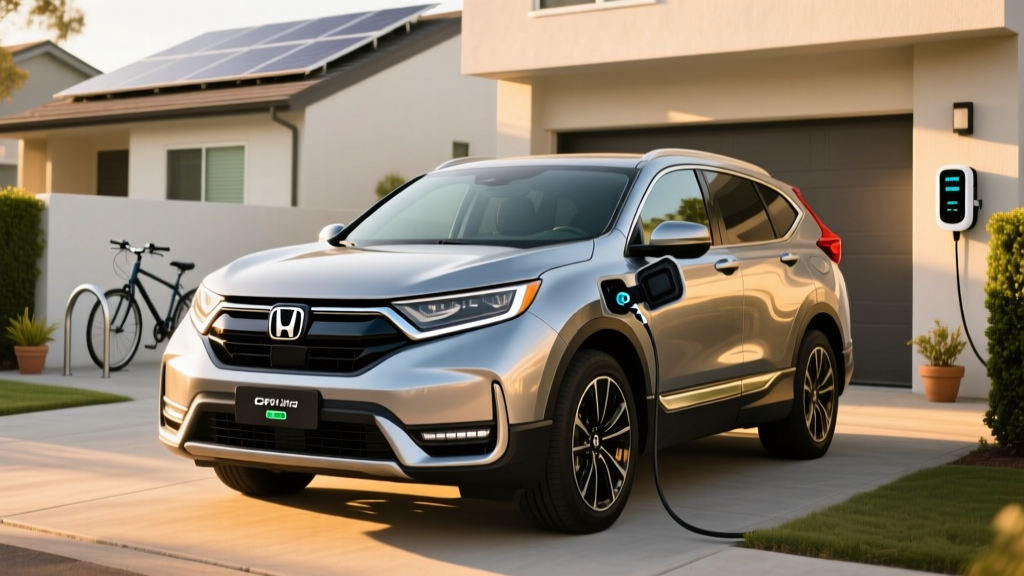
The Honda CR-V has been one of America's best-selling compact SUVs for decades, and Honda's electrification strategy has focused heavily on standard hybrid (HEV) versions. But for buyers searching for a Honda CR-V hybrid plug in option in the U.S. market, the situation requires careful navigation. The CR-V e:PHEV exists globally—in China and Europe—but Honda has not brought a plug-in hybrid CR-V to North American dealerships as of the 2026 model year. Instead, the 2026 Honda CR-V Hybrid (HEV) is the electrified model available to U.S. buyers. Here, we break down exactly what Honda offers, what the global e:PHEV variant delivers, and whether a conventional hybrid, a plug-in, or a full BEV is the right call for your next purchase.
HEV vs PHEV: What Honda Actually Sells in the U.S.
Before evaluating specs, it's critical to distinguish between the two electrified CR-V configurations Honda produces worldwide:
Conventional Hybrid (HEV) — Available in the U.S.
The 2026 Honda CR-V Hybrid uses a 2.0-liter Atkinson-cycle four-cylinder engine paired with two electric motors. It cannot be plugged in. A small lithium-ion battery (~1.06 kWh) is recharged through regenerative braking and the engine. You simply fuel it like a normal car and benefit from electric assist during acceleration and low-speed driving.
Plug-In Hybrid (PHEV / e:PHEV) — Not Available in the U.S.
The CR-V e:PHEV, sold in China and Europe, carries a much larger battery (~17.7 kWh) that can be charged via a wall outlet or public Level 2 charger. It offers roughly 33–51 miles of electric-only driving (depending on the test cycle) before the gasoline engine engages. U.S. buyers cannot currently purchase this variant from Honda.
If you've seen references to a "Honda CR-V hybrid plug in" online, most of that content discusses the e:PHEV sold overseas. For U.S. buyers, the relevant product is the 2026 CR-V Hybrid HEV, and we'll cover it in full detail below—while also providing the e:PHEV specs for context and comparison.
2026 Honda CR-V Hybrid (HEV): Powertrain & Performance
The U.S.-market 2026 CR-V Hybrid is powered by Honda's fourth-generation two-motor hybrid system. Here's what's under the hood:
| Specification | 2026 Honda CR-V Hybrid (HEV) |
|---|---|
| Engine | 2.0L Atkinson-cycle 4-cylinder |
| Electric Motors | Two-motor hybrid system |
| Combined System Output | 204 hp / 247 lb-ft torque |
| Battery (Usable) | ~1.06 kWh lithium-ion |
| Drivetrain | FWD or AWD (Real Time AWD) |
| 0–60 mph | ~7.7 seconds |
| Transmission | e-CVT (no traditional gears) |
The two-motor system operates primarily in series-hybrid mode at low speeds: the engine spins a generator, which feeds electricity to the drive motor. At highway speeds, a lock-up clutch allows the engine to directly drive the wheels for better efficiency. This is a proven architecture Honda has refined across the Accord Hybrid and Civic Hybrid as well.
Fuel Economy: EPA Ratings and Real-World MPG
Fuel economy is where the CR-V Hybrid earns its keep. The EPA rates the 2026 CR-V Hybrid as follows:
| Configuration | City | Highway | Combined |
|---|---|---|---|
| CR-V Hybrid FWD | 43 MPG | 36 MPG | 40 MPG |
| CR-V Hybrid AWD | 40 MPG | 34 MPG | 37 MPG |
Compared to the gas-only CR-V (28 MPG combined with AWD), the hybrid saves roughly 150–180 gallons of fuel per year for a driver covering 15,000 miles. At $3.50/gallon, that's $525–$630 in annual fuel savings.
The Global CR-V e:PHEV: What U.S. Buyers Are Missing
For context—and because many buyers search for "Honda CR-V hybrid plug in" expecting a PHEV—here's what the e:PHEV variant offers in markets where it's sold:
- Battery: ~17.7 kWh lithium-ion (NMC chemistry)
- Electric-only range: ~33 miles (WLTP) in Europe; up to ~51 miles on the CLTC cycle in China
- Combined range: 420+ miles (electric + gasoline)
- AC charging: Level 2 (6.6 kW onboard charger), 0–100% in approximately 2.5 hours
- DC fast charging: Not supported (no CCS or CHAdeMO port)
- Combined output: ~181 hp (varies by market tune)
The e:PHEV's 33-mile electric range is modest compared to competitors like the Toyota RAV4 Prime (42 miles) or the Hyundai Tucson PHEV (33 miles). However, the lack of DC fast charging is a notable limitation—many PHEVs skip DC capability, but it means public fast-charging networks like Electrify America or Tesla Superchargers are off the table.
Pricing, Trims, and Tax Credit Eligibility
2026 Honda CR-V Hybrid (U.S. HEV) Pricing
| Trim | Drivetrain | MSRP |
|---|---|---|
| Sport Hybrid | FWD | ~$36,300 |
| Sport Hybrid | AWD | ~$37,800 |
| Sport-L Hybrid | AWD | ~$40,200 |
| Sport Touring Hybrid | AWD | ~$43,000 |
Prices are approximate MSRP including destination charge. Dealer markups or discounts may apply.
Federal Tax Credit: Does the CR-V Hybrid Qualify?
The short answer: No. Under the current IRS §30D Clean Vehicle Credit rules, only plug-in electric vehicles (BEVs and PHEVs) with sufficient battery capacity qualify for the up-to-$7,500 federal tax credit. Conventional hybrids like the CR-V HEV do not have a large enough battery or plug-in capability to meet the statutory requirements.
- Vehicle must be a BEV or PHEV with ≥7 kWh battery capacity
- MSRP must not exceed $80,000 (SUVs/vans/pickups) or $55,000 (sedans)
- Buyer AGI must not exceed $150K (single) / $300K (joint)
- Battery components and critical minerals must meet North American sourcing thresholds
- Credit can be transferred to the dealer at point of sale for an upfront discount
The CR-V HEV fails the first criterion entirely. If Honda ever introduces the e:PHEV to the U.S., it could potentially qualify—but eligibility would depend on battery sourcing and final MSRP at that time. Always consult a tax professional for your specific situation.
Battery Warranty, Reliability, and Replacement Costs
Hybrid battery longevity is a top concern for buyers moving from a conventional gas car. Here's what Honda provides:
Honda Hybrid Battery Warranty
Coverage: 8 years / 100,000 miles (10 years / 150,000 miles in CARB states including California, New York, Massachusetts, and others that follow California emissions standards).
What's covered: Defects in materials or workmanship, and capacity loss below a defined threshold (typically ~60–70% of original capacity, though Honda does not publish a specific percentage).
Powertrain warranty: 5 years / 60,000 miles covers the engine, electric motors, and e-CVT.
Real-World Reliability
Honda's hybrid system is one of the most proven on the market. The two-motor architecture has been in production since 2014 (Accord Hybrid), and the CR-V Hybrid has been sold in the U.S. since the 2020 model year. According to owner forums and long-term reviews, hybrid battery failures before 150,000 miles are rare. The smaller ~1 kWh battery in the HEV experiences far less stress than the large packs in BEVs, because it operates within a narrow state-of-charge window—the car's computer never lets it fully charge or fully deplete.
Battery Replacement Cost
If the hybrid battery does fail outside of warranty, replacement costs for the CR-V HEV battery pack typically range from $2,000 to $4,000 (parts and labor). This is dramatically less than a BEV battery replacement ($8,000–$20,000+), because the HEV battery is much smaller. Some independent hybrid specialists offer refurbished packs for $1,200–$2,000.
CR-V Hybrid vs PHEV vs Full EV: Which Fits You?
Choosing between a conventional hybrid, a plug-in hybrid, and a battery-electric vehicle comes down to your daily driving, charging access, and budget. Here's a practical decision framework:
Choose the CR-V Hybrid (HEV) If:
- You don't have reliable access to home or workplace charging
- You want better fuel economy without changing any habits—just fill up and go
- You regularly drive more than 300 miles between fill-ups
- You want a lower purchase price (~$36K–$43K) without worrying about tax credit eligibility
- You live in an apartment or street-park and can't install a charger
Choose a PHEV (e.g., Toyota RAV4 Prime, Hyundai Tucson PHEV) If:
- You can charge at home (Level 1 or Level 2) most nights
- Your daily commute is under 35 miles round-trip (covering most driving on electricity)
- You want electric-only driving for errands but gas flexibility for road trips
- You want to qualify for the §30D federal tax credit (up to $7,500, subject to income and sourcing rules)
Choose a Full BEV (e.g., Tesla Model Y, Hyundai Ioniq 5) If:
- You have reliable Level 2 home charging
- Your daily driving is under 250 miles and you're comfortable planning DC fast-charge stops on road trips
- You want the lowest per-mile fuel cost ($0.04–$0.06/mile on home electricity vs $0.12–$0.15/mile for the hybrid)
- You want to maximize tax credits and eliminate tailpipe emissions
Pros and Cons: 2026 Honda CR-V Hybrid
✓ Pros
- Excellent real-world city MPG (42–46 observed)
- No plug-in required—zero behavior change from a gas car
- Strong 204 hp with smooth electric torque off the line
- Proven hybrid reliability with 8–10 year battery warranty
- Low battery replacement cost ($2K–$4K) vs BEV
- Spacious cabin with 76.5 cu ft cargo volume (rear seats folded)
- Honda Sensing ADAS suite standard on all trims
✗ Cons
- No plug-in PHEV option available in the U.S.
- No federal tax credit eligibility for the HEV
- Highway MPG (34–36) less impressive than city; highway driving favors diesel or PHEV
- AWD hybrid starts at ~$37,800—$3,000+ premium over gas CR-V EX
- No DC fast charging (irrelevant for HEV, but PHEV buyers should note this)
- Infotainment lags behind competitors in responsiveness (Sport Touring gets a 9-inch screen)
Frequently Asked Questions
How many MPG does the Honda CR-V Hybrid get?
The 2026 Honda CR-V Hybrid FWD is EPA-rated at 43 city / 36 highway / 40 combined MPG. The AWD version drops slightly to 40 city / 34 highway / 37 combined. In real-world city driving, many owners report 42–46 MPG thanks to aggressive regenerative braking. Highway driving at speeds above 75 mph typically yields 32–35 MPG.
How far can the Honda CR-V plug-in hybrid go on electric only?
The CR-V e:PHEV sold in Europe and China offers approximately 33 miles of electric-only range (WLTP). However, this plug-in variant is not available in the United States as of the 2026 model year. U.S. buyers looking for a compact SUV PHEV with electric-only range should consider the Toyota RAV4 Prime (42 miles) or Hyundai Tucson PHEV (33 miles).
Does the Honda CR-V Hybrid qualify for any tax credit?
No. The CR-V Hybrid (HEV) does not qualify for the federal §30D Clean Vehicle Credit because it is not a plug-in vehicle. The credit requires a battery capacity of at least 7 kWh and plug-in charging capability. Some states or local utilities may offer small rebates for hybrid purchases, but these vary by jurisdiction—check your state energy office or utility provider for current programs.
Is the Honda CR-V Hybrid reliable? What does a battery replacement cost?
Yes, Honda's hybrid system is among the most reliable in the industry, with a track record dating to 2014. The hybrid battery is covered by an 8-year/100,000-mile warranty (10 years/150,000 miles in CARB states). If replacement is needed outside of warranty, expect to pay $2,000–$4,000 for a new OEM pack, or $1,200–$2,000 for a refurbished unit from an independent hybrid specialist.
Should I buy the CR-V Hybrid or wait for a plug-in version?
Honda has not announced plans to bring the CR-V e:PHEV to the U.S. market. If a plug-in hybrid compact SUV is a priority, the Toyota RAV4 Prime (42 miles EV range, ~$44,000 MSRP, potentially eligible for a federal tax credit) is the strongest current alternative. If you're flexible and want excellent fuel economy without plug-in infrastructure, the CR-V Hybrid HEV is a strong buy now—waiting for an unannounced PHEV could mean years of uncertainty.
Can I charge the Honda CR-V Hybrid at home?
The U.S.-market CR-V Hybrid (HEV) cannot be plugged in. It charges its small battery entirely through regenerative braking and the gasoline engine. Only the global e:PHEV variant has a charging port, and it supports Level 2 AC charging (not DC fast charging).
Bottom Line: Who Should Buy the 2026 CR-V Hybrid?
The 2026 Honda CR-V Hybrid is the right choice for buyers who want a fuel-efficient compact SUV without altering their refueling routine. With 40 MPG combined (FWD), a proven powertrain, and a hybrid battery warranty that extends up to 10 years in CARB states, it's a low-risk electrification play. The lack of a U.S.-market plug-in CR-V is a genuine gap in Honda's lineup, and buyers specifically seeking a "Honda CR-V hybrid plug in" will need to look at the Toyota RAV4 Prime or Hyundai Tucson PHEV for now. But if you want hybrid efficiency, strong reliability, and no charging hassle, the CR-V Hybrid HEV delivers exactly what it promises—with real-world city MPG that often beats the EPA sticker.