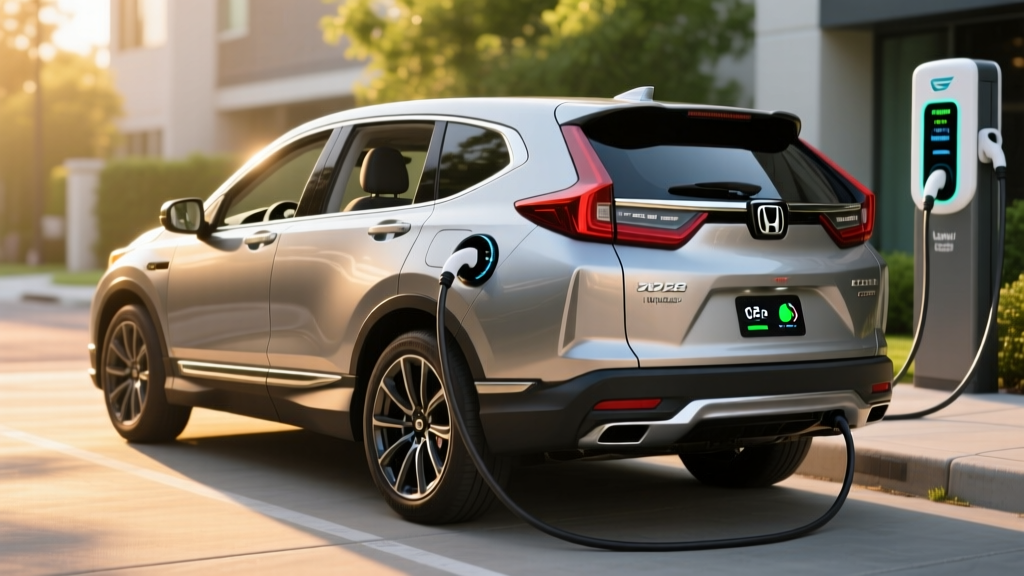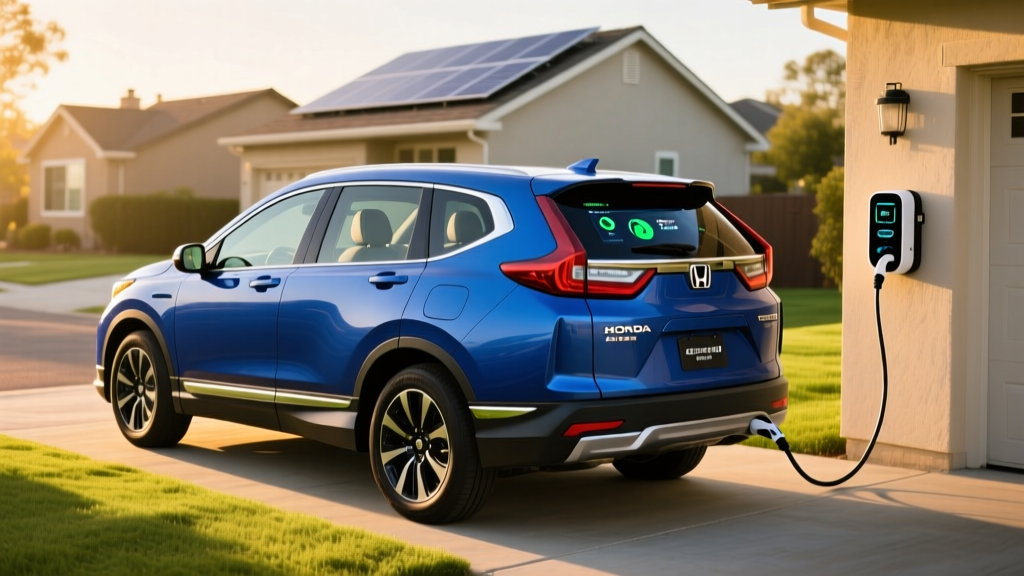
The Honda CR-V has long been the default compact SUV for practicality-minded buyers, and the hybrid variant has become the volume seller in the lineup. For 2026, the Honda CR-V Hybrid continues to pair a 2.0-liter Atkinson-cycle engine with a two-motor hybrid system, delivering strong fuel economy without the plug-in complexity or range anxiety of a full EV. If you're researching the CR-V Honda Hybrid to decide whether it's worth the premium over the gas model — or whether you should leap to a plug-in hybrid or battery-electric SUV instead — this guide covers every number that matters.
HEV vs. PHEV: Which CR-V Hybrid Are We Talking About?
Before diving into specs, it's critical to understand what Honda actually sells. In the US market, the CR-V is available as a conventional hybrid (HEV) — it does not plug in. Honda discontinued the Clarity PHEV years ago and has not introduced a CR-V plug-in hybrid in North America as of the 2026 model year.
| Attribute | CR-V Hybrid (HEV) | Plug-In Hybrid (PHEV) — General | Full EV (BEV) — General |
|---|---|---|---|
| Plug in to charge? | No — self-charging via regenerative braking and engine | Yes — has a larger battery + charge port | Yes — battery only, no gas engine |
| Electric-only driving | Brief, low-speed EV mode (~1-2 miles) | 20-40 miles typical on battery alone | 200-350+ miles on battery |
| Fuel/energy source | Gasoline (hybrid system optimizes engine use) | Gasoline + grid electricity | Grid electricity only |
| Maintenance profile | Standard gas-car maintenance, reduced brake wear | Gas maintenance + battery care | Minimal — no oil changes, fewer fluids |
This matters because some buyers searching for a "CR-V hybrid" assume it plugs in. It doesn't. The CR-V Hybrid charges its small lithium-ion battery pack entirely through regenerative braking and the gasoline engine. You fuel it like any other car and never think about charging.
Fuel Economy: EPA Ratings and Real-World MPG
The headline number for the 2026 CR-V Hybrid is 40 MPG combined for front-wheel-drive trims, and 37 MPG combined for all-wheel-drive trims. Here's the full EPA breakdown per fueleconomy.gov:
| Drivetrain | City MPG | Highway MPG | Combined MPG |
|---|---|---|---|
| FWD (Sport, Sport Touring) | 43 | 36 | 40 |
| AWD (Sport, Sport Touring) | 40 | 34 | 37 |
Real-World MPG: What Owners Actually See
Honda's two-motor hybrid system excels in city and suburban driving, where regenerative braking and electric-only low-speed crawling do the heavy lifting. In real-world mixed driving, many owners report meeting or slightly exceeding the EPA combined figure in warm weather — 38-42 MPG is common in suburban commuting.
Highway-heavy trips tell a different story. At sustained 70-80 mph speeds, the hybrid advantage diminishes because there's less regenerative braking to recapture energy. Expect 33-36 MPG on the highway for AWD models on long road trips. Cold weather (below 35°F) further reduces efficiency by 10-15% as the engine runs more frequently to provide cabin heat and maintain battery temperature.
Powertrain Specs: How the CR-V Hybrid Drives
| Specification | 2026 Honda CR-V Hybrid |
|---|---|
| Engine | 2.0L DOHC Atkinson-cycle 4-cylinder |
| Engine output | 145 hp / 138 lb-ft torque |
| Electric motors | Two-motor hybrid system (one drive, one generator) |
| Combined system output | 204 hp / 247 lb-ft torque |
| Transmission | Direct-drive (no traditional CVT or gears) |
| 0-60 mph (est.) | ~7.6 seconds |
| Drivetrain options | FWD or Real Time AWD™ |
| Towing capacity | 1,000 lbs |
| Fuel tank | 14.0 gallons |
| Total range (AWD, est.) | ~518 miles per tank |
The two-motor system operates in three modes: EV Drive (battery powers the drive motor at low speeds), Hybrid Drive (engine powers the generator, which feeds the drive motor), and Engine Drive (a lock-up clutch connects the engine directly to the wheels at highway cruising speeds). The transitions are seamless — most drivers won't notice which mode is active.
The 247 lb-ft of torque from the electric drive motor gives the CR-V Hybrid strong off-the-line acceleration that feels punchier than the 204 hp figure suggests. It's noticeably quicker and more responsive around town than the turbocharged gas-only CR-V (190 hp), even though the gas model may match it at higher speeds.
Pricing, Trims, and Tax Credit Eligibility
The CR-V Hybrid is available exclusively in the sport-oriented trims for 2026. Here's the MSRP breakdown (destination charge included):
| Trim | Drivetrain | MSRP (approx.) |
|---|---|---|
| CR-V Sport Hybrid | FWD | $36,350 |
| CR-V Sport Hybrid | AWD | $37,850 |
| CR-V Sport Touring Hybrid | AWD (standard) | $41,850 |
Does the CR-V Hybrid Qualify for a Federal Tax Credit?
No. Under current IRS §30D Clean Vehicle Credit rules, the federal tax credit of up to $7,500 applies only to plug-in electric vehicles (BEVs and PHEVs) with sufficient battery capacity. Because the CR-V Hybrid is a conventional HEV — it cannot be plugged in and its battery pack is far too small — it does not qualify for the federal EV tax credit or the point-of-sale transfer.
Some states and local utilities offer modest rebates or incentives for conventional hybrids, but these vary widely by jurisdiction and change frequently. Check your state energy office or utility provider for current programs. Do not count on any incentive when budgeting.
- Vehicle must be a plug-in EV (BEV) or plug-in hybrid (PHEV) — the CR-V Hybrid is neither
- Minimum battery capacity of 7 kWh — the CR-V Hybrid's pack is approximately 1.1 kWh
- MSRP caps ($55,000 for sedans, $80,000 for SUVs/vans/pickups) — would pass, but irrelevant
- Buyer income caps ($150K single / $300K joint) — would pass for most buyers, but irrelevant
- Battery critical-mineral and component sourcing requirements — does not apply to HEVs
Battery Warranty, Reliability, and Replacement Cost
This is the top concern for hybrid shoppers, and it deserves a direct answer.
- Coverage: 8 years / 100,000 miles (10 years / 150,000 miles in CARB states including CA, NY, MA, and others that follow California emissions standards)
- What's covered: Defects and capacity loss below a defined threshold
- Hybrid system components: Inverter, motor, and control electronics carry the same warranty period
How Long Do CR-V Hybrid Batteries Actually Last?
Honda's hybrid battery packs are designed to last the life of the vehicle under normal use. The lithium-ion pack in the CR-V Hybrid is relatively small (~1.1 kWh usable) and is managed conservatively — the system never fully charges or fully depletes it, keeping the battery in the optimal state-of-charge window (roughly 40-80%) to minimize degradation.
Based on long-term data from Honda's hybrid lineup (Insight, Accord Hybrid, and earlier CR-V Hybrids), battery failures before 150,000 miles are uncommon. Many Honda hybrid owners report 200,000+ miles on the original battery pack with minimal capacity loss.
Battery Replacement Cost
If the hybrid battery does need replacement out of warranty, expect to pay between $2,000 and $4,000 for a new OEM battery pack installed at a Honda dealer. Third-party refurbishment shops offer replacements for $1,500-$2,500. This is significantly cheaper than full EV battery replacements ($5,000-$20,000+) because the hybrid pack is much smaller.
For reliability data, the CR-V consistently earns strong marks. The IIHS typically rates it a Top Safety Pick when equipped with qualifying headlights, and the Honda Sensing suite (adaptive cruise, lane-keeping, automatic emergency braking) comes standard on all trims including the Hybrid.
CR-V Hybrid vs. Gas CR-V vs. Electric SUV: Which Fits You?
The CR-V lineup forces a three-way decision: gas-only, hybrid, or stepping outside the CR-V to a full EV. Here's how to think about it.
| Factor | CR-V Gas (EX/LX) | CR-V Hybrid (Sport) | EV SUV (e.g., Ioniq 5, Model Y) |
|---|---|---|---|
| Starting MSRP | ~$31,450 | ~$36,350 | $42,000-$48,000 |
| Combined MPG/MPGe | 28-30 MPG | 37-40 MPG | 100-120 MPGe |
| Fuel cost per mile (est.) | ~$0.13 | ~$0.09 | ~$0.04-$0.06 (home charging) |
| Federal tax credit | None | None | Up to $7,500 (if eligible) |
| Home charging needed? | No | No | Yes (Level 2 recommended) |
| Road-trip convenience | Gas stations everywhere | Gas stations everywhere | Route planning around DC chargers |
| Maintenance cost | Highest (oil, filters, brakes) | Moderate (oil, less brake wear) | Lowest (no oil, regen saves brakes) |
- You drive 12,000+ miles per year and want meaningful fuel savings without changing your refueling habits
- You don't have reliable access to home or workplace EV charging
- You frequently take long road trips and don't want to plan around DC fast chargers
- You want the torque-rich, smooth acceleration of electric drive without plug-in complexity
- You drive under 10,000 miles per year — the hybrid premium (~$4,900) won't pay back in fuel savings
- You want the lowest possible purchase price and plan to sell within 3-4 years
- You can install a Level 2 home charger and most daily driving is under 250 miles
- You qualify for the $7,500 federal tax credit, narrowing the price gap
- You want the lowest per-mile operating cost and minimal maintenance long-term
Pros and Cons of the 2026 CR-V Hybrid
- 40 MPG combined (FWD) — among the best in the compact SUV class
- 247 lb-ft of electric torque gives strong, responsive city acceleration
- No charging infrastructure needed — fuel it like any gas car
- 8-year/100,000-mile hybrid battery warranty (10yr/150K in CARB states)
- Honda Sensing safety suite standard on all trims
- Spacious cargo area (36.3 cu ft behind rear seats, 76.5 cu ft folded)
- Proven reliability track record from Honda's hybrid systems
- No federal tax credit eligibility — full EVs get up to $7,500
- Hybrid only available in Sport and Sport Touring trims (no base LX hybrid)
- AWD reduces combined MPG to 37 — a 3 MPG penalty
- 1,000-lb towing capacity is low for the class (gas model tows 1,500 lbs)
- Highway fuel economy advantage over the gas model narrows at sustained speeds
- No plug-in hybrid option if you want electric-only commuting
- Road noise on coarse pavement remains a CR-V weak point
Frequently Asked Questions
How many MPG does the Honda CR-V Hybrid get?
The 2026 CR-V Hybrid with FWD achieves 43 city / 36 highway / 40 combined MPG per the EPA. The AWD version is rated at 40 city / 34 highway / 37 combined. In real-world driving, expect 35-42 MPG depending on conditions, with city driving yielding the best results.
Does the CR-V Hybrid need to be plugged in?
No. The CR-V Hybrid is a conventional hybrid (HEV), not a plug-in hybrid (PHEV). Its small battery charges through regenerative braking and the gasoline engine. You never plug it in — you simply fill up at a gas station as usual.
Is the CR-V Hybrid reliable, and what does battery replacement cost?
Honda's hybrid systems have a strong reliability record. The hybrid battery is covered for 8 years/100,000 miles (10 years/150,000 miles in CARB states). Out-of-warranty battery replacement typically costs $2,000-$4,000 at a dealer, though many packs last 200,000+ miles without issue.
Does the CR-V Hybrid qualify for any tax credit?
The CR-V Hybrid does not qualify for the federal §30D Clean Vehicle Credit because it is not a plug-in vehicle. That credit applies only to BEVs and PHEVs meeting battery-sourcing, MSRP, and income requirements. Some state or utility hybrid incentives may exist — check your local programs.
How does the CR-V Hybrid compare to the Toyota RAV4 Hybrid?
The RAV4 Hybrid (39-41 MPG combined depending on trim) is the CR-V Hybrid's closest competitor. The RAV4 offers AWD standard on all hybrid trims and has a slightly higher towing capacity (1,750 lbs). The CR-V Hybrid counters with a more refined ride, a more modern interior, and slightly better cargo volume. Both are excellent choices — the decision often comes down to styling preference and dealer experience.
Should I buy the CR-V Hybrid or wait for a plug-in hybrid version?
Honda has not announced a CR-V PHEV for the US market. If plug-in capability is essential for your commute (electric-only driving for 20-40 miles), you'd need to look at competitors like the Toyota RAV4 Prime (42 miles electric-only, qualifies for partial tax credit) or consider a full EV. If you simply want excellent fuel economy without plug-in hassle, the current CR-V Hybrid is ready now.
What's the difference between the Sport and Sport Touring Hybrid trims?
The Sport Hybrid (~$36,350 FWD / ~$37,850 AWD) includes a 7-inch touchscreen, wireless Apple CarPlay/Android Auto, heated front seats, and 18-inch wheels. The Sport Touring Hybrid (~$41,850, AWD standard) adds a 9-inch touchscreen with wireless CarPlay, navigation, a premium Bose audio system, wireless phone charging, heated rear seats, a heated steering wheel, and a hands-free power liftgate. Both share the identical hybrid powertrain and MPG ratings.
The 2026 Honda CR-V Hybrid earns its place as one of the most sensible compact SUVs on the market. It doesn't need a charger, it doesn't need a tax credit to justify its existence, and it delivers real-world fuel savings that compound meaningfully over years of ownership. For buyers who want efficiency without lifestyle change, it remains a benchmark.