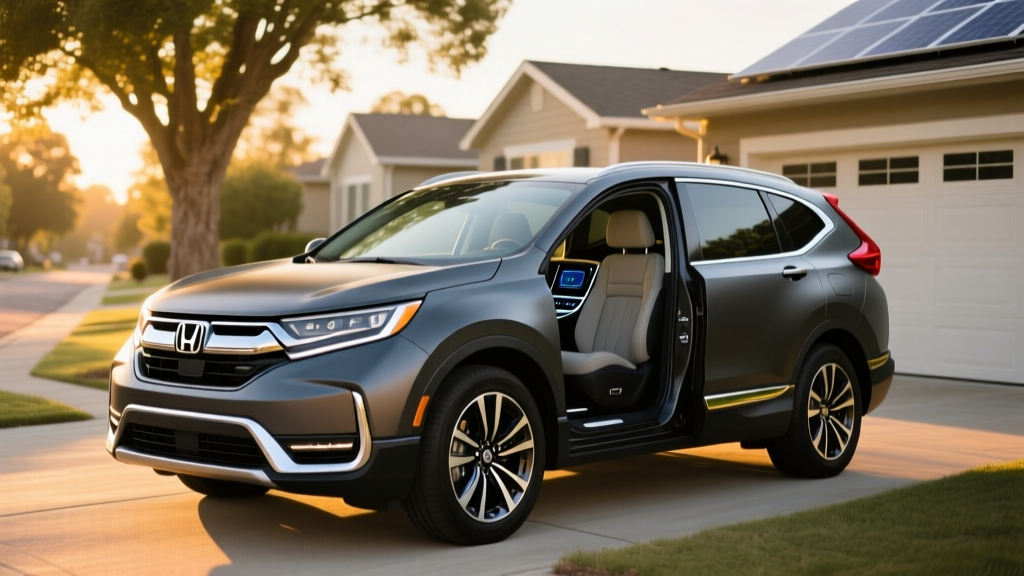
The Honda CR-V has long been one of America's best-selling compact SUVs, and the hybrid version has quietly become the smart-money pick in the lineup. For 2026, the Honda CR-V Hybrid continues as a conventional hybrid electric vehicle (HEV) — meaning it requires no plug, no charging routine, and no lifestyle adjustment beyond filling up less often. If you've been searching for a hybrid CR-V Honda that balances daily usability with genuine fuel savings, this is the guide that separates EPA sticker numbers from what you'll actually see at the pump.
Honda positions the hybrid powertrain on the higher trims (Sport and Sport Touring), which means you're getting the most feature-rich versions of the CR-V along with the most efficient powertrain. But the real question buyers ask is whether the hybrid premium over the gas-only CR-V pays for itself — and whether you should instead consider a plug-in hybrid or full EV. Let's run the numbers.
HEV vs PHEV: What the Honda CR-V Hybrid Actually Is
Conventional Hybrid (HEV) — This Is the CR-V Hybrid
The 2026 CR-V Hybrid is a self-charging hybrid. It pairs a 2.0-liter Atkinson-cycle four-cylinder engine with two electric motors and a small lithium-ion battery (approximately 1.06 kWh). The battery charges through regenerative braking and the engine — you never plug it in. It cannot drive on electric power alone for meaningful distances.
Plug-In Hybrid (PHEV) — Not Offered on the CR-V
Honda does not currently offer a CR-V plug-in hybrid in the United States. If you want a compact SUV PHEV with 30+ miles of electric-only range, you'd need to look at competitors like the Toyota RAV4 Prime (42 mi EV range) or the Hyundai Tucson PHEV (33 mi EV range). Honda's U.S. PHEV offering remains limited to the Clarity PHEV, which was discontinued after the 2021 model year.
Full Battery Electric (BEV) — The Honda Prologue
For buyers ready to plug in, Honda offers the Prologue, an all-electric midsize SUV with an EPA-estimated range of up to 296 miles. It's larger and more expensive than the CR-V but eliminates gasoline entirely.
Fuel Economy: EPA Ratings and Real-World MPG
Fuel economy is the headline reason buyers choose the CR-V Hybrid. Here's how the numbers break down by drivetrain configuration, per EPA data from fueleconomy.gov:
| 2026 Honda CR-V Hybrid Trim | City MPG | Highway MPG | Combined MPG | Drivetrain |
|---|---|---|---|---|
| Sport (FWD) | 43 | 36 | 40 | FWD |
| Sport (AWD) | 40 | 34 | 37 | AWD |
| Sport Touring (AWD) | 40 | 34 | 37 | AWD |
| Gas CR-V EX (AWD, for comparison) | 27 | 32 | 29 | AWD |
Real-World MPG: What to Actually Expect
Honda's hybrid system excels in stop-and-go city driving, where the electric motors handle low-speed propulsion and regenerative braking recaptures energy. In real-world testing by multiple outlets, the CR-V Hybrid AWD consistently achieves 36-39 MPG combined in mixed suburban and city driving — matching or slightly exceeding its EPA rating.
However, sustained highway driving at 75+ mph drops efficiency to approximately 31-33 MPG, because the gasoline engine carries more of the load at higher speeds. In cold weather (below 30°F), expect a 5-10% reduction in fuel economy due to increased engine idling for cabin heat and reduced battery efficiency. This is still a substantial improvement over the gas-only AWD CR-V, which typically returns 26-28 MPG combined in real-world conditions.
Powertrain Specs: Horsepower, Motors, and Drivetrain
| Specification | 2026 CR-V Hybrid |
|---|---|
| Engine | 2.0L Atkinson-cycle DOHC 4-cylinder |
| Engine Power | 146 hp @ 6,100 rpm / 134 lb-ft torque |
| Electric Motors | Dual-motor system (propulsion + generator) |
| Combined System Output | 204 hp / 247 lb-ft torque |
| Transmission | e-CVT (electronically controlled) |
| Hybrid Battery | ~1.06 kWh lithium-ion |
| Drivetrain | FWD (Sport) or AWD (Sport, Sport Touring) |
| 0-60 mph | ~7.6 seconds (AWD, tested) |
| Towing Capacity | 1,000 lbs |
| Fuel Tank | 14.0 gallons |
Honda's fourth-generation two-motor hybrid system is fundamentally different from a traditional parallel hybrid. The propulsion motor drives the wheels most of the time, while the gasoline engine primarily acts as a generator. At highway cruising speeds, a lock-up clutch connects the engine directly to the wheels for efficiency. The result is smooth, electric-like acceleration around town with the range security of a gasoline engine for longer trips.
The 204 combined horsepower and 247 lb-ft of torque make the CR-V Hybrid noticeably quicker off the line than the gas-only 1.5L turbo CR-V (190 hp). The instant torque from the electric motor eliminates the turbo lag you feel in the non-hybrid model, and the e-CVT avoids the rubber-band sensation of older continuously variable transmissions.
Pricing, Trims, and Tax Credit Eligibility
For 2026, the CR-V Hybrid is available in two trims, both positioned above the mid-range gas models:
| Trim | Drivetrain | MSRP | Key Features |
|---|---|---|---|
| Sport Hybrid | FWD | ~$35,950 | 9" touchscreen, wireless CarPlay/Android Auto, heated front seats, Honda Sensing suite |
| Sport Hybrid AWD | AWD | ~$37,450 | Same as FWD Sport + Real Time AWD |
| Sport Touring Hybrid AWD | AWD | ~$40,850 | Bose 12-speaker audio, wireless charging, heated steering wheel, navigation, power liftgate, roof rails |
Does the CR-V Hybrid Qualify for a Federal Tax Credit?
No. Under current IRS §30D rules, the federal Clean Vehicle Credit applies only to plug-in electric vehicles (BEVs and PHEVs) with a minimum battery capacity of 7 kWh. The CR-V Hybrid's ~1.06 kWh battery does not meet this threshold, and as a conventional HEV, it is not eligible for the federal credit.
Some states offer their own incentives for hybrid vehicles, but these are increasingly rare as state programs shift focus to zero-emission vehicles. Check your state's energy office or the DOE Alternative Fuels Data Center for any local hybrid incentives. For current federal rules, consult IRS.gov's Clean Vehicle Tax Credits page.
Battery Warranty, Reliability, and Replacement Cost
Honda Hybrid Battery Warranty
Honda covers the CR-V Hybrid's lithium-ion battery pack with a 8-year / 100,000-mile warranty (extended to 10 years / 150,000 miles in states that follow California Air Resources Board emissions standards, including CA, CO, CT, ME, MD, MA, NJ, NY, OR, RI, VT, and WA). This warranty covers defects and capacity loss below a specified threshold — typically around 60-70% of original capacity.
Honda's hybrid powertrain has proven highly reliable across multiple model lines (Accord Hybrid, Civic Hybrid). The CR-V Hybrid's battery is small by EV standards (~1.06 kWh), and because it operates within a narrow state-of-charge window (never fully charged or fully depleted), degradation is minimal. Real-world data from earlier-generation Honda hybrids shows battery packs routinely lasting 150,000-200,000+ miles before any significant capacity loss.
If replacement is needed outside warranty, a CR-V Hybrid battery pack currently costs approximately $2,500-$4,000 installed — significantly less than a full EV battery replacement, which can exceed $10,000-$20,000. This relatively low replacement cost is one advantage of the small-battery HEV architecture.
For overall reliability, Honda has historically scored well with IIHS safety ratings, and the CR-V carries top marks in crash testing. The hybrid variant shares the same structural platform and safety systems as the gas model.
CR-V Hybrid vs. the Competition
✓ CR-V Hybrid Advantages
- Best-in-class city MPG (43 FWD)
- Strong 204 hp combined output
- Spacious cargo area (36.3 cu ft rear seats up)
- Refined ride quality and low cabin noise
- Excellent Honda Sensing safety suite
✗ CR-V Hybrid Limitations
- AWD drops combined MPG to 37
- No PHEV variant available
- Hybrid only on Sport/Sport Touring trims (higher entry price)
- 1,000-lb towing capacity (lower than some rivals)
- No DC fast charging capability (HEV, not applicable)
The CR-V Hybrid's most direct rival is the Toyota RAV4 Hybrid, which offers standard AWD and an EPA-estimated 39 MPG combined across most trims, with pricing starting around $33,000. The RAV4 Prime PHEV variant adds 42 miles of electric-only range and qualifies for a partial federal tax credit, but commands a $44,000+ MSRP and faces limited availability.
The Hyundai Tucson Hybrid (38 MPG combined AWD) and Kia Sportage Hybrid (38 MPG combined AWD) offer competitive fuel economy with more aggressive pricing, though neither matches Honda's long-term reliability reputation or resale value.
Who Should Buy the CR-V Hybrid vs. a PHEV or Full EV?
Choose the CR-V Hybrid (HEV) If:
- You don't have reliable access to home or workplace charging
- You want a simple ownership experience — no plugs, no charging apps, no range planning
- Your driving is mostly city and suburban (where the hybrid system shines)
- You want a $35K-$41K compact SUV with minimal fuel cost
- You take regular road trips and don't want to plan around charging stops
Consider a PHEV (RAV4 Prime, Tucson PHEV) If:
- You can charge at home (Level 1 or 2) and your daily commute is under 35 miles
- You want electric-only commuting with gas-engine backup for road trips
- You want partial federal tax credit eligibility (varies by model and current sourcing rules)
Consider a Full EV (Honda Prologue, Hyundai Ioniq 5, Tesla Model Y) If:
- You have Level 2 home charging and want to eliminate gasoline entirely
- You want the lowest per-mile fuel cost and minimal maintenance
- You qualify for the full $7,500 federal tax credit under current §30D rules
- Your daily driving is under 250 miles and you're comfortable with public DC fast charging for road trips
Ownership Costs: Fuel Savings Over 5 Years
| 5-Year Cost Factor | CR-V Hybrid AWD (37 MPG) | CR-V Gas AWD (29 MPG) |
|---|---|---|
| Estimated Fuel Cost (75,000 mi @ $3.40/gal) | $6,892 | $8,793 |
| Fuel Savings vs. Gas Model | ~$1,901 | — |
| Estimated Maintenance (5 yr) | ~$2,800 | ~$3,200 |
| Hybrid Trim Price Premium Over Gas EX-L AWD | ~$2,000-$3,000 | — |
The hybrid's fuel savings typically offset its trim-level price premium within 3-5 years of average driving (15,000 miles/year). If you drive more than average or live in a state with higher gas prices (California, Washington, New York), the payback period shortens to 2-3 years. The hybrid also benefits from slightly lower brake wear due to regenerative braking, which handles much of the deceleration without engaging the friction brakes.
Frequently Asked Questions
How many MPG does the Honda CR-V Hybrid get?
The 2026 Honda CR-V Hybrid FWD (Sport trim) achieves an EPA-estimated 43 city / 36 highway / 40 combined MPG. The AWD versions (Sport AWD and Sport Touring) are rated at 40 city / 34 highway / 37 combined MPG. In real-world mixed driving, owners typically see 36-39 MPG combined, with city-heavy driving occasionally exceeding the EPA estimate.
Does the Honda CR-V Hybrid need to be plugged in?
No. The CR-V Hybrid is a conventional HEV (hybrid electric vehicle). It charges its small battery through regenerative braking and the gasoline engine. You simply fill it with gasoline like any other car. Honda does not currently offer a plug-in hybrid (PHEV) version of the CR-V in the U.S. market.
Is the CR-V Hybrid reliable and what does battery replacement cost?
Honda's hybrid system has a strong reliability track record across its model lineup. The hybrid battery is covered by an 8-year/100,000-mile warranty (10 years/150,000 miles in CARB states). Real-world data suggests these batteries commonly last 150,000-200,000+ miles. Out-of-warranty replacement costs approximately $2,500-$4,000 — far less than an EV battery replacement.
Does the Honda CR-V Hybrid qualify for any tax credits?
The CR-V Hybrid does not qualify for the federal §30D Clean Vehicle Credit, which requires a plug-in vehicle with at least 7 kWh of battery capacity. Some states may offer small incentives for hybrid vehicles, but most state programs now focus on plug-in and zero-emission vehicles. Consult a tax professional and your state's energy office for specifics.
Hybrid vs PHEV vs EV — which is right for me?
Choose the CR-V Hybrid if you lack home charging access and want a no-compromise, no-plug experience. Choose a PHEV (like the RAV4 Prime) if you can charge at home and want 30-42 miles of electric-only commuting with gas backup. Choose a full EV (like the Prologue or Ioniq 5) if you have Level 2 home charging, want the lowest operating costs, and qualify for the $7,500 federal tax credit. The right answer depends entirely on your charging access, daily mileage, and budget.
How does AWD affect the CR-V Hybrid's fuel economy?
The AWD system reduces combined fuel economy by 3 MPG (from 40 to 37 combined). This is because the rear axle motor draws additional power and adds weight. However, the AWD CR-V Hybrid still significantly outperforms the gas-only AWD CR-V (29 combined MPG). If you need AWD for snow or adverse conditions, the fuel economy penalty is modest and worthwhile.