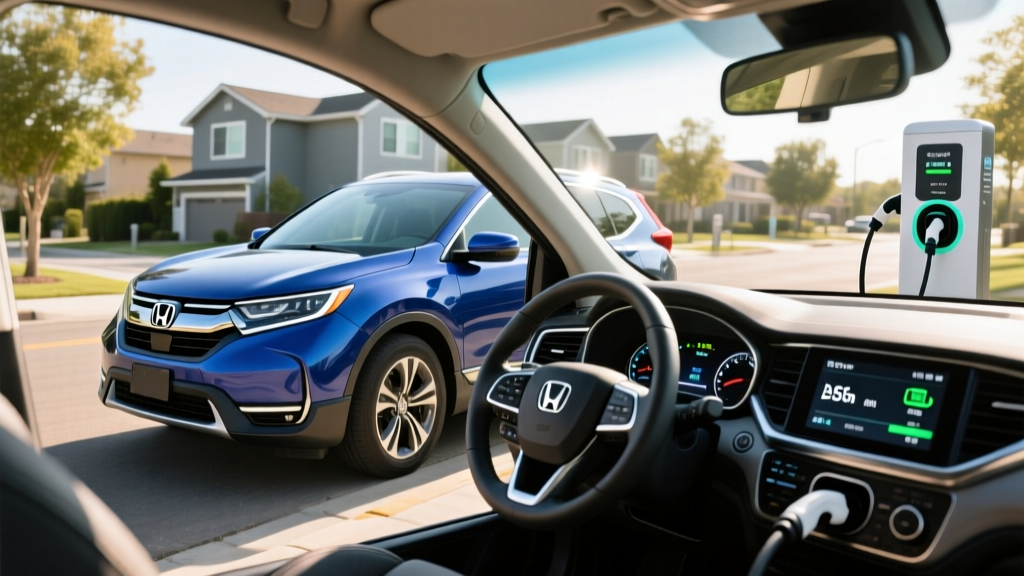
The Honda CR-V Hybrid has become one of the best-selling electrified SUVs in America for a straightforward reason: it delivers exceptional fuel economy without requiring you to change a single habit. No plug, no range anxiety, no charging apps — just significantly better mileage than a gas-only compact SUV. But what does Honda CR-V hybrid mileage actually look like once you leave the dealer lot?
After analyzing EPA data, owner-reported fuel economy, and real-world driving conditions, here's a complete breakdown of what you can expect from the current-generation CR-V Hybrid — including where it beats its EPA sticker, where it falls short, and how it stacks up against plug-in hybrid and full EV alternatives.
EPA Ratings vs. Real-World Honda CR-V Hybrid Mileage
The 2025–2026 Honda CR-V Hybrid (Sport, Sport-L, and Sport Touring trims) carries the following EPA fuel economy estimates:
| Drivetrain | City MPG | Highway MPG | Combined MPG |
|---|---|---|---|
| FWD (Sport) | 43 | 36 | 40 |
| AWD (Sport, Sport-L, Sport Touring) | 40 | 34 | 37 |
Source: EPA / fueleconomy.gov
Hybrid Powertrain: How Honda Achieves 40 MPG
The CR-V Hybrid uses Honda's fourth-generation two-motor hybrid system, which operates differently from a traditional Toyota-style planetary gearset hybrid. Here's the powertrain breakdown:
| Specification | Detail |
|---|---|
| Engine | 2.0L Atkinson-cycle 4-cylinder |
| Engine Output | 145 HP / 138 lb-ft torque |
| Drive Motor Output | 181 HP / 247 lb-ft torque |
| Combined System Output | 204 HP / 247 lb-ft torque |
| Hybrid Battery | ~1.06 kWh lithium-ion (HEV — not plug-in) |
| Transmission | Direct-drive (no traditional CVT or gears) |
| 0–60 mph | ~7.6 seconds (AWD) |
| EPA Combined MPG | 40 (FWD) / 37 (AWD) |
| Fuel Tank | 14.0 gallons |
| Estimated Total Range | ~518–560 miles |
The key to the CR-V Hybrid's efficiency is that the gasoline engine primarily acts as a generator. At low and moderate speeds, the electric drive motor handles all propulsion while the engine generates electricity. Only at sustained highway speeds does a lock-up clutch connect the engine directly to the wheels. This means the engine operates almost exclusively in its most efficient RPM range — a major advantage over conventional drivetrains.
HEV vs. PHEV: The Honda CR-V Is a Conventional Hybrid
A common point of confusion: the Honda CR-V Hybrid sold in the U.S. is a conventional hybrid (HEV), not a plug-in hybrid (PHEV). This matters for your expectations and your wallet.
- HEV (CR-V Hybrid): Charges its small battery through regenerative braking and the gas engine. You never plug it in. The battery enables short electric-only bursts (typically under 1 mile at low speed) but primarily assists the engine for better overall MPG. No electric-only range to speak of.
- PHEV (e.g., Toyota RAV4 Prime, Hyundai Tucson PHEV): Has a larger battery (typically 13–18 kWh) that you plug in to charge. Offers 30–42 miles of electric-only driving before the gas engine kicks in. Once the battery depletes, it operates as a conventional hybrid.
- BEV (e.g., Tesla Model Y, Hyundai Ioniq 5): No gas engine. Runs entirely on a large battery (60–80+ kWh) with 250–320+ miles of range. Requires home or public charging infrastructure.
Honda does not currently offer a CR-V PHEV in the United States. If plug-in capability with electric-only commuting range is a priority, you'll need to look at competitors like the Toyota RAV4 Prime (42 miles EV range) or the Hyundai Tucson PHEV (33 miles EV range).
Pricing, Trim Levels, and Tax Credit Eligibility
| Trim | Drivetrain | MSRP (approx.) |
|---|---|---|
| Sport | FWD | $36,395 |
| Sport | AWD | $37,895 |
| Sport-L | AWD | $39,895 |
| Sport Touring | AWD | $42,695 |
Pricing is approximate and subject to change; verify with Honda's official configurator and your local dealer for current figures including destination charges.
Does the CR-V Hybrid Qualify for a Federal Tax Credit?
No. Under current IRS §30D rules, the federal clean vehicle tax credit (up to $7,500) applies only to plug-in electric vehicles — battery electric vehicles (BEVs) and plug-in hybrids (PHEVs) with a minimum battery capacity of 7 kWh. Because the CR-V Hybrid is a conventional HEV with a ~1 kWh battery and no plug-in capability, it does not qualify for the federal EV tax credit.
However, some states and municipalities offer separate incentives for hybrid vehicles, though these are far less common than EV incentives. Check your state's energy office or the Alternative Fuels Data Center for any local hybrid rebates or HOV lane access programs.
Battery Reliability, Warranty, and Replacement Costs
Hybrid battery longevity is consistently the top concern among first-time hybrid buyers. Here's what Honda provides:
- Hybrid Battery: 8 years / 100,000 miles (10 years / 150,000 miles in California and states that follow CARB emissions standards)
- Hybrid System Components: 8 years / 100,000 miles (including the IPU, power control unit, and drive motors)
- Limited Powertrain Warranty: 5 years / 60,000 miles
Real-World Battery Lifespan
Honda's hybrid system has proven highly durable in practice. The CR-V Hybrid's lithium-ion battery pack is relatively small (~1.06 kWh) and operates within a narrow state-of-charge window — the hybrid system never fully charges or fully depletes it, which dramatically reduces degradation stress. Based on long-term data from Honda's earlier hybrid systems (Accord Hybrid, Insight) and industry-wide hybrid battery studies, most Honda hybrid batteries last well beyond 150,000 miles without significant capacity loss.
Replacement Cost if Needed
If a hybrid battery replacement is required out of warranty, expect the following approximate costs:
- OEM battery pack: $2,000–$4,000 (parts)
- Labor: $500–$1,000
- Total out-of-pocket: $2,500–$5,000
This is significantly less than a full EV battery replacement ($5,000–$20,000+) because the HEV battery is much smaller. Third-party refurbished hybrid batteries are also available for $1,000–$2,000, further reducing worst-case costs.
CR-V Hybrid vs. Gas CR-V vs. Plug-In Hybrid Competitors
Here's how the CR-V Hybrid stacks up against the gas-only CR-V and the closest PHEV competitor:
| Attribute | CR-V Hybrid AWD | CR-V Gas AWD | Toyota RAV4 Prime AWD (PHEV) |
|---|---|---|---|
| EPA Combined MPG | 37 | 29 | 38 (hybrid mode) / 94 MPGe (EV mode) |
| City MPG | 40 | 27 | 40 (hybrid mode) |
| Highway MPG | 34 | 32 | 36 (hybrid mode) |
| EV-Only Range | N/A (HEV) | N/A | 42 miles |
| Combined HP | 204 | 190 | 302 |
| 0–60 mph | ~7.6 sec | ~8.5 sec | ~5.7 sec |
| Plug-In Required? | No | No | Yes (for EV range) |
| Federal Tax Credit | No | No | Up to $7,500 (check current IRS rules) |
| Starting MSRP | ~$36,395 | ~$31,450 | ~$44,500 |
Sources: EPA fueleconomy.gov, manufacturer spec sheets. Verify current pricing and credit eligibility with IRS §30D guidelines.
- Excellent city MPG (40–43 EPA, often exceeded in practice)
- No plug-in required — zero lifestyle change
- Strong low-end torque (247 lb-ft from electric motor)
- Proven Honda reliability with 8–10 yr hybrid warranty
- 560-mile total range eliminates fuel stops on long trips
- Spacious interior and strong safety ratings (IIHS Top Safety Pick)
- No EV-only driving range (always uses some gasoline)
- Highway MPG trails city MPG significantly
- No federal tax credit eligibility
- Hybrid trims start ~$5,000 above base gas model
- No PHEV variant available from Honda in the U.S.
- Engine drone under hard acceleration (fixed-ratio direct drive)
Who Should Buy the CR-V Hybrid — And Who Shouldn't
Choose the CR-V Hybrid if:
- Your commute is city-heavy or mixed (the hybrid system recovers the most energy in stop-and-go traffic)
- You don't have access to home or workplace charging (no plug needed)
- You want lower fuel costs without learning a new refueling routine
- You drive 12,000–15,000 miles/year and want to save ~$400–$700 annually on fuel vs. the gas CR-V
- You plan to keep the vehicle 5+ years (the fuel savings compound and offset the higher MSRP)
Choose a PHEV (like the RAV4 Prime) instead if:
- Your daily commute is under 40 miles round-trip and you can charge at home (you'd rarely use gasoline)
- You want federal tax credit eligibility (up to $7,500, subject to income and sourcing rules)
- You want electric-only driving for short trips while keeping gas backup for road trips
Choose a full EV (like the Hyundai Ioniq 5 or Tesla Model Y) instead if:
- You have reliable home Level 2 charging access
- Your daily driving is under 250 miles and you take occasional road trips
- You want zero tailpipe emissions and the lowest per-mile "fuel" cost (electricity at ~$0.12/kWh is roughly equivalent to $1.00/gallon gasoline)
- You want to maximize federal and state incentives
Annual Fuel Cost Savings: CR-V Hybrid vs. Gas
Using the EPA's annual fuel cost estimates and assuming 15,000 miles/year with 55% city / 45% highway driving at $3.40/gallon regular unleaded:
- CR-V Hybrid AWD (37 MPG combined): ~$1,378/year in fuel
- CR-V Gas AWD (29 MPG combined): ~$1,759/year in fuel
- Annual savings with hybrid: ~$381/year
- 5-year savings: ~$1,900
With a ~$5,000 premium for the hybrid trim over the base gas model, the fuel savings alone won't fully close the price gap over five years. However, the hybrid trims include additional standard equipment (larger wheels, upgraded infotainment, Honda Sensing suite enhancements), which narrows the effective price difference. Resale value for hybrid trims also tends to be stronger, further offsetting the initial premium.
Frequently Asked Questions
How many MPG does the Honda CR-V Hybrid actually get?
The EPA rates the FWD CR-V Hybrid at 43 city / 36 highway / 40 combined MPG. The AWD version is rated at 40 city / 34 highway / 37 combined. In real-world driving, city-dominant commuters often exceed the EPA city figure (44+ MPG is common), while sustained highway driving at 75+ mph may return 32–34 MPG for AWD models.
Does the Honda CR-V Hybrid need to be plugged in?
No. The CR-V Hybrid is a conventional hybrid (HEV). Its small battery charges through regenerative braking and the gasoline engine. You simply fill it with gas like any other vehicle — there is no plug and no electric-only driving range.
Is there a Honda CR-V plug-in hybrid (PHEV)?
Not in the United States. Honda offers a CR-V e:PHEV in China and Europe, but it is not available in the U.S. market as of the 2026 model year. If you want a compact SUV PHEV, the Toyota RAV4 Prime (42 miles EV range) and Hyundai Tucson PHEV (33 miles EV range) are the closest alternatives.
How long will the CR-V Hybrid battery last, and what does replacement cost?
Honda covers the hybrid battery for 8 years/100,000 miles (10 years/150,000 miles in CARB states). Real-world data from Honda's hybrid lineup suggests these batteries routinely last 150,000+ miles without significant issues. If replacement is needed out of warranty, expect $2,500–$5,000 for an OEM pack and labor — far less than an EV battery replacement.
Does the Honda CR-V Hybrid qualify for a tax credit?
The CR-V Hybrid does not qualify for the federal §30D clean vehicle tax credit, which requires plug-in capability and a minimum 7 kWh battery. Some states may offer small hybrid incentives or HOV lane access — check your state's energy department or the Alternative Fuels Data Center for local programs.
Is the CR-V Hybrid good for highway driving?
It's adequate but not where the hybrid system shines. At sustained highway speeds, the engine connects directly to the wheels and the electric motor provides less benefit. You'll see 32–35 MPG on the highway (AWD), which is only marginally better than the gas CR-V's 32 MPG highway. The hybrid's big advantage is city and suburban driving, where it can return 40+ MPG.
How does the CR-V Hybrid perform in cold weather?
Like all hybrids, the CR-V Hybrid's fuel economy drops in cold weather — typically 5–10% below EPA estimates when temperatures fall below 30°F. The engine runs more frequently to provide cabin heat (since there's no large battery to power an electric heater), which reduces the electric motor's contribution. Expect 34–37 MPG combined in winter for AWD models versus 37–40 in mild weather.