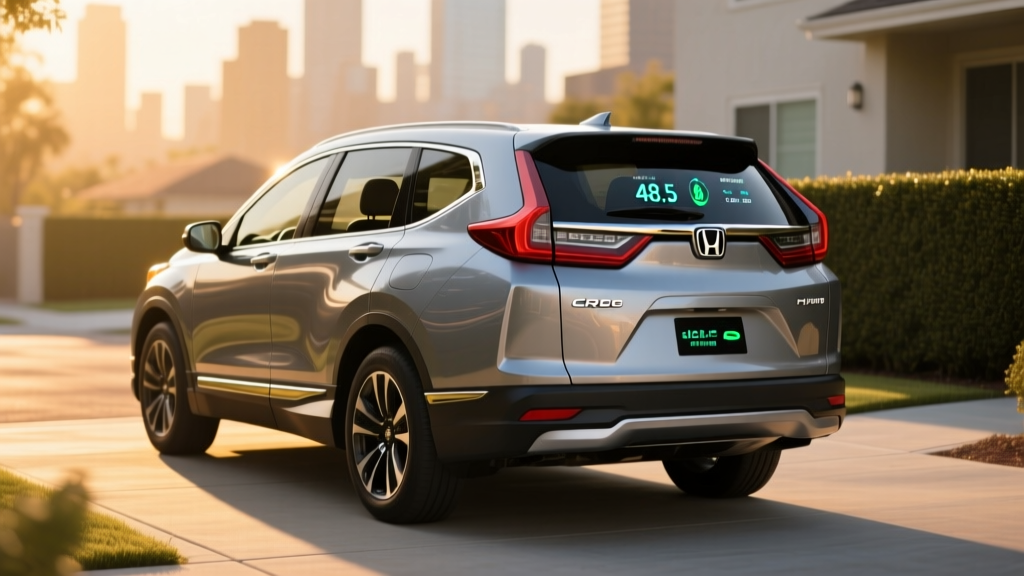
The Honda CR-V Hybrid has quietly become one of the best-selling electrified vehicles in America — not because it's flashy, but because it delivers where compact SUV buyers care most: fuel efficiency, cargo space, and long-term reliability. For the 2026 model year, Honda continues the CR-V Hybrid with its proven two-motor powertrain, slightly refreshed styling, and a starting price that undercuts many non-hybrid rivals once you factor in fuel savings.
If you've been searching for details on fuel economy Honda CR-V Hybrid trims deliver, this guide covers every number that matters — EPA stickers, real-world city and highway results, powertrain output, battery warranty terms, and whether any federal tax credits apply. We'll also break down exactly who should buy this hybrid versus stepping up to a plug-in hybrid (PHEV) or a full battery-electric vehicle (BEV).
HEV vs PHEV: What the CR-V Hybrid Actually Is
Before we get into MPG numbers, it's essential to clarify what the CR-V Hybrid is — and what it isn't.
The Honda CR-V Hybrid is a conventional hybrid (HEV). It pairs a gasoline engine with electric motors and a small battery that recharges through regenerative braking and the engine. You never plug it in. There is no electric-only driving range beyond brief low-speed assist.
As of the 2026 model year, Honda does not offer a CR-V plug-in hybrid (PHEV) in the United States. If you need plug-in capability with electric-only range, you'd need to look at competitors like the Toyota RAV4 Prime (42 miles EV range) or the Hyundai Tucson PHEV (33 miles EV range).
| Feature | Conventional Hybrid (HEV) | Plug-in Hybrid (PHEV) |
|---|---|---|
| Plug in to charge? | No | Yes |
| Electric-only range | None (motor assist only) | 25–45 miles typical |
| Battery size | ~1–2 kWh | ~13–20 kWh |
| Federal tax credit | No | Up to $7,500 (if eligible) |
| Home charger needed? | No | Recommended (Level 2) |
EPA Fuel Economy: Every 2026 CR-V Hybrid Trim
The EPA rates the 2026 Honda CR-V Hybrid at 43 MPG city / 36 MPG highway / 40 MPG combined for front-wheel-drive (FWD) trims. All-wheel-drive (AWD) models drop slightly to 40 MPG city / 35 MPG highway / 37 MPG combined due to the added weight and drivetrain losses of the rear motor.
| Trim / Drivetrain | City MPG | Highway MPG | Combined MPG | MSRP (2026) |
|---|---|---|---|---|
| Sport FWD | 43 | 36 | 40 | $35,495 |
| Sport AWD | 40 | 35 | 37 | $37,095 |
| Sport-L FWD | 43 | 36 | 40 | $38,495 |
| Sport-L AWD | 40 | 35 | 37 | $40,095 |
| Sport Touring AWD | 40 | 35 | 37 | $43,395 |
Source: EPA Fuel Economy Guide — Honda CR-V Hybrid
Real-World MPG: Where the CR-V Hybrid Shines (and Where It Doesn't)
EPA numbers are a starting point, not a guarantee. The CR-V Hybrid's two-motor system excels in stop-and-go city driving, where regenerative braking recaptures energy and the electric motor handles low-speed acceleration. In real-world urban commuting, many owners report 42–45 MPG in FWD trims — sometimes exceeding the EPA city rating.
Highway driving tells a different story. At sustained speeds above 70 mph, the gasoline engine does most of the work, and aerodynamic drag reduces efficiency. Expect 32–35 MPG on long highway trips in AWD models. Cold weather (below 40°F) further reduces efficiency by 10–15% as the engine runs more frequently to heat the cabin and warm the catalytic converter.
Real-World Fuel Economy Summary:
- City commuting (FWD): 42–45 MPG
- Highway cruising (AWD, 70+ mph): 32–35 MPG
- Mixed driving (AWD, all seasons): 35–38 MPG
- Cold-weather penalty: –10% to –15% in winter months
- Total range on one tank (AWD, 14.0 gal): ~500–520 miles mixed
For comparison, the non-hybrid 2026 CR-V with its 1.5L turbocharged engine rates at 29/36/32 MPG (FWD). The hybrid's 5–8 MPG advantage in combined driving translates to roughly $400–$600 in annual fuel savings for a driver covering 15,000 miles per year at $3.40/gallon.
Powertrain and Performance Specs
| Specification | 2026 Honda CR-V Hybrid |
|---|---|
| Engine | 2.0L Atkinson-cycle 4-cylinder |
| Electric Motors | Dual-motor system (front drive + generator) |
| Combined System Output | 204 hp / 247 lb-ft torque |
| Transmission | Electronic CVT (e-CVT) |
| Drivetrain | FWD or AWD (rear electric motor) |
| 0–60 mph | ~7.6 seconds (AWD) |
| Battery (hybrid) | ~1.06 kWh lithium-ion |
| Towing Capacity | 1,000 lbs |
| Cargo Volume | 36.3 cu ft (rear seats up) / 76.5 cu ft (folded) |
The CR-V Hybrid uses Honda's fourth-generation two-motor hybrid system. Unlike a traditional transmission, the e-CVT seamlessly blends power from the gasoline engine and electric motors. The gasoline engine primarily acts as a generator at low speeds, while the electric motor drives the wheels. At highway speeds, the engine can directly drive the wheels through a lock-up clutch for better efficiency.
The 204 combined horsepower is adequate for daily driving and highway merging but won't win any drag races. The instant torque from the electric motors (247 lb-ft) gives the CR-V Hybrid a responsive feel around town that the non-hybrid turbo model can't quite match at low RPMs.
Battery Warranty, Lifespan, and Replacement Cost
Honda Hybrid Battery Warranty:
- Coverage: 8 years / 100,000 miles (10 years / 150,000 miles in CARB states including CA, NY, MA, and others)
- What's covered: Hybrid battery pack, hybrid control module, electric motors
- Threshold: Warranty applies if battery capacity drops below functional specifications
Hybrid battery longevity is the top concern for buyers considering a used CR-V Hybrid or planning to keep a new one long-term. The good news: Honda's hybrid batteries are significantly smaller than those in full EVs (about 1 kWh vs. 60–100 kWh), which means lower replacement costs and less stress on the cells.
Real-world data from CR-V Hybrid owners (and the mechanically similar Accord Hybrid) shows that these batteries routinely last 150,000–200,000+ miles with minimal degradation. The battery never fully charges or fully discharges — Honda's battery management system keeps the state of charge between roughly 20% and 80%, dramatically extending cycle life.
If replacement is needed out of warranty, expect to pay $2,000–$3,500 for a new hybrid battery pack at a Honda dealer, or $1,200–$2,000 for a refurbished unit from an independent hybrid specialist. This is a fraction of full EV battery replacement costs ($8,000–$20,000+).
Tax Credits and Incentives: What Applies to the CR-V Hybrid?
Here's the straightforward answer: The Honda CR-V Hybrid does not qualify for the federal §30D clean vehicle tax credit. That credit — up to $7,500 — is reserved for plug-in electric vehicles (BEVs and PHEVs) that meet specific battery sourcing, MSRP, and buyer income requirements. Since the CR-V Hybrid is a conventional HEV that cannot plug in, it's ineligible.
| Incentive | CR-V Hybrid Eligible? | Notes |
|---|---|---|
| Federal §30D Tax Credit (up to $7,500) | No | HEVs excluded; applies only to PHEVs/BEVs |
| Federal Used EV Credit (§25E, up to $4,000) | No | Applies only to used PHEVs/BEVs |
| State Hybrid Rebates | Varies | Some states offer $500–$1,500 for HEVs — check your state energy office |
| HOV Lane Access | Limited | A few states grant hybrid HOV access; most now require PHEV/BEV |
| Local Utility Rebates | Unlikely | Utility programs typically target plug-in vehicles |
Some states do offer modest incentives for conventional hybrids. Check your state's energy office or department of environmental quality for current programs. These are typically $500–$1,500 rebates and change frequently. See the Alternative Fuels Data Center for a state-by-state database of incentives.
CR-V Hybrid vs. PHEV vs. Full EV: Which Should You Choose?
Choose the CR-V Hybrid (HEV) if:
- You can't charge at home (apartment, street parking, no garage)
- You want maximum simplicity — no plugs, no charging apps, no range planning
- You drive a mix of city and highway and want consistent fuel savings everywhere
- Your budget is $35K–$43K and you want a well-equipped compact SUV
- You plan to keep the vehicle 10+ years and want proven long-term reliability
Choose a PHEV (like the Toyota RAV4 Prime) if:
- You can install a Level 2 home charger
- Your daily commute is under 40 miles round-trip (run on electricity most days)
- You want the $7,500 federal tax credit (if eligible) to offset a higher purchase price
- You still want gas flexibility for road trips without charging stops
Choose a full EV (like the Tesla Model Y or Hyundai Ioniq 5) if:
- You have reliable home charging and your daily driving is under 250 miles
- You want zero tailpipe emissions and the lowest per-mile energy cost
- You're ready to plan road trips around DC fast-charging stops
- You want the lowest maintenance costs (no oil changes, no engine)
The CR-V Hybrid occupies a practical middle ground. It delivers meaningful fuel savings without any lifestyle changes — no charging, no route planning, no range anxiety. The trade-off is that you're still burning gasoline, and you miss out on the substantial tax credits available to plug-in vehicles.
Pros and Cons: 2026 Honda CR-V Hybrid
Pros
- 40 MPG combined (FWD) — class-leading for a non-plug-in compact SUV
- Strong city MPG that often exceeds EPA estimates in real-world driving
- 204 hp with instant electric torque for confident merging
- Spacious interior: 36.3 cu ft cargo with seats up
- Excellent IIHS safety ratings (Top Safety Pick)
- 8-year/100,000-mile hybrid battery warranty (10/150K in CARB states)
- No charging infrastructure needed — works for apartment dwellers
- Strong resale value and proven Honda reliability
Cons
- No federal tax credit eligibility (HEV exclusion)
- AWD highway MPG drops to 35 — less impressive on road trips
- No plug-in / electric-only option in the Honda CR-V lineup
- Only 1,000-lb towing capacity (non-hybrid turbo also limited)
- Road noise is noticeable at highway speeds
- Cold-weather MPG drops 10–15% in winter
- Sport Touring AWD pushes past $43K — premium territory
Frequently Asked Questions
How many MPG does the 2026 Honda CR-V Hybrid get?
The EPA rates the FWD CR-V Hybrid at 43 city / 36 highway / 40 combined MPG. AWD trims rate at 40 city / 35 highway / 37 combined. Real-world city driving often yields 42–45 MPG in FWD models, while highway-heavy trips in AWD may return 32–35 MPG.
Does the Honda CR-V Hybrid need to be plugged in?
No. The CR-V Hybrid is a conventional hybrid (HEV). Its small battery recharges through regenerative braking and the gasoline engine. You simply fill up at a gas station like any other car.
Is the CR-V Hybrid reliable, and what does a battery replacement cost?
Yes. Honda's hybrid system is one of the most proven on the market, with millions of miles of real-world data across the Accord, Civic, and CR-V lineups. The hybrid battery is warrantied for 8 years/100,000 miles (10/150K in CARB states) and routinely lasts 150,000–200,000+ miles. Out-of-warranty replacement costs $2,000–$3,500 for a new pack.
Does the CR-V Hybrid qualify for any tax credit?
The CR-V Hybrid does not qualify for the federal §30D clean vehicle tax credit (up to $7,500), which is limited to plug-in vehicles. Some states offer modest hybrid rebates ($500–$1,500), but these vary widely. Check the Alternative Fuels Data Center for your state.
How does the CR-V Hybrid compare to the Toyota RAV4 Hybrid?
The 2026 RAV4 Hybrid rates at 41/38/40 MPG (AWD) and starts around $33,500 — slightly more affordable with standard AWD. The CR-V Hybrid offers a more refined interior and slightly more cargo space. Both are excellent choices; the RAV4 edges out on highway MPG, while the CR-V wins on interior quality and ride comfort.
Can I tow with the CR-V Hybrid?
The 2026 CR-V Hybrid is rated for 1,000 lbs of towing capacity — enough for a small utility trailer or a pair of dirt bikes, but not a boat or camper. If you need more towing capacity, consider a non-hybrid compact SUV or a midsize SUV.