Quick Verdict: The CR-V AWD Hybrid Nails the Daily-Driver Formula
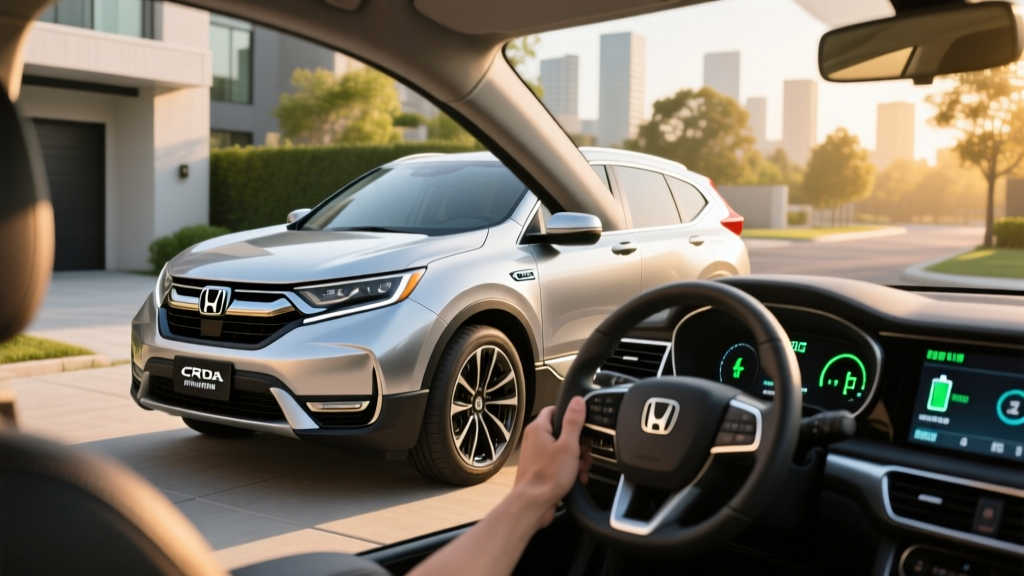
The 2026 Honda CR-V AWD Hybrid occupies a specific and compelling niche: buyers who want SUV practicality, all-weather traction, and meaningful fuel savings without ever plugging in. With an EPA-estimated 40 MPG combined and a combined system output of 204 horsepower, the CR-V Sport Hybrid AWD delivers where it matters — at the pump and in real-world drivability — while sidestepping the charging-access and range-anxiety questions that still complicate full EV ownership for many households.
This is a conventional hybrid (HEV), not a plug-in. You fuel it with gasoline and never think about charging. If you're cross-shopping the RAV4 Hybrid, Tucson Hybrid, or Forester Hybrid, here's everything you need to know about Honda's electrified compact SUV.
HEV vs PHEV: Why the CR-V Hybrid Doesn't Plug In
A common source of confusion in hybrid shopping is the difference between a conventional hybrid and a plug-in hybrid. The 2026 CR-V Hybrid is a conventional hybrid (HEV). Honda does not currently offer a plug-in hybrid (PHEV) variant of the CR-V in the United States.
HEV vs PHEV — What's the Difference?
| Feature | HEV (CR-V Hybrid) | PHEV (e.g., RAV4 Prime) |
|---|---|---|
| Plugs in to charge? | No | Yes |
| Electric-only range | ~1 mi at low speed | 25–42 mi typical |
| Battery size | ~1.06 kWh | 13.6–18.1 kWh |
| Federal tax credit | Not eligible | Up to $7,500 (varies) |
| Home charger needed? | No | Recommended (Level 2) |
| Price premium over gas | ~$1,500–$2,500 | ~$5,000–$8,000 |
The CR-V Hybrid's small battery recharges through regenerative braking and the gasoline engine. You simply drive it like a normal car.
Fuel Economy: EPA Numbers and Real-World MPG
The headline number is what brings most buyers to this page. Here's the official EPA breakdown for the 2026 CR-V Hybrid AWD, per fueleconomy.gov:
| Cycle | MPG |
|---|---|
| City | 40 |
| Highway | 34 |
| Combined | 37 |
Real-World MPG vs. EPA Sticker
Hybrid powertrains shine in stop-and-go driving, where regenerative braking recaptures energy and the electric motor handles low-speed propulsion. In real-world ownership, many CR-V Hybrid drivers report exceeding the EPA city estimate — 41–44 MPG is common in urban and suburban commutes. Highway fuel economy tends to run closer to sticker or slightly below, particularly above 75 mph where aerodynamic drag dominates and the gasoline engine does most of the work.
In cold weather (below 30°F), expect a 5–10% fuel-economy dip as the engine runs more frequently to maintain cabin heat and battery temperature. This is normal for all hybrids and far less severe than the 20–30% range loss a full EV experiences in winter.
For context, the non-hybrid CR-V AWD with the 1.5L turbocharged engine earns an EPA 29 MPG combined — the hybrid delivers roughly 28% better combined fuel economy with smoother low-speed acceleration as a bonus.
Powertrain and Performance Specs
The CR-V Hybrid pairs a 2.0-liter Atkinson-cycle four-cylinder engine with a two-motor hybrid system. Honda's e-CVT (continuously variable transmission) manages power delivery without traditional gear shifts.
| Specification | Value |
|---|---|
| Engine | 2.0L Atkinson-cycle I-4 |
| Engine horsepower | 145 HP |
| Electric motor output | 181 HP / 247 lb-ft torque |
| Combined system horsepower | 204 HP |
| Transmission | e-CVT |
| Drivetrain | Real Time AWD™ (rear electric motor) |
| 0–60 mph (est.) | ~7.6 seconds |
| Hybrid battery capacity | ~1.06 kWh (lithium-ion) |
| Towing capacity | 1,000 lbs |
| Fuel tank | 14.0 gallons |
The AWD system in the CR-V Hybrid is worth noting: Honda uses a dedicated rear-mounted electric motor to power the rear axle when traction demands it. There's no mechanical driveshaft connecting the engine to the rear wheels — it's an electrically activated system. This means AWD engagement is instant and seamless, and it doesn't meaningfully hurt fuel economy compared to the FWD hybrid variant (which earns 40 combined MPG).
Pricing, Trims, and Tax Credit Eligibility
The 2026 Honda CR-V Hybrid is offered in two AWD trims in the US market:
| Trim | MSRP | Key Features |
|---|---|---|
| Sport Hybrid AWD | $36,395 | 18" wheels, wireless CarPlay/Android Auto, Honda Sensing suite |
| Sport Touring Hybrid AWD | $41,395 | Leather, Bose 12-speaker audio, navigation, heated rear seats, wireless charging |
Prices include destination charge. Actual dealer pricing may vary.
Federal Tax Credit: Not Eligible
The CR-V Hybrid is a conventional HEV, not a plug-in vehicle. Under current IRS §30D rules, only battery electric vehicles (BEVs) and plug-in hybrids (PHEVs) with sufficient battery capacity qualify for the federal clean vehicle credit. The CR-V Hybrid does not qualify for the $7,500 federal tax credit.
Some states offer their own hybrid incentives — check your state's energy office or DMV for local programs. These vary by jurisdiction and change frequently.
Battery Warranty, Reliability, and Replacement Cost
Hybrid battery longevity is consistently the top concern among first-time hybrid buyers. Here's the data:
Honda Hybrid Battery Warranty
Honda covers the CR-V Hybrid's high-voltage battery with an 8-year / 100,000-mile warranty (10 years / 150,000 miles in CARB states including California, New York, Massachusetts, and others that follow California emissions standards). This warranty covers the battery against defects and excessive capacity loss.
In practice, Honda's hybrid batteries have demonstrated strong longevity. The hybrid system's small battery (~1.06 kWh) operates within a narrow state-of-charge window — it never fully charges or fully discharges, which dramatically reduces stress on the cells. Real-world data from Honda hybrid owners (Insight, Accord Hybrid, CR-V Hybrid) shows most batteries retaining strong performance well past 150,000 miles.
If replacement is needed out of warranty, a new OEM hybrid battery for the CR-V Hybrid typically costs between $2,000 and $3,500 including labor. This is far less than an EV traction battery replacement ($8,000–$20,000+) because the hybrid battery is small. Third-party refurbishment shops offer reconditioned units for $1,000–$1,800.
For broader reliability, Honda's two-motor hybrid system has been in production since 2014 (Accord Hybrid) and has proven durable. The CR-V Hybrid has earned strong marks from Consumer Reports and carries top safety ratings from the IIHS.
Hybrid vs PHEV vs EV: Which Is Right for You?
The CR-V Hybrid competes in a segment where buyers are weighing three electrification paths. Here's a practical decision framework:
Choose the CR-V Hybrid (HEV) if:
- You don't have access to home or workplace charging (apartment, street parking, no garage)
- You want lower fuel costs without changing any habits — just fill up with gas
- Your budget is under $42,000 and you want AWD
- You regularly drive in cold climates where EV range loss is a concern
- You tow occasionally (though 1,000 lbs is modest)
Consider a PHEV (like the RAV4 Prime) if:
- You can install a Level 2 home charger and your commute is under 40 miles
- You want electric-only daily driving but gas flexibility for road trips
- You qualify for the $7,500 federal tax credit, which can offset the higher purchase price
Go full EV (like the Ioniq 5 or Model Y) if:
- You have reliable home charging (Level 2)
- Your daily driving is under 250 miles and you road-trip infrequently
- You want to eliminate gasoline costs entirely and minimize maintenance
- You qualify for federal and state EV incentives
Pros and Cons
✓ Pros
- 40 MPG city / 37 combined — class-leading efficiency
- No charging required — zero lifestyle change
- Strong reliability record for Honda's hybrid system
- Spacious interior with 36.3 cu ft cargo behind rear seats
- Honda Sensing ADAS suite standard on all trims
- Smooth, quiet low-speed electric propulsion
✗ Cons
- No federal tax credit eligibility
- Highway MPG (34) lags behind city — typical for hybrids
- Only two trims available — limited customization
- 1,000-lb towing capacity is low for the segment
- Engine drone under hard acceleration (e-CVT characteristic)
- No plug-in hybrid option from Honda
Ownership Costs: 5-Year Fuel Savings vs. Gas CR-V
The hybrid premium over the gas-only CR-V AWD is roughly $1,500–$2,500 depending on trim. Here's how the fuel math works out over five years, assuming 15,000 miles/year and $3.50/gallon regular unleaded:
| Model | Combined MPG | Gallons Used | 5-Year Fuel Cost |
|---|---|---|---|
| CR-V AWD (1.5T Gas) | 29 | 2,586 | $9,051 |
| CR-V Hybrid AWD | 37 | 2,027 | $7,095 |
| Savings | 559 gal | $1,956 |
At current fuel prices, the hybrid pays back its premium in roughly 4–5 years through fuel savings alone. If gas prices rise above $4.00/gallon, the payback period shortens to 3 years. Factor in the hybrid's smoother stop-and-go driving experience and reduced brake wear (regenerative braking extends pad life), and the value proposition strengthens further.
Frequently Asked Questions
How many MPG does the CR-V AWD Hybrid get in real-world driving?
The EPA rates it at 40 city / 34 highway / 37 combined. In real-world ownership, city and suburban drivers frequently report 41–44 MPG thanks to regenerative braking. Highway-only driving at 75+ mph typically yields 32–35 MPG. Cold weather reduces economy by 5–10%.
Does the CR-V Hybrid need to be plugged in?
No. The CR-V Hybrid is a conventional hybrid (HEV). Its small battery recharges through regenerative braking and the gasoline engine. You simply fill it with gasoline at any station — no plug, no charger, no behavior change required.
Is there a plug-in hybrid (PHEV) version of the CR-V?
Not in the United States. Honda does not offer a CR-V PHEV in the US market for the 2026 model year. If you want a compact SUV PHEV, the Toyota RAV4 Prime (42 mi electric-only range) and Mitsubishi Outlander PHEV (38 mi) are the primary alternatives.
How long will the CR-V Hybrid battery last?
Honda's hybrid batteries are designed to last the life of the vehicle. The battery is covered by an 8-year/100,000-mile warranty (10 years/150,000 miles in CARB states). Real-world data from Honda's hybrid lineup shows most batteries performing well beyond 150,000 miles. If replacement is needed, expect $2,000–$3,500 for an OEM unit.
Does the CR-V Hybrid qualify for a federal tax credit?
No. Under current IRS §30D rules, only plug-in electric vehicles (BEVs and PHEVs) qualify for the federal clean vehicle credit. Conventional hybrids like the CR-V Hybrid are not eligible. Check your state's energy office for any local hybrid incentives.
How does the CR-V Hybrid compare to the RAV4 Hybrid?
The Toyota RAV4 Hybrid AWD is the CR-V Hybrid's closest rival. The RAV4 Hybrid is rated at 41 city / 38 highway / 39 combined — slightly better on paper, especially on the highway. The CR-V Hybrid counters with a more refined interior, a slightly more powerful electric motor (181 HP vs 118 HP motor output), and Honda's strong safety suite. Both are excellent choices; the decision often comes down to brand preference, dealer pricing, and interior feel.
What's the total driving range on a full tank?
With a 14.0-gallon fuel tank and 37 MPG combined, the CR-V Hybrid AWD delivers approximately 518 miles of total range. In city-heavy driving at 40 MPG, that stretches to roughly 560 miles between fill-ups — a genuine advantage over most EVs for road-trip convenience.