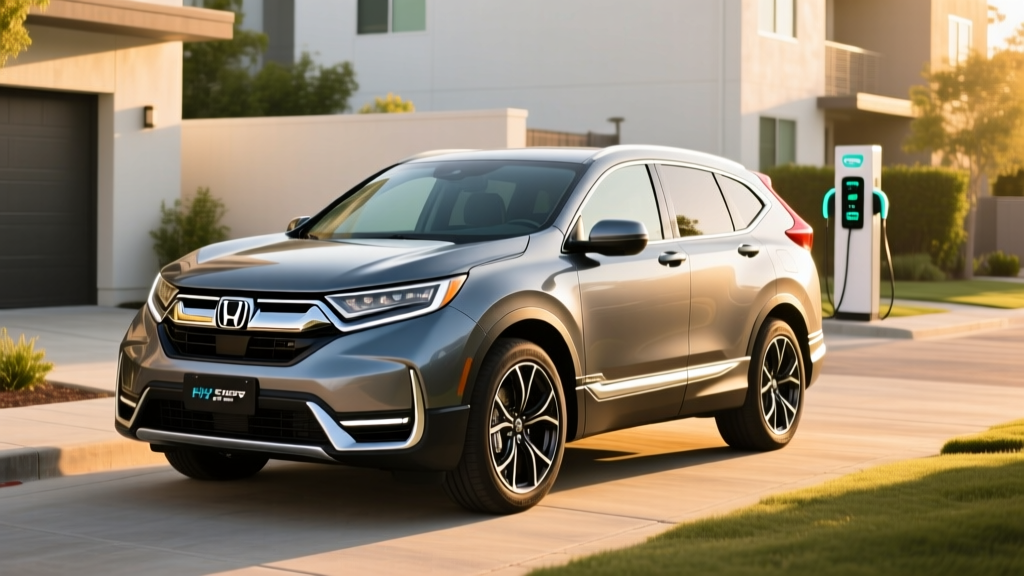
The 2026 Honda CR-V Hybrid Sport sits in one of the most competitive segments in the auto market: the compact hybrid SUV. Buyers cross-shopping this against the Toyota RAV4 Hybrid, Ford Escape Hybrid, and Hyundai Tucson Hybrid want one thing above all else — fuel savings without plugging in. Honda's two-motor hybrid system in the CR-V Sport delivers exactly that, pairing a 2.0-liter Atkinson-cycle engine with a dual-motor setup for 204 combined horsepower and an EPA-estimated 40 MPG combined.
This is a conventional hybrid (HEV), not a plug-in. You never plug it in, and there is no electric-only range to manage. The battery recharges through regenerative braking and the gasoline engine. If you need plug-in capability, Honda discontinued the CR-V PHEV for the US market after the 2023 model year, so the 2026 lineup is strictly HEV for American buyers.
Fuel Economy: EPA Ratings vs Real-World MPG
The 2026 CR-V Hybrid Sport carries EPA estimates of 43 MPG city / 36 MPG highway / 40 MPG combined for front-wheel-drive trims. The available Real-Time AWD drops those figures slightly to 40/34/37 MPG combined. These numbers are published on fueleconomy.gov and represent the official testing cycle.
| Drivetrain | City MPG | Highway MPG | Combined MPG |
|---|---|---|---|
| FWD (Sport / Sport Touring) | 43 | 36 | 40 |
| AWD (Sport / Sport Touring) | 40 | 34 | 37 |
Real-world expectation: Honda's two-motor hybrid system excels in stop-and-go city driving, where the electric motors handle low-speed propulsion and the engine acts primarily as a generator. Owners who drive predominantly in urban or suburban conditions frequently report exceeding the EPA city figure, hitting 44-46 MPG in warm weather. Highway cruising at 70-80 mph, however, relies more on the gasoline engine operating in direct-drive mode, and real-world highway numbers tend to land closer to 33-35 MPG. In cold weather (below 30°F), expect a 3-5 MPG drop across the board as the engine runs more frequently to provide cabin heat and maintain battery temperature.
Powertrain: How the Two-Motor Hybrid System Works
The CR-V Hybrid Sport uses Honda's fourth-generation two-motor hybrid system. Here is how the components break down:
| Component | Specification |
|---|---|
| Engine | 2.0L DOHC Atkinson-cycle 4-cylinder |
| Engine Output | 145 hp @ 6,100 rpm / 134 lb-ft torque |
| Drive Motor | 181 hp / 247 lb-ft torque |
| Combined System Output | 204 hp / 247 lb-ft torque |
| Transmission | e-CVT (direct-drive with lockup clutch) |
| Hybrid Battery | 1.06 kWh lithium-ion (approx.) |
| 0-60 mph | ~7.8 seconds (estimated) |
| Drivetrain | FWD standard, Real-Time AWD available |
Unlike a traditional parallel hybrid, Honda's system operates in three distinct modes. At low speeds and light loads, the gasoline engine generates electricity while the drive motor propels the vehicle (EV Drive). Under hard acceleration, both the engine and motor contribute (Hybrid Drive). At sustained highway speeds, a lockup clutch engages to connect the engine directly to the wheels for maximum efficiency (Engine Drive). This architecture eliminates the rubber-band feel of older e-CVTs and delivers responsive, linear acceleration from the 247 lb-ft electric motor.
HEV vs PHEV: Why the CR-V Is a Conventional Hybrid Only
With Honda offering no plug-in CR-V in the US for 2026, understanding the distinction between HEV and PHEV matters for buyers weighing their options.
Conventional Hybrid (HEV) — What the CR-V Sport Is
- No plug required. The small ~1 kWh battery recharges via regenerative braking and the engine.
- No electric-only range. The motor assists the engine but cannot sustain propulsion alone at higher speeds.
- Lower upfront cost. Typically $1,500-$2,500 more than a gas-only equivalent.
- Consistent fuel savings. 37-40 MPG combined regardless of driving habits.
Plug-In Hybrid (PHEV) — What the CR-V Is Not
- Requires plugging in to access 25-40 miles of electric-only range.
- Larger battery (typically 15-20 kWh) with Level 2 charging capability.
- Higher upfront cost but potential for $3,750-$7,500 federal tax credit under IRS §30D.
- Variable savings — maximize value only if you charge daily and drive under the electric range.
If plug-in capability is a dealbreaker, cross-shop the Toyota RAV4 Prime (42 miles EV range, PHEV), Hyundai Tucson PHEV (33 miles EV range), or the Ford Escape PHEV (37 miles EV range). Each carries a higher MSRP but qualifies for partial or full federal tax credits depending on battery sourcing and buyer income.
Pricing and Tax Credit Eligibility
The 2026 Honda CR-V Hybrid Sport starts at a base MSRP of approximately $36,395 (including destination charge). The Sport Touring Hybrid, which adds AWD standard, leather seats, a Bose audio system, and a wireless phone charger, starts around $42,195.
| Trim | Drivetrain | MSRP (incl. destination) |
|---|---|---|
| Sport Hybrid | FWD | $36,395 |
| Sport Hybrid | AWD | $37,895 |
| Sport Touring Hybrid | AWD | $42,195 |
Federal tax credit: The CR-V Hybrid is a conventional HEV and does not qualify for the IRS §30D New Clean Vehicle Credit. That credit is reserved for plug-in electric vehicles (BEVs and PHEVs) with a minimum battery capacity of 7 kWh. Conventional hybrids are excluded regardless of price or buyer income. Some states and local utilities offer rebates for hybrid purchases — check your state energy office or utility provider for current programs, as these vary by jurisdiction and change frequently.
Battery Warranty, Reliability, and Replacement Cost
Hybrid battery longevity remains the top concern for buyers moving from a conventional gas car. Honda covers the CR-V Hybrid's lithium-ion battery pack under its hybrid system warranty:
Honda Hybrid Battery Warranty
- Duration: 8 years / 100,000 miles (10 years / 150,000 miles in CARB states including California, New York, Massachusetts, and others that follow California emissions standards)
- Coverage: Defects in materials and workmanship, plus capacity loss below a functional threshold
- Hybrid system components covered: Inverter, electric motors, battery control module, and related wiring
Real-world longevity data: Honda's two-motor hybrid system has been in production since 2014 (Accord Hybrid, then CR-V Hybrid starting 2020). The small ~1 kWh battery pack experiences shallow charge cycles — it never fully depletes or fully charges, which dramatically reduces degradation stress compared to a BEV or PHEV battery. Based on long-term fleet data from similar Honda hybrid systems, battery replacement before 150,000 miles is uncommon. When replacement is needed out of warranty, expect a cost between $2,000 and $4,000 for the battery pack, plus labor. This is significantly less than BEV battery replacement ($8,000-$20,000+) because the pack is small and modular.
Honda's overall reliability reputation remains strong. The CR-V consistently earns high marks from Consumer Reports and J.D. Power for dependability. The hybrid powertrain eliminates the traditional transmission — there are no gears, belts, or torque converters to wear out. The e-CVT is a direct-drive unit with a lockup clutch, and regenerative braking reduces wear on the friction brake pads, often lasting 80,000+ miles before service.
Driving Impressions: Performance, Ride, and Daily Use
The 204 combined horsepower and 247 lb-ft of torque from the drive motor give the CR-V Hybrid Sport a responsive, confident feel in city and suburban driving. Off-the-line acceleration is immediate — the electric motor delivers peak torque from 0 rpm, which makes merging and passing feel effortless even though the 0-60 time of roughly 7.8 seconds is not sportscar territory.
On the highway, the engine occasionally drones under hard acceleration, but Honda's sound insulation has improved in this generation. The Sport trim rides on 18-inch alloy wheels with all-season tires, and the suspension tuning leans toward comfort over sportiness — body roll is present in corners but well-controlled. The available Real-Time AWD system engages the rear axle only when front-wheel slip is detected, adding minimal weight and no noticeable efficiency penalty in normal driving.
Cargo space: The hybrid battery is mounted under the cargo floor, preserving the full 36.3 cubic feet of cargo volume behind the rear seats (76.5 cu ft with seats folded). This matches the gas-only CR-V — no compromise for going hybrid.
Who Should Buy the CR-V Hybrid Sport vs a Full EV or Gas Car
Choose the CR-V Hybrid Sport if:
- You want 37-40 MPG without changing your fueling habits — no plugs, no apps, no charging networks.
- You drive 12,000-18,000 miles per year in mixed city/highway conditions.
- You lack access to home or workplace charging (apartment dwellers, street parkers).
- You want a lower purchase price than a PHEV or BEV while still cutting fuel costs by 30-40%.
- You plan to keep the vehicle 8-10 years and want the hybrid warranty coverage for peace of mind.
Choose a PHEV or full EV instead if:
- You have reliable home Level 2 charging and a commute under 30-40 miles (a PHEV covers your daily driving on electricity alone).
- You want to qualify for the $3,750-$7,500 federal tax credit under IRS §30D (requires a qualifying BEV or PHEV).
- You drive fewer than 10,000 miles per year — the fuel savings from a hybrid may not offset the higher purchase price of a PHEV.
- You want zero tailpipe emissions in daily driving — a BEV or a PHEV used in EV mode achieves this.
At current national average gas prices (~$3.15/gallon in early 2026), a driver covering 15,000 miles per year in a 40 MPG CR-V Hybrid Sport spends roughly $1,180 per year on fuel. A comparable gas-only compact SUV at 28 MPG combined would cost about $1,690 per year — a savings of approximately $510 annually, or $2,550 over five years. That savings helps offset the hybrid's modest price premium over the gas CR-V.
Frequently Asked Questions
How many MPG does the 2026 Honda CR-V Hybrid Sport get?
The EPA rates the FWD CR-V Hybrid Sport at 43 city / 36 highway / 40 combined MPG. The AWD version is rated at 40/34/37. In real-world city driving, many owners report 44-46 MPG. Highway driving at 75+ mph tends to yield 33-35 MPG.
Does the CR-V Hybrid need to be plugged in?
No. The 2026 CR-V Hybrid is a conventional hybrid (HEV). The battery recharges through regenerative braking and the gasoline engine. You fuel it like any other car at a gas station.
Is the CR-V Hybrid reliable?
Honda's hybrid system has been in production since 2014 with strong reliability records. The hybrid battery carries an 8-year/100,000-mile warranty (10 years/150,000 miles in CARB states). Battery failure before 150,000 miles is uncommon based on fleet data.
How much does a CR-V Hybrid battery replacement cost?
Out-of-warranty replacement of the CR-V Hybrid battery pack typically costs $2,000-$4,000 including labor. This is significantly less than a full EV battery replacement due to the smaller ~1 kWh pack size.
Does the 2026 CR-V Hybrid qualify for a tax credit?
No. The IRS §30D New Clean Vehicle Credit applies only to plug-in vehicles (BEVs and PHEVs) with at least 7 kWh of battery capacity. The CR-V Hybrid's ~1 kWh battery does not qualify. Check your state and local utility for potential hybrid-specific rebates.
How does the CR-V Hybrid compare to the Toyota RAV4 Hybrid?
The RAV4 Hybrid is rated at 41 MPG combined (AWD standard) with 219 hp and a starting price around $34,000. The CR-V Hybrid Sport offers comparable efficiency (37-40 MPG depending on drivetrain), slightly less power (204 hp), and a higher starting MSRP. The RAV4 has a marginal fuel-economy edge; the CR-V offers a more refined interior and quieter ride. Both are strong choices — test-drive both before deciding.