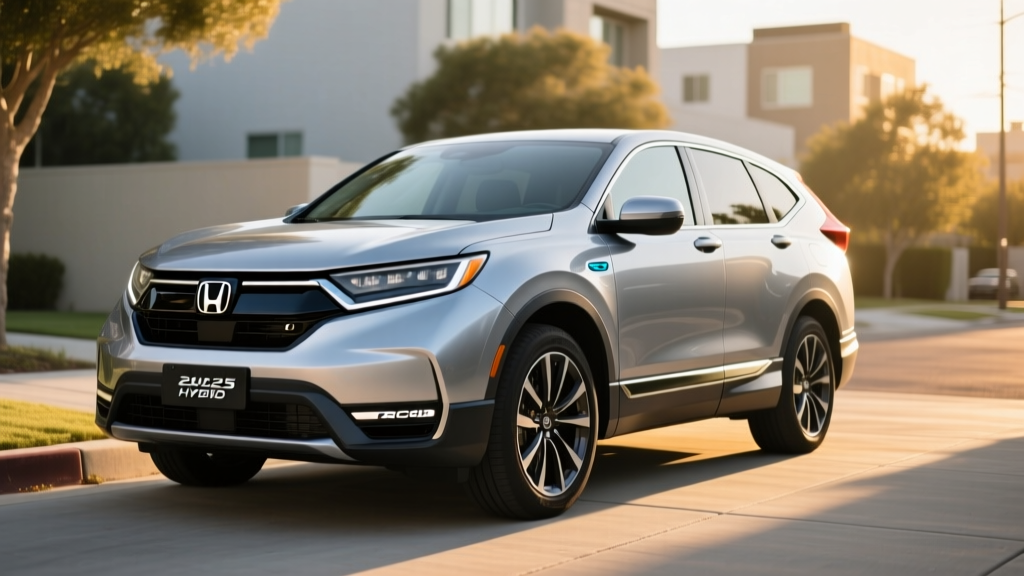
Quick Verdict: The CR-V Hybrid Is Honda's Efficiency Sweet Spot
If you want the practicality of a compact SUV without the complexity of plugging in, the 2025 Honda CR-V Hybrid is one of the most compelling choices in its segment. It delivers an EPA-estimated 40 MPG combined in front-wheel-drive form, offers standard all-wheel drive on most trims with only a 3-MPG penalty, and wraps everything in Honda's reputation for long-term reliability. It isn't a plug-in hybrid — and that's actually the point. For buyers who lack home charging access or simply don't want to think about cords, the CR-V HEV (hybrid electric vehicle) bridges the gap between a conventional gas SUV and a full battery-electric vehicle.
| Spec | FWD Trims | AWD Trims |
|---|---|---|
| Powertrain | 2.0L 4-cyl + 2 electric motors | 2.0L 4-cyl + 2 electric motors |
| Combined Horsepower | 204 hp | 204 hp |
| Combined Torque | 247 lb-ft | 247 lb-ft |
| EPA MPG (City / Hwy / Combined) | 43 / 36 / 40 | 40 / 34 / 37 |
| Fuel Tank Capacity | 15.3 gal | 15.3 gal |
| Total Range (EPA est.) | ~612 miles | ~566 miles |
| 0–60 mph (est.) | ~7.8 sec | ~8.0 sec |
| Cargo Volume (rear seats up / down) | 36.3 / 76.5 cu ft | 36.3 / 76.5 cu ft |
| Towing Capacity | 1,000 lb | 1,000 lb |
| Starting MSRP (Sport trim) | $35,395 | $36,895 |
| Battery Warranty | 8 years / 100,000 miles (10 yr/150,000 mi in CARB states) | |
HEV vs. PHEV: Why the CR-V Hybrid Doesn't Plug In
A common source of confusion among SUV shoppers is the difference between a conventional hybrid (HEV) and a plug-in hybrid (PHEV). The 2025 CR-V Hybrid is an HEV. It uses a small lithium-ion battery (roughly 1.1 kWh) that recharges exclusively through regenerative braking and the gasoline engine. You never plug it in. You simply fill it with gas and drive.
| Feature | HEV (CR-V Hybrid) | PHEV (e.g., Toyota RAV4 Prime) |
|---|---|---|
| Plug-in charging required? | No | Yes (Level 1 or Level 2) |
| Battery size | ~1.1 kWh | ~18.1 kWh |
| Electric-only range | None (EV assist only) | ~42 miles |
| Federal tax credit (§30D) | No | Up to $7,500 (if eligible) |
| Best for | No home charging, simplicity | Home charging + short commutes |
Honda does not currently offer a PHEV version of the CR-V in the United States. If electric-only commuting is a priority, you'll need to look at competitors like the Toyota RAV4 Prime (42 miles EV range) or consider a full BEV such as the Hyundai Ioniq 5.
Fuel Economy: EPA Numbers and Real-World MPG
The 2025 CR-V Hybrid's EPA fuel economy ratings, as published on fueleconomy.gov, break down as follows:
| Drivetrain | City | Highway | Combined |
|---|---|---|---|
| FWD (Sport, Sport-L, Sport Touring) | 43 MPG | 36 MPG | 40 MPG |
| AWD (Sport, Sport-L, Sport Touring) | 40 MPG | 34 MPG | 37 MPG |
Real-World MPG: What to Actually Expect
Hybrid powertrains shine in stop-and-go city driving where regenerative braking recaptures energy that a conventional gas car wastes as heat. Expect the CR-V Hybrid FWD to deliver 42–46 MPG in city driving under moderate conditions — potentially exceeding its EPA city rating. Highway driving is a different story: at sustained 70–80 mph speeds, the electric motors contribute less and the 2.0L Atkinson-cycle engine does most of the work. Real-world highway figures typically land between 32–35 MPG for FWD models.
Cold weather reduces fuel economy in any vehicle, but hybrids are hit harder because the engine must run more frequently to provide cabin heat (unlike a BEV with a heat pump). In sub-freezing conditions, expect a 10–15% drop in combined MPG, bringing an FWD model to roughly 34–36 MPG combined until temperatures recover.
Powertrain Deep Dive: How Honda's Two-Motor Hybrid Works
The CR-V Hybrid uses Honda's fourth-generation two-motor hybrid system. Here's the mechanical breakdown:
- Engine: 2.0-liter DOHC Atkinson-cycle 4-cylinder producing 145 hp and 138 lb-ft of torque. The Atkinson cycle sacrifices peak power for thermal efficiency — ideal for a hybrid where electric motors fill in the torque gap.
- Propulsion motor: One electric motor (181 hp / 247 lb-ft) that drives the front wheels in most conditions. This is the primary motivator at low and medium speeds.
- Generator motor: A second motor that functions as a generator, converting engine output into electricity to feed the propulsion motor or charge the battery.
- Combined system output: 204 hp and 247 lb-ft of torque.
- Transmission: No conventional gearbox. Honda uses an e-CVT (electronic continuously variable transmission) that manages the interplay between engine and motors seamlessly.
In normal driving below ~45 mph, the CR-V Hybrid operates primarily as a series hybrid — the engine generates electricity and the motor drives the wheels. At highway cruising speeds, a lockup clutch connects the engine directly to the wheels for better efficiency. Under hard acceleration, both the engine and motor work in tandem. The result is a powertrain that feels responsive off the line (thanks to instant electric torque) while delivering strong highway passing power.
Pricing, Trims, and Tax Credit Eligibility
For 2025, Honda positions the CR-V Hybrid across three trims, all badged with the "Sport" moniker to differentiate them from the gas-only CR-V lineup:
| Trim | FWD MSRP | AWD MSRP | Key Features |
|---|---|---|---|
| Sport | $35,395 | $36,895 | 18" wheels, 7" touchscreen, wireless CarPlay/Android Auto, Honda Sensing suite |
| Sport-L | $37,395 | $38,895 | Leather-trimmed seats, power tailgate, heated front seats, wireless phone charger |
| Sport Touring | — | $42,195 | 9" touchscreen, Bose 12-speaker audio, navigation, heated steering wheel, hands-free tailgate |
Federal Tax Credit (§30D): The CR-V Hybrid does not qualify for the federal §30D clean vehicle tax credit. That credit applies only to plug-in electric vehicles (BEVs and PHEVs) meeting battery sourcing and critical mineral requirements. Conventional hybrids are ineligible. Some states or local utilities may offer small rebates for hybrid purchases — check your state energy office or utility provider for current programs. Always verify eligibility with a tax professional and reference IRS.gov §30D guidelines.
Battery Longevity, Warranty, and Replacement Costs
Hybrid battery anxiety is one of the most common concerns we hear from buyers transitioning from a conventional gas car. Here's what the data tells us:
Warranty Coverage
Honda covers the CR-V Hybrid's lithium-ion battery pack for 8 years or 100,000 miles, whichever comes first. In states that follow California Air Resources Board (CARB) emissions standards — which include California, New York, Massachusetts, and over a dozen others — that coverage extends to 10 years or 150,000 miles. The warranty guarantees the battery will retain sufficient capacity to function as designed; if it fails or degrades beyond Honda's threshold, replacement is covered.
Real-World Degradation
Unlike a full EV battery that cycles deeply every day, the CR-V Hybrid's small ~1.1 kWh pack operates within a narrow state-of-charge window — typically between 40% and 80%. This shallow-cycling strategy dramatically reduces degradation stress. Honda's hybrid batteries in the Accord and Insight have demonstrated strong longevity in the field, with many exceeding 150,000–200,000 miles without replacement. Toyota's hybrid track record (Prius, RAV4 Hybrid) reinforces that modern HEV batteries routinely outlast the vehicles themselves.
Replacement Cost If Out of Warranty
If the battery does require replacement outside the warranty window, expect a dealer-installed hybrid battery pack to cost between $2,000 and $4,000 depending on labor rates and parts availability. Independent hybrid specialists often offer refurbished packs for $1,500–$2,500. This is far less than a full EV battery replacement ($5,000–$20,000+), because the CR-V Hybrid's pack is small and relatively simple.
Reliability and Safety Ratings
Honda's hybrid system has matured over multiple generations, and the CR-V Hybrid benefits from that development history. The 2025 CR-V (including hybrid trims) carries strong safety credentials:
- IIHS: The CR-V has historically earned TOP SAFETY PICK or TOP SAFETY PICK+ ratings. Check the IIHS vehicle ratings page for the latest 2025 test results.
- NHTSA: Refer to NHTSA.gov for the most current star ratings.
- Honda Sensing: Standard across all trims — includes adaptive cruise control, lane-keeping assist, collision mitigation braking, road departure mitigation, and traffic sign recognition. Note: this is an SAE Level 2 driver-assistance system, meaning the driver must remain fully engaged with hands on the wheel and eyes on the road at all times.
Pros
- 40 MPG combined (FWD) with no plug-in hassle
- Strong electric torque makes city driving responsive
- Spacious cabin with 36.3 cu ft cargo area
- Proven Honda hybrid reliability and generous battery warranty
- Honda Sensing safety suite standard on every trim
- Higher resale value than many competitors
Cons
- No PHEV option — zero electric-only range
- No federal tax credit eligibility
- 1,000-lb towing limit (gas CR-V tows up to 1,500 lb)
- Highway MPG drops noticeably at 75+ mph
- Sport Touring trim pushes past $42K
- Rear seats don't slide or recline as much as some rivals
Who Should Buy the CR-V Hybrid — and Who Shouldn't
Choose the CR-V Hybrid if:
- You don't have access to home or workplace charging and a BEV isn't practical.
- Your commute is mixed city/highway and you want maximum fuel savings without behavior changes.
- You plan to own the vehicle 8+ years and value long-term reliability over cutting-edge EV tech.
- You want a compact SUV with strong cargo space and a proven safety record.
Choose a PHEV (like the RAV4 Prime) if:
- You have Level 2 home charging and a daily commute under 40 miles — you could drive months without buying gas.
- You want to qualify for the federal §30D tax credit (up to $7,500 for eligible buyers and vehicles).
Choose a full BEV (like the Ioniq 5 or Tesla Model Y) if:
- You have reliable home charging and want zero tailpipe emissions.
- You want the lowest per-mile fuel cost (~$0.04–0.06/mi on home electricity vs. ~$0.10–0.12/mi in the CR-V Hybrid at 40 MPG and $3.50/gal gas).
- You're eligible for the full $7,500 federal credit, which can make a BEV cost-competitive with a hybrid after incentives.
5-Year Ownership Cost Snapshot
To put the CR-V Hybrid's economics in context, here's a simplified 5-year/75,000-mile fuel cost comparison assuming $3.50/gallon regular unleaded and 15,000 miles driven annually:
| Vehicle | Combined MPG | Gallons Used | Total Fuel Cost |
|---|---|---|---|
| 2025 Honda CR-V Hybrid AWD | 37 MPG | 2,027 | $7,095 |
| 2025 Honda CR-V Gas AWD (28 MPG) | 28 MPG | 2,679 | $9,375 |
| 2025 Toyota RAV4 Hybrid AWD | 39 MPG | 1,923 | $6,731 |
| 2025 Hyundai Tucson Hybrid AWD | 38 MPG | 1,974 | $6,908 |
The CR-V Hybrid saves approximately $2,280 in fuel costs over five years compared to the gas-only CR-V AWD. That nearly offsets the hybrid's ~$1,500–$2,000 price premium over equivalent gas trims, and the savings grow if gas prices rise. Insurance costs for the CR-V Hybrid are generally comparable to the gas model — check quotes from your provider, as hybrid-specific surcharges are rare for Honda.
Frequently Asked Questions
How many MPG does the 2025 Honda CR-V Hybrid actually get?
The EPA rates the FWD model at 43 city / 36 highway / 40 combined MPG, and the AWD at 40 city / 34 highway / 37 combined MPG. In real-world driving, city MPG often exceeds the EPA estimate (42–46 MPG is common), while highway driving at 75+ mph may return 32–35 MPG. Cold weather can reduce combined figures by 10–15%.
Does the CR-V Hybrid need to be plugged in?
No. The CR-V Hybrid is a conventional HEV. Its small battery recharges through regenerative braking and the gasoline engine. You simply fill it with gas like any other car. If you want plug-in capability, Honda does not currently offer a CR-V PHEV in the U.S.
Is the 2025 CR-V Hybrid reliable?
Honda's hybrid system is in its fourth generation and has a strong track record. The hybrid battery is warranted for 8 years/100,000 miles (10 years/150,000 miles in CARB states). Real-world data from Honda's other hybrid models (Accord Hybrid, Civic Hybrid) shows battery packs routinely lasting 150,000+ miles. The CR-V platform itself is one of Honda's most established nameplates.
What does a CR-V Hybrid battery replacement cost?
Out-of-warranty replacement runs approximately $2,000–$4,000 at a Honda dealer, or $1,500–$2,500 through an independent hybrid specialist using a refurbished pack. Given the battery's shallow-cycling design and generous warranty, most owners will never face this expense.
Does the 2025 CR-V Hybrid qualify for any tax credit?
No. The federal §30D clean vehicle credit applies only to plug-in vehicles (BEVs and PHEVs) that meet battery sourcing and critical minerals requirements. The CR-V Hybrid, as a conventional HEV, is not eligible. Some states or utilities may offer small hybrid rebates — check local programs. Consult a tax professional for your specific situation.
How does the CR-V Hybrid compare to the Toyota RAV4 Hybrid?
The RAV4 Hybrid is the CR-V Hybrid's closest rival. The RAV4 Hybrid AWD is rated at 41 city / 38 highway / 39 combined MPG and starts around $33,575 — slightly less than the CR-V Hybrid AWD. The RAV4 also offers a PHEV variant (RAV4 Prime) with 42 miles of EV range and potential tax credit eligibility. The CR-V Hybrid counters with a slightly more refined interior, more rear-seat legroom, and Honda's driving dynamics. Both are excellent; test-driving both back-to-back is the best way to decide.
Can the CR-V Hybrid tow?
Yes, but the limit is 1,000 pounds across all hybrid trims — sufficient for a small utility trailer or a couple of dirt bikes, but not a boat or camper. The gas-only CR-V AWD is rated for up to 1,500 pounds. If towing is a priority, neither the hybrid nor gas CR-V is ideal; consider a midsize SUV instead.