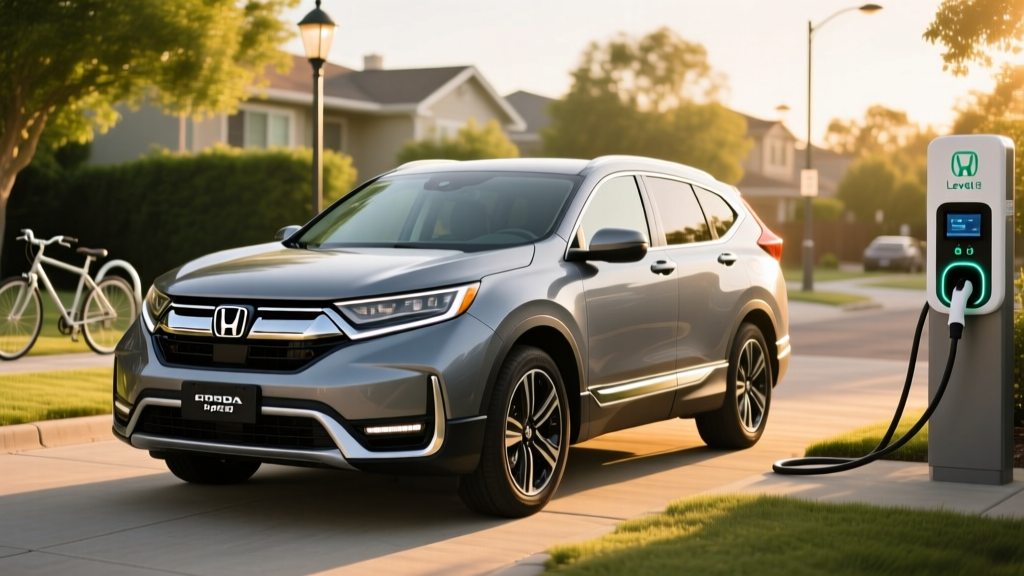
The 2024 Honda CR-V Hybrid targets buyers who want crossover utility and strong fuel economy without plugging in. It's not a plug-in hybrid (PHEV) and not a battery-electric vehicle (BEV) — it's a conventional self-charging hybrid (HEV) that uses regenerative braking and its gasoline engine to keep a small battery topped up. For the 2024 model year, Honda made the two-motor hybrid powertrain the volume play, offering it on the Sport, Sport-L, and Sport Touring trims. The result is a compact SUV that returns up to 40 MPG combined EPA while delivering 204 horsepower.
This guide covers the 2024 CR-V Hybrid's real-world efficiency, how it stacks up against PHEV alternatives like the Toyota RAV4 Prime, whether it qualifies for any federal tax credits, and who should choose it over a full EV or a gas-only compact SUV.
HEV vs. PHEV: Why the CR-V Hybrid Is Not a Plug-In
A common point of confusion is whether the CR-V Hybrid needs to be plugged in. It does not. Honda currently does not offer a plug-in hybrid (PHEV) version of the CR-V in the United States. The 2024 CR-V Hybrid is a conventional hybrid electric vehicle (HEV). Its 1.3 kWh lithium-ion battery pack charges exclusively through regenerative braking and the onboard 2.0-liter gasoline engine. You fuel it at a gas station like any other car.
| Feature | HEV (2024 CR-V Hybrid) | PHEV (e.g., RAV4 Prime) | BEV (e.g., Tesla Model Y) |
|---|---|---|---|
| Plug-in charging required? | No | Yes (optional but recommended) | Yes (mandatory) |
| Battery size | ~1.3 kWh | ~18.1 kWh | 60–82 kWh |
| Electric-only range | ~1 mile at low speed | ~42 miles EPA | 250–330 miles EPA |
| Fuel type | Gasoline only | Gasoline + electricity | Electricity only |
| Federal tax credit (§30D) | Not eligible | Up to $7,500 if eligible | Up to $7,500 if eligible |
| Home charger needed? | No | Recommended (Level 2) | Essential (Level 2) |
If you want electric-only commuting in a Honda, the closest option is the discontinued Clarity PHEV (last sold in 2022). Honda's current electrified U.S. lineup leans HEV for the CR-V, Accord, and Civic, with no PHEV offerings as of the 2024 model year.
Fuel Economy: EPA Ratings and Real-World MPG
The 2024 CR-V Hybrid's headline number is its EPA-estimated fuel economy. Front-wheel-drive (FWD) models achieve the highest ratings; all-wheel-drive (AWD) trims sacrifice 1–2 MPG across the board. Here is the full breakdown from fueleconomy.gov:
| Drivetrain | City MPG | Highway MPG | Combined MPG | Annual Fuel Cost* |
|---|---|---|---|---|
| FWD (Sport, Sport-L) | 43 | 36 | 40 | ~$1,500 |
| AWD (Sport, Sport-L, Sport Touring) | 40 | 34 | 37 | ~$1,650 |
*Based on 15,000 miles/year at $3.50/gallon regular unleaded. Actual costs vary by region and driving habits.
Real-World MPG: What Owners Actually See
Honda's two-motor hybrid system excels in city driving, where the electric motor handles most low-speed propulsion and the engine acts primarily as a generator. In real-world ownership, many drivers report exceeding the EPA city estimate — a trait common to series-parallel hybrids. On aggregated owner forums and Fuelly tracking, 2024 CR-V Hybrid owners average between 36–42 MPG combined depending on climate and driving mix.
Highway driving is where the advantage narrows. At sustained 70–80 mph speeds, the CR-V Hybrid operates mostly on its gasoline engine with the electric motor providing only supplemental torque. Expect 33–36 MPG highway in real-world conditions, slightly below the EPA sticker. Cold weather (below 35°F) can reduce combined fuel economy by 5–10%, as the engine runs more frequently to provide cabin heat and maintain battery temperature.
Powertrain Specs: How Honda's Two-Motor Hybrid Works
The 2024 CR-V Hybrid uses Honda's fourth-generation two-motor hybrid system. Unlike Toyota's planetary-gear power-split device, Honda's system uses a clutch-based arrangement that switches between EV drive, hybrid drive (engine generates electricity for the motor), and engine drive (direct mechanical connection at highway speeds).
| Specification | Detail |
|---|---|
| Engine | 2.0L Atkinson-cycle inline-4 |
| Engine output | 145 hp @ 6,100 rpm / 134 lb-ft @ 4,500 rpm |
| Drive motor output | 181 hp / 247 lb-ft |
| Combined system output | 204 hp / 247 lb-ft |
| Transmission | Direct-drive (no traditional gears; fixed-ratio clutch) |
| Hybrid battery | ~1.3 kWh lithium-ion |
| 0–60 mph | ~7.6 seconds (AWD) |
| Towing capacity | 1,000 lbs |
| Drivetrain options | FWD or Real-Time AWD |
The drive motor's 247 lb-ft of torque is available from zero RPM, giving the CR-V Hybrid strong off-the-line acceleration that feels punchier than its 7.6-second 0–60 time suggests. The engine only directly drives the wheels above roughly 50 mph via a lock-up clutch, which improves highway efficiency by eliminating the electrical conversion step.
Pricing, Trims, and Tax Credit Eligibility
The 2024 CR-V Hybrid is offered in three trims, all positioned above the base gas-only LX. Pricing starts at $33,950 for the Sport FWD and tops out at $40,850 for the Sport Touring AWD (MSRP before destination).
| Trim | Drivetrain | MSRP | Key Features |
|---|---|---|---|
| Sport | FWD | $33,950 | 18" wheels, 7" touchscreen, wireless CarPlay/Android Auto |
| Sport | AWD | $35,450 | Same as FWD + Real-Time AWD |
| Sport-L | FWD | $36,550 | Leather seats, 9" touchscreen, wireless charging, power liftgate |
| Sport-L | AWD | $38,050 | Same as FWD + Real-Time AWD |
| Sport Touring | AWD only | $40,850 | Bose 12-speaker audio, heated rear seats, panoramic moonroof, navigation |
All prices are base MSRP and exclude the $1,350 destination charge.
Does the 2024 CR-V Hybrid Qualify for a Federal Tax Credit?
No. The 2024 Honda CR-V Hybrid does not qualify for the IRS §30D Clean Vehicle Credit. That credit — up to $7,500 — applies exclusively to plug-in electric vehicles (BEVs and PHEVs) that meet battery sourcing, critical mineral, MSRP cap, and buyer income requirements. Because the CR-V Hybrid is a conventional HEV with no plug-in capability, it is ineligible for §30D.
- ❌ No federal plug-in vehicle tax credit (HEV, not PHEV/BEV)
- ❌ No point-of-sale transfer option
- ✅ Possible state-level hybrid rebates (check your state energy office)
- ✅ Potential fuel savings vs. gas-only CR-V (~$400–$600/year at 15K miles)
For current §30D eligibility rules, consult the IRS Clean Vehicle Credits page.
Reliability and Hybrid Battery Warranty
Honda's hybrid powertrain has a solid reliability track record. The fourth-generation two-motor system has been in production since 2020 (debuted in the Accord Hybrid) and carries forward lessons from earlier IMA and i-MMD systems. The CR-V Hybrid has earned strong ratings from major testing bodies, including a TOP SAFETY PICK award from IIHS for models built after March 2024.
| Component | Coverage |
|---|---|
| New vehicle (bumper-to-bumper) | 3 years / 36,000 miles |
| Powertrain | 5 years / 60,000 miles |
| Hybrid battery (high-voltage) | 8 years / 100,000 miles (10 years / 150,000 miles in CARB states) |
| Hybrid system components | 8 years / 100,000 miles |
Hybrid Battery Replacement Cost
If the high-voltage battery fails outside of warranty, replacement cost for the CR-V Hybrid's 1.3 kWh pack typically ranges from $2,000 to $4,000 including labor at a Honda dealer. This is substantially less than a PHEV or BEV battery replacement because the pack is small. In practice, Honda hybrid batteries have shown strong longevity — many owners of earlier-generation Accord and CR-V Hybrids report 150,000+ miles with minimal degradation. The battery's modest capacity means it cycles less aggressively than a PHEV or BEV pack, which reduces wear.
For comparison, a Toyota RAV4 Prime PHEV battery replacement runs $6,000–$8,000, while a Tesla Model Y battery replacement can exceed $12,000–$16,000.
Who Should Buy the 2024 CR-V Hybrid vs. a PHEV or Full EV?
Choose the 2024 CR-V Hybrid if:
- You don't have access to home or workplace charging (apartment, street parking)
- You want 37–40 MPG without changing your fueling habits
- Your budget is $34,000–$42,000 and you want a well-equipped compact SUV
- You regularly take long road trips and don't want to plan around charging stops
- You want proven Honda reliability with an 8-year hybrid battery warranty
Choose a PHEV (e.g., Toyota RAV4 Prime, Hyundai Tucson PHEV) if:
- You have Level 2 home charging and a commute under 40 miles round-trip
- You want to drive mostly on electricity for daily errands but need gas for road trips
- You qualify for the $7,500 federal tax credit (income and sourcing rules apply)
- You're willing to pay a $5,000–$8,000 price premium over an HEV
Choose a full BEV (e.g., Tesla Model Y, Hyundai Ioniq 5) if:
- You have reliable home Level 2 charging
- You want zero tailpipe emissions and minimal maintenance
- Your daily driving is under 250 miles and you can plan road-trip charging
- You want to take advantage of the $7,500 §30D credit and lower per-mile energy costs
Pros and Cons at a Glance
Pros
- 40 MPG combined (FWD) — best-in-class for non-PHEV compact SUVs
- Strong 247 lb-ft torque from electric motor; responsive city driving
- No plug-in required — fuel at any gas station
- Spacious interior with 36.3 cu ft cargo (rear seats up), 76.5 cu ft (folded)
- 8-year/100,000-mile hybrid battery warranty (10/150K in CARB states)
- IIHS TOP SAFETY PICK (post-March 2024 build)
Cons
- No PHEV variant available — no electric-only commuting
- No federal tax credit eligibility
- Highway MPG drops to 34 (AWD); less advantage at sustained speed
- 1,000-lb towing capacity — lowest in the segment
- Sport Touring AWD pushes $42,200 with destination — steep for a compact SUV
- Infotainment (7" base screen) feels dated vs. competitors
Frequently Asked Questions
How many MPG does the 2024 CR-V Hybrid actually get?
The EPA rates the FWD model at 43 city / 36 highway / 40 combined MPG, and the AWD at 40 city / 34 highway / 37 combined MPG. Real-world owners typically report 36–42 MPG combined, with city driving often exceeding the EPA estimate and highway driving falling slightly short.
Can I plug in the 2024 CR-V Hybrid to charge?
No. The 2024 CR-V Hybrid is a conventional hybrid (HEV), not a plug-in hybrid (PHEV). It has no charging port. The battery charges through regenerative braking and the gasoline engine. If you want plug-in capability in a similar vehicle, consider the Toyota RAV4 Prime (42 miles electric-only) or Hyundai Tucson PHEV (33 miles electric-only).
Is the CR-V Hybrid reliable?
Honda's hybrid system has a strong reliability record, and the CR-V Hybrid carries an 8-year/100,000-mile warranty on the hybrid battery (10 years/150,000 miles in CARB states like California, New York, and others). Out-of-warranty battery replacement runs $2,000–$4,000. The vehicle earned an IIHS TOP SAFETY PICK award for 2024.
Does the 2024 CR-V Hybrid qualify for any tax credit?
It does not qualify for the federal §30D Clean Vehicle Credit, which is limited to plug-in vehicles (BEVs and PHEVs). Some states offer modest hybrid incentives — check your state energy office or the AFDC state incentive database for current programs.
How does the CR-V Hybrid compare to the RAV4 Hybrid?
The Toyota RAV4 Hybrid (AWD standard) is EPA-rated at 41 MPG combined — 1 MPG above the CR-V Hybrid AWD. The RAV4 also offers a PHEV variant (RAV4 Prime, 42 miles electric-only) that the CR-V lacks. However, the CR-V Hybrid provides more cargo space (36.3 vs. 33.5 cu ft behind the rear seats) and a more refined ride quality. Both are strong choices; the RAV4 wins on fuel economy and PHEV availability, while the CR-V wins on interior practicality.
What is the top speed and acceleration of the CR-V Hybrid?
The 2024 CR-V Hybrid AWD accelerates from 0–60 mph in approximately 7.6 seconds. Top speed is electronically limited to approximately 115 mph. The 204 combined horsepower and 247 lb-ft of electric motor torque provide confident merging and passing performance.