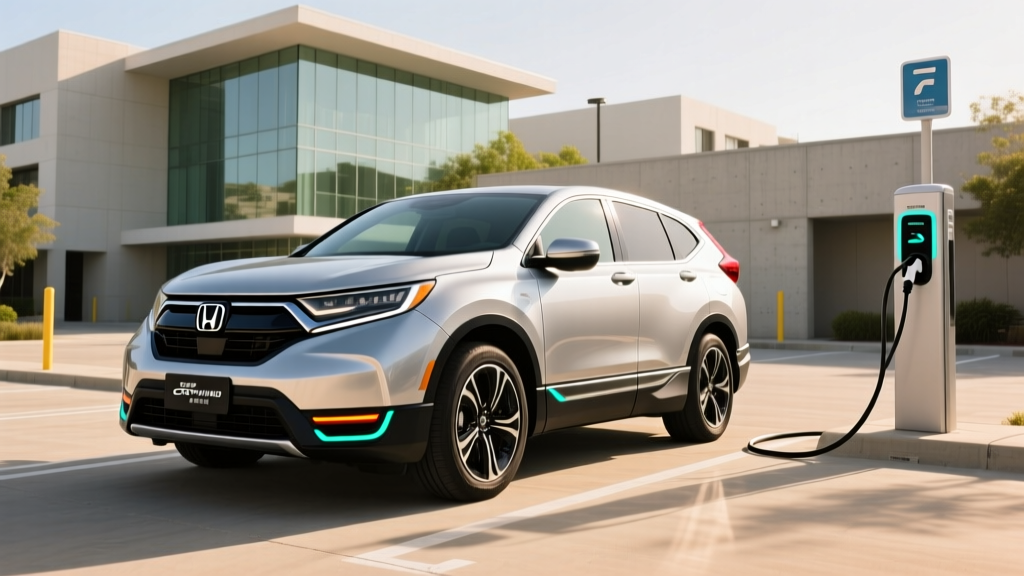
The 2022 Honda CR-V Hybrid at a Glance
The 2022 Honda CR-V Hybrid occupies a narrow but valuable lane: a conventional hybrid (HEV) compact SUV that never needs plugging in, yet returns fuel economy numbers that rival much smaller cars. Honda's two-motor hybrid system pairs a 2.0-liter Atkinson-cycle four-cylinder with dual electric motors for a combined output of 212 horsepower — enough to make this the quickest CR-V variant Honda offered that model year.
With the CR-V receiving a full redesign for 2023, the 2022 model year represents the final iteration of the fifth-generation platform. That matters for used-car shoppers in 2026: you're buying a proven, well-debugged powertrain at depreciated prices. Here's exactly what you're getting.
| Spec | Value |
|---|---|
| Powertrain | 2.0L Atkinson I-4 + dual electric motors (HEV) |
| Combined Horsepower | 212 hp |
| Drivetrain | AWD standard (all trims) |
| EPA Fuel Economy | 40 city / 35 highway / 38 combined MPG |
| Fuel Tank | 14.0 gallons |
| Total Range | ~532 miles (EPA combined) |
| Cargo Volume | 33.0 cu ft (rear seats up) / 68.7 cu ft (folded) |
| 0–60 mph | ~7.8 seconds |
| Towing Capacity | 1,000 lbs |
| Hybrid Battery Warranty | 8 years / 100,000 miles (10 yr/150k in CARB states) |
| Original MSRP (2022) | $31,735–$37,935 |
Fuel Economy: EPA vs. Real-World MPG
The EPA rates the 2022 CR-V Hybrid at 40 city / 35 highway / 38 combined MPG across all trims (EX, EX-L, Touring). All-wheel drive is standard — there's no FWD hybrid variant, which simplifies the lineup but means highway numbers trail some FWD-only competitors.
| Driving Cycle | EPA MPG | Real-World Expectation |
|---|---|---|
| City | 40 MPG | 40–44 MPG (hybrid advantage) |
| Highway | 35 MPG | 32–34 MPG (70+ mph sustained) |
| Combined | 38 MPG | 35–40 MPG (mixed driving) |
| Cold Weather Combined | — | 30–34 MPG (winter penalty) |
For comparison, the gas-only 2022 CR-V AWD is rated at 27 city / 32 highway / 29 combined MPG. The hybrid delivers roughly 31% better combined fuel economy — a meaningful gap if you drive 12,000+ miles annually.
Hybrid vs. Plug-In Hybrid vs. Full EV: Where the CR-V Hybrid Fits
Honda did not offer a plug-in hybrid (PHEV) version of the CR-V in the U.S. market for the 2022 model year. The CR-V Hybrid is strictly a conventional hybrid (HEV) — it charges its small lithium-ion battery pack through regenerative braking and the gasoline engine. There is no plug, no electric-only driving mode, and no home charging requirement.
HEV vs. PHEV vs. BEV — Quick Distinction
- HEV (this vehicle): No plug. Small battery (~1–2 kWh usable). Motor assists the engine. Never drives on electricity alone for meaningful distances. Best for drivers without home charging access.
- PHEV: Has a plug. Larger battery (typically 12–20 kWh). Can drive 20–40 miles on electricity alone before the gas engine engages. Requires home or work charging to realize fuel savings.
- BEV (full EV): No gas engine. Large battery (60–100+ kWh). 200–400+ mile range. Requires reliable charging access (home Level 2 strongly recommended).
The 2022 CR-V Hybrid makes sense if you want better fuel economy without changing your refueling habits. You still visit gas stations — just less often. With a 14-gallon tank and 38 MPG combined, you'll refuel roughly every 530 miles instead of every 400.
Choose the CR-V Hybrid If:
- You lack home charging access (apartment, street parking)
- You want AWD with strong city fuel economy
- You drive 10,000–15,000 miles/year in mixed conditions
- You want a proven platform at used-car pricing
Look at a PHEV or BEV Instead If:
- You have reliable home Level 2 charging
- Your commute is under 30 miles (PHEV covers it on electricity)
- You want to eliminate or drastically reduce gas purchases
- You qualify for the federal §30D tax credit (up to $7,500 for new qualifying EVs/PHEVs)
Powertrain Deep Dive: How Honda's Two-Motor Hybrid Works
The 2022 CR-V Hybrid uses Honda's two-motor hybrid system, which operates differently from Toyota's planetary-gear hybrid synergy drive. Here's how it functions across driving modes:
- EV Drive: At low speeds and light loads, the propulsion motor drives the wheels using battery energy alone. The engine is off. This covers parking lots and gentle acceleration up to roughly 25 mph — but only for very short distances given the small battery.
- Hybrid Drive: The engine runs but does not drive the wheels directly. Instead, it spins a generator motor that produces electricity, which feeds the propulsion motor. Think of it as a series hybrid — the engine acts as a range-extending generator.
- Engine Drive: At steady highway speeds, a lock-up clutch connects the engine directly to the front wheels through a single fixed gear ratio. This is more efficient than running the generator-motor loop at constant speeds.
The result is seamless transitions that most drivers never notice. The 212 combined horsepower figure comes from the electric motor's peak output (the engine produces 143 hp and 129 lb-ft on its own, but the system is limited by the motor and battery discharge capability, not simple addition).
Acceleration is genuinely strong for the segment. The electric motor delivers instant torque from a stop, making the CR-V Hybrid feel quicker than its 7.8-second 0–60 time suggests in around-town driving. The engine can get vocal under hard acceleration — a common Atkinson-cycle trait — but it's well-isolated at cruising speeds.
Hybrid Battery Longevity, Warranty, and Replacement Cost
The lithium-ion battery pack in the 2022 CR-V Hybrid is relatively small — approximately 1.4 kWh total capacity, with roughly 0.9–1.0 kWh usable. Because the battery is small and the system avoids deep discharge cycles (the computer maintains a state-of-charge buffer, typically keeping the pack between 40–80% SoC), degradation is minimal compared to full EVs.
Real-world longevity data: Honda's two-motor hybrid system has been in production since 2014 (Accord Hybrid, then CR-V Hybrid starting 2020). Reports of premature battery failure are rare. The battery is air-cooled rather than liquid-cooled, which is a simpler design but theoretically less optimal in extreme heat. In practice, replacement before 150,000 miles is uncommon.
Out-of-warranty replacement cost: If the hybrid battery does fail outside the warranty window, expect a dealer replacement to cost between $2,000 and $4,000 including labor, based on current parts pricing for Honda's hybrid battery modules. Independent hybrid specialists may offer refurbished packs for $1,200–$2,500. This is significantly less than full EV battery replacements, which can exceed $10,000–$15,000.
Pricing, Depreciation, and Tax Credit Eligibility
When new, the 2022 CR-V Hybrid was offered in three trims:
- EX Hybrid: $31,735 MSRP
- EX-L Hybrid: $34,335 MSRP
- Touring Hybrid: $37,935 MSRP
As of 2026, the 2022 model year is four years old. Used-market pricing for a 2022 CR-V Hybrid typically falls between $22,000 and $30,000 depending on mileage, condition, and trim. Touring models with low miles command the top of that range; higher-mileage EX trims sit near the bottom.
The lack of a federal tax credit is a consideration if you're cross-shopping against a new PHEV or EV that does qualify. However, at used-market prices of $22K–$30K, the CR-V Hybrid often costs less out-of-pocket than a new hybrid competitor even after a credit is applied.
Pros and Cons: The Honest Verdict
Pros
- 38 MPG combined EPA; often exceeds 40 MPG in city driving
- 212 hp makes it the quickest 2022 CR-V variant
- AWD standard on every hybrid trim
- No plug required — zero lifestyle change from a gas car
- Strong reliability record; hybrid battery rarely fails early
- Excellent cargo space (33.0 cu ft) for the compact SUV class
- Proven 5th-gen platform at depreciated used prices
Cons
- Highway MPG drops to ~32–34 at sustained 70+ mph
- No PHEV option — cannot drive on electricity alone
- Engine drones under hard acceleration (Atkinson-cycle trait)
- Towing limited to 1,000 lbs (gas CR-V AWD: 1,500 lbs)
- No federal tax credit eligibility
- Infotainment feels dated vs. 2023+ redesign
- Air-cooled battery less ideal in extreme desert heat
2022 Honda CR-V Hybrid FAQ
How many MPG does the 2022 Honda CR-V Hybrid get?
The EPA rates it at 40 city / 35 highway / 38 combined MPG. In real-world city driving, many owners report 40–44 MPG thanks to regenerative braking. Highway cruising at 70+ mph typically returns 32–34 MPG. Cold weather reduces combined economy to roughly 30–34 MPG.
Does the 2022 CR-V Hybrid need to be plugged in?
No. This is a conventional hybrid (HEV), not a plug-in hybrid (PHEV). The battery charges through regenerative braking and the gasoline engine. You refuel only at gas stations — no charging cable, no home charger, no public charging required.
How far can the 2022 CR-V Hybrid go on electric only?
Not far. The hybrid system can propel the vehicle on electric power alone at very low speeds (under ~25 mph) for brief distances — typically under one mile. There is no meaningful electric-only range. If electric-only commuting is a priority, look at a PHEV like the Toyota RAV4 Prime (42 miles electric-only) or a full EV.
Is the 2022 CR-V Hybrid reliable?
Honda's two-motor hybrid system has been in production since 2014 and has a strong reliability track record. The 2022 model year benefits from several years of refinement. The hybrid battery is warrantied for 8 years/100,000 miles (10 years/150,000 in CARB states). Out-of-warranty battery replacement costs $2,000–$4,000, but premature failure is uncommon.
Does the 2022 CR-V Hybrid qualify for any tax credit?
No federal tax credit applies. The IRS §30D credit is limited to plug-in vehicles (BEVs and PHEVs) meeting specific battery sourcing, MSRP, and income requirements. Conventional hybrids are excluded. Check your state or local utility for possible hybrid rebates — some jurisdictions offer $250–$1,000 incentives.
Should I buy the 2022 CR-V Hybrid or wait for a newer model?
The 2023+ CR-V Hybrid uses a revised two-motor system with slightly more torque and a marginally updated interior. However, the 2022 model offers strong value at used-market prices ($22K–$30K) with a proven platform. If you want the latest tech and are willing to pay new-car prices ($35K+), the newer generation is worth considering. If value and fuel economy are your priorities, the 2022 is a smart buy.
How does the CR-V Hybrid compare to the Toyota RAV4 Hybrid?
The 2022 RAV4 Hybrid is rated at 41 city / 38 highway / 40 combined MPG — slightly better, especially on the highway. The RAV4 also offers a PHEV variant (RAV4 Prime, 42 miles electric-only). The CR-V Hybrid counters with more horsepower (212 vs. 219 — comparable), slightly more cargo space, and a quieter cabin at cruise. Both are strong choices; the RAV4 edges ahead on highway efficiency and PHEV availability, while the CR-V offers a more refined driving experience. Check fueleconomy.gov side-by-side for detailed comparison data.