Quick Verdict: The TrailSport Hybrid Balances Dirt Roads and Fuel Bills
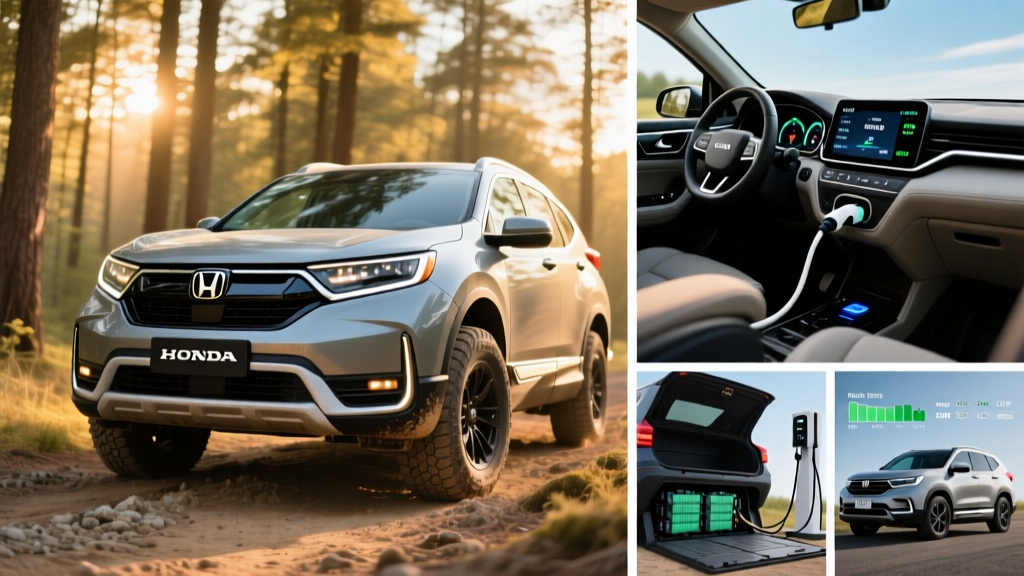
The 2026 Honda CR-V TrailSport Hybrid occupies a specific niche: buyers who want the rugged styling and mild off-road hardware of the TrailSport trim without the fuel-economy penalty that usually accompanies all-terrain SUVs. Honda pairs its proven two-motor hybrid system with standard all-wheel drive, delivering an EPA-estimated 40 MPG combined — a figure that makes the TrailSport Hybrid one of the most efficient adventure-oriented compact SUVs on the market.
This is a conventional hybrid (HEV), not a plug-in hybrid (PHEV). You never plug it in. The system recovers energy through regenerative braking and the gasoline engine to keep the small lithium-ion battery charged. If you're looking for electric-only driving range, you'll want to look at PHEVs like the Toyota RAV4 Prime or the CR-V's own sibling markets — but Honda does not currently offer a CR-V PHEV in the United States.
| Spec | Value |
|---|---|
| Powertrain | 2.0L Atkinson-cycle 4-cyl + 2 electric motors |
| Combined Horsepower | 204 HP |
| Combined Torque | 247 lb-ft (electric motor peak) |
| Drivetrain | AWD (standard, real-time with torque vectoring) |
| EPA MPG (City / Hwy / Combined) | 40 / 34 / 37 (AWD TrailSport) |
| Fuel Tank | 14.0 gallons |
| Total Range | ~518 miles (combined EPA) |
| 0–60 mph | ~7.8 seconds (estimated) |
| Ground Clearance | 8.3 inches |
| Towing Capacity | 1,000 lbs |
| Cargo Volume (behind rear seats) | 39.3 cu ft |
| Base MSRP (TrailSport Hybrid) | ~$40,850 (est.) |
| Federal Tax Credit (§30D) | Not eligible (HEV, not PHEV/BEV) |
| Hybrid Battery Warranty | 8 years / 100,000 miles |
HEV vs. PHEV: Where the TrailSport Hybrid Fits
Before diving deeper, it's essential to understand the distinction, because buyer confusion here is common:
| Feature | HEV (TrailSport Hybrid) | PHEV (e.g., RAV4 Prime) |
|---|---|---|
| Plug in to charge? | No — self-charging via engine & regen | Yes — plug in for electric-only miles |
| Electric-only range | None (electric motor assists at low speeds) | Typically 30–45 miles |
| Battery size | ~1.1 kWh (small, buffer-style) | 15–20 kWh (larger, usable capacity) |
| Fuel economy after battery depleted | Full hybrid MPG always available | Drops to hybrid-only MPG (~38–40) |
| Federal tax credit (§30D) | Not eligible | Up to $7,500 if eligible |
| Best for | No home charging access; want simplicity | Home charging available; short commutes |
The 2026 CR-V TrailSport Hybrid is firmly an HEV. Honda's fourth-generation two-motor hybrid system uses a 2.0-liter Atkinson-cycle engine primarily as a generator, with the electric motors doing most of the actual propulsion. At highway speeds, the engine can mechanically connect to the wheels via a lock-up clutch for efficiency. This architecture means you get electric-motor responsiveness around town without ever needing a charger or changing your fueling habits.
Fuel Economy: EPA Numbers and Real-World Expectations
| Driving Condition | EPA Estimate | Real-World Expectation |
|---|---|---|
| City | 40 MPG | 38–43 MPG (hybrids often exceed EPA in stop-and-go) |
| Highway | 34 MPG | 30–33 MPG (aerodynamic drag, sustained 70+ mph) |
| Combined | 37 MPG | 34–38 MPG (mixed driving) |
The TrailSport Hybrid's EPA ratings are slightly lower than the standard CR-V Sport Hybrid (which achieves up to 43/36/40 MPG city/highway/combined in FWD). The difference comes from the TrailSport's all-terrain tires, increased ride height (8.3 inches of ground clearance vs. 8.0), and standard AWD system — all of which add rolling resistance and weight.
Based on fueleconomy.gov data and owner-reported averages for the current-generation CR-V Hybrid AWD, here's what to expect in practice:
- City and suburban driving: Hybrids shine here. Expect 38–43 MPG. The electric motor handles low-speed propulsion, and regenerative braking recaptures energy at every stop. Many owners report beating the EPA city estimate.
- Highway cruising (70–75 mph): This is where the TrailSport Hybrid gives back some efficiency. The boxy SUV shape and all-terrain tires create more drag and noise. Expect 30–33 MPG on sustained interstate drives.
- Cold weather (below 30°F): The gasoline engine runs more frequently to provide cabin heat and maintain battery temperature. Expect a 10–15% reduction, bringing combined figures to roughly 30–33 MPG in winter conditions.
- Light off-road / gravel: Low-speed trail driving uses the electric motors heavily, which is efficient, but the AWD system's mechanical losses and soft-surface rolling resistance will drop economy to the mid-20s depending on terrain.
With a 14.0-gallon fuel tank, the TrailSport Hybrid delivers roughly 518 miles of total range under combined EPA conditions — enough for most road trips without a fuel stop.
Powertrain and Performance: 204 HP with Electric-Motor Torque
Honda's fourth-generation hybrid system in the 2026 CR-V TrailSport Hybrid pairs a 2.0-liter direct-injected Atkinson-cycle four-cylinder engine with two electric motors mounted in the transmission housing. Combined system output is 204 horsepower, with peak torque of 247 lb-ft coming from the electric motors.
The driving experience differs from a conventional gas-powered SUV in several ways:
- Off-the-line acceleration: Electric motors deliver peak torque from 0 RPM, giving the TrailSport Hybrid responsive city and suburban acceleration. The 0–60 mph time of approximately 7.8 seconds is adequate for merging and passing, though not sporty.
- Highway passing: The engine engages more audibly under hard acceleration, and the e-CVT (which isn't a traditional belt-and-pulley CVT but rather a fixed-gear ratio system with electric motor modulation) can create a droning sensation under full throttle.
- Trail capability: The TrailSport trim adds all-terrain tires (typically 235/60R18), revised damper tuning, and underbody skid plates. The AWD system can send up to 50% of torque to the rear wheels and includes a torque-vectoring function. Ground clearance of 8.3 inches handles fire roads, snow-covered driveways, and moderate trail obstacles — but this is not a rock crawler.
Towing capacity is limited to 1,000 pounds, which covers a small utility trailer or a pair of dirt bikes but rules out most camping trailers. If you need serious towing, a body-on-frame SUV or a truck remains the right tool.
Pricing, Trims, and Tax Credit Eligibility
The 2026 Honda CR-V TrailSport Hybrid carries an estimated starting MSRP of approximately $40,850, including destination charges. This positions it between the Sport Touring Hybrid (~$41,000) and the non-hybrid TrailSport (~$38,000).
Pros
- 40 MPG city from an AWD adventure SUV
- Standard AWD with torque vectoring — no FWD penalty trim
- Proven hybrid system with strong reliability record
- 8.3 inches of ground clearance for real trail use
- Spacious cargo area (39.3 cu ft) with low load floor
- Honda Sensing suite standard (adaptive cruise, lane-keeping, AEB)
Cons
- Highway MPG drops to low 30s at 75 mph
- No plug-in hybrid option for electric-only commuting
- Towing limited to 1,000 lbs
- No federal tax credit eligibility (HEV)
- All-terrain tires generate more road noise than touring tires
- Base price approaching $41K before options
Does the CR-V TrailSport Hybrid qualify for a federal tax credit?
No. Under current IRS §30D rules, the federal clean vehicle credit applies only to battery electric vehicles (BEVs) and plug-in hybrid electric vehicles (PHEVs) that meet battery capacity, critical-mineral sourcing, and MSRP/income thresholds. Conventional hybrids like the CR-V TrailSport Hybrid do not qualify for the §30D credit.
Some states offer their own incentives for hybrid vehicles, though these are less common than EV incentives. Check your state's energy or environmental agency website for current programs. A few states have offered hybrid rebates in the past, but most have shifted incentive funding toward full EVs and PHEVs.
Battery Warranty, Reliability, and Replacement Cost
Honda Hybrid Battery Warranty
Coverage: 8 years or 100,000 miles (whichever comes first) in most states. In CARB states (California, New York, Massachusetts, and others that follow California emissions standards), coverage extends to 10 years or 150,000 miles.
What's covered: Defects in the hybrid battery pack and related components. If the battery's capacity drops below a functional threshold during the warranty period, Honda will repair or replace it at no cost.
Honda's hybrid system has earned a strong reliability reputation over multiple generations. The CR-V Hybrid uses a relatively small lithium-ion battery pack (~1.1 kWh) that operates within a narrow state-of-charge window — typically between 40% and 80%. This partial-cycling strategy significantly reduces degradation compared to the deep charge-discharge cycles that BEV batteries endure.
Real-world longevity data: Honda hybrids from the 2014+ era (including the Accord Hybrid and CR-V Hybrid) have demonstrated battery longevity well beyond 150,000 miles in owner forums and fleet data. The small battery, conservative charge management, and robust thermal design contribute to this track record.
Out-of-warranty replacement cost: If the hybrid battery does require replacement after the warranty expires, expect a cost in the range of $2,000 to $4,000 for parts and labor at a Honda dealer. Independent hybrid specialists may offer refurbished or reconditioned packs for $1,500 to $2,500. This is substantially less than a full EV battery replacement, which can exceed $10,000.
For context, the hybrid battery in the TrailSport Hybrid is far less stressed than an EV battery. It doesn't need to store 300 miles of range — it simply buffers energy between the engine and the electric motors. This design philosophy is a key reason hybrid batteries routinely outlast their warranty periods without issues.
Hybrid vs. PHEV vs. Full EV: Which Powertrain Fits Your Life?
Choose the CR-V TrailSport Hybrid (HEV) if:
- You don't have access to home or workplace charging
- You want a single vehicle for daily commuting, road trips, and light trails
- You value simplicity — no plugs, no range planning, no charging apps
- Your annual mileage is moderate to high (15,000+ miles) and you want consistent MPG
- You want to avoid the upfront price premium of a PHEV or BEV
Choose a PHEV (e.g., Toyota RAV4 Prime, Hyundai Tucson PHEV) if:
- You have Level 2 home charging and a commute under 40 miles round-trip
- You want to drive mostly on electricity weekdays but need gas flexibility for weekends
- You want to qualify for the up-to-$7,500 federal tax credit (subject to IRS §30D eligibility)
Choose a full EV (e.g., Hyundai Ioniq 5, Tesla Model Y, Ford Mustang Mach-E) if:
- You have reliable home Level 2 charging
- Your typical trips fall within 200–300 miles (or you're willing to plan DC fast-charging stops)
- You want zero tailpipe emissions and the lowest per-mile fuel cost
- You want access to the full $7,500 federal tax credit (eligibility permitting)
The TrailSport Hybrid's strongest argument is its flexibility. It doesn't require any infrastructure changes, doesn't lose range in cold weather the way EVs do, and doesn't need route planning for long trips. For buyers in rural areas, apartment dwellers without charging access, or those who regularly drive in extreme cold, the HEV powertrain eliminates the practical barriers that still accompany EV ownership in 2026.
Off-Road Capability: What the TrailSport Badge Actually Adds
The TrailSport trim isn't just an appearance package. Compared to the standard CR-V Hybrid trims, the TrailSport Hybrid adds:
- All-terrain tires: Typically 235/60R18 with a more aggressive tread pattern for gravel, mud, and snow traction
- Increased ground clearance: 8.3 inches (vs. 8.0 on other trims), helping clear rocks, ruts, and deep snow
- Revised suspension tuning: Damper calibration optimized for uneven surfaces while maintaining on-road composure
- Underbody protection: Skid plates for the engine and fuel tank areas
- AWD torque vectoring: The rear axle can distribute torque side-to-side for improved traction on loose surfaces
- Trail-specific drive mode: Adjusts throttle response, transmission mapping, and AWD behavior for off-road conditions
These additions make the TrailSport Hybrid genuinely capable on Forest Service roads, snow-covered passes, and maintained dirt trails. It won't replace a Jeep Wrangler or Toyota 4Runner for serious rock crawling, but it handles the "last mile" to a trailhead or campsite with confidence — while returning 37 MPG combined on the paved drive home.
Ownership Costs: Fuel Savings vs. the Gas-Only CR-V
How much does the TrailSport Hybrid's efficiency save you compared to a gas-only compact SUV? Using national average fuel prices ($3.40/gallon as of early 2026) and 15,000 miles per year:
| Vehicle | Combined MPG | Gallons/Year | Annual Fuel Cost |
|---|---|---|---|
| CR-V TrailSport Hybrid (AWD) | 37 MPG | 405 | ~$1,377 |
| CR-V EX AWD (gas, 1.5T) | 28 MPG | 536 | ~$1,822 |
| Toyota RAV4 AWD (gas) | 30 MPG | 500 | ~$1,700 |
| Subaru Outback AWD (gas) | 28 MPG | 536 | ~$1,822 |
The TrailSport Hybrid saves roughly $400–$450 per year in fuel compared to a comparable gas-only AWD SUV. Over a typical 5-year ownership period, that's approximately $2,000–$2,250 in fuel savings — partially offsetting the hybrid's higher purchase price.
Insurance costs for the CR-V Hybrid are generally in line with the gas-powered CR-V, as insurers factor in the vehicle's safety ratings and repair costs rather than powertrain type. According to IIHS, the current-generation CR-V has earned top safety ratings, which helps keep premiums reasonable.
Frequently Asked Questions
How many MPG does the 2026 Honda CR-V TrailSport Hybrid get?
The EPA rates the CR-V TrailSport Hybrid AWD at 40 MPG city, 34 MPG highway, and 37 MPG combined. In real-world driving, expect 38–43 MPG in city conditions (hybrids often exceed EPA city estimates thanks to regenerative braking) and 30–33 MPG on sustained highway drives at 70+ mph. Cold weather can reduce combined economy by 10–15%.
Is the CR-V TrailSport Hybrid a plug-in hybrid?
No. The CR-V TrailSport Hybrid is a conventional hybrid (HEV). It charges its own battery through regenerative braking and the gasoline engine. You never plug it in. Honda does not currently offer a plug-in hybrid (PHEV) version of the CR-V in the United States.
Does the CR-V TrailSport Hybrid qualify for a federal tax credit?
No. The federal §30D clean vehicle credit applies only to battery electric vehicles (BEVs) and plug-in hybrids (PHEVs) that meet specific battery sourcing, MSRP, and buyer income requirements. Conventional hybrids are not eligible. Check your state's energy agency for any state-level hybrid incentives, though these are increasingly rare.
How reliable is the Honda hybrid system, and what does battery replacement cost?
Honda's hybrid system has demonstrated strong reliability across multiple model lines and generations. The hybrid battery is warrantied for 8 years/100,000 miles (10 years/150,000 miles in CARB states). Out-of-warranty replacement costs typically range from $2,000 to $4,000 at a dealer, or $1,500 to $2,500 through independent hybrid specialists. The small battery and conservative charge management mean most hybrid batteries outlast their warranty periods without issues.
Can the CR-V TrailSport Hybrid handle real off-road trails?
Yes, for moderate off-road use. With 8.3 inches of ground clearance, all-terrain tires, skid plates, and AWD with torque vectoring, the TrailSport Hybrid handles Forest Service roads, gravel, snow, mud, and maintained dirt trails competently. It is not designed for rock crawling or extreme terrain — think fire roads and trailhead access, not Moab.
How does the TrailSport Hybrid compare to the RAV4 Hybrid Woodland Edition?
Both target the adventure-hybrid niche. The Toyota RAV4 Hybrid (LE AWD) achieves 41/38/39 MPG EPA and starts around $35,000. The TrailSport Hybrid offers slightly more ground clearance, a more refined interior, and Honda's driving dynamics, but at a higher starting price (~$40,850). The RAV4 Prime PHEV offers 42 miles of electric-only range and potential tax credit eligibility but starts above $45,000. Your choice depends on budget, whether you have home charging, and brand preference.
What is the towing capacity of the CR-V TrailSport Hybrid?
The CR-V TrailSport Hybrid is rated to tow up to 1,000 pounds. This covers a small utility trailer, bike rack trailer, or light cargo trailer but is insufficient for most boat or camping trailers. If towing is a priority, consider a truck or a larger body-on-frame SUV.