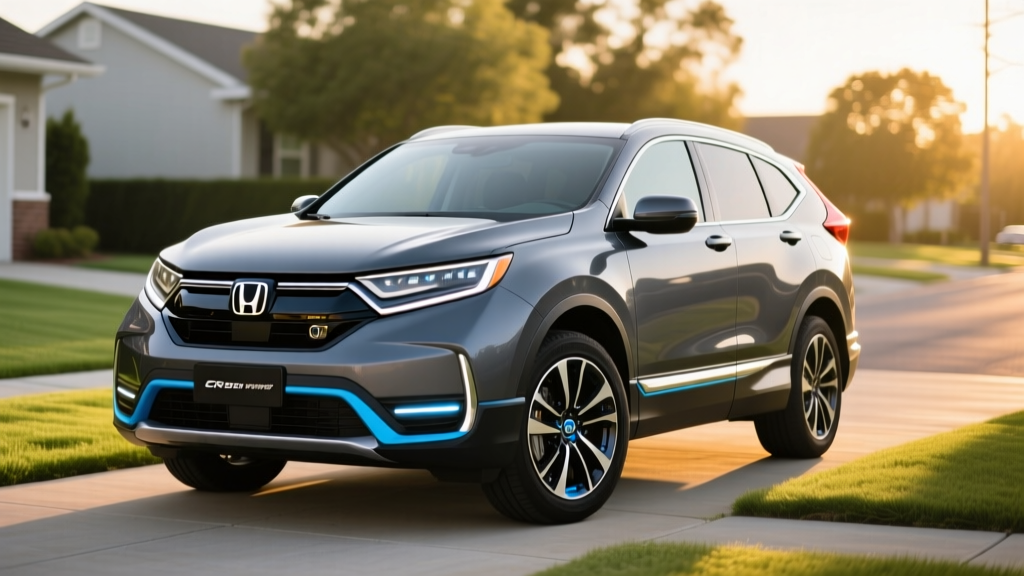
The Honda CR-V Hybrid has quietly become one of the most popular electrified compact SUVs in America, and the Sport-L trim sits at a compelling sweet spot: leather interior, wireless connectivity, and Honda's proven two-motor hybrid system — all without the premium of the top-tier Sport Touring. If you've been searching for the Honda CR-V Sport-L Hybrid and wondering whether its real-world fuel economy matches the EPA sticker, how the powertrain actually works, or whether it makes more sense than a plug-in hybrid or full EV, this guide breaks down every number that matters.
Let's be clear up front: the CR-V Sport-L Hybrid is a conventional hybrid (HEV), not a plug-in hybrid (PHEV). You never plug it in. It generates and recovers all its own electricity through regenerative braking and its gasoline engine. That distinction matters enormously for ownership expectations, and we'll cover exactly what it means for your daily driving and wallet.
2026 Honda CR-V Sport-L Hybrid: Core Specifications
| Specification | Value |
|---|---|
| Powertrain | 2.0L DOHC 4-cyl + two-motor hybrid system |
| Combined Horsepower | 204 hp |
| Combined Torque | 247 lb-ft (electric motor) |
| Transmission | e-CVT (direct-drive, no fixed gears) |
| Drivetrain (Sport-L AWD) | Real Time AWD™ |
| EPA Fuel Economy (AWD) | 40 city / 34 highway / 37 combined MPG |
| EPA Fuel Economy (FWD) | 43 city / 36 highway / 40 combined MPG |
| Fuel Tank Capacity | 14.0 gallons |
| Total Driving Range (AWD est.) | ~518 miles |
| 0–60 mph (est.) | ~7.8 seconds |
| Cargo Volume (behind rear seats) | 36.3 cu ft |
| Cargo Volume (rear seats folded) | 76.5 cu ft |
| Towing Capacity | 1,000 lbs |
| Base MSRP (AWD) | ~$38,350 (incl. destination) |
| Federal Tax Credit (§30D) | Not eligible (HEV, not PHEV/BEV) |
| Hybrid Battery Warranty | 8 years / 100,000 miles |
Fuel Economy: EPA Ratings vs. Real-World MPG
Honda's two-motor hybrid system excels in stop-and-go driving, where the electric motor handles most low-speed propulsion and the 2.0L Atkinson-cycle engine acts primarily as a generator. This is why the city MPG rating significantly outpaces the highway number — the opposite of what you'd see in a conventional gas car.
| Drivetrain | City | Highway | Combined |
|---|---|---|---|
| FWD | 43 MPG | 36 MPG | 40 MPG |
| AWD | 40 MPG | 34 MPG | 37 MPG |
Source: fueleconomy.gov — EPA
In mixed suburban driving with moderate temperatures, most owners report 38–42 MPG combined with the AWD Sport-L — often meeting or slightly exceeding the EPA combined estimate. Highway-only trips at 75+ mph tend to yield 31–34 MPG, as the engine engages more directly and aerodynamic drag increases. In cold weather (below 30°F), expect a 3–5 MPG reduction as the engine runs more frequently for cabin heat and the battery operates less efficiently. City-heavy routes with frequent stops are where this hybrid shines brightest, routinely returning 42–45 MPG in warm conditions.
How the Two-Motor Hybrid Powertrain Works
Honda's hybrid system is fundamentally different from Toyota's planetary-gear approach. The CR-V Sport-L Hybrid uses a series-parallel two-motor architecture:
- Propulsion Motor (184 hp / 247 lb-ft): Drives the front wheels directly in most normal driving conditions, delivering smooth, electric-like acceleration from a stop.
- Generator Motor: Connected to the 2.0L Atkinson-cycle engine. At low and moderate speeds, the engine turns this generator to produce electricity that feeds the propulsion motor — the engine never mechanically drives the wheels in this mode.
- Lock-Up Clutch (highway mode): At sustained highway speeds (roughly 50–80 mph under light load), a clutch engages to connect the engine directly to the wheels, bypassing the electric conversion for better efficiency.
The result is a driving experience that feels more like an EV around town than a traditional hybrid, with seamless torque delivery and no gear hunting. The e-CVT designation is somewhat misleading — there are no belts, pulleys, or simulated gear steps. It's a direct-drive system with a single fixed reduction ratio for the electric motor.
HEV vs. PHEV vs. EV: Which Powertrain Fits Your Life?
A common question from CR-V shoppers: should you go conventional hybrid (HEV), plug-in hybrid (PHEV), or full battery-electric (BEV)? Here's how the Sport-L Hybrid compares to each path:
| Factor | CR-V Sport-L Hybrid (HEV) | Typical PHEV SUV | Typical BEV SUV |
|---|---|---|---|
| Plug-in Required? | No | Yes (for EV range) | Yes (always) |
| Electric-Only Range | 0 miles (motor assists only) | 25–40 miles | 250–330 miles |
| Total Range | ~518 miles | ~400–500 miles | 250–330 miles |
| Combined Efficiency | 37–40 MPG | 25–30 MPG (gas) / 80+ MPGe (electric) | 90–110 MPGe |
| Home Charging Needed? | No | Recommended (Level 2) | Essential (Level 2) |
| Federal Tax Credit (§30D) | Not eligible | Up to $7,500 (if qualified) | Up to $7,500 (if qualified) |
| Upfront Cost (typical) | $35,000–$42,000 | $40,000–$52,000 | $42,000–$58,000 |
| Best For | No home charging access, road trips, simplicity | Short commutes + home charging, occasional long trips | Home charging, daily commuting, lowest running cost |
- You don't have access to home or workplace charging (apartment, street parking)
- You regularly drive 300+ miles in a single day and don't want to plan charging stops
- You want better fuel economy without changing any habits — just fill up with gas
- Your budget is under $40,000 and you want AWD with leather
- You have a garage or driveway where you can install a Level 2 charger
- Your daily commute is under 35 miles round-trip (a PHEV covers it on electricity alone)
- You want the lowest possible per-mile fuel cost and qualify for the §30D tax credit
- You want to minimize tailpipe emissions in your neighborhood
Pricing, Trims, and Tax Credit Eligibility
The 2026 Honda CR-V Sport-L Hybrid carries an MSRP of approximately $38,350 with AWD (including destination charge). The FWD version, available in select markets, lists around $36,850. Key standard equipment on the Sport-L includes:
- Leather-trimmed seats with heated front seats
- Wireless Apple CarPlay and Android Auto
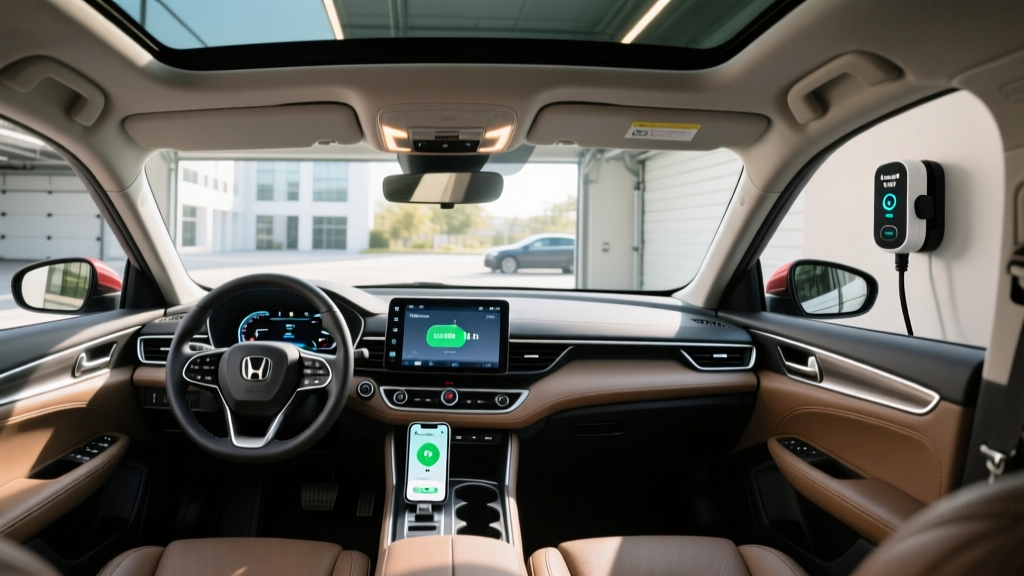
- 9-inch touchscreen with wireless phone charging pad
- Honda Sensing® suite (adaptive cruise, lane-keeping, collision mitigation, traffic sign recognition)
- Power moonroof
- 18-inch gloss black alloy wheels
- Hands-free power tailgate
Federal Tax Credit: The Hard Truth for HEVs
The Honda CR-V Sport-L Hybrid is a conventional hybrid (HEV). Under current IRS §30D rules, conventional hybrids do not qualify for the federal clean vehicle tax credit. The credit — up to $7,500 — is reserved for plug-in electric vehicles (BEVs) and plug-in hybrids (PHEVs) that meet battery capacity, critical-mineral sourcing, MSRP caps, and buyer income limits.
If the tax credit is a priority for your purchase, you'd need to look at PHEV alternatives (like the Toyota RAV4 Prime or Hyundai Tucson PHEV) or full EVs (like the Hyundai Ioniq 5 or Tesla Model Y). However, the CR-V Hybrid's lower base price often narrows the after-credit gap substantially, and it avoids the higher insurance premiums and charging infrastructure costs associated with plug-in vehicles.
State and Local Incentives
A handful of states offer modest rebates or HOV-lane access for conventional hybrids, but these programs are increasingly focused on PHEVs and BEVs. Check your state's energy office or department of environmental quality for current programs — eligibility and amounts vary by jurisdiction and change frequently.
Battery Warranty, Reliability, and Replacement Costs
Hybrid battery longevity is consistently the top concern among first-time hybrid buyers. Here's what the data shows for the CR-V Sport-L Hybrid:
- Coverage: 8 years / 100,000 miles (10 years / 150,000 miles in CARB states including CA, CT, ME, MA, NJ, NY, OR, RI, VT, WA)
- What's covered: Hybrid battery pack, power control unit, electric motors, and related hybrid-system components
- Capacity threshold: Honda warrants against abnormal degradation that causes a malfunction indicator or significant performance loss — there is no published percentage-retention guarantee as with BEVs
How Long Do Honda Hybrid Batteries Actually Last?
Honda's two-motor hybrid system uses a relatively small lithium-ion battery pack (approximately 1.06 kWh of total capacity). Because the system constantly cycles through shallow charge/discharge ranges — typically operating between 30% and 70% state of charge — the battery experiences far less stress than a full EV battery that regularly cycles from 10% to 90%.
Based on long-term data from earlier-generation Honda hybrids (Accord Hybrid, Insight, previous CR-V Hybrid), hybrid battery packs routinely last 150,000–200,000+ miles before significant degradation occurs. Many first-generation Insight and Civic Hybrid owners reported original batteries lasting the life of the vehicle.
Battery Replacement Cost
If the hybrid battery does require replacement outside of warranty, expect:
- New OEM battery pack: $2,000–$3,500 (parts only)
- Installed at a Honda dealer: $3,000–$4,500 (parts + labor)
- Refurbished/remanufactured options: $1,500–$2,500 installed
This is substantially less than a full EV battery replacement ($8,000–$20,000+) because the hybrid battery pack is far smaller. It's also a repair that most owners will never need during typical ownership.
Overall Reliability
Honda's hybrid powertrain has earned strong reliability marks from IIHS and consumer reliability surveys. The e-CVT design eliminates the mechanical complexity of a traditional transmission — no torque converter, no clutch packs, no gear sets to wear. The 2.0L Atkinson-cycle engine is lightly stressed, running at lower RPMs than a conventional engine, which contributes to longevity. Oil change intervals remain at Honda's standard maintenance minder schedule.
Ownership Costs: What You'll Actually Spend
Let's put real numbers to five years of CR-V Sport-L Hybrid ownership, assuming 15,000 miles per year and $3.50/gallon regular unleaded:
| Category | Annual Cost | 5-Year Total |
|---|---|---|
| Fuel (15,000 mi/yr @ 37 MPG) | $1,419 | $7,095 |
| Insurance (national avg.) | $1,650 | $8,250 |
| Maintenance (oil, tires, brakes) | $550 | $2,750 |
| Depreciation (est. 45% over 5 yr) | — | $17,258 |
| Total 5-Year Operating Cost | ~$35,353 |
For comparison, a similarly equipped gas-only compact SUV averaging 28 MPG combined would cost approximately $9,375 in fuel over the same period — a $2,280 fuel savings with the hybrid over five years. The hybrid's regenerative braking also extends brake pad life significantly; many hybrid owners report original brake pads at 60,000+ miles.
Pros and Cons: The Honest Assessment
- 40 MPG combined (FWD) in a spacious AWD-capable SUV
- EV-like smoothness around town with no plugging in
- 204 hp / 247 lb-ft provides confident merging and passing
- 76.5 cu ft cargo space with seats folded — class-leading
- Honda Sensing standard on all trims (no safety-feature paywall)
- Strong resale value and proven hybrid reliability
- Leather, moonroof, wireless tech at a reasonable price point
- No federal tax credit eligibility (HEV, not PHEV/BEV)
- Highway MPG drops to 34 (AWD) — less advantage on road trips
- 1,000-lb towing capacity — not suitable for trailers
- Engine drone under hard acceleration (e-CVT characteristic)
- No spare tire — tire-inflation kit only
- Sport-L lacks the Sport Touring's Bose audio and heated steering wheel
- AWD system is reactive (FWD-biased), not true torque-vectoring
Frequently Asked Questions
How many MPG does the Honda CR-V Sport-L Hybrid actually get?
The EPA rates the AWD Sport-L Hybrid at 40 city / 34 highway / 37 combined MPG. The FWD version is rated at 43/36/40 MPG. In real-world mixed driving, most owners report 38–42 MPG combined. City-heavy routes favor the hybrid system and can yield 42–45 MPG, while sustained highway driving at 75+ mph typically returns 31–34 MPG.
Does the CR-V Sport-L Hybrid need to be plugged in?
No. The CR-V Sport-L Hybrid is a conventional hybrid (HEV), not a plug-in hybrid (PHEV). It charges its own small battery pack through regenerative braking and the gasoline engine. You simply fill it with regular unleaded gasoline — no charging cable, no home charger installation, no charging apps.
Does the Honda CR-V Hybrid qualify for any federal tax credit?
No. Under current IRS §30D rules, only plug-in electric vehicles (BEVs and PHEVs) with sufficient battery capacity qualify for the federal clean vehicle credit. Conventional hybrids like the CR-V Sport-L Hybrid are not eligible. Some states may offer small incentives for hybrids, but these vary by jurisdiction.
How long will the hybrid battery last, and what does replacement cost?
Honda covers the hybrid battery for 8 years/100,000 miles (10 years/150,000 miles in CARB states). Based on long-term data from Honda's hybrid lineup, the battery pack typically lasts 150,000–200,000+ miles. If replacement is needed out of warranty, expect $3,000–$4,500 at a dealer, or $1,500–$2,500 for a refurbished unit installed.
Is the CR-V Hybrid better than a full EV for my situation?
It depends on your charging access and driving patterns. If you can't charge at home (apartment living, street parking), regularly take trips over 300 miles, or want the lowest upfront cost with zero lifestyle changes, the CR-V Hybrid is the practical choice. If you have home charging, a daily commute under 35 miles, and want the lowest per-mile cost and zero tailpipe emissions, a full EV like the Hyundai Ioniq 5 or Tesla Model Y may be a better long-term fit — especially with the $7,500 federal credit potentially available.
Can the CR-V Sport-L Hybrid tow a trailer?
The CR-V Hybrid is rated for 1,000 lbs of towing capacity — suitable for a small utility trailer or a couple of dirt bikes, but not a camping trailer, boat, or horse trailer. If towing is a priority, you'll need to look at larger SUVs or trucks.
What's the difference between the Sport-L and Sport Touring Hybrid?
The Sport Touring adds approximately $3,000–$3,500 and includes a Bose premium audio system, heated steering wheel, heated rear seats, front foot and door-handle ambient lighting, and a Wi-Fi hotspot. Both trims share the same 204-hp hybrid powertrain, the same EPA fuel economy, and the same Honda Sensing safety suite. The Sport-L represents the better value if you don't need those premium features.