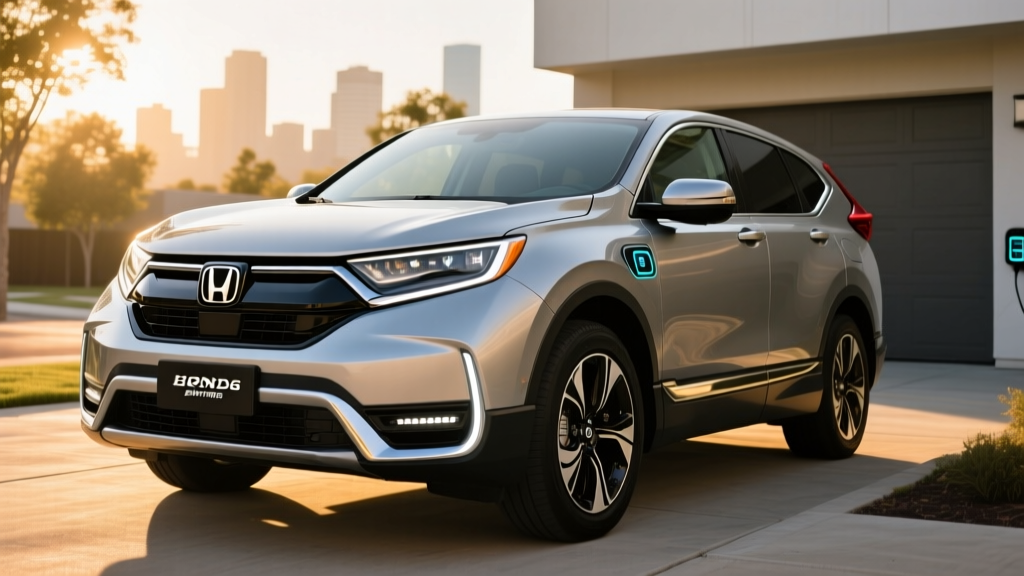
The Honda CR-V has been a compact SUV staple for decades, but the electrified variant is where the real value proposition lives. The Honda CR-V Sport Hybrid sits in the sweet spot of the lineup: it pairs Honda's proven two-motor hybrid system with the sportier styling of the Sport trim, all without requiring a plug or any change to your daily routine. For 2026, the CR-V Sport Hybrid continues to deliver strong fuel economy, confident acceleration, and the practicality buyers expect — but how does it stack up against plug-in hybrids and full EVs?
This guide breaks down every number that matters: EPA MPG, real-world fuel economy, powertrain specs, battery warranty, pricing, and whether a conventional hybrid, PHEV, or full EV is the right call for your driveway.
HEV vs PHEV: Where the CR-V Sport Hybrid Fits
Before examining the numbers, it's essential to understand what the CR-V Sport Hybrid is — and what it isn't.
Conventional Hybrid (HEV) — Honda CR-V Sport Hybrid
- No plug required. The battery recharges through regenerative braking and the gasoline engine.
- Small battery (~1.06 kWh usable): assists the engine and enables brief electric-only driving at low speeds, but cannot sustain EV mode for meaningful distances.
- Fuel economy benefit: significant MPG gains, especially in city driving, with zero lifestyle change.
Plug-In Hybrid (PHEV)
- Plugs in to charge. Larger battery (typically 15-20+ kWh) enables 25-40 miles of electric-only driving.
- Requires charging access (home or workplace) to realize the full efficiency benefit.
- May qualify for the §30D federal tax credit (up to $7,500) if battery sourcing, MSRP, and income requirements are met.
The CR-V Sport Hybrid is a conventional HEV. You never plug it in. You fuel it like any other gas car and the hybrid system works invisibly in the background to cut fuel consumption. Honda does not currently offer a PHEV version of the CR-V in the U.S. market for the 2026 model year.
Fuel Economy: EPA Ratings and Real-World MPG
The headline number for any hybrid is fuel economy, and the CR-V Sport Hybrid delivers. According to fueleconomy.gov, the EPA rates the 2026 Honda CR-V Sport Hybrid as follows:
| Configuration | City MPG | Highway MPG | Combined MPG |
|---|---|---|---|
| FWD | 43 | 36 | 40 |
| AWD | 40 | 34 | 37 |
That city-heavy advantage is typical of series-parallel hybrid systems. In stop-and-go traffic, the electric motor handles low-speed propulsion while regenerative braking recaptures energy that a gas-only car would waste as heat. The result: you'll often see real-world city MPG that meets or exceeds the EPA sticker, particularly on suburban commutes with frequent stops.
On the highway, the story shifts. At sustained 70-80 mph speeds, the gasoline engine does most of the work, and aerodynamic drag dominates. Expect real-world highway fuel economy in the 33-36 MPG range for AWD models, with slightly better results for FWD. Cold weather, roof cargo boxes, and aggressive acceleration will reduce these figures further.
For context, the non-hybrid 2026 CR-V with the 1.5L turbocharged engine rates at roughly 29 MPG combined (AWD). The Sport Hybrid's ~27% improvement in combined driving translates to roughly 100-120 fewer gallons per year for a driver covering 15,000 miles — meaningful savings at any fuel price.
Powertrain Specs: What's Under the Hood
| Specification | 2026 Honda CR-V Sport Hybrid |
|---|---|
| Engine | 2.0L Atkinson-cycle 4-cylinder |
| Electric Motors | Dual-motor hybrid system |
| Combined System Output | 204 hp / 247 lb-ft torque |
| Transmission | e-CVT (direct-drive with fixed gear ratio) |
| Drivetrain | FWD standard, AWD available |
| Hybrid Battery | ~1.06 kWh lithium-ion |
| 0-60 mph (est.) | ~7.6 seconds |
| Towing Capacity | 1,000 lbs |
Honda's two-motor hybrid system is one of the smoothest in the compact SUV segment. Unlike some competitors that use a traditional planetary gearset, Honda's system primarily operates in series-hybrid mode at lower speeds — the engine generates electricity, and the drive motor propels the wheels. At highway speeds, a lockup clutch connects the engine directly to the wheels for efficiency. The result is seamless acceleration without the "rubber-band" feel some e-CVTs exhibit.
The 204 combined horsepower and 247 lb-ft of torque give the CR-V Sport Hybrid noticeably more punch than the turbo-gas model's 190 hp, especially in the 0-40 mph range where the electric motor's instant torque shines. Merging and passing are confident, if not thrilling.
Pricing, Trims, and Tax Credit Eligibility
The 2026 Honda CR-V Sport Hybrid is offered in two trim levels:
- Sport Hybrid (FWD): Starting MSRP approximately $35,700
- Sport Hybrid (AWD): Starting MSRP approximately $37,200
- Sport Touring Hybrid (AWD): Starting MSRP approximately $41,200
Destination charges add roughly $1,350 to these figures.
Does the CR-V Sport Hybrid Qualify for a Federal Tax Credit?
No. The Honda CR-V Sport Hybrid is a conventional HEV, not a plug-in vehicle. The federal §30D Clean Vehicle Credit (up to $7,500) applies only to new plug-in electric vehicles (BEVs and qualifying PHEVs) with sufficient battery capacity and compliant critical-mineral/battery-component sourcing. Conventional hybrids do not qualify for this credit. Some states or utilities may offer small rebates for hybrid purchases — check your state energy office or utility provider for current programs. For the latest federal credit rules, consult IRS.gov §30D guidance.
The absence of a federal tax credit stings compared to a qualifying PHEV or BEV, but the CR-V Hybrid's lower purchase price (typically $3,000-$6,000 less than a compact electric SUV before credits) and zero charging infrastructure cost partially offset the gap. Run a 5-year total-cost comparison for your specific situation before deciding.
Battery Warranty, Reliability, and Replacement Cost
Hybrid battery longevity is the number one concern we hear from buyers considering their first electrified vehicle. Here's what you need to know about the CR-V Sport Hybrid's battery:
| Item | Details |
|---|---|
| Hybrid Battery Warranty | 8 years / 100,000 miles (10 years / 150,000 miles in CARB states) |
| Powertrain Warranty | 5 years / 60,000 miles |
| Battery Chemistry | Lithium-ion |
| Estimated Replacement Cost | $2,000 – $4,000 (out of warranty) |
Honda's hybrid battery warranty covers capacity loss below a defined threshold (typically 60-70% of original capacity) and defects. In practice, Honda's hybrid batteries have demonstrated strong longevity. The company has been refining this system since the early 2000s Insight, and real-world data from high-mileage CR-V Hybrids and Accord Hybrids shows minimal degradation under normal use.
The battery pack is small (~1.06 kWh), which means replacement costs are dramatically lower than a full EV battery. Out-of-warranty replacement typically runs $2,000-$4,000 including labor — a fraction of the $10,000-$20,000+ you'd face with a long-range BEV. Many owners will never need a replacement, as these packs routinely last 150,000+ miles.
Honda's overall reliability track record with the CR-V line is strong. IIHS has consistently rated recent CR-V models highly for crashworthiness, and the hybrid powertrain adds few new failure points — the electric motors and power electronics are sealed, brushless units with minimal wear components.
Hybrid vs PHEV vs EV: Which Powertrain Fits You?
The CR-V Sport Hybrid is the right choice for a specific buyer profile. Here's a decision framework:
Choose the CR-V Sport Hybrid (HEV) if:
- You lack reliable access to home or workplace charging
- You want maximum fuel savings with zero lifestyle change
- Your budget is under $42,000 and you don't want to wait for a tax credit to realize savings
- You take frequent road trips where charging infrastructure is sparse
- You live in an apartment or rent and cannot install a charger
Consider a PHEV (e.g., Toyota RAV4 Prime, Hyundai Tucson PHEV) if:
- You can charge at home nightly and want 30-40 miles of electric-only commuting
- Your daily commute is under 40 miles round-trip
- You want to reduce gas consumption to near-zero on weekdays while retaining gas flexibility for road trips
- You qualify for the §30D tax credit (income under $150K single / $300K joint, vehicle MSRP under $80K for SUVs, and battery sourcing requirements met)
Go Full EV (e.g., Tesla Model Y, Hyundai Ioniq 5) if:
- You have Level 2 home charging and your daily driving is under 250 miles
- You want the lowest per-mile "fuel" cost (electricity at $0.12-$0.16/kWh is roughly equivalent to $1.00-$1.50/gallon gas)
- You want to eliminate oil changes, spark plugs, and transmission fluid entirely
- You qualify for the full $7,500 §30D credit and can apply it at point of sale
The CR-V Sport Hybrid's biggest advantage is universality. It works for every driver, in every climate, on every route, with no infrastructure dependency. That matters more than most spec sheets suggest.
Real-World Ownership: What to Expect
Beyond the numbers, here's what living with the CR-V Sport Hybrid actually looks like:
Cold-weather performance: Unlike EVs, which can lose 20-30% of range in freezing temperatures, hybrids experience a more modest fuel economy drop — typically 3-5 MPG in winter. The engine generates waste heat that warms the cabin without a significant efficiency penalty. You'll still get 35+ MPG combined in most winter conditions.
Cargo and practicality: The hybrid battery pack is mounted under the cargo floor, and Honda has managed to preserve nearly all of the gas CR-V's cargo volume: roughly 36.3 cu ft behind the rear seats and 76.5 cu ft with seats folded. There's no frunk, obviously, and no compromise to passenger space.
Driving feel: The Sport Hybrid's regenerative braking is mild compared to a full EV. You won't get one-pedal driving, and the brake pedal feel is natural — a common complaint with some hybrids is a grabby or inconsistent brake transition, but Honda has tuned this well. Paddle shifters let you adjust regen intensity on the fly.
Insurance and maintenance: Insurance premiums for the CR-V Hybrid are generally in line with the gas model — sometimes slightly higher due to the higher MSRP. Maintenance costs are low: the hybrid system requires no special service, and the brake pads often last longer than on gas models thanks to regen handling much of the deceleration. Expect oil changes at standard intervals (roughly every 7,500-10,000 miles with synthetic oil).
Pros and Cons
Pros
- 40 MPG combined (FWD) with no plug-in required
- 204 hp and 247 lb-ft — more torque than the gas model
- Strong reliability history and 8-year/100K-mile hybrid battery warranty
- No charging infrastructure cost or range anxiety
- Full cargo capacity preserved vs. gas CR-V
- Smooth, quiet two-motor hybrid operation
Cons
- No federal tax credit eligibility (HEV, not PHEV/BEV)
- AWD drops combined MPG to 37
- 1,000-lb towing limit (lower than some competitors)
- No electric-only commuting capability beyond very low speeds
- Sport trim lacks some premium features found on Touring
Frequently Asked Questions
How many MPG does the Honda CR-V Sport Hybrid get?
The 2026 Honda CR-V Sport Hybrid with FWD achieves an EPA-rated 43 city / 36 highway / 40 combined MPG. The AWD version rates at 40 city / 34 highway / 37 combined. Real-world city driving often meets or slightly exceeds EPA figures, while sustained highway driving at 75+ mph typically yields 33-36 MPG for AWD models.
Does the CR-V Sport Hybrid need to be plugged in?
No. The CR-V Sport Hybrid is a conventional hybrid (HEV). Its small lithium-ion battery recharges through regenerative braking and the gasoline engine. You never plug it in — just fuel it at any gas station like a standard vehicle.
Is the Honda CR-V Sport Hybrid reliable?
Honda's hybrid system has been in production for over two decades and has demonstrated strong long-term reliability. The hybrid battery carries an 8-year/100,000-mile warranty (10 years/150,000 miles in CARB states). Out-of-warranty battery replacement typically costs $2,000-$4,000 — significantly less than a full EV battery. The CR-V line consistently earns top safety ratings from IIHS.
How far can the CR-V Sport Hybrid drive on electric only?
Not far — typically under 1 mile at very low speeds (parking lots, traffic creep). This is a conventional hybrid, not a PHEV. The electric motor assists the engine and handles brief low-speed propulsion, but it cannot sustain highway speeds or meaningful distances on battery power alone. If you want 30+ miles of electric-only driving, you need a PHEV or a full BEV.
Does the CR-V Sport Hybrid qualify for any tax credit?
The CR-V Sport Hybrid does not qualify for the federal §30D Clean Vehicle Credit, which is reserved for plug-in vehicles (BEVs and PHEVs) meeting battery sourcing, MSRP, and buyer income requirements. Some state or utility programs may offer small hybrid rebates — check your local programs. For current federal credit rules, visit IRS.gov.
How much does it cost to replace the hybrid battery?
Out-of-warranty replacement for the CR-V Sport Hybrid's lithium-ion battery pack typically costs between $2,000 and $4,000 including parts and labor. The pack is covered under Honda's hybrid battery warranty for 8 years/100,000 miles (10 years/150,000 miles in CARB states). Given the small pack size and Honda's proven track record, most owners will never face this cost.
Hybrid vs PHEV vs EV — which should I choose?
Choose the HEV (CR-V Sport Hybrid) if you can't charge at home, want zero lifestyle change, and prioritize a lower purchase price. Choose a PHEV if you have home charging and want 30-40 miles of electric commuting with gas backup. Choose a full EV if you have reliable charging, drive under 250 miles daily, and want the lowest operating costs plus the full $7,500 federal tax credit.
The 2026 Honda CR-V Sport Hybrid isn't the most electrified option in the compact SUV segment — and that's precisely its strength. It delivers meaningful fuel savings, stronger acceleration than its gas counterpart, and the practicality CR-V buyers demand, all without asking you to change a single habit. For the millions of drivers who can't charge at home or who regularly drive beyond the reach of charging networks, it remains one of the smartest electrified choices on the market.