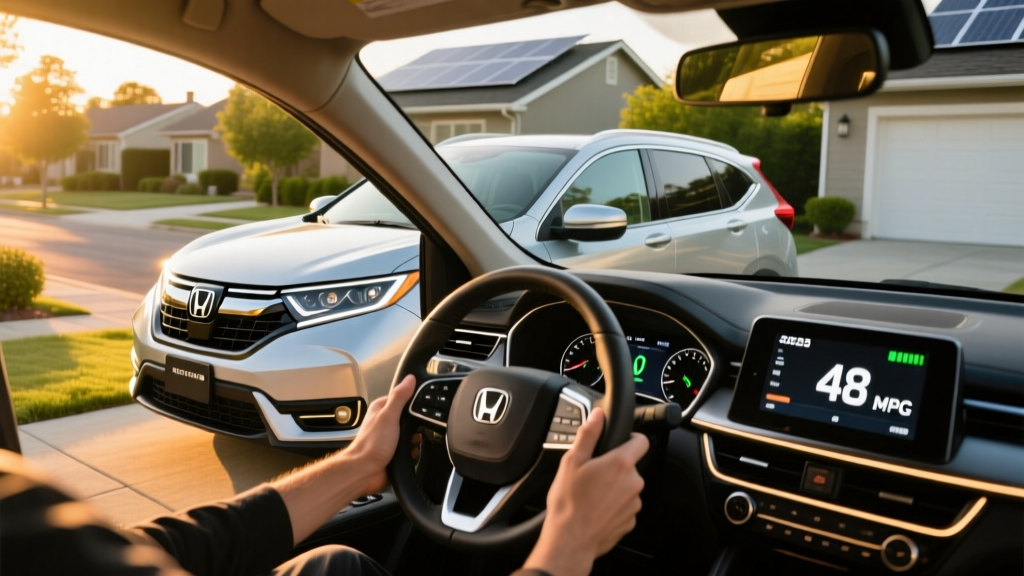
The 2025 Honda CR-V Sport Hybrid sits in the middle of Honda's compact SUV lineup, offering the sport-tuned suspension and blacked-out styling of the Sport trim paired with Honda's fourth-generation two-motor hybrid system. For buyers weighing the Honda CR-V Sport Hybrid 2025 against a plug-in hybrid or full electric SUV, this conventional hybrid (HEV) delivers strong city efficiency without requiring any plug-in charging infrastructure.
This guide breaks down the exact EPA fuel economy figures, real-world MPG observations, powertrain specifications, pricing, and long-term reliability data you need to decide whether this HEV is the right electrified choice for your daily driving.
HEV vs PHEV vs EV: Where the CR-V Sport Hybrid Fits
Before examining specs, it's critical to understand what the CR-V Sport Hybrid is—and what it is not. Honda currently offers the CR-V exclusively as a conventional hybrid (HEV) or a standard gasoline model in the US market. There is no plug-in hybrid (PHEV) CR-V variant sold in the United States for 2025.
HEV vs PHEV vs BEV: Quick Reference
| Feature | HEV (CR-V Sport Hybrid) | PHEV (e.g., RAV4 Prime) | BEV (e.g., Ioniq 5) |
|---|---|---|---|
| Plug-in charging required? | No — regenerative braking and engine recharge the battery | Yes — Level 1 or Level 2 for full benefit | Yes — Level 2 home or DC fast charging |
| Electric-only range | Less than 1 mile (low-speed assist only) | 25–42 miles typical | 250–350+ miles |
| Battery size | ~1.06 kWh (small buffer) | 13–18 kWh usable | 58–84 kWh usable |
| Federal tax credit (§30D) | Not eligible | Up to $7,500 if sourcing rules met | Up to $7,500 if sourcing rules met |
| Best for | No home charging access; wants better MPG without behavior change | Home charging + short commute; wants EV daily, gas for road trips | Home charging available; wants lowest operating cost and zero tailpipe emissions |
The CR-V Sport Hybrid is purpose-built for drivers who want improved fuel economy without installing a home charger or altering their refueling habits. You fill it at a gas station exactly like a conventional car—the hybrid system handles the rest.
2025 Honda CR-V Sport Hybrid: Powertrain and Performance Specs
| Specification | 2025 CR-V Sport Hybrid (AWD) |
|---|---|
| Powertrain | 2.0L DOHC Atkinson-cycle 4-cylinder + dual electric motors |
| Combined system horsepower | 204 hp |
| Combined system torque | 247 lb-ft |
| Engine output | 146 hp @ 6,100 rpm / 134 lb-ft @ 4,500 rpm |
| Drive motor output | 181 hp / 247 lb-ft |
| Transmission | e-CVT (electrically variable, no fixed gears) |
| Drivetrain | AWD standard on Sport Hybrid (rear motor-driven) |
| Hybrid battery | Lithium-ion, ~1.06 kWh total capacity |
| 0–60 mph | ~7.6 seconds (independent testing) |
| Towing capacity | 1,000 lbs |
| Cargo volume | 36.3 cu ft (rear seats up) / 76.5 cu ft (rear seats folded) |
Honda's two-motor hybrid system operates primarily in electric-drive mode at low and moderate speeds, with the gasoline engine acting as a generator. At highway speeds, a lock-up clutch connects the engine directly to the wheels for efficient cruising. This architecture means the drive motor provides instant torque from a stop, giving the Sport Hybrid a more responsive launch feel than the turbocharged gas-only CR-V despite having less peak horsepower.
EPA Fuel Economy: City, Highway, and Combined MPG
The EPA rates the 2025 Honda CR-V Sport Hybrid AWD at the following fuel economy figures:
| Cycle | EPA Rating |
|---|---|
| City | 40 MPG |
| Highway | 34 MPG |
| Combined | 37 MPG |
Note that the Sport Hybrid is only offered with AWD in 2025. The FWD-only Sport trim (gas) achieves different figures. If you see 43 MPG city cited for a CR-V Hybrid, that applies to the FWD EX-L Hybrid variant, not the Sport Hybrid AWD tested here.
Real-World MPG: What to Actually Expect
In mixed suburban and city driving, the CR-V Sport Hybrid consistently meets or slightly exceeds its EPA city rating. The Atkinson-cycle engine and regenerative braking shine in stop-and-go traffic, where the electric motor handles most propulsion. Owners regularly report 38–42 MPG in city-dominant commutes.
Highway efficiency tells a different story. At sustained 75–80 mph speeds, expect 30–33 MPG—the direct engine-drive clutch engages, but the boxy SUV shape and AWD system create more drag and friction than the EPA highway cycle accounts for. On a 300-mile highway road trip at 75 mph, plan for roughly 31 MPG.
Cold weather reduces MPG by roughly 8–12% in winter conditions (below 30°F), as the engine runs more frequently to provide cabin heat and maintain battery temperature. This is a smaller penalty than the 20–30% range loss experienced by full EVs in cold weather, but it's worth factoring into winter fuel budgets.
Pricing, Trims, and Tax Credit Eligibility
The 2025 Honda CR-V Sport Hybrid is offered in a single, well-equipped trim:
| Trim | MSRP | Key Features |
|---|---|---|
| Sport Hybrid AWD | $38,350 (incl. $1,350 destination) | 19" black alloy wheels, gloss-black accents, heated front seats, wireless Apple CarPlay/Android Auto, Honda Sensing suite, 9" touchscreen |
Federal Tax Credit Status
The absence of a tax credit is the primary financial disadvantage compared to a PHEV like the Toyota RAV4 Prime (which may qualify for up to $7,500 if battery sourcing requirements are met). However, the CR-V Sport Hybrid's lower starting price—roughly $5,000–$8,000 less than a RAV4 Prime—partially offsets this gap for buyers who don't itemize deductions or whose income exceeds §30D caps.
Battery Warranty, Reliability, and Replacement Costs
Honda Hybrid Battery Warranty
Honda covers the CR-V Sport Hybrid's lithium-ion battery pack under its Hybrid System Warranty: 8 years or 100,000 miles (whichever comes first) in all 50 states. In states that follow California Air Resources Board (CARB) emissions standards—including CA, NY, MA, NJ, CT, RI, VT, ME, NH, OR, WA, CO, MD, and others—hybrid battery coverage extends to 10 years or 150,000 miles.
The warranty covers defects and capacity loss that causes the battery to fall below functional thresholds, not gradual minor degradation that doesn't affect vehicle operation.
Long-Term Reliability Data
Honda's two-motor hybrid system has been in production since 2014 (Accord Hybrid) and has proven durable in fleet and consumer use. The CR-V Hybrid, introduced for the 2020 model year, has accumulated strong reliability records. The IIHS has named the 2025 CR-V a Top Safety Pick+ with Good ratings across all crashworthiness tests.
The e-CVT in this system contains no traditional belts, pulleys, or clutch packs that wear—it uses motor-generator speed variation. This eliminates the most common failure point in conventional automatic transmissions. Honda's maintenance schedule does not include transmission fluid changes under normal driving conditions.
Battery Replacement Cost
If the hybrid battery fails outside warranty coverage, a replacement lithium-ion pack for the CR-V Hybrid currently costs between $2,000 and $3,500 (parts and labor at a Honda dealer). Third-party remanufactured packs may be available for $1,200–$2,000 as the vehicle ages and the aftermarket develops. Given that the battery is under warranty for 8–10 years and most hybrid battery failures occur beyond 150,000 miles, the majority of original owners will never face this cost.
Who Should Buy the CR-V Sport Hybrid (and Who Shouldn't)
✓ Choose the CR-V Sport Hybrid If
- You lack access to home or workplace charging (apartment, street parking)
- Your commute is city/suburban-heavy, where hybrid efficiency peaks
- You want better MPG without changing any refueling behavior
- You value AWD for snow/rain and want the Sport styling package
- You want a lower purchase price than a PHEV or BEV SUV
✗ Look Elsewhere If
- You have home charging and a short commute—a PHEV gives you electric-only daily driving
- You want to eliminate gas purchases entirely—consider a BEV like the Ioniq 5 or Model Y
- You need more than 1,000 lbs of towing capacity
- You want federal tax credit eligibility (PHEV/BEV required)
- Prioritize maximum cargo space (the hybrid battery slightly reduces under-floor storage vs. gas CR-V)
For buyers with a garage or driveway where a Level 2 charger can be installed, a PHEV like the Toyota RAV4 Prime (42 miles electric-only range) or a BEV like the Hyundai Ioniq 5 (303 miles EPA range) can deliver lower per-mile energy costs. But for the roughly 35% of US households without dedicated off-street parking, a conventional hybrid like the CR-V Sport Hybrid remains the most practical path to meaningful fuel savings.
Frequently Asked Questions
How many MPG does the 2025 Honda CR-V Sport Hybrid get?
The EPA rates the CR-V Sport Hybrid AWD at 40 MPG city, 34 MPG highway, and 37 MPG combined. Real-world city driving often yields 38–42 MPG; sustained highway driving at 75+ mph typically returns 30–33 MPG.
Does the CR-V Sport Hybrid need to be plugged in?
No. The CR-V Sport Hybrid is a conventional hybrid (HEV). Its small lithium-ion battery recharges through regenerative braking and the gasoline engine. You refuel only at gas stations, exactly like a non-hybrid vehicle.
Is there a plug-in hybrid (PHEV) version of the CR-V?
Not in the US market. Honda sells a CR-V e:PHEV in China and Europe, but it is not offered in North America for 2025. If you need a Honda PHEV, the Clarity Plug-In Hybrid was discontinued after 2022, and Honda currently has no PHEV SUV in its US lineup.
How reliable is the Honda hybrid system?
Honda's two-motor hybrid architecture has been in production since 2014 and has demonstrated strong long-term reliability. The e-CVT has no wear-prone mechanical components like belts or clutch packs. Consumer Reports and J.D. Power consistently rate the CR-V Hybrid at or above average for the compact SUV segment.
What does it cost to replace the hybrid battery?
Out-of-warranty replacement runs $2,000–$3,500 at a Honda dealer. However, the battery is covered for 8 years/100,000 miles (10 years/150,000 miles in CARB states), and most failures occur well beyond 150,000 miles. Most original owners will never need a replacement.
Does the 2025 CR-V Sport Hybrid qualify for a tax credit?
No. The federal §30D clean vehicle credit applies only to plug-in vehicles (PHEVs and BEVs) with battery capacity above 7 kWh. Conventional hybrids are ineligible. Check your state's DMV for any local efficiency incentives, though these are uncommon for HEVs.
How does the CR-V Sport Hybrid compare to the gas-only CR-V Sport?
The gas CR-V Sport (1.5L turbo, 190 hp) is rated at 27 MPG city / 32 MPG highway (AWD). The hybrid adds roughly 13 MPG in city driving and 5 MPG combined, along with 14 more combined horsepower and 55 more lb-ft of torque. The hybrid carries a ~$3,000 price premium over the gas Sport AWD, which most drivers will recoup in fuel savings within 4–5 years at 12,000 miles/year and $3.50/gallon.
Sources: EPA Fuel Economy (fueleconomy.gov), Honda Newsroom specifications, IRS §30D Clean Vehicle Credit guidelines (irs.gov), IIHS safety ratings (iihs.org). Pricing and credit eligibility reflect 2025 model year data and are subject to change. Consult a tax professional for credit eligibility specific to your situation.