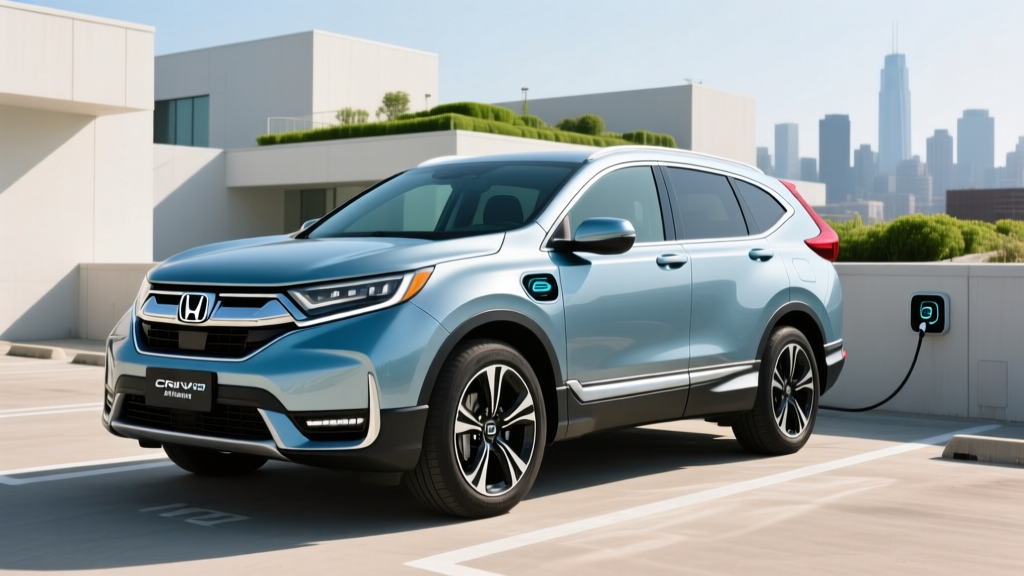
The Honda CR-V has long been one of America's best-selling compact SUVs, and Honda's electrification strategy has introduced both a conventional hybrid and a plug-in hybrid variant to the lineup. If you're researching the Honda CR-V plug-in hybrid, you likely want to know exactly how far it can drive on electricity alone, what happens when the battery depletes, and whether the PHEV premium over the standard hybrid is worth the investment. This guide breaks down every spec that matters — from EPA range and MPGe to battery warranty and real-world efficiency — so you can make a data-driven decision.
Honda CR-V PHEV vs. CR-V Hybrid: What's the Difference?
Before diving into specs, it's critical to understand the distinction between the conventional CR-V Hybrid (HEV) and the CR-V Plug-In Hybrid (PHEV). They share a similar exterior and interior, but their powertrains serve fundamentally different use cases.
HEV vs. PHEV at a Glance
| Feature | CR-V Hybrid (HEV) | CR-V Plug-In Hybrid (PHEV) |
|---|---|---|
| Plugs in to charge? | No — charges via regenerative braking and engine | Yes — plug in for electric-only driving |
| Battery size | ~1.06 kWh (small buffer) | ~17.7 kWh usable |
| Electric-only range | Less than 1 mile at low speed | EPA-est. 47 miles |
| Total range | ~500+ miles | ~430+ miles combined (EV + gas) |
| Charging port | None | J1772 (Level 1/2 AC) |
| DC fast charging | N/A | No — AC charging only |
| Starting MSRP (2025) | ~$34,050 | ~$40,850 |
| Federal tax credit (§30D) | Not eligible | Not eligible (see tax section below) |
The conventional HEV is ideal for buyers who want better fuel economy without changing any habits — no plugs, no apps, no charging routines. The PHEV is designed for drivers who can charge at home or work and want to handle most daily commutes on electricity while retaining a gas engine for longer trips.
Electric-Only Range and Total Range
The Honda CR-V plug-in hybrid carries a lithium-ion battery pack rated at approximately 17.7 kWh usable. According to fueleconomy.gov, the EPA estimates 47 miles of electric-only range on a full charge. This puts it among the leaders in the compact PHEV SUV segment, trailing only the Toyota RAV4 Prime (42 miles EPA) and comparable to the Hyundai Tucson PHEV (33 miles EPA).
Real-World Electric Range Expectations
EPA estimate: 47 miles electric-only
Real-world expectation: 38–45 miles in mixed driving; 30–35 miles in cold weather (below 40°F) or sustained highway speeds above 70 mph. Cabin heating and battery thermal demands reduce usable range in winter. In mild weather with moderate city driving, some owners report matching or slightly exceeding the EPA figure thanks to regenerative braking.
When the battery depletes, the CR-V PHEV seamlessly transitions to hybrid mode, where the 2.0-liter Atkinson-cycle four-cylinder engine and electric motor work together. Total combined range (electric + gasoline) is approximately 430 miles, meaning you'll never face range anxiety on road trips — you simply fill up at any gas station as you would with a conventional vehicle.
Fuel Economy: MPGe and Gas-Only MPG
PHEV fuel economy is measured two ways: MPGe (miles per gallon equivalent, measuring efficiency while using battery and gas together) and gas-only MPG (efficiency after the battery is depleted, functioning as a conventional hybrid).
| Metric | City | Highway | Combined |
|---|---|---|---|
| MPGe (charge-sustaining + electric) | 95 MPGe combined (EPA est.) | ||
| Gas-only MPG (battery depleted) | 40 MPG | 36 MPG | 38 MPG |
| CR-V Hybrid HEV (comparison) | 43 MPG | 36 MPG | 40 MPG |
A few things stand out in these numbers. First, the gas-only MPG of 38 combined is slightly lower than the conventional CR-V Hybrid's 40 combined. This is because the PHEV carries roughly 300–350 additional pounds of battery mass, which the engine must move once the electric range is exhausted. Second, in real-world city driving with regular charging, many PHEV owners use almost zero gasoline during the work week — a 20-mile round-trip commute falls well within the 47-mile electric envelope.
Real-world note: Hybrid and PHEV vehicles typically exceed their EPA city estimates in stop-and-go traffic because regenerative braking recovers energy that a gas car wastes as heat. Highway efficiency is lower due to aerodynamic drag and the reduced benefit of regen at steady speeds.
Powertrain, Performance, and Charging Specs
2025 Honda CR-V Plug-In Hybrid: Key Specifications
| Specification | Value |
|---|---|
| Engine | 2.0L Atkinson-cycle 4-cylinder |
| Electric motor | Two-motor hybrid system (drive + generator) |
| Combined horsepower | 204 hp |
| Combined torque | 247 lb-ft |
| 0–60 mph | ~7.5 seconds (est.) |
| Battery (usable) | 17.7 kWh lithium-ion |
| Electric-only range (EPA) | 47 miles |
| Charge port | J1772 (AC only) |
| Level 1 charging (120V, 1.4 kW) | ~12–14 hours (0–100%) |
| Level 2 charging (240V, 7.7 kW) | ~2.5 hours (0–100%) |
| DC fast charging | Not supported |
| Drivetrain | FWD (e-CVT) |
| Towing capacity | 1,000 lbs |
| Cargo volume (behind rear seats) | ~36.3 cu ft |
The CR-V PHEV uses Honda's two-motor hybrid system, where one motor primarily drives the wheels and the second acts as a generator. In most low-to-moderate speed driving, the vehicle operates as a series hybrid — the engine generates electricity while the drive motor propels the car. At highway speeds, a lock-up clutch connects the engine directly to the wheels for better efficiency. This architecture is proven and smooth, though it lacks the instant punch of a full battery-electric vehicle.
Charging reality: The absence of DC fast charging means this PHEV is designed for home and workplace charging, not road-trip top-ups. A standard 240V Level 2 home charger replenishes the battery in roughly 2.5 hours, which is practical for overnight charging. If you only have a 120V outlet, plan on plugging in when you get home — a full charge takes about 12–14 hours, meaning you'll recover roughly 4–5 miles of range per hour of Level 1 charging.
Pricing, Trims, and Tax Credit Eligibility
The 2025 Honda CR-V plug-in hybrid starts at approximately $40,850 MSRP (including destination), which represents a premium of roughly $6,800 over the base CR-V Hybrid. Honda has positioned the PHEV in higher trim levels, meaning it comes well-equipped with features like a 9-inch touchscreen, wireless Apple CarPlay and Android Auto, heated front seats, and the full Honda Sensing suite of driver-assistance features (adaptive cruise control, lane-keeping assist, automatic emergency braking).
Federal Tax Credit (§30D) Status
As of current IRS guidelines, the Honda CR-V Plug-In Hybrid does not qualify for the federal §30D clean vehicle credit of up to $7,500. Here's why:
- Battery sourcing requirements: The §30D credit requires that a percentage of critical minerals and battery components are sourced from the US or free-trade-agreement countries. The CR-V PHEV's battery supply chain does not currently meet these thresholds.
- MSRP cap: SUVs must be under $80,000 MSRP — the CR-V PHEV passes this test.
- Income cap: Buyer AGI must be under $150,000 (single) or $300,000 (joint) — applies at point of sale.
- Assembly: Final assembly must occur in North America — the CR-V is assembled in the US and Canada, so this requirement is met.
Bottom line: The battery-sourcing requirement is the disqualifying factor. Always verify current eligibility at fueleconomy.gov before purchasing, as sourcing rules and eligible vehicle lists are updated periodically by the IRS. Some state-level incentives (e.g., California's CVRP or utility rebates) may still apply — check your state's energy office for details.
Battery Warranty, Reliability, and Replacement Cost
Honda backs the CR-V plug-in hybrid's battery pack with a warranty of 8 years or 100,000 miles (whichever comes first), which covers defects and excessive capacity loss. In states that follow California Air Resources Board (CARB) standards — including California, New York, Massachusetts, and several others — the hybrid battery warranty extends to 10 years or 150,000 miles.
Battery Warranty Summary
| Coverage | Federal (49-state) | CARB States |
|---|---|---|
| Hybrid battery | 8 years / 100,000 mi | 10 years / 150,000 mi |
| Hybrid system components | 8 years / 100,000 mi | 10 years / 150,000 mi |
| Capacity retention threshold | Typically ~60–70% of original capacity | Same |
Reliability outlook: Honda's two-motor hybrid system has been in production since the early 2000s (starting with the Insight and Civic Hybrid). The current-generation system used in the CR-V is among the most refined in the industry. Lithium-ion battery degradation in PHEVs tends to be gradual — expect roughly 10–15% capacity loss over 8–10 years under normal use, which would reduce the electric range from 47 miles to approximately 40 miles. This is a manageable decline, not a catastrophic failure.
Replacement cost: If the battery pack does need replacement outside of warranty, current estimates for a CR-V-class PHEV battery range from $4,000 to $7,000 (parts and labor), depending on the service provider and whether a new or refurbished unit is used. This cost has been declining as battery manufacturing scales. For context, the vast majority of Honda hybrid owners never require a battery replacement within typical ownership periods.
Who Should Buy the CR-V PHEV vs. an EV or Gas Car?
Choosing between a PHEV, a conventional hybrid, and a full battery-electric vehicle (BEV) depends on your daily driving pattern, charging access, and trip profile. Here's a practical decision framework:
Choose the CR-V Plug-In Hybrid If:
- Your daily round-trip commute is under 40 miles and you can charge at home overnight
- You take road trips of 200+ miles several times per year and don't want to plan around charging stations
- You live in an apartment or area where reliable public DC fast charging is limited
- You want to reduce gasoline consumption significantly without committing to a full EV
- You value the option of electric-only driving for neighborhood errands and school runs
Choose the CR-V Hybrid (HEV) Instead If:
- You cannot install a charger at home or work
- Your daily driving exceeds 50+ miles, making the PHEV premium harder to recoup
- You want the lowest upfront price and simplest ownership experience
- You drive predominantly highway miles, where the PHEV's electric advantage diminishes
Choose a Full BEV (e.g., Tesla Model Y, Hyundai Ioniq 5) Instead If:
- You can install a Level 2 charger at home and your daily driving is under 250 miles
- You want zero gasoline costs, minimal maintenance (no oil changes, no engine), and the lowest per-mile fuel cost
- You qualify for the $7,500 federal tax credit on an eligible BEV, narrowing the price gap
- You want access to DC fast charging for 200+ mile road trips with 20–30 minute stops
CR-V PHEV Pros
- 47 miles EPA electric range covers most daily commutes
- 38 MPG gas-only is still excellent when battery depletes
- No range anxiety — gas engine provides 430+ total miles
- Proven Honda hybrid reliability with strong warranty
- Spacious interior and strong cargo utility for the class
- Honda Sensing ADAS suite included on all trims
CR-V PHEV Cons
- ~$6,800 premium over the CR-V Hybrid with no federal tax credit to offset it
- No DC fast charging — limited to Level 2 AC
- FWD only — no AWD option (unlike RAV4 Prime)
- Gas-only MPG slightly lower than the lighter HEV variant
- Reduced cargo volume vs. non-hybrid CR-V due to battery placement
- Towing limited to 1,000 lbs
Frequently Asked Questions
How many MPG does the Honda CR-V plug-in hybrid get?
After the battery is depleted, the CR-V PHEV achieves an EPA-estimated 40 city / 36 highway / 38 combined MPG operating as a conventional hybrid. When factoring in electric driving, the combined rating is 95 MPGe. In real-world city driving with regular charging, many owners use little to no gasoline during the work week.
How far can the CR-V PHEV go on electric only?
The EPA estimates 47 miles of electric-only range. In real-world conditions, expect 38–45 miles in mild weather and mixed driving, and 30–35 miles in cold weather or at sustained highway speeds above 70 mph.
Can I charge the CR-V PHEV at a DC fast charger?
No. The CR-V plug-in hybrid only supports AC charging via a J1772 connector — Level 1 (120V) at roughly 1.4 kW or Level 2 (240V) at up to 7.7 kW. DC fast charging (CCS, NACS, CHAdeMO) is not supported. This is typical for most PHEVs, which are designed for overnight home charging.
Does the Honda CR-V PHEV qualify for a federal tax credit?
No. As of current IRS rules, the CR-V PHEV does not meet the battery critical-mineral sourcing requirements of the §30D clean vehicle credit. It does meet the MSRP cap ($80,000 for SUVs) and North American assembly requirements, but the sourcing threshold disqualifies it. Check fueleconomy.gov for updates, as eligible vehicle lists change periodically.
Is the CR-V plug-in hybrid reliable? What about battery replacement?
Honda's hybrid system is one of the most proven in the industry, with decades of production history. The battery is warrantied for 8 years/100,000 miles (10 years/150,000 miles in CARB states). Gradual degradation of 10–15% over a decade is typical. Out-of-warranty battery replacement, if needed, is estimated at $4,000–$7,000. Most owners never require a replacement within normal ownership periods.
How does the CR-V PHEV compare to the Toyota RAV4 Prime?
The RAV4 Prime offers 42 miles of EPA electric range (slightly less than the CR-V's 47), but it provides standard AWD and a more powerful 302-hp powertrain. The RAV4 Prime also starts at a higher MSRP (~$44,000). Both lack DC fast charging. If AWD is essential for your climate, the RAV4 Prime has the edge; if electric range and value matter more, the CR-V PHEV is compelling.
Should I get the CR-V PHEV or just buy a full electric vehicle?
If you can charge at home, your daily driving is under 250 miles, and you're comfortable planning road-trip charging stops, a full BEV will offer lower operating costs, less maintenance, and potential access to the $7,500 federal tax credit. The CR-V PHEV is the better choice if you lack reliable charging access away from home, frequently drive 300+ miles without stopping, or simply want the flexibility of a gas engine as a backup.