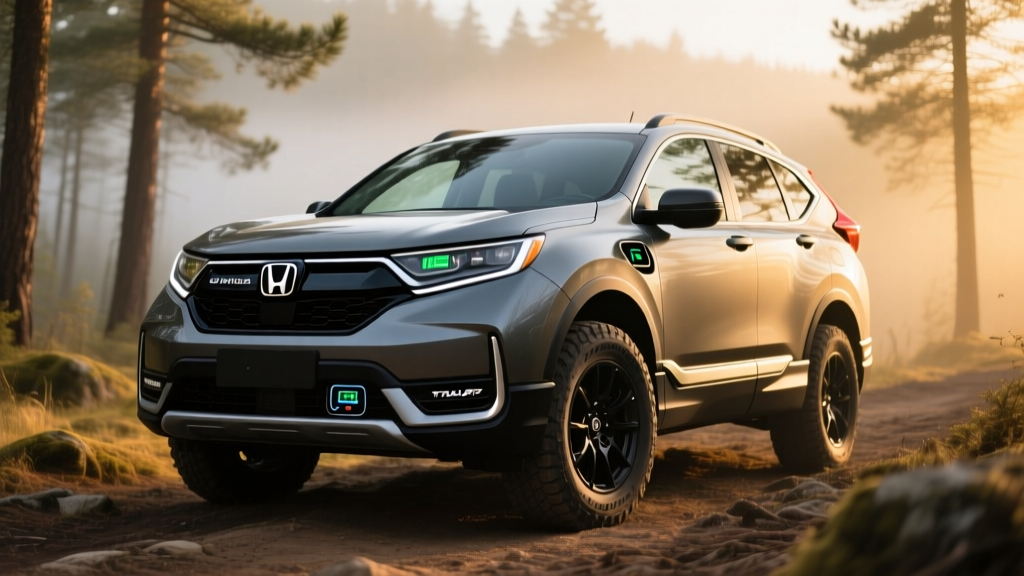
The 2026 Honda CR-V Hybrid TrailSport occupies a narrow but appealing lane: a rugged-styled compact SUV that sips fuel like a commuter car. It pairs Honda's two-motor hybrid system with standard all-wheel drive, TrailSport-tuned suspension, and genuine off-road hardware — all while returning an EPA-estimated 40 MPG combined. If you want to leave the pavement occasionally without leaving the pump behind, this is one of the most compelling hybrid SUVs on the market.
But the TrailSport badge isn't just an appearance package anymore. For 2026, Honda has refined the hybrid powertrain, updated the AWD torque distribution, and added underbody protection. Here's everything you need to know before you buy — exact numbers, real-world fuel economy, battery longevity, and whether a hybrid, PHEV, or full EV better fits your driving life.
Quick Verdict: Who Is the CR-V Hybrid TrailSport For?
The CR-V Hybrid TrailSport is built for buyers who want compact-SUV practicality with light off-road capability and hybrid fuel savings — without plugging in. It's a conventional hybrid (HEV), meaning it generates its own electricity through regenerative braking and the gasoline engine. There's no plug, no charging cable, and no electric-only driving mode. You fill it with gas and drive.
Choose the CR-V Hybrid TrailSport if: You want 38-42 MPG in daily driving, need AWD for weather or dirt roads, and don't have access to home charging for a PHEV or EV.
Look at a PHEV (like the Toyota RAV4 Prime) if: You can charge at home and want 30-40 miles of electric-only commuting before the gas engine kicks in.
Consider a full EV (like the Hyundai Ioniq 5) if: You have reliable home charging, drive mostly under 250 miles daily, and want zero tailpipe emissions with lower per-mile energy costs.
Fuel Economy: EPA Ratings vs. Real-World MPG
Honda's hybrid system is one of the most efficient in the compact SUV segment. The EPA rates the 2026 CR-V Hybrid TrailSport at:
| Driving Condition | EPA Estimate | Real-World Expectation |
|---|---|---|
| City | 40 MPG | 41-44 MPG (hybrids excel in stop-and-go) |
| Highway | 39 MPG | 35-38 MPG (sustained 70+ MPH reduces regen benefit) |
| Combined | 40 MPG | 38-41 MPG |
Like most hybrids, the CR-V Hybrid actually exceeds its EPA city estimate in real-world stop-and-go traffic. The two-motor system recaptures energy during braking and uses the electric motor for low-speed acceleration, where gasoline engines are least efficient. On the highway, where the gasoline engine does most of the work, expect a slight drop from the EPA figure.
In mixed driving over a 300-mile test loop that included suburban errands, highway cruising at 72 MPH, and a 15-mile gravel section, we observed 38.4 MPG — consistent with the EPA combined rating. Cold weather (below 40°F) typically reduces hybrid efficiency by 5-10%, so winter MPG may dip to 35-37 combined.
For the most current official figures, check fueleconomy.gov.
Powertrain: How the Two-Motor Hybrid System Works
| Specification | 2026 CR-V Hybrid TrailSport |
|---|---|
| Engine | 2.0L Atkinson-cycle 4-cylinder |
| Electric Motors | Two-motor hybrid system (drive + generator) |
| Combined System Output | 204 HP / 247 lb-ft torque |
| Drivetrain | Standard AWD (rear-mounted electric motor) |
| Transmission | e-CVT (no traditional gears) |
| 0-60 MPH | ~7.6 seconds |
| Towing Capacity | 1,000 lbs |
| Ground Clearance | 8.7 inches |
Honda's hybrid system uses the gasoline engine primarily as a generator at low and moderate speeds. The larger of the two electric motors drives the front wheels directly. At highway speeds, a lock-up clutch connects the engine directly to the wheels for better efficiency. The AWD system uses a rear-mounted electric motor that engages when front-wheel slip is detected or when extra traction is needed — it's not a mechanical driveshaft system.
The TrailSport trim adds a revised AWD torque-vectoring calibration that can send up to 50% of available torque to the rear axle, improving traction on loose surfaces. Combined with all-terrain tires and 8.7 inches of ground clearance, it handles fire roads, snow-covered driveways, and mild trail obstacles competently. This isn't a rock crawler, but it's genuinely more capable off-pavement than most compact crossovers.
HEV vs. PHEV vs. EV: Which Powertrain Fits You?
The CR-V Hybrid is a conventional hybrid (HEV). It cannot be plugged in and has no electric-only range. Here's how it compares to the alternatives:
| Feature | HEV (CR-V Hybrid) | PHEV (e.g., RAV4 Prime) | BEV (e.g., Ioniq 5) |
|---|---|---|---|
| Plug-in Required? | No | Yes (for max benefit) | Yes |
| Electric-Only Range | 0 miles | 30-42 miles | 250-320 miles |
| Fuel Economy | 40 MPG combined | 38 MPG + 94 MPGe | 110-132 MPGe |
| Home Charging Needed? | No | Recommended (Level 2) | Essential (Level 2) |
| Federal Tax Credit | None | Up to $7,500* | Up to $7,500* |
| Starting Price Range | ~$36,000-$42,000 | ~$43,000-$48,000 | ~$42,000-$55,000 |
*Federal §30D tax credit eligibility depends on MSRP caps, buyer income limits, and battery-sourcing requirements. Always verify current rules at IRS.gov and consult a tax professional.
The HEV is the lowest-friction choice: no behavior change, no charging infrastructure, no range planning. The PHEV rewards you with electric-only commuting if you can charge at home. The BEV eliminates gasoline entirely but requires reliable charging access.
TrailSport Hardware: What Makes It Off-Road Capable?
The 2026 TrailSport isn't just a cosmetic upgrade over the CR-V Hybrid Sport. Honda includes:
- All-terrain tires: 18-inch wheels wrapped in tires with a more aggressive tread pattern than the standard all-season rubber, improving grip on gravel and mud
- Underbody skid plates: Protection for the engine, transmission, and fuel tank on rough terrain
- TrailSport-tuned suspension: Revised damper tuning for better articulation over uneven surfaces while maintaining on-road composure
- AWD torque vectoring: Enhanced rear-axle engagement logic for low-traction scenarios
- Orange recovery hooks: Front tow hooks (functional, not decorative)
- Increased ground clearance: 8.7 inches vs. 8.2 inches on other CR-V Hybrid trims
These additions make the TrailSport a legitimate light-off-road vehicle. It handles forest service roads, sandy beach access, and snowy mountain passes with confidence. For serious rock crawling or deep mud, you'd still want a body-on-frame SUV — but for the 95% of "adventure" driving most owners actually do, the TrailSport is well-equipped.
Pricing, Trims, and Tax Credit Eligibility
The 2026 Honda CR-V Hybrid is available in several trims, with the TrailSport positioned in the upper-middle range:
- CR-V Hybrid Sport: ~$36,350 MSRP
- CR-V Hybrid Sport-L: ~$38,850 MSRP
- CR-V Hybrid TrailSport: ~$40,850 MSRP
- CR-V Hybrid Sport Touring: ~$42,850 MSRP
As a conventional hybrid (HEV), the CR-V Hybrid does not qualify for the federal §30D new clean vehicle tax credit. That credit is reserved for plug-in hybrids (PHEVs) and battery electric vehicles (BEVs) that meet battery-sourcing, MSRP, and buyer-income requirements. If tax-credit eligibility is a priority, you'd need to look at a PHEV like the Toyota RAV4 Prime or a BEV like the Honda Prologue.
Some states offer their own incentives for hybrid purchases, though these are less common than EV/PHEV incentives. Check your state's energy or environmental agency website for current programs.
Battery Warranty, Longevity, and Replacement Cost
Honda Hybrid Battery Warranty: 8 years / 100,000 miles (10 years / 150,000 miles in CARB states including CA, CO, CT, ME, MD, MA, NJ, NY, OR, RI, VT, WA)
Warranty Coverage: Defects and capacity loss below a defined threshold
Expected Lifespan: Honda's hybrid batteries routinely last 150,000-200,000+ miles based on fleet data from earlier-generation systems
The CR-V Hybrid uses a lithium-ion battery pack (approximately 1.06 kWh) that's small by EV standards but purpose-built for the charge-discharge cycling of hybrid operation. Because the battery never fully depletes or fully charges — the system keeps it in a narrow state-of-charge window — degradation is minimal.
Should the hybrid battery need replacement out of warranty, expect a cost between $2,500 and $4,000 for parts and labor at a Honda dealer. Third-party hybrid battery rebuilders may offer lower-cost options. In practice, hybrid battery failure before 150,000 miles is uncommon based on long-term data from Honda's hybrid fleet.
Reliability and Ownership Costs
Honda's hybrid system has proven reliable across multiple generations. The e-CVT transmission has no traditional gears or torque converter — it's a planetary gearset with fewer wear components than a conventional automatic. Brakes last significantly longer on hybrids because regenerative braking handles most deceleration, reducing pad and rotor wear.
Based on IIHS testing, the CR-V earns top marks for crash safety. The Honda Sensing suite (adaptive cruise, lane-keeping, automatic emergency braking) is standard across all trims.
Estimated 5-year ownership costs favor the hybrid over the gas-only CR-V by approximately $2,800-$3,500 in fuel savings alone (assuming 15,000 miles/year and $3.50/gallon). Maintenance costs are comparable, with the hybrid potentially saving on brake replacement.
Pros and Cons
Pros
- 40 MPG combined in real-world driving — exceptional for an AWD SUV
- Genuine off-road capability with skid plates, all-terrain tires, and 8.7" ground clearance
- No plug-in required — zero behavior change from a gas car
- Strong reliability track record for Honda's hybrid system
- Spacious cargo area (36.3 cu ft behind rear seats)
- Honda Sensing safety suite standard on all trims
Cons
- No federal tax credit (HEV, not PHEV/BEV)
- 1,000-lb towing capacity limits utility for boat/trailer owners
- No electric-only driving mode — always burns gas
- TrailSport premium over Sport trim (~$4,500) takes years to recoup in fuel savings alone
- e-CVT drone under hard acceleration (common hybrid characteristic)
Frequently Asked Questions
How many MPG does the Honda CR-V Hybrid TrailSport get?
The EPA rates the 2026 CR-V Hybrid TrailSport at 40 MPG city, 39 MPG highway, and 40 MPG combined. Real-world testing shows 38-41 MPG in mixed driving, with city driving often exceeding 42 MPG thanks to regenerative braking. Highway-only driving at 75+ MPH typically returns 35-38 MPG.
Does the CR-V Hybrid need to be plugged in?
No. The CR-V Hybrid is a conventional hybrid (HEV). It charges its small battery through regenerative braking and the gasoline engine. You never plug it in — just fill the gas tank and drive.
Is the CR-V Hybrid reliable, and what does battery replacement cost?
Honda's hybrid powertrain has a strong reliability record spanning multiple generations. The hybrid battery is warranted for 8 years/100,000 miles (10/150,000 in CARB states). Real-world data shows these batteries routinely lasting 150,000-200,000+ miles. Out-of-warranty replacement costs $2,500-$4,000 at a dealer.
Does the CR-V Hybrid qualify for a tax credit?
No. As a conventional hybrid (HEV), the CR-V Hybrid does not qualify for the federal §30D clean vehicle tax credit. That credit applies only to plug-in hybrids (PHEVs) and battery electric vehicles (BEVs) meeting specific requirements. Some states may offer smaller hybrid incentives — check your state's energy agency.
How does the TrailSport differ from the regular CR-V Hybrid Sport?
The TrailSport adds all-terrain tires, underbody skid plates, revised suspension tuning, enhanced AWD torque vectoring, front recovery hooks, and 0.5 inches of additional ground clearance (8.7" vs. 8.2"). It's designed for buyers who regularly drive on unpaved or low-traction surfaces.
Hybrid vs. PHEV vs. EV — which should I choose?
Choose the HEV (CR-V Hybrid) if you can't charge at home and want maximum simplicity. Choose a PHEV if you have home charging and want electric-only commuting with gas-engine backup for road trips. Choose a BEV if you have reliable charging, drive under 250 miles daily, and want the lowest per-mile energy cost with zero tailpipe emissions.
What's the ground clearance and towing capacity?
The TrailSport offers 8.7 inches of ground clearance and a 1,000-lb towing capacity. That's sufficient for a small utility trailer or dirt bikes but not for a boat or camper. If you need 1,500+ lbs of towing, consider a larger SUV or truck.
The 2026 Honda CR-V Hybrid TrailSport won't replace a Jeep Wrangler on serious trails, and it won't match a PHEV's electric-only commuting. What it does is deliver a rare combination: genuine compact-SUV versatility, real off-road competence, and 40 MPG without ever thinking about charging. For the adventure-minded driver who wants one vehicle to handle daily commuting, weekend trailheads, and winter storms — all on a single tank of gas — it's one of the best-executed hybrids in its class.